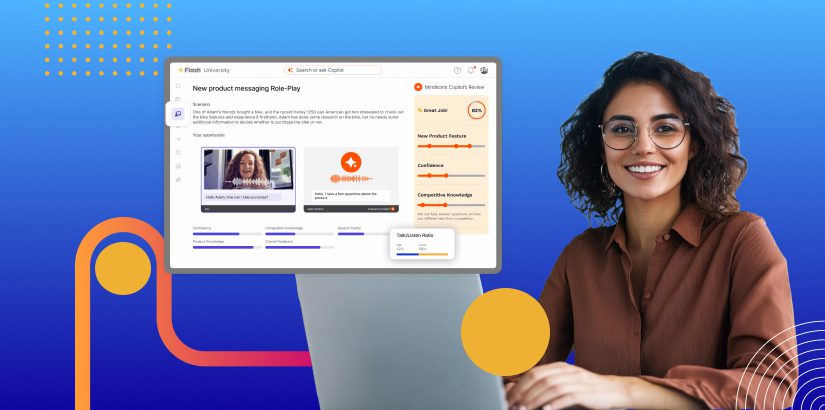


As a revenue and enablement leader, you know that practice makes perfect. But the reality is that for many sellers, finding time to practice their craft might be the last thing on their list of priorities. And when they can carve out the time, that might not coincide with when their manager or peers are free. This is where AI role play can help.
Key Takeaways
- Why It Matters: Traditional sales coaching doesn’t scale. AI role play gives reps a safe, always-available way to practice customer conversations and get consistent feedback without tying up managers.
- How to Evaluate: This guide covers 12 essential questions for vetting AI role play vendors. Focus on conversational realism, enterprise security, global support, and whether it’s integrated with your sales platform (not just another standalone tool).
- What to Avoid: Don’t buy a disconnected point solution. If practice isn’t tied to your learning content and performance analytics, you can’t measure impact or prove ROI.
Understanding AI Sales Role Plays
Practicing with an AI simulation for a range of meeting scenarios, customer personalities, and job functions is a great way for busy sellers to sharpen their skills.
AI role play gives sales reps a safe place to fail because they can try and fail without real customer consequences. Sellers can practice whenever they want without having to rely on the availability of others. They can practice many different scenarios with personas that mimic actual buyers, and across a range of industries, products, languages, and personalities. Through AI, sellers get objective and immediate feedback.
AI Role Plays helps GTM teams:
- Reduce ramp time
- Increase average deal size for new products
- Improve conversions with better conversations
Managers and enablement teams benefit from the ability to see metrics, trends, and skill gaps at scale. Without AI Role Play, your sellers are likely practicing on real customers leading to lost revenue.
AI Sales Role Play Tool Categories
There are many types of vendors offering some sort of AI sales training capabilities. Let’s look at the different vendor categories and how they’re approaching AI role plays.
Vendor Category | Sample Vendors | Role Play Offered |
Content marketplace | Udemy, Coursera, LinkedIn Learning | General AI role plays for business learners, not specific to sales. |
Interview practice tools | Interview School, ChatGPT voice mode, Gemini (on phone only) | General purpose interview practice tools for students and professionals, often free |
Corporate coaching platforms | Unboxed Technology, Valence | AI role plays offered as part of corporate coaching and leadership solutions, not specific to sales. |
AI-native role play startups | Second Nature, Hyperbound, Yoodli | Fast to deploy but coaching can be shallow with limited analysis |
Revenue enablement platforms | Mindtickle, Allego, Highspot (partnership with Yoodli) | AI role plays offered as part of the platform’s core focus to provide sales readiness. Depth of functionality varies from vendor to vendor. |
Limitations of Traditional Role Plays and Why AI Scales
The traditional manager-seller sales coaching way is no longer an efficient or effective approach to keeping sales teams sharp. Here are some downsides to offline coaching:
- Inability to scale: Managers can’t train thousands of reps or partners.
- Limited manager availability: Managers are too busy and peers aren’t ideal for coaching.
- Inconsistent and subjective feedback: Managers score differently and bias can often creep in.
- Anxiety-inducing and performative: Sellers can feel nervous, especially in front of peers or leaders.
- Lack of proof of impact: Limited data about improvements.
- Poor analytics on skills gap: Lack of documentation of training accuracy.
AI delivers role plays at scale, coaching sellers across global, multilingual, and complex selling scenarios. AI role plays deliver instant feedback. Sellers receive coaching in a judgment-free way and get objective scoring.
How to Evaluate an AI Sales Role Play Platform
With so many types of vendors offering their own spin on AI role plays, finding the perfect platform for your sales organization can be complicated. Consider these 11 questions as you evaluate the best platform for your needs.
1. Can the platform provide coaching for every function in the sales organization?
General role play solutions from content marketplaces and corporate coaching companies only go so far in helping your team because they’re aimed at a broader business audience. As a revenue leader or sales enablement professional, you’re better off seeking a solution that is specifically designed for everyone on your team.
For example, some vendors can tackle cold call practice well but may not have role plays relevant to solution consultants or customer success managers. Look for a solution that best serves your needs.
2. Is the platform scalable?
Make sure the platform doesn’t break as you scale coaching and onboard different teams, regions and your extensive partner network. Seek a vendor that’s recognized for scale and reliability.
3. Are the scenarios realistic?
In enterprise selling, your reps likely have to try and persuade a wide range of job roles, and people with very different personalities and expectations. Sellers have to conduct detailed discovery and be adept at demonstrating competitive differentiation and negotiating pricing.
Seek an AI coaching tool that offers lifelike call simulations where the AI buyer pushes back, interrupts and challenges your reps’ every move. Want to see how you fare in these scenarios?
4. How realistic does the bot sound?
Your reps should feel like they’re having a natural conversation, even though they’re talking to a bot. The content of the conversation should feel dynamic and the AI responses should be realistic, with strong reasoning. Some bots have been known to go off on a tangent and talk gibberish.
5. How long does the bot take to respond?
Lag time or latency is the time it takes for the bot to respond after you have finished speaking. Your seller should be in the flow of the conversation when they practice and not have to wait through awkward pauses or have to press a Start/Stop button. Vendors with limited resources, use older language models that tend to have longer pauses.
Ideally the lag time should be 2 seconds, which is considered near human. Any longer than that and it would feel like they’re talking to … well, a bot. You can easily check this with the stop watch on your smartphone. Get your hands dirty; don’t just buy after a demo, ask to use the tool before you buy.
6. How easy is it to use?
Reps neither have the time nor the patience to have to learn the AI platform before they can practice their pitch. They just want to log in, pick a scenario, and start practicing within minutes. Similarly, admins shouldn’t need IT to build scenarios. They should be able to spin up a new role play in minutes with a prompt or template.
Reps also don’t want an essay as feedback. They want clear and specific pointers like, “You missed the pain point,” or “Slow down here.” That’s the kind of actionable feedback that’s instantly memorable and fixable.
7. Is it part of a sales enablement platform?
Coaching through role play isn’t a standalone activity, it’s part of sales readiness. AI role play is only valuable if it connects to everything else that drives seller performance, like product knowledge, messaging certification, analytics, and reinforcement. When they’re connected, reps can learn, practice, and prove proficiency in one continuous workflow.
Here’s how a workflow might happen when role play is part of an enablement system: A rep completes a new product module in the platform. They immediately launch an AI role play to practice that pitch. The system gives them a score and recommends coaching or next-step training. The tool sends the results to their manager so they can track readiness metrics. This closed loop only works if AI role play is embedded in the same enablement system.
If it is not part of your sales enablement platform, it becomes one more tool that you throw at your sellers when they are already inundated with sales tools.
8. Can reps access the tool on the mobile?
If sellers aren’t desk bound, they will need role plays on their phones.Reps want to be able to practice their pitches while on the move, especially if they have a few minutes to spare before a prospect meeting.
Check if the role play vendor offers role play on the mobile. Many point solutions don’t.
9. Does it support multiple languages?
If you are a global company that operates across regions, you need role plays in multiple languages with high accuracy and the right diction. Many role play vendors will claim they support 20-25 languages but ask them for the accuracy rate of translations. Even though the tech is improving fast, AI translations outside of the most commonly used languages, like English, Spanish, German, and Japanese, tend to have higher error rates because there is limited training data.
10. Does it offer enterprise security?
AI role plays may use sensitive data, like real product details that could be pre-launch or otherwise confidential. . You want all your company information safe and secure.
When evaluating tools, ask the vendor where information is stored or processed, if data is encrypted in transit and at rest, and if the data is used to train the model.
Look for a vendor who has been awarded the ISO 42001 certification, the world’s first comprehensive AI system security standard. If you are in EMEA, see if the vendor complies with the European Union AI Act, which ensures AI systems used in Europe are safe, transparent, and non-discriminatory.
11. Does it play well with your LMS and current sales tech stack?
Practice separated from learning makes little sense. Imagine if a rep has to log into one place to take a training course, another to practice, and a third to access collateral. It is far from ideal. All these systems, be it training, practice, CRM, and content should all play together and be in the flow of work for your sellers.
12. Does it provide analytics and skill-specific feedback?
All vendors provide sellers with immediate feedback. Examine if the feedback is constructive and actionable.
At the aggregate level, admins and managers should be able to see:
- Completion rates – who has practiced, how many times, and got certified.
- Proficiency scores – scores assigned by the AI or manager.
- Improvement over time – reps’ skills over time .
- Readiness gaps – managers get a visual dashboard showing team strengths and gaps.
Best Sales Role Play Platforms
There are a number of AI role play tools in the market and it’s tough to know which option is the best fit for your team. Here are the top AI role play platforms and what they provide.
| Platform | Primary Focus & Use Case | Key Differentiator(s) & Limitations |
| Mindtickle | Enterprise GTM Teams. Purpose-built for complex sales, including AEs, BDRs, SEs, and CSMs. | Pro: Natively unified with a complete sales enablement platform. Proven at scale (1.5M+ role plays) with enterprise-grade security (ISO 42001). Pro: Handles complex use cases (custom rubrics, hierarchies). |
| SecondNature | AI-Native Pitch Practice. Acts as a “virtual pitch partner” for individual rep practice. | Pro: Highly interactive, natural language conversations. Con: Point solution, not a full platform. Users report the AI can “drift”. |
| Yoodli | General Communication Coach. Designed for individuals to improve speech confidence (e.g., reduce filler words). | Pro: Very user-friendly and affordable (has a free plan). Con: Not purpose-built for sales. Lacks sales-specific analytics, team training, and coaching features. Comes up short for complex sales scenarios. |
| Hyperbound | AI-Native Cold Call Practice. Primarily built for BDRs and SDRs to practice cold-calling. | Pro: Good for mid-market, SDR use cases with gamification. Con: Very new solution. Users note it can be repetitive and challenging to scale for enterprise needs. |
1. Mindtickle
Mindtickle’s AI Role Play software is built for modern revenue teams that want to drive measurable performance gains through practice. Unlike generic point solutions, Mindtickle is focused solely on the unique needs of go-to-market teams. With Mindtickle, sellers, BDRs, and SCs have tailored opportunities to drive measurable outcomes, including better win rates and greater revenue growth. Having completed 1.5 million role plays and backed by a decade of expertise in role play, Mindtickle’s AI Role Play solution brings scale, is proven, and delivers enterprise-grade security.
2. SecondNature
Founded in 2018, this Israeli startup has a small team of some 45 employees. SecondNature is used by sales teams and university students to practice and refine their talk tracks. SecondNature acts as a “virtual pitch partner,” engaging with sales reps and providing feedback. In reviews, some users flagged occasional scenario drift, for example, when the AI’s responses change unexpectedly though the same scenario is being practiced. Buyers should ask about scenario consistency, branching logic, and ability to lock down the AI persona when evaluating.
3. Yoodli
Founded in 2021, Yoodli is an AI speech coach that helps people communicate with more confidence. It aims to do for speech, what Grammarly did for writing. The tool isn’t designed exclusively for sales. However, a growing number of sales organizations use this software to practice their selling skills.
4. Hyperbound
Founded in 2024, Hyperbound is the newest kid on the block. Launched as a cold email automation company, it has pivoted to AI role plays. It is best suited for contact centers and BDR teams to practice cold-calling scenarios. While they claim to have broadened their use cases, the proof will be in the pudding.
Mistakes to Avoid When Choosing an AI Sales Role Play Platform for Your Sales Team
There is no shortage of choice when selecting an AI role play platform. Here are the top three mistakes to avoid:
- Avoid a piecemeal solution: Select a sales enablement platform that actually drives sales performance, with learning, AI role play and analytics tightly integrated. Learning and practice need to go hand in hand.
- Avoid the new shiny object: It’s best to invest in a platform by an established vendor that is in it for the long haul and will continue to drive innovation and value for your organization as you grow your business.
- Avoid basic tools that support only narrow use cases: Selling is complex, so it’s best to invest in a platform that offers a wide range of complex scenarios from detailed discovery, competitive differentiation, and pricing negotiations. Seek a solution that is deep enough to allow sellers, solution consultants, and CSMs to practice in very technical and complex scenarios and really move the needle. Avoid buying a basic tool that you will outgrow tomorrow.
Conclusion
As new competitors appear in your industry and economic pressures continue to mount, investing in an AI role play platform will be one of the most important decisions you’ll make help your GTM teams close bigger deals faster. . Remember when you don’t have an AI role play solution in place, your sellers practice on real customers leading to lost revenue.
Think long-term when evaluating solutions, ask vendors tough questions, plus get your hands dirty and use the platform for yourself. Invest in a solution that is in it for the long haul, drives innovation and can scale across your business units, regions, and offers bulletproof data security.
The Proof: An Enterprise-Grade AI Sales Training Case Study (Cisco)
What happens when a true AI sales role play platform is deployed to a global sales team?
Cisco needed to run a massive, global pitch contest for 7,200 sellers. Manually reviewing the submissions was a non-starter. The company calculated it would have taken 38 weeks of cumulative manager time.
Instead, Cisco used Mindtickle’s AI sales role play platform. The AI (Copilot) handled the initial review of all 7,200 submissions, saving those 6,000 manager hours. More importantly, the AI created a safe, instant feedback loop. This motivated reps to practice, on average, 4-6 times before their final submission. They were not just trying to pass; they were actively trying to improve their skills and win a Porsche.
This was not just an efficiency play. The program, powered by this AI-driven practice, led to tangible business results: a 31% increase in average deal size and a 25% rise in booked deal values. The data showed a direct correlation between platform practice and real-world sales performance.
Frequently Asked Questions
Enterprise-grade AI sales role play platforms are "un-gameable" by design. They use a dynamic AI buyer that doesn't follow a rigid script. Administrators can configure this AI with specific personalities (e.g., "Skeptical CFO," "Time-Pressed Executive") and program it to interject with unexpected objections and tough questions. This forces the rep to stop reciting, actively listen, and adapt to the conversation in real-time.
Newer capabilities, such as Mindtickle's Real Deal AI Role Plays, make this even more advanced by pulling context directly from a rep's live CRM opportunities to generate the simulation, making a generic script completely useless.
A basic one-way video role play is simply a recording. A rep records their pitch and sends it to their manager, who must then find time to manually review it. This is the "manager bottleneck", it's slow, subjective, and doesn't scale.
An interactive AI role play simulation is a dynamic, two-way conversation. The rep speaks, and the AI buyer responds in real-time. More importantly, the rep receives instant, objective feedback from the AI on everything from talk tracks, pace, and filler words to keyword usage. This allows the rep to practice, review, and practice again 4-6 times in a single session, driving mastery without any manager involvement.
This capability comes from a "reasoning engine" powered by generative AI, like Mindtickle Copilot. Instead of just matching keywords, the system understands context in two ways:
- Pre-Call Context: The platform is configured with the specific sales role play scenario, including the buyer's persona, persona’s pain points, industry knowledge, the deal stage, and the product being discussed.
- Conversational Context: The AI doesn't just hear what the rep says, but how and when. It can identify if a rep listed a feature but failed to connect it to a pain point the buyer mentioned earlier. It then provides advanced, qualitative AI sales coaching feedback, such as, "You missed an opportunity to tie the product's value to the buyer's stated goal."
This is a core customization feature of advanced AI role play platforms. Enablement teams and sales managers can define the AI buyer persona before the simulation begins. This includes setting:
- Personality: 'Skeptical,' 'Inquisitive,' 'Friendly,' or 'Time-Pressed.'
- Voice: A range of voices to match different buyer profiles.
- Objections: The specific objections you want the AI to raise.
This ensures that the sales role play scenarios are hyper-realistic and prepare reps for the specific buyers and challenging conversations they will face in the field.
This is a non-negotiable "table stakes" requirement for any enterprise evaluation. Your CISO and CIO will demand a comprehensive portfolio of third-party audited certifications. Key ones to look for include:
- AI-Specific (Most Critical): ISO 42001. This is the first international standard for AI Management Systems. It is your guarantee that the vendor is governing its AI responsibly and, most importantly, is not using your proprietary sales strategies or customer data to train public models.
- Foundational Security: SOC 2 Type 2 (validating security, confidentiality, and privacy controls) and ISO 27001 (for information security management).
- Global Privacy: GDPR compliance for EU data and CCPA compliance for California data.
Industry-Specific: HIPAA (for healthcare) or 21 CFR Part 11 (for life sciences), if applicable.
Buying best-of-breed point solutions (a separate LMS, content tool, and coaching tool) creates data silos. You can't connect the dots, and your sales tech stack becomes bloated and inefficient.
The benefits of a unified sales enablement platform are:
- Connected Data: It allows you to track the entire seller journey, from training (LMS) and practice (AI sales role play) to real-world application (Call AI / Conversation Intelligence) and results (CRM).
- Better User Experience: It provides a "single pane of glass" for reps to find content and coaching, and for managers to see a single dashboard of rep performance.
- Provable ROI: This is the only way to definitively prove the impact of enablement. A unified platform can correlate practice and certification scores directly to performance outcomes in the CRM, like win rates and deal size.
This is done by connecting readiness data (from the platform) with performance data (from the CRM).
- Track Readiness: The AI role play platform tracks leading indicators like learning and practice scores, skill progression, and certifications.
- Track Performance: Your CRM (e.g., Salesforce) tracks lagging indicators like win rates, average deal size, and sales cycle length.
- Correlate the Data: A unified platform with a bi-directional CRM integration correlates these two datasets. This allows you to prove a direct link between the reps who practiced more (or scored higher) and their real-world sales success.
For example, Cisco used this correlation to find that reps who practiced with Mindtickle's AI sales role play platform had a 31% increase in average deal size, definitively proving the ROI of practice on revenue.