





Why revenue teams know exactly what good looks like—and still can't get their sellers to do it.
_________________________________________________________________
Here is the quiet failure at the heart of modern revenue organizations. They know what good looks like. They have the playbooks, the training programs, the certifications, the battle cards, the coaching frameworks. And yet, quarter after quarter, sellers don't do it when it matters, in a live deal, with a real buyer, under real pressure.
The blame usually lands on motivation, or content, or management. But those are just symptoms. The underlying problem is structural, and it has a name.
| DEFINING THE GAP: The Know-Do Gap™ is the structural distance between what sellers know (skills, playbooks, best practices, product knowledge) and what they actually execute on live deals. |
|---|
Every revenue leader has felt this. The rep who aces every certification and then loses a deal on the same objection they trained for one month ago. The manager who gives identical coaching feedback in every 1:1 and watches nothing change. The enablement team that builds a thorough content library that reps never open at the moment of need.
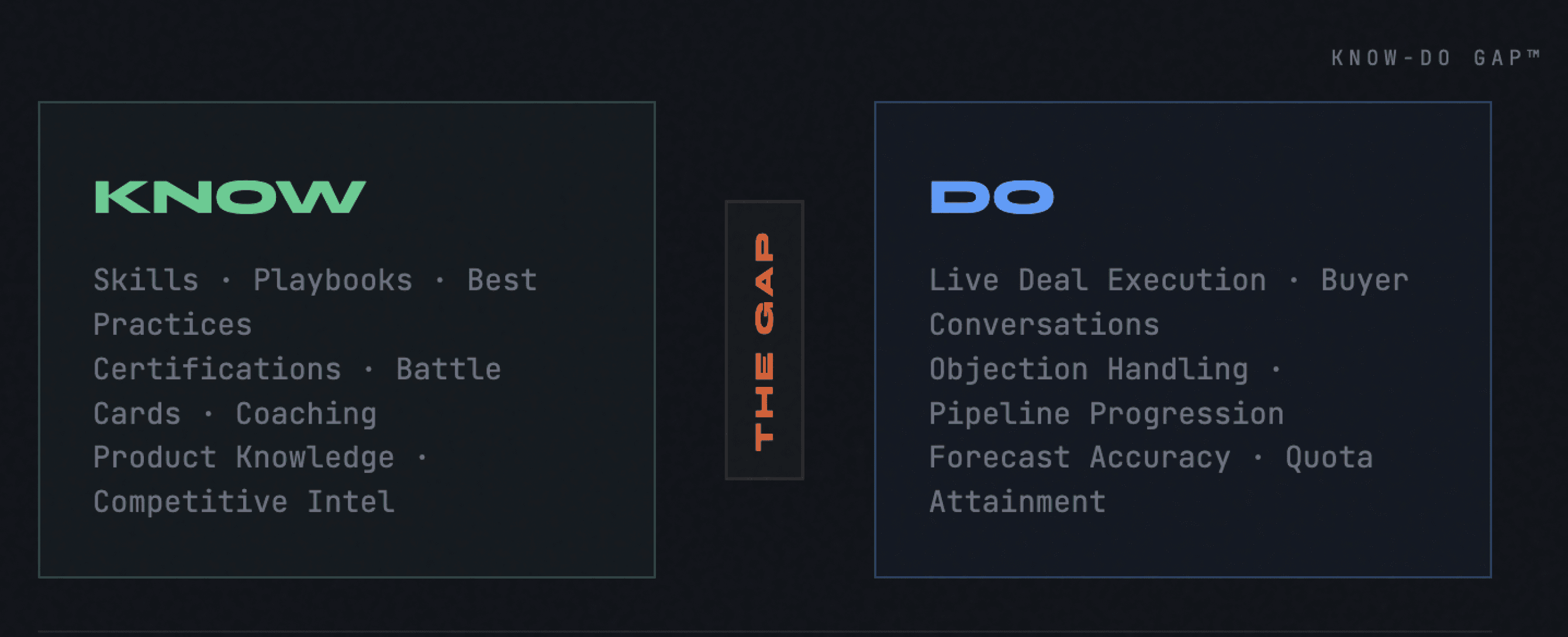
The Know-Do Gap™ has existed as long as sales organizations have. What has been missing is a system built to close it.
Part I: We have been solving the wrong problem
The revenue technology industry has spent years asking one question: how do we give sellers more content, more training, more dashboards, more coaching sessions, more tools? The implicit assumption has been that the gap between knowing and doing is a supply problem. Give sellers enough of the right material and performance will follow.
It hasn't. Sellers complete certifications and revert to old habits on the next live call. Managers give the same coaching feedback month after month and watch nothing change. CROs see deal risk in the CRM but can't connect it to specific rep behavior, let alone prescribe what to fix. Onboarding runs for 90 days and still leaves reps underprepared for a competitive deal.
The deeper issue is that enablement was built as a collection of disconnected activities (train, coach, create content, assess) rather than as an integrated operating system that connects knowledge to behavior to outcomes. Each tool does its job in isolation and none of them talk to each other, so the loop between what a rep learns, how they execute, and what results follow is never closed.
| Knowledge lives in one system, behavior signals in another, deal outcomes in a third. No one can see the full picture, and no agent can act on it. |
|---|
ElevateOS is Mindtickle's answer to that fragmentation. It is a revenue operating system that deploys AI agents to connect seller readiness, live deal execution, and buyer engagement in a continuous loop, so enablement stops being something that happens to sellers before a deal and starts running alongside every deal, in real time. The architecture was built specifically around a decade of seller behavior data, which is what makes it possible to move from spotting a problem to prescribing a fix.
The stack was architected for a world where training was an event, coaching was a calendar item, and enablement meant pushing content at sellers and hoping something would stick. That model had a good run.
Part II: What the Know-Do Gap™ actually costs
Revenue leaders feel this every quarter, even when they can't name it, and it shows up in four specific places.
-
Ramp time that should take 60 days takes 120, because onboarding is an event rather than a system with no closed loop between what reps learn and whether it changes how they sell.
-
Forecast inaccuracy that compounds every quarter, because the numbers in the CRM reflect what managers hope is true rather than what deal behavior actually indicates.
-
Top performer dependence, where 20% of the team carries 80% of the quota, because the behaviors that make someone exceptional have never been identified, codified, or taught to the rest.
-
Coaching that consumes management time without producing ROI, because it is reactive rather than prescriptive or predictive, triggered by loss rather than early warning.
The Know-Do Gap™ is this: the playbook for winning already exists. It lives in the behavior of your best performers. The problem is that it has never been extracted, systematized, and made available to every rep on every deal.
Part III: Four things we now know to be true
A decade of working with demanding revenue organizations has shaped how we think about closing the Know-Do Gap™. These four convictions are the foundation on which ElevateOS, Mindtickle's revenue operating system, is built.
1. You cannot fix what you cannot diagnose.
Most platforms surface deal risk as a flag in the CRM. What revenue leaders actually need to know is which rep behavior created the risk and what has to change to reverse it. The Know-Do Graph™, Mindtickle's proprietary context architecture, connects seller readiness signals, conversation data, content engagement, and deal outcomes into a single diagnostic layer. The answer to "why is this deal at risk" comes from evidence rather than a manager's read of the room.
2. Reps learn better from deals than from training modules.
The assumption that a training event produces durable behavior change has not held up. What coaches consistently find is that the richest signal comes from the deal itself: what was said, how the buyer responded, where the rep lost the thread. AI agents that coach against real deal context in the flow of work do what scheduled training sessions have never managed to do consistently.
3. The loop does not close at the seller.
Most revenue tools are built entirely around the seller's workflow, but the Know-Do Gap™ has a buyer dimension too. Deals stall and friction accumulates when the seller's world and the buyer's world remain separate systems. Closing the loop means feeding buyer engagement signals back into seller intelligence in real time: how buyers interact with content, where they go quiet, what questions they ask.
4. An operating system beats a tool stack every time.
What makes an operating system powerful is how it connects the parts. ElevateOS embeds into the platforms your teams already use (Salesforce, Slack, Teams, your CRM) and runs across all of them as a single system, so sellers get coaching, guidance, and deal support without switching between tools.
Part IV: The flywheel that closes the gap
ElevateOS is built on a self-reinforcing loop. Every deal makes the diagnosis sharper, every coaching interaction makes the agents more precise, and the Know-Do Graph™ gets richer with every outcome logged.
| OBSERVE: Unify every signal into the Know-Do Graph™ to build a complete picture of seller readiness and deal reality: calls, emails, CRM data, content engagement, buyer behavior. |
|---|
| REASON: Diagnose root causes. Behavior Intelligence identifies which behavior stalled this deal, which skill gap is costing this rep, which playbook deviation is hurting this team, then turns those signals into a specific prescription. |
|---|
| ACT: Six purpose-built AI agents coach gaps, guide deals, create content, engage buyers, update CRM, and brief managers. They run automatically inside the platforms your teams already use, triggered by deal context rather than a human scheduling them. |
|---|
| COMPOUND: Every conversation and deal outcome makes the Know-Do Graph™ richer. More context produces smarter agents, and smarter agents produce more value. |
|---|
The compounding effect is what creates a durable advantage. A decade of seller behavior data already lives in the Know-Do Graph™, so from the first deployment, agents are working from a deep base of context rather than learning from scratch.
Part V: Why nothing else closes the gap
Each major competitor in this space owns one side of the Know-Do equation well. What none of them can do is bridge both sides in a closed loop.
| Competitor | Owns | Misses | Kill line |
|---|---|---|---|
| Gong | Conversation signals, deal analytics | No readiness, no coaching loop, no behaviour change | Gong tells you the risk. ElevateOS diagnoses why and coaches the gap. |
| Highspot | Content management, guided selling | No behaviour intel, no coaching, merger distraction | Highspot organises content. ElevateOS orchestrates seller + content. |
| Seismic | Content automation, Aura AI | Static delivery, no closed loop, two AI engines | Seismic automates content. ElevateOS automates the selling motion. |
| Merged entity | Content + some training + coaching | Two architectures (18–24 months) | They’re merging. We’re shipping. Gap widens every quarter. |
| Letter.ai | AI-native training, single agent | No deals, no buyer, startup risk | Letter.ai trains reps. ElevateOS trains, coaches, guides, and engages buyers. |
| GTM Buddy | Content activation | No behaviour intel, narrow scope | GTM Buddy pushes content. ElevateOS pushes intelligence. |
What makes ElevateOS defensible is the closed loop itself. Behavior Intelligence diagnoses the gap, Agentic Enablement closes it, Buyer Engagement extends it to the other side of the deal, and an Interoperable Foundation makes all of it run on your existing platforms. That combination takes years to build and a proprietary data layer to power.
The era of train-and-pray is over
Closing the Know-Do Gap™ is a solvable problem. It takes a system that connects what sellers learn to what they do in deals, and connects what they do in deals to what outcomes follow.