





AI Sales Role Play: How to Shift From Generic Scenarios to Contextual Practice


Sales role plays aren’t a new concept, but they’re one that has staying power. Even as buyer preferences, sales methodologies, and technology continue to evolve, sales role plays remain a go-to way to build reps’ skills and confidence. In fact, a recent analysis found that in 2024, companies used Mindtickle Copilot to create 30% more role play modules than the previous year.
This growth isn’t surprising. Role plays, when done well, can have a big impact. The same analysis found that top-performing sellers engage in six times more role play practice than their lower performing peers.
But often, teams take a generic approach that’s disconnected from reality. While this approach checks a box, it rarely improves reps’ behaviors or sales performance.
That’s why more revenue teams are making the shift to contextual AI sales role plays that actually move the needle.
In this post, we’ll explore how to make the switch from generic scenarios to contextual practice and how AI sales role play tools make it possible to scale impactful practice across your entire sales team.
Generic vs contextual sales role plays: What’s the difference?
Chances are, you’re already familiar with sales role plays. But not all sales role plays are the same.
Today, most organizations continue to use generic sales role plays. But a growing number are making the shift to contextual role play scenarios that better reflect real-life conversations and drive measurable impact.
So, what’s the difference?
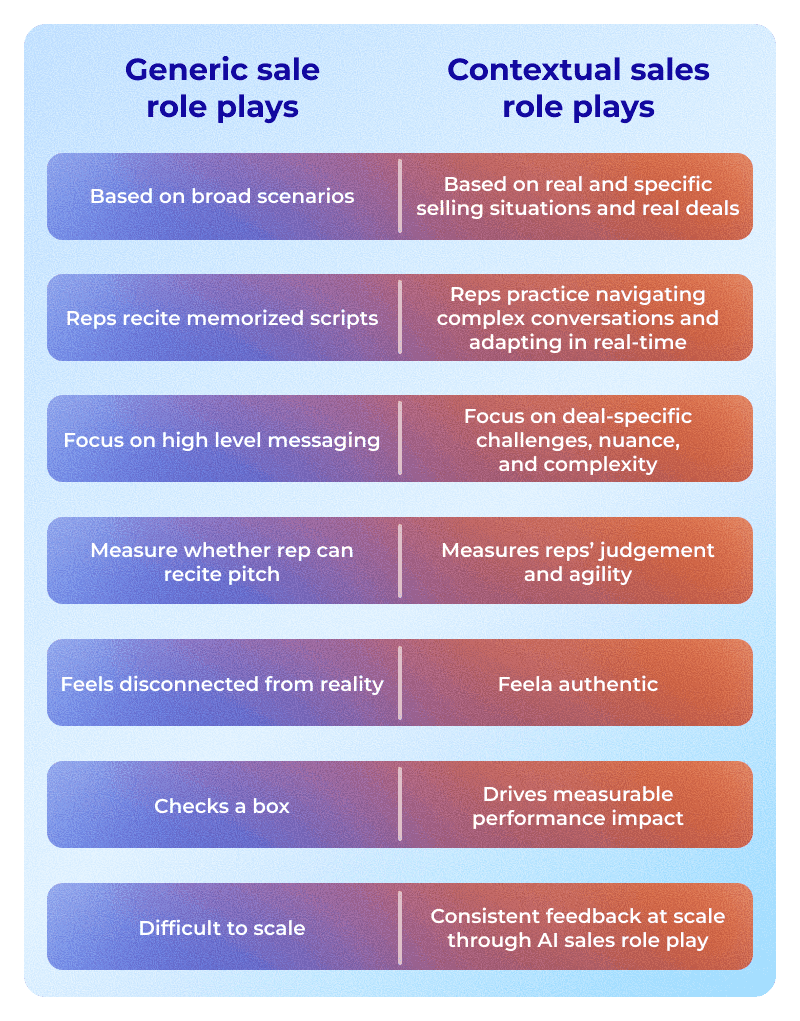
Generic sales role plays are high-level scenarios where reps recite memorized scripts or practice broad sales conversations. They’re based on cardboard buyers and static scenarios that rarely reflect what reps actually experience in the field. So while a seller may ace their role plays, they may still struggle to apply that practice with actual buyers.
On the other hand, contextual role plays are rooted in real-world selling situations. Revenue teams use real buyer data, competitive dynamics, common objections, and deal patterns to develop realistic sales role play scenarios. Contextual role plays simulate the very real pressure, nuance, and unpredictability of engaging with an actual buyer.
While generic sales role plays gauge whether a rep can accurately recite a pitch, contextual role plays assess how effectively they navigate complexity, adapt in real-time, and remain confident no matter where the conversation goes.
The bottom line is that while generic sales role plays help reps memorize scripts, contextual role plays build sellers’ skills and agility so they can confidently navigate any customer interaction, no matter what direction it takes.
Generic vs. contextual sales role plays
How to build contextual sales role plays that actually move the needle
Sure, generic role plays might check the box. But contextual role plays are what actually moves the needle on reps’ behaviors and sales performance.
If generic role plays are all you know, making the shift can feel daunting. It doesn’t have to be.
Let’s explore a practical, step-by-step process any revenue team can use to build contextual sales role plays that drive measurable performance improvements.
Step 1: Mine your data for real scenarios
Contextual role plays should reflect real-world conversations. So first, you must mine your data to determine what’s actually happening in the field.
Analyze win/loss data, CRM notes, objection trends, and pipeline patterns. Figure out where deals are lost and where they stall. These insights are critical for building realistic practice opportunities that address real risks and opportunities.
Step 2: Build role plays around current deal dynamics
Don’t invent hypothetical stories. Instead, base sales role play scenarios on real deal motion, like:
- Competitive displacement
- Budget challenges
- Executive alignment
- Negotiation
When you replicate actual situations, your reps will have opportunities to build their skills and confidence.
Step 3: Create a detailed buyer persona
Generic personas can be useful when it comes to general messaging. But contextual role plays depend on deeper insights.
Develop a detailed buyer persona that includes details like:
- Role
- Demographics like age and gender
- Personality traits, like conservative in decision making, reticent, talkative, etc.
- KPIs
- Business pressures
- Recent triggers
- What success looks like for them
This will help sellers speak the buyer’s language, uncover pain points, and tailor the conversation accordingly.
Step 4: Set one clear goal per session
It’s tempting to try to cover everything in one role play session. But it’s not an effective way to practice.
Instead, focus on one thing, such as uncovering pain points or addressing a specific objection. Focusing on one thing at a time allows for meaningful coaching, repetition, and behavior improvement.
Step 5: Role play the unexpected
Let’s face it: real sales conversations rarely follow a set script. Contextual sales role plays shouldn’t either.
Be sure to incorporate things like curveball objections and changing buyer sentiment in your contextual role plays. This will help sellers develop judgment and hone their ability to pivot in the moment. That way, they’ll be ready to navigate any conversation, no matter what direction it goes in.
Step 6: Review recordings and reinforce
Practice without feedback doesn’t lead to behavior improvements. Reviewing recorded sales role plays allows managers and reps to understand what’s going well and where gaps remain. Then, repetition can reinforce skills and drive long-term behavior change.
AI makes this process much more scalable. Instead of waiting for a manager to review each recording, AI delivers targeted feedback immediately after a role play. The seller can apply that feedback right away, repeat the exercise, and improve their performance – all without waiting on a manager.
Step 7: Measure improvement over time
At the end of the day, contextual role plays should drive measurable performance outcomes. Continuous measurement ensures that’s the case.
Track skills and readiness metrics and see how they correlate with deal progression, pipeline velocity, and win rates. When reps can clearly see progress tied to real results, they’re more likely to engage and practice.
By following these steps, your sales role plays will feel less like a box to check and more like an impactful performance driver.
How AI sales role plays deliver impactful, contextual practice at scale
Contextual role plays can have a big impact on reps’ behaviors and performance. But manually executing them across an entire sales organization is no easy feat.
Manual role plays are time consuming for both sales managers and enablement teams. Creating custom sales role play scenarios, listening to practice sessions, and delivering consistent feedback all take time, which many managers are short on. Seven in 10 sales managers are responsible for more sales reps today than they were in the past, so role play often falls by the wayside.
Sales role plays also depend heavily on sales managers being strong coaches. Sure, some are exceptional. But others lack the coaching skills, tools, and bandwidth to deliver consistent, actionable feedback. That means role play quality varies widely, and many reps don’t get enough repetition to build their skills and confidence.
Clearly, there’s a gap. More and more revenue organizations are turning to AI sales role plays as a foundational component of modern AI sales coaching and AI sales training strategies.
AI sales role plays provide realistic, dynamic, and adaptive practice opportunities. An AI buyer responds to what the rep says, which creates a back-and-forth dialog that feels like engaging with a real customer. Reps can practice wherever and whenever they want, without waiting on a manager’s calendar to open up.
AI sales role plays also deliver objective scoring and real-time, personalized AI sales coaching that sellers can use right away. In fact, reps who act on AI feedback to retry or readjust their role play submissions increase their average score by 10%.
Most importantly, AI sales plays scale. Each seller gets consistent, personalized opportunities to practice, review, and improve, without adding additional headcount. AI sales coaching is standardized and equitable, allowing every rep to build their skills, confidence, and agility.
To be clear, AI sales role plays don’t replace human managers. Instead, they empower sellers to develop their skills and confidence in real time while freeing leaders to focus on strategy, deal execution, and targeted support.
Stop practicing and start preparing with AI sales role plays from Mindtickle
At many organizations, sales role plays remain a go-to method for practice. But generic practice rarely gives sellers the confidence and skills to close more deals.
Contextual role plays give reps the chance to build the skills and agility needed to confidently navigate real-world conversations with buyers. With AI sales role plays, you can deliver contextual practice and consistent coaching at scale.
Of course, security should be a top priority when exploring any AI sales role play tool. Always be sure to choose tools that take a thorough approach to AI data security.
Ready to make the move to contextual sales role plays that actually move the needle? See for yourself how Mindtickle’s AI Role Plays can help your teams practice smarter and perform stronger, while keeping data security front and center.