





In Conversation with MuleSoft on Sales Coaching



This post is based on a webinar where Stephen Hallowell, VP of Sales Enablement at MuleSoft discusses why companies should invest in sales coaching.

MuleSoft is a leading high-growth technology company that focuses on application integration under one platform. With over 800 employees and over 1000 enterprise customers across 60 countries, MuleSoft has had astounding growth.
“We have been evolving quite a bit as a company over the years. We have gone from what was a fairly tactical engagement to selling business value associated with what otherwise can be a pretty technical concept. We are enabling change on a broad scale inside some very large companies,” explains Hallowell.
Why sales coaching matters
A significant part of MuleSoft’s success can be credited to their investment in sales coaching. “To improve the outcome and win more deals, the sales rep has to start doing things in a fundamentally different way than they were previously. Natural behavior is to put one foot in front of the other and keep marching straight. We need our sales reps to stop and take a left turn at some point. The only way that we’ve been able to drive that behavior change is through coaching, ” says Hallowell
Two main aspects of the coaching program
Sales leadership at MuleSoft decided that their sales coaching initiative should answer two questions:
-
Are
their reps doing what is important?
-
How can their managers help their reps sell the right way?
Most sales teams get their approach to the second question right by coaching their sales reps. But the first question is often under-recognized yet it’s vital to ‘accountability’.
“If the manager doesn’t actually know and doesn’t have the ability to know, whether somebody’s doing the right thing, and the individual contributor also doesn’t know, you can never get that self-diagnosis. The more you can make it very apparent to people what they’re doing well and what they’re not doing well, you create the need for change,” explains Hallowell.
“If somebody comes in and coaches me and says, “Ah, well, hey, here’s a better way of doing things,” and I haven’t seen that reason yet for doing things differently, I’m not going to get the results out of it,” he continues.
Building a competency map
The first step was to identify what knowledge gaps their managers had. This was done through effective benchmarking.
“To kick this off, we did some benchmarking with our managers by assessing them against some third party statistics. That helped us realize some are exceptional and some are not. That helped create that need for change across all levels of the organization,” explains Hallowell.
Once the gaps were identified, the next step in the process was to train them effectively on their skill gaps. “The next thing we did was build the competency maps. We did that probably 9 to 12 months into the process. In my experience, for a competency map to be effective it’s got to be somewhat detailed, just because you’ve got to be precise about what you want people to do. That level of detail delivered too early can be a bit overwhelming. Trying to find that right balance of really defining for the managers, these are the specific behaviors and skills you need to coach, to giving them enough detail to be actionable, but not so much detail that you overwhelm them,” explains Hallowell.
Designing the certification program
“One important thing we drove was a significant relaunch of our messaging. A pool of leaders and individual contributors locked themselves in a room for a couple of days and came out with something that everybody felt really good about. Once it reached the field, there was no question of “Is this the right message?” Our leaders bought into it,” says Hallowell. The primary element in the coaching program at MuleSoft was message calibration, which was done by the leadership team.
“We had the core team record themselves in the Mindtickle platform to provide examples and best practices. Then we formed a group of best performing reps and managers who we call black belts. This group of black belts then certified the full team. We had over 500 people go through this program,” explained Hallowell.
Coaching is not a checkbox exercise
The importance of this program is well understood given that over 500 employees went through the coaching program. The program was well received across the organization. What exactly worked for MuleSoft?
There were multiple factors including support from their leadership, setting high benchmarks for their sales reps and providing personalized feedback for each rep.
“One of the things that were really important for us is that this wasn’t just a check the box exercise. If it had been simply a box-checking exercise, there wouldn’t have been a lot of opportunity for coaching. I can’t overstate the importance of really broad management support and solving a pain point that everybody recognizes. The next thing is holding that performance bar very high. We did not pass people who were not completely 100%. Yeah, it might take a little longer than we want, but we’re going to make sure we get everybody’s attention on,” says Hallowell.
Finally, make it awesome
The success of a coaching program is measured on how well it is adopted.
“
The last thing I’ll leave you with is we have a set of core values at MuleSoft. One of them is to make it awesome. It’s one that I love. I use it with my team all the time, and I think it’s so important in our role. You’re going to ask a lot of people going through this program. If they detect anything that’s not awesome, they’re not going to invest, ”
says Hallowell.
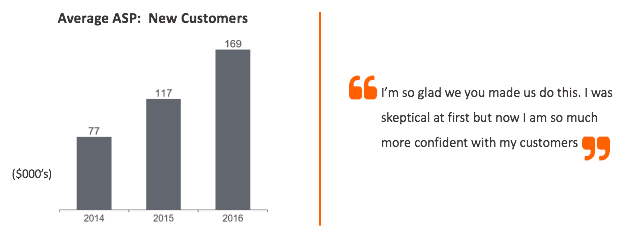
Did Hallowell and his team make it awesome? Given their success, it sure looks like they did. The coaching program helped MuleSoft scale their sales team without compromising on the performance of any individual. Their average selling price went up from $ 77K to $169K. And feedback about the coaching program was really positive across all levels of the organization.
“A number of people that came up to me and just said, “Thanks for making me go through that.” I think this quote is verbatim from half a dozen people, said, “You know, I was pretty skeptical about this thing when we first started, but I’m so glad you made me do it. I’m so much more confident with my customers,” says Hallowell proudly.
About the Author
Strategic Inbound Marketer
Shrimithran R was a Strategic Inbound Marketer at Mindtickle from 2017 to 2018.

Subscribe to the blog
Get the latest sales enablement tips, guides, and industry best practices delivered to your inbox. Unsubscribe anytime.