







Having a dedicated sales enablement team was once the exception. But now, it’s the norm across organizations of all sizes and industries. Research tells us 84% of organizations currently invest in a sales enablement team.
While most organizations are placing their bets on sales enablement, many still struggle to gauge their programs’ success (or failure).
Of course, tracking revenue is important. But it doesn’t tell you the full story of sales enablement impact. You must also correlate sales activities with tangible business outcomes to discover what’s working – and what’s not.
Fortunately, several effective ways to measure and track your sales enablement efforts exist. In this post, we’ll walk you through how each method works so you can pick the one best suited to your company’s needs. Once you identify the best ways to measure your sales program, you can start improving, standardizing activities, and developing successful sales enablement strategies.
The importance of measuring sales enablement performance
Soon, we’ll dive into how you can measure sales enablement success. But first, let’s take a step back to discuss why measuring sales enablement performance even matters.
Ongoing measurement unlocks optimization opportunities
Every sales enablement team aims to build an enablement program that greatly impacts sales performance. Ongoing measurement is critical to building an optimized program that’ll have the greatest impact.
Regular measurement lets you understand what’s working and what’s not. Then, you can do more of what’s working – and optimize what’s not working.
For example, you might notice that video content has greater engagement (and impact) than written content. So, you make it a priority to create more video content.
Or, perhaps you notice that sellers in a specific region score low on certain competencies. So, you work to develop additional resources to strengthen those weaker skills.
The bottom line is, ongoing sales enablement measurement allows you to properly optimize your efforts for greater impact.
Proving ROI is essential for securing resources
We all know that budgets are tight. And, more than ever, companies are only investing in what they know will have an impact.
With ongoing measurement, you can prove the ROI of your sales enablement strategy, programs, and technology. When you can prove impact, you’ll have an easier time maintaining your resources – and potentially scoring additional resources.
Note: Each method is labeled direct or indirect. Direct ways of measuring sales enablement performance can be tied to revenue, while indirect ways can still impact the bottom line, but they’re not as immediate.
- Lead-to-opportunity conversion rate
- Win rate
- Competitive win rate
- Average deal size
- Quota attainment
- Sales process adherence
- Average time to productivity
- Time to quota
- Rep turnover rate
- Employer Net Promoter Score (NPS)
- Knowledge retention
- Content usage and adoption
- Call to action insights
1. Lead-to-opportunity conversion rate (direct)
Your lead-to-opportunity conversion rate tells you how often your salespeople convince your leads to stay in the sales funnel and potentially make a purchase. If your lead-to-opportunity conversion rate is high, your salespeople have the right skills, knowledge, and content to convince leads to consider buying your product or service.

2. Win rate (direct)
Your sales win rate shows how often your salespeople convert opportunities into closed deals and gives you a gauge of individual sales rep performance and the abilities of your sales team(s) overall.
By looking at each rep’s win rate, you can tell whether or not they need more training or knowledge on how to convert. If the win rate of the team is consistently low, look into which practices aren’t working. For example, you may need to rethink your target customer, upskill all your sales reps, or review your marketing content.

3. Competitive win rate (direct)
This measurement is similar to win rate but only measures the rate of closed deals where your prospects (those who are in the opportunity stage) are also considered to be in a deal with a competitor.
If you have a lot of prospects who choose competitors, try to identify why they’re choosing competitors and use that info to equip your reps to close more of these deals. For example, if there’s a particular competitor your opportunities frequently choose over you, look at what they offer that you don’t. Or see what features their product or brand has that could be perceived as an advantage.

4. Average deal size (direct)
This KPI tells you the average amount of money each customer spends on your product or service. Measure average deal size to identify patterns in the value of your deals. This can help you pinpoint better cross-selling and upselling opportunities for your salespeople.

5. Quota attainment (direct)
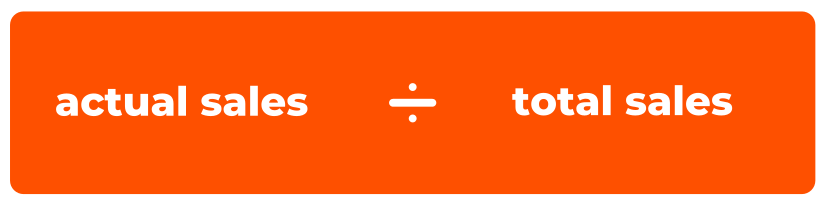
Quota attainment is the percentage of your salespeople who are hitting their target sales goal during each sales cycle. Each rep has to meet their quotas for your team and your company to meet its quotas. If you have team members who have trouble meeting their quotas, you can help them improve with sales coaching, training, and enhancing their knowledge.
6. Sales process adherence (indirect)
This is a measurement of how well your sales process is adhered to by your sales reps. If you see your sales reps are not adhering to the process and also not meeting quotas, there may be a correlation. You can track this and find ways to get your reps to adhere to the process more closely.
7. Average time to productivity (indirect)
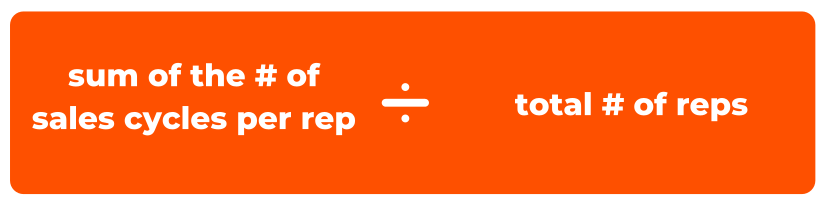
The average time to productivity is often referred to as ramp-up time, and it tells you the amount of time it takes for your newly hired sales reps to reach full productivity. Knowing the average time to productivity helps sales leaders make more accurate forecasts based on the capacity of each rep.

8. Time to quota (indirect)
This key metric measures the amount of time it takes for your reps to reach their sales quota for the first time. It can tell you how effective your sales enablement onboarding is. If you see it takes longer for reps to meet their quota, you can pinpoint areas of your onboarding process that aren’t setting them up to succeed. For example, maybe the onboarding process needs to have more emphasis or focus on time management.
9. Rep turnover rate (indirect)
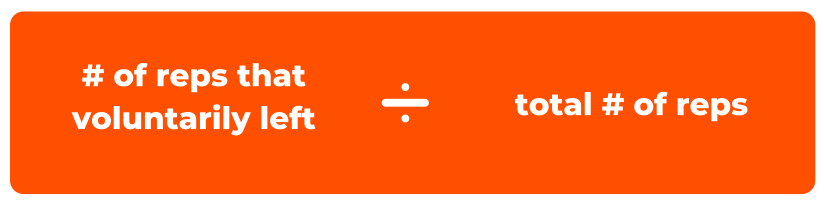
Rep turnover rate measures how often your reps voluntarily leave your company for any reason. This can be indicative of a few things but, in general, a high turnover rate indicates a problem among your sales reps that needs to be identified and fixed.
To find out more from your reps who leave, conduct a voluntary exit interview. Ask questions related to preparedness and your sales enablement program to find out how effective they perceive it to be.
10. Employee Net Promoter Score (indirect)
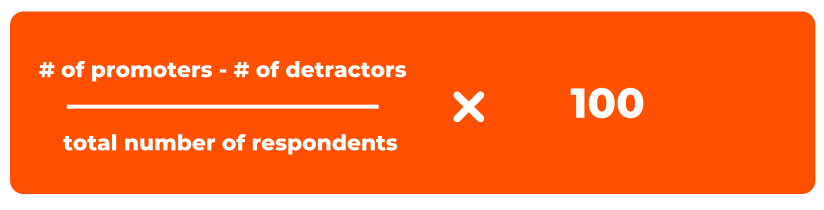
You may already be familiar with a Net Promoter Score, which helps you gauge your customer experience and how satisfied your customers are. Similarly, an employee Net Promoter Score lets you measure your employees’ experience and satisfaction with your company. The more satisfied your employees are, the less likely it is you’ll see high turnover.
11. Knowledge retention (indirect)
It’s not enough for sales teams to just understand the knowledge and content related to their jobs. Sales reps need to retain the information they learn so they can easily recall it for use during customer interactions.
12. Content usage and adoption (indirect)
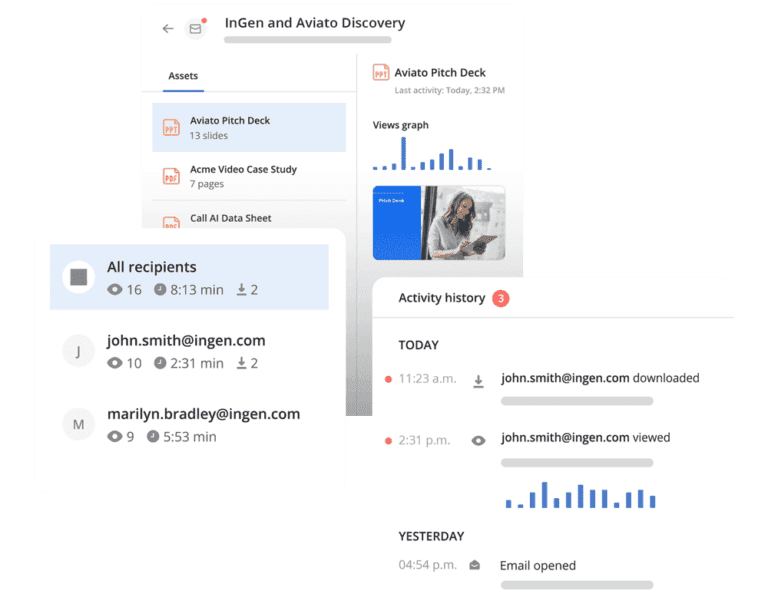
A big part of measuring sales enablement is tracking how well received and used related content is by your sellers and customers.
13. Calls-to-action insights (indirect)
Calls-to-action (CTA) insights show you how often a potential customer takes action on your content, including blogs, paid ads, emails, and more. The more your leads click on your content to learn something or take an action, the more effective the content is.
You can compare whether the actions taken on your content correlate to more leads or more opportunities won by your sales reps.
Start measuring sales enablement success with Mindtickle
When it’s done right, sales enablement can significantly impact sales productivity and performance. Ongoing measurement is key to ensuring your sales enablement program is as impactful as possible.
The 13 sales enablement metrics we explored in this post can give you insight into what’s working and what’s not. But simply tracking these sales enablement metrics isn’t enough. You must also analyze the data and take action on it.
With Mindtickle, you can track, measure, and improve your sales enablement program holistically – all from one platform. Our integrated revenue enablement platform helps you keep your content up-to-date, analyze seller behaviors and skills, and deliver tailored training, enablement, and coaching that prepares sellers to conquer any deal that comes their way. With Mindtickle, you can easily track key sales enablement metrics – and determine how to put those insights into action to improve impact.
Want to see how others measure ROI?
See how leaders from PayPal, Zoominfo, and Patronix measure the impact of their sales enablement efforts.
This post was originally published in August 2022, was updated in November 2023, and again in October 2024.