




How to Choose an AI Sales Role Play Software: 14 Questions to Ask the Vendor



The right AI sales role play software should do more than simulate a sales conversation. It should help you practice realistic situations, provide useful feedback, and give enablement and sales leaders a way to connect practice with measurable improvement.
That distinction matters when you’re evaluating software. Some are primarily conversation simulators. Others combine role play with coaching, conversation intelligence, readiness, and performance data. The differences can have a significant impact on how useful the software becomes once it is deployed across a sales organization.
This guide breaks down what to evaluate when buying an AI sales role play software, with fourteen questions to help you assess your options and zero in on the right solution.
Key takeaways
- Look beyond basic conversation simulation. Evaluate how realistically the AI handles buyer personas, objections, interruptions, and complex sales scenarios.
- Prioritize integration and scalability. Choose a software that fits into your existing sales enablement and tech stack and can support teams, regions, and use cases as you grow.
- Evaluate the quality of feedback and analytics. Look for actionable, skill-specific feedback and visibility into proficiency, improvement, and readiness gaps.
- Connect practice to real-world performance. The strongest software use conversation and performance data to personalize practice and connect role play with coaching, readiness, and business outcomes.
Understanding AI sales role plays
Practicing with an AI simulation for a range of meeting scenarios, customer personalities, and job functions is a great way for busy sellers to sharpen their sales skills.
AI sales role play gives sales reps a safe place to fail because they can try and fail without real customer consequences. Sellers can practice whenever they want without having to rely on the availability of others. They can practice many different scenarios with personas that mimic actual buyers, and across a range of industries, products, languages, and personalities. Through AI, sellers get objective and immediate feedback.
AI sales role plays help GTM teams:
- Reduce ramp time
- Increase average deal size for new products
- Improve conversions with better conversations
AI sales role play software categories
There are many types of vendors offering some sort of AI sales coaching and training capabilities. Let’s look at the different vendor categories and how they’re approaching AI role plays.
| Vendor category | Sample vendors | Role play offered |
|---|---|---|
| Content marketplace | Udemy, Coursera, LinkedIn Learning | General AI role plays for business learners, not specific to sales. |
| Interview practice tools | Interview School, ChatGPT voice mode, Gemini (on phone only) | General purpose interview practice tools for students and professionals, often free |
| Corporate coaching platforms | Unboxed Technology, Valence | AI role plays offered as part of corporate coaching and leadership solutions, not specific to sales. |
| AI-native role play startups | Second Nature, Hyperbound, Yoodli | Fast to deploy but coaching can be shallow with limited analysis |
| Revenue enablement platforms | Mindtickle, Allego, Highspot (partnership with Yoodli) | AI role plays offered as part of the platform’s core focus to provide sales readiness. Depth of functionality varies from vendor to vendor. |
Limitations of traditional role plays and why AI scales
The traditional manager-seller sales coaching way is no longer an efficient or effective approach to keeping sales teams sharp. Here are some downsides to offline coaching:
- Inability to scale: Managers can’t train thousands of reps or partners.
- Limited manager availability: Managers are too busy and peers aren’t ideal for coaching.
- Inconsistent and subjective feedback: Managers score differently and bias can often creep in.
- Anxiety-inducing and performative: Sellers can feel nervous, especially in front of peers or leaders.
- Lack of proof of impact: Limited data about improvements.
- Poor analytics on skills gap: Lack of documentation of training accuracy.
AI delivers role plays at scale, coaching sellers across global, multilingual, and complex selling scenarios. AI role plays deliver instant feedback. Sellers receive coaching in a judgment-free way and get objective scoring.
How to evaluate an AI sales role play software
If you’re searching for AI sales role play tools and feeling overwhelmed by the options, you’re not alone. Here are fourteen essential questions to ask before choosing any software.
1. Can the software provide coaching for every function in the sales organization?
General role play solutions from content marketplaces and corporate coaching companies only go so far in helping your team because they’re aimed at a broader business audience. As a revenue leader or sales enablement professional, you’re better off seeking a solution that is specifically designed for everyone on your team.
For example, some vendors can tackle cold call practice well but may not have role plays relevant to solution consultants or customer success managers. Look for a solution that best serves your needs.
2. Is the software scalable?
Make sure the software doesn’t break as you scale coaching and onboard different teams, regions and your extensive partner network. Seek a vendor that’s recognized for scale and reliability.
3. Are the scenarios realistic?
In enterprise selling, your reps likely have to try and persuade a wide range of job roles, and people with very different personalities and expectations. Sellers have to conduct detailed discovery and be adept at demonstrating competitive differentiation and negotiating pricing.
Seek an AI sales coaching platform that offers lifelike call simulations where the AI buyer pushes back, interrupts and challenges your reps’ every move.
4. How realistic does the bot sound?
Your reps should feel like they’re having a natural conversation, even though they’re talking to a bot. The content of the conversation should feel dynamic and the AI responses should be realistic, with strong reasoning. Some bots have been known to go off on a tangent and talk gibberish.
5. How long does the bot take to respond?
Lag time or latency is the time it takes for the bot to respond after you have finished speaking. Your seller should be in the flow of the conversation when they practice and not have to wait through awkward pauses or have to press a Start/Stop button. Vendors with limited resources, use older language models that tend to have longer pauses.
Ideally the lag time should be 2 seconds, which is considered near human. Any longer than that and it would feel like they’re talking to … well, a bot. You can easily check this with the stop watch on your smartphone. Get your hands dirty; don’t just buy after a demo, ask to use the tool before you buy.
6. How easy is it to use?
Reps neither have the time nor the patience to have to learn the AI platform before they can practice their pitch. They just want to log in, pick a scenario, and start practicing within minutes. Similarly, admins shouldn’t need IT to build scenarios. They should be able to spin up a new role play in minutes with a prompt or template.
Reps also don’t want an essay as feedback. They want clear and specific pointers like, “You missed the pain point,” or “Slow down here.” That’s the kind of actionable feedback that’s instantly memorable and fixable.
7. Is it part of a sales enablement platform?
Coaching through role play isn’t a standalone activity, it’s part of sales readiness. AI role play is only valuable if it connects to everything else that drives seller performance, like product knowledge, messaging certification, analytics, and reinforcement. When they’re connected, reps can learn, practice, and prove proficiency in one continuous workflow.
Here’s how a workflow might happen when role play is part of an enablement system: A rep completes a new product module in the platform. They immediately launch an AI role play to practice that pitch. The system gives them a score and recommends coaching or next-step training. The tool sends the results to their manager so they can track readiness metrics. This closed loop only works if AI role play is embedded in the same enablement system.
If it is not part of your sales enablement platform, it becomes one more tool that you throw at your sellers when they are already inundated with sales tools.
8. Can reps access the tool on the mobile?
If sellers aren’t desk bound, they will need role plays on their phones.Reps want to be able to practice their pitches while on the move, especially if they have a few minutes to spare before a prospect meeting. Check if the role play vendor offers role play on the mobile. Many point solutions don’t.
9. Does it support multiple languages?
If you are a global company operating across regions, you need role plays in multiple languages with high accuracy and the right diction. Many role play vendors will claim they support 20-25 languages but ask them for the accuracy rate of translations. Even though the tech is improving fast, AI translations outside of the most commonly used languages, like English, Spanish, German, and Japanese, tend to have higher error rates because there is limited training data.
10. Does it offer enterprise security?
AI role plays may use sensitive data, like real product details that could be pre-launch or otherwise confidential. You want all your company information safe and secure.
When evaluating tools, ask the vendor where information is stored or processed, if data is encrypted in transit and at rest, and if the data is used to train the model.
Look for a vendor who has been awarded the ISO 42001 certification, the world’s first comprehensive AI system security standard. If you are in EMEA, see if the vendor complies with the European Union AI Act, which ensures AI systems used in Europe are safe, transparent, and non-discriminatory.
11. Does it play well with your LMS and current sales tech stack?
Practice separated from learning makes little sense. Imagine if a rep has to log into one place to take a training course, another to practice, and a third to access collateral. It is far from ideal. All these systems, be it training, practice, CRM, and content should all play together and be in the flow of work for your sellers.
12. Does it provide analytics and skill-specific feedback?
All vendors provide sellers with immediate feedback. Examine if the feedback is constructive and actionable.
At the aggregate level, admins and managers should be able to see:
- Completion rates – who has practiced, how many times, and got certified.
- Proficiency scores – scores assigned by the AI or manager.
- Improvement over time – reps’ skills over time .
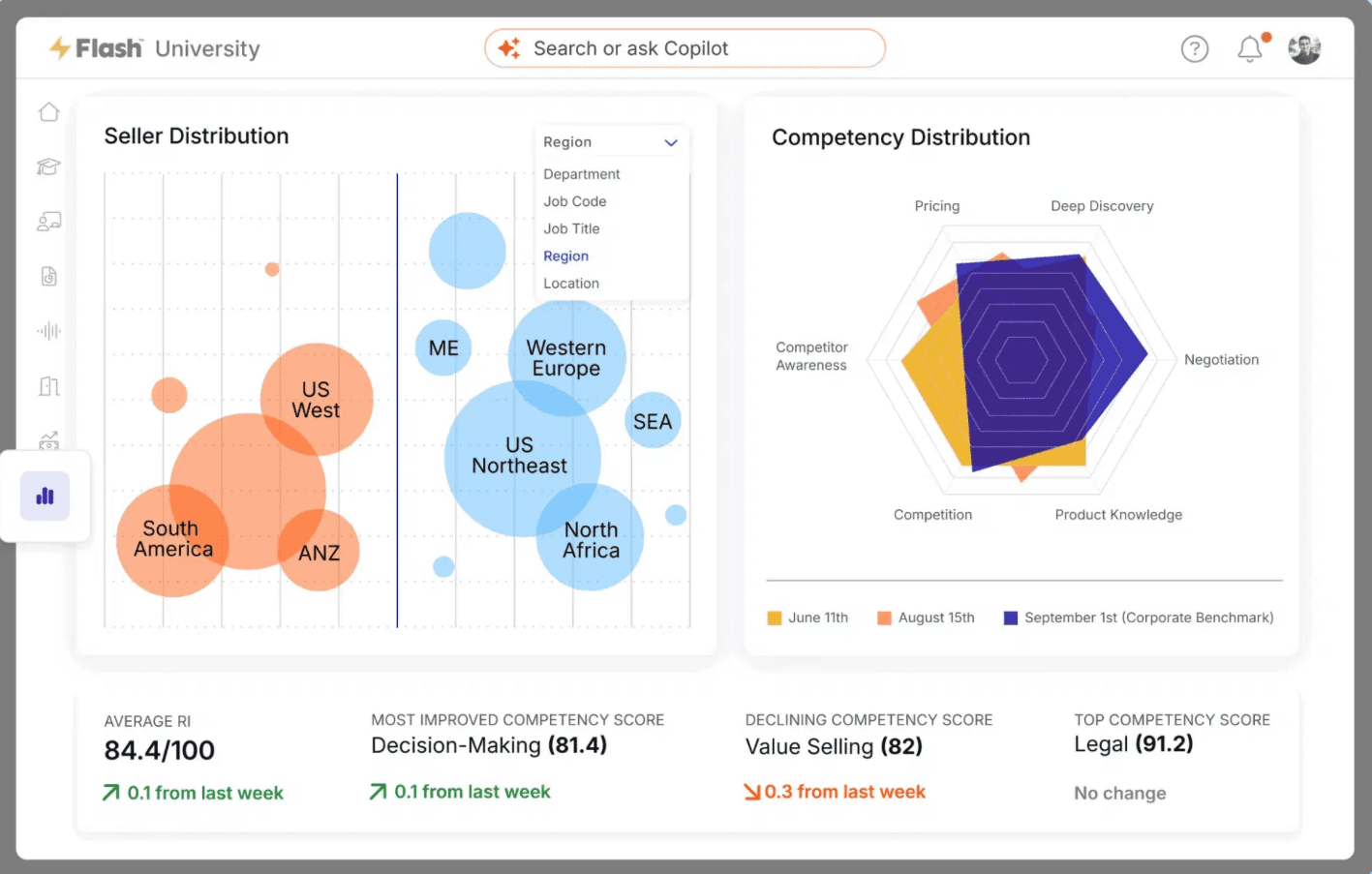
- Readiness gaps – managers get a visual dashboard showing team strengths and gaps.
13. Are the roleplays based on real deals and skill gaps of your sellers?
Generic role plays have a ceiling. A rep can rehearse a discovery call scenario a dozen times and still struggle on a live call because the practice wasn’t built around their actual gaps.
The best software connects directly to conversation intelligence data which means role plays are generated from what’s actually happening on a rep’s calls, not assigned from a static library. If a rep is consistently losing deals at the pricing conversation, the system identifies that pattern and triggers a relevant role play automatically.
Ask vendors whether role plays are auto-generated from live call performance or manually created by admins. The former scales across an entire sales org without administrative overhead. The latter means someone has to notice the gap, build the scenario, and assign it — by which time the rep has already had three more calls with the same problem.
14. How long does it take to build a roleplay?
If it takes days to build a single scenario, your enablement team becomes a bottleneck. Products evolve, messaging shifts, and your practice library needs to keep pace.
Look for a software where admins can spin up a new role play in minutes using a prompt, a template, or by uploading existing content — a sales deck, a call recording, or a one-pager. The AI should handle the heavy lifting without IT involvement.
A good benchmark: a new scenario should be ready in under five minutes. If a vendor can’t demonstrate that live during your evaluation, that’s worth noting.
Evaluating Mindtickle as an AI sales role play software
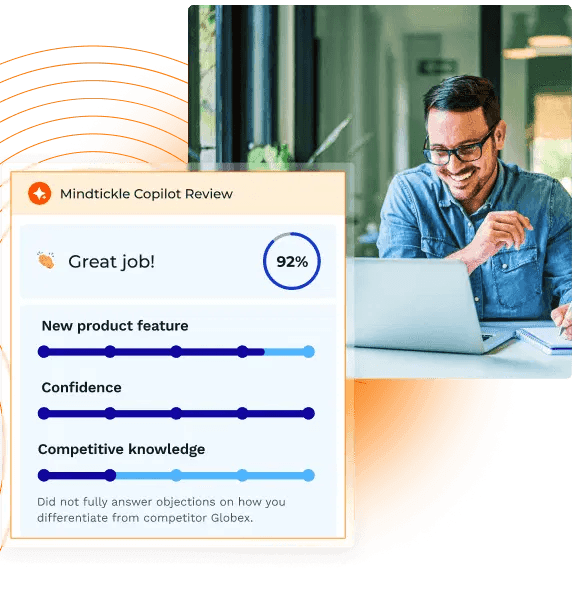
If you’re evaluating Mindtickle alongside other AI sales role play software, one thing to consider is how role play fits into the broader enablement workflow. In Mindtickle, AI role play is connected with conversation intelligence, coaching, and readiness measurement rather than operating as a standalone practice tool.
Mindtickle’s AI Sales Role Play allows teams to create practice scenarios for situations such as cold calls, discovery, objection handling, negotiations, renewals, and product launches. Scenarios can be created from templates or natural-language prompts, while AI can support scenario creation, scoring, and feedback. This can make it easier for enablement teams to offer more opportunities for practice without requiring managers to manually build and assess every exercise.
Where this approach may be relevant for buyers is the connection between practice and what sellers are actually encountering in customer conversations. Mindtickle’s conversation intelligence can surface patterns and potential skill gaps from sales calls, which can then inform targeted practice. For example, a seller who consistently struggles with pricing objections could be directed toward practice focused on that situation, rather than receiving the same role play as the rest of the team.
That connection also changes how role play can fit into a manager’s workflow. Instead of treating practice as a separate enablement activity, teams can use call insights to identify areas for coaching, use role play to reinforce those skills, and then look at subsequent customer conversations to see whether the behavior is showing up in the field. The value here depends less on the role play simulation itself and more on how consistently the organization connects practice, coaching, and real-world performance.
There is also a practical consideration around scale. AI-generated scenarios, automated assignments, and immediate feedback can reduce some of the administrative work involved in running a role play program. Managers can spend less time reviewing every practice session and more time working directly with sellers on the areas that require judgment or deeper coaching.
What makes Mindtickle different from others
Mindtickle reports more than 2 million completed role plays across its customer base. For buyers assessing the platform, however, the more useful question may be what happens after the role play: whether practice data can be connected to coaching and readiness signals, and whether the organization can ultimately determine if practice is influencing seller behavior and performance.
This makes Mindtickle worth considering for organizations that want AI sales role play to be part of a broader revenue enablement workflow rather than a standalone simulation tool. If your primary requirement is simply to provide sellers with a place to practice conversations, a more focused role play software may be sufficient. If you want practice to be informed by customer conversations and connected to coaching and readiness measurement, the broader workflow is an important factor to evaluate.
What happens when a true AI sales role play software is deployed to a global sales team?
Cisco wanted to run a pitch competition for 7,200 sellers. Manually reviewing every submission would have required an estimated 38 weeks of cumulative manager time. Using Mindtickle’s AI sales role play, the company automated the initial assessment and saved approximately 6,000 manager hours.
The impact went beyond efficiency. With immediate feedback after each attempt, sellers practiced an average of four to six times before submitting their final pitch. Cisco also reported a 31% increase in average deal size and a 25% increase in booked deal value among participants.
Mistakes to avoid when choosing an AI sales role play software for your sales team
There is no shortage of choice when selecting an AI role play software. Here are the top three mistakes to avoid:
- Avoid a piecemeal solution: Select a sales enablement platform that actually drives sales performance, with learning, AI role play and analytics tightly integrated. Learning and practice need to go hand in hand.
- Avoid the new shiny object: It’s best to invest in a platform by an established vendor that is in it for the long haul and will continue to drive innovation and value for your organization as you grow your business.
- Avoid basic tools that support only narrow use cases: Selling is complex, so it’s best to invest in a platform that offers a wide range of complex scenarios from detailed discovery, competitive differentiation, and pricing negotiations. Seek a solution that is deep enough to allow sellers, solution consultants, and CSMs to practice in very technical and complex scenarios and really move the needle. Avoid buying a basic tool that you will outgrow tomorrow.
The right AI role play software should do more than simulate conversations
The AI role play market is moving fast. According to Mindtickle’s State of Agentic Revenue Enablement Report 2026, reps completing 10 or more AI role plays monthly score measurably higher on live calls.
As you evaluate vendors, look beyond fancy features. Ask how the software connects practice to coaching, readiness, conversation intelligence, and revenue performance. The most effective solutions don’t treat role play as a standalone activity; they make it part of a continuous learning and coaching loop. That’s what helps sellers build confidence, managers coach more effectively, and enablement teams prove impact.
If you’d like to see what that looks like in practice, try a 7-min AI sales role play for free. You can test realistic buyer simulations, receive AI-powered feedback, and experience how personalized practice works in a revenue enablement environment. If you prefer an expert-led demo instead, hit the button below.
Frequently Asked Questions

Subscribe to the blog
Get the latest sales enablement tips, guides, and industry best practices delivered to your inbox. Unsubscribe anytime.
Related Articles

How to Choose the Right AI Role Play Platform for Sales Tech Consolidation in 2026

Why Teams Are Switching from Reactive Call Coaching to Proactive AI Role Play in 2026