



Mindtickle vs. Second Nature: Which Platform is Better for Revenue Enablement Teams?



Enablement leaders see when reps need more practice. But they often can't tell if practice actually improves sales. Without a clear link between training and pipeline results, the C-suite loses trust in enablement, and budgets become harder to defend.
Teams looking to solve this typically land on one of two approaches: a point solution like Second Nature, which specializes in AI-powered conversational practice, or a complete enablement platform like Mindtickle that connects practice, coaching, content, and deal data in one place.
Both use AI role play so reps can practice key conversations before live calls. The real difference is what happens to practice data after simulation.
The comparison below helps enablement, and RevOps leaders choose the model that fits their data strategy, tech stack, and coaching workflows. It is based on public product pages, G2 reviews, and customer case studies.
Key Takeaways
- Practice without context is just activity. Role play data only matters when it connects to call insights, deal performance, and coaching workflows — not when it lives in a separate tool.
- The right choice depends on what happens after the simulation ends. Second Nature is built for focused practice. Mindtickle connects that practice to everything else. Different tools, different problems.
- Tech stack architecture is an enablement decision. Point solutions are fast to adopt. But as revenue attribution and AI governance requirements grow, integration debt compounds. That architecture decision is worth making intentionally and early.
Mindtickle vs. Second Nature: Choosing the right revenue enablement platform
Both platforms offer AI role play. What separates them is everything that happens around it. Here's a side-by-side look.
| Capability | Mindtickle | Second Nature |
|---|---|---|
| Platform type | Unified revenue enablement platform connecting practice, coaching, content, and deal data into a single system | Point solution focused on AI-powered sales role play and conversational practice |
| Ramping and upskilling reps | Structured onboarding and continuous learning through microlearning, certifications, and AI role plays — all tied to an Ideal Rep Profile | Uses high-fidelity AI simulations for discovery, demos, and objection handling |
| Content management and buyer engagement | Native Asset Hub for content management and Digital Sales Rooms (DSR) for tracking buyer engagement through the deal cycle | Content capabilities are primarily oriented around uploading training materials to build and support role-play scenarios |
| Conversation intelligence | Built-in Call AI analyzes real call data, surfaces skill gaps, and triggers structured coaching workflows tied to live deal activity | No native conversation intelligence; role play is typically assigned by managers or initiated via integrated conversational intelligence and CRM tools |
| CRM and revenue integration | Native CRM integrations that correlate rep skills with win rates. See Mindtickle Integrations | Integrations exist, but revenue correlation typically requires cross-system analysis |
| Implementation and setup | Comprehensive enterprise rollout with professional services designed for organizations with a dedicated enablement function | Faster pilot deployment with a standalone setup; lower barrier to entry for teams evaluating AI role play |
Best fit by use case (Core comparison)
Here's how each one performs against the use cases that matter most to enablement and RevOps leaders.
Use case 1: Onboarding and rep development
New rep ramp time is one of the most expensive problems in sales. The longer it takes a rep to become confident and productive, the more pipeline the business leaves on the table. Identifying skill gaps early is what shortens that curve.
Mindtickle connects rep readiness data to live CRM data through its Salesforce-integrated Readiness Index — meaning training completion, role-play scores, and skill assessments sit alongside pipeline and deal data in a single view. Enablement and RevOps teams can see which skills correlate with higher win rates and where gaps are costing deals.
Janssen India cut new rep ramp time by 50% as part of a broader enablement rollout that included AI role play. The outcome reiterates the fact that when practice data connects to performance data, enablement can prove its impact.
Second Nature provides built-in evaluation, competency scoring, and practice analytics. These are useful signals for managers, but connecting them to revenue outcomes requires manually pulling data into a CRM or BI tool. For teams that don't have that infrastructure already in place, it's an additional integration layer to build and maintain.
😊 Good to know
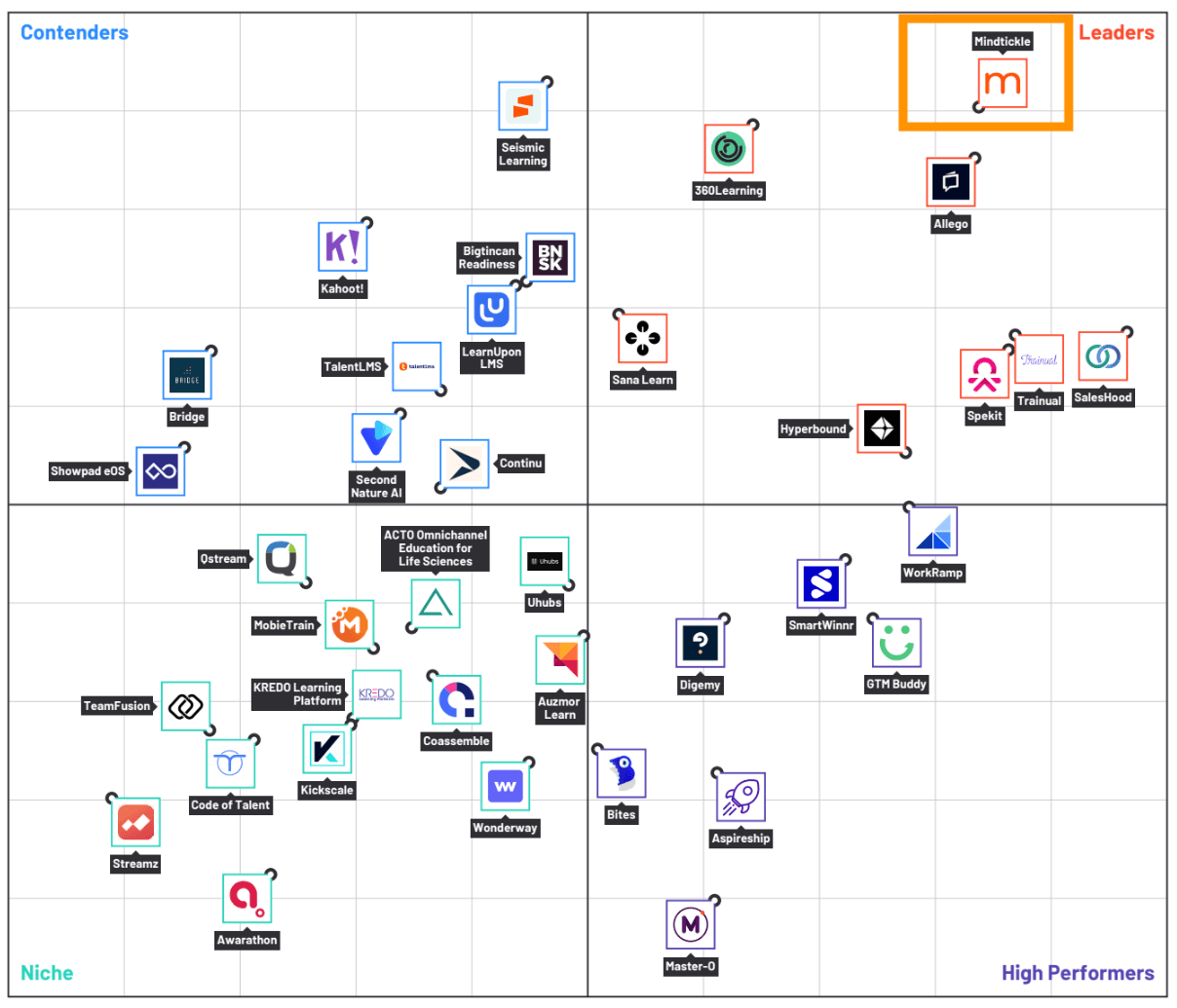
Mindtickle is ranked No. 1 on G2 for Sales Onboarding and Training and holds the Leader position in both the Enterprise and Mid-Market segments. It is the only platform to lead in both. It has also earned 115 badges, with leadership across 8 categories and holding the #1 spot in Sales Training & Onboarding for 26 straight quarters!
Use case 2: Personalized AI role play
Every rep struggles with a different gap. Generalized scenarios cover the basics but rarely move the needle on the specific skill holding a rep back. Personalized practice has to target those gaps directly.
Mindtickle's AI Role Play identifies coaching gaps from live calls and automatically triggers targeted practice to address them. Role plays are auto-generated from each rep's actual call performance — tailored to their skill profile, deal stage, and specific gaps. Reps choose from a library built around their needs, and enablement admins don't need to manually create or assign anything. The system handles it.
The platform has logged over 2 million AI sales role plays in the past five years, reflecting the volume of practice enterprise teams are running at scale.
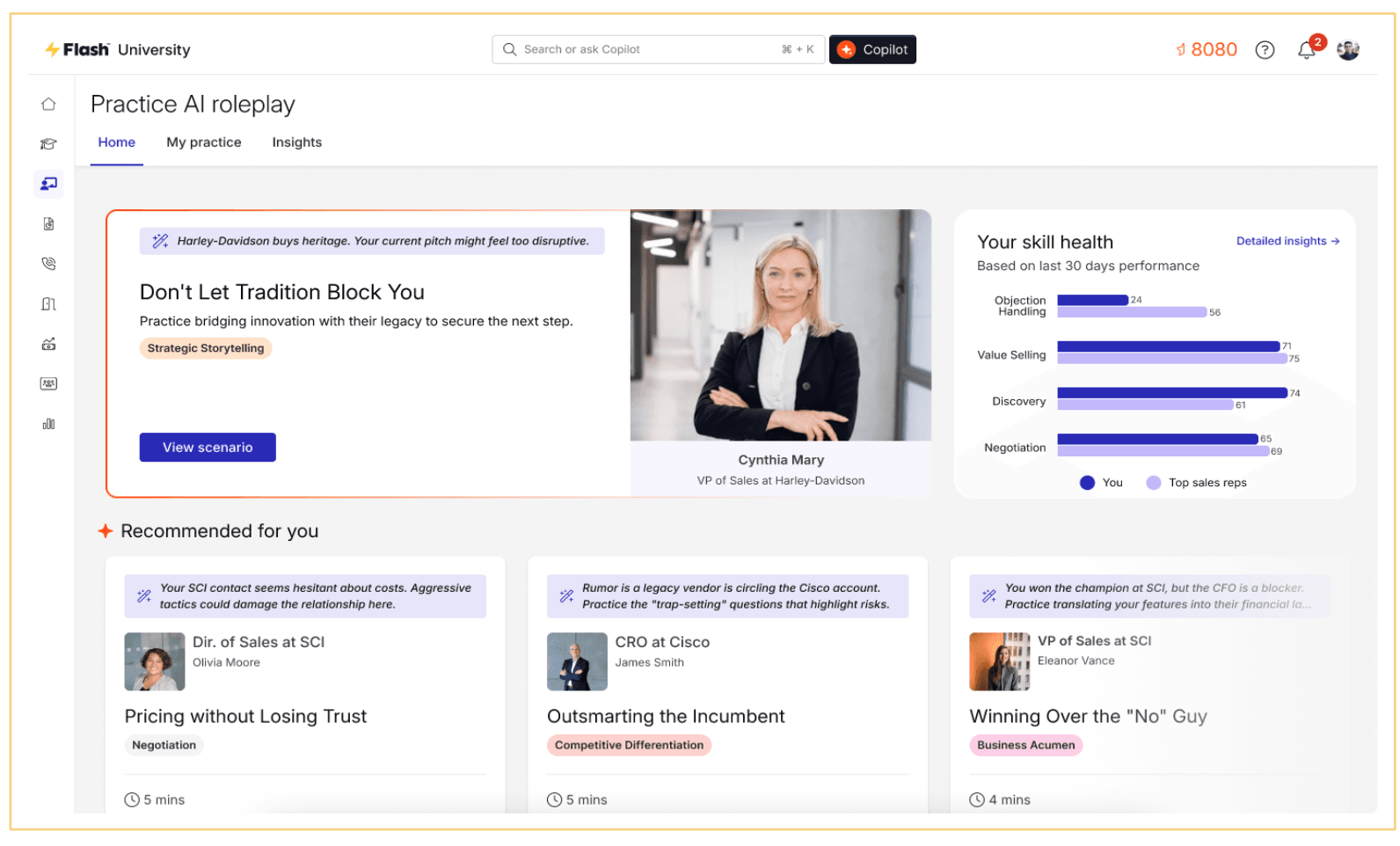
Second Nature identifies skill gaps within practice sessions and surfaces targeted feedback to reps after each simulation. Managers can review performance data and manually assign modules. The platform also offers a Salesforce integration that pushes context-aware practice suggestions based on deal stage, adding some automation to the assignment workflow. However, there is no native conversation intelligence, and the automated link from a live call signal to a triggered simulation is not a built-in capability.
💡 What would your team do with 800 extra hours?
Juniper Networks saved 800 hours of manager time through a single AI role-play program — a figure that illustrates what happens when AI takes over the review and feedback loop that managers would otherwise handle manually.
Start a Role Play Now
Use case 3: Consolidating the enablement tech stack
As sales teams grow, so does the number of tools supporting them. At some point, teams have to make a deliberate choice: keep managing a fragmented stack, or consolidate into a system where everything works together.
Mindtickle is built for the second path. AI role play sits inside a broader readiness program — connected to structured enablement, coaching workflows, content, and CRM performance data in a single system. The practical implication is that learning activity, practice scores, and deal data aren't siloed across tools. They inform each other. Read The Magic of Bringing Your Tech Stack Under One Roof
Second Nature is designed to slot into an existing stack without disrupting it. That's a genuine advantage for teams that want to add AI role play quickly without a large implementation commitment. The trade-off is that it becomes another data source — one that needs to be connected to everything else to tell a complete story about rep performance.
✅ Pro Tip
The core tension here is depth versus context. Second Nature keeps its focus tight: the practice experience, and nothing beyond it. Mindtickle's bet is that practice only moves the needle when it's connected to everything else happening in a rep's workflow — the calls they're taking, the deals they're working on, the skills they're being coached on.
Which model fits depends on where your team is. If you already have a mature stack and need to add high-quality practice without rebuilding anything, Second Nature is worth evaluating. If you're looking to consolidate tools or build an enablement function that connects training directly to revenue outcomes, Mindtickle's integrated model is the more logical fit.
How thoughtful tech consolidation improved the enablement experience at Syndigo
Mindtickle vs Second Nature: Related aspects worth considering
Beyond core capabilities, a few operational factors shape how well either platform fits your team's reality and your long-term ROI.
Ease of adoption and daily use
Mindtickle's implementation is a structured, end-to-end process. A dedicated professional services team, including consultants, solutions architects, and onboarding specialists, works alongside you through setup, integration, and deployment. For enterprise teams, that means you're not navigating configuration alone. Once live, a rep's training, practice, content, and coaching are all available in a single interface with no context switching between tools.
Second Nature's setup is considerably lighter. As a standalone tool purpose-built for practice, it doesn't require the same depth of integration work to get started. Teams can get pilots off the ground quickly, which lowers the barrier to initial adoption. The flip side is that the more value you want to extract from the data — connecting practice scores to pipeline, for instance — the more integration work you'll need to do separately.
📌 Editor's Note
The right framing isn't which setup is easier. It's what you need the tool to do at full deployment. Quick to launch and deeply integrated are rarely the same thing.
Flexibility, scalability, and long-term fit
Mindtickle's unified data model means leaders can see patterns across training, coaching, content, and pipeline data without stitching reports together from multiple systems. Programs can be adapted as the business evolves without rebuilding the underlying infrastructure.
On the compliance side, Mindtickle is independently audited against ISO 42001 and the EU AI Act — and customer data is never used to train AI models or retained after processing. For enterprise organizations navigating tightening AI governance requirements, that's a meaningful risk reduction built into the platform itself.
Second Nature scales well for organizations adding users to conversational practice programs. It's a focused tool that does what it's designed to do. The consideration for longer-term fit is architectural: as requirements around revenue attribution, cross-functional data alignment, and AI governance grow, teams using a standalone tool will need to invest in connecting it to the broader stack to meet those requirements. That's a solvable problem, but it's worth factoring into the total cost of ownership.
✔️ Worth Noting
If CRM-connected readiness data is a baseline requirement for you and not a future consideration, the integration architecture matters from the start.
Risks and limitations of both platforms
Mindtickle's implementation scope is broader than most standalone tools, but dedicated professional services support at every stage makes that manageable for enterprise teams. The more important consideration is data quality: revenue attribution through the Readiness Index depends on accurate CRM data mapping. Configured incorrectly, it loses most of its diagnostic value, which is worth factoring into implementation planning from the start.
For Second Nature, third-party G2 reviews surface a few recurring patterns worth noting. Inconsistent AI scoring is one: users report that presenting the same content can produce different grades across sessions. One verified G2 reviewer put it plainly: the AI "judges you differently" even when the content and delivery are the same.
As a standalone tool, Second Nature can also become an isolated data source over time — useful for tracking practice activity, but disconnected from the revenue metrics that matter most to leadership unless actively integrated with other systems.
Why organizations choose Mindtickle
The choice between a point solution and a platform comes down to what you need enablement to prove. Adding structured AI practice to an existing stack is one problem. Connecting that practice to pipeline performance and showing leadership that it's working is a different one entirely.
Mindtickle is built for the second problem. Practice, coaching, content, conversation intelligence, and CRM data in one place, with their relationships visible. That's why revenue organizations from high-growth teams to Fortune 500 enterprises choose Mindtickle and why their enablement leaders describe it the same way: a system where reps know where to go, managers know what to fix, and leadership can see the impact.
If that's the outcome you're looking for, the next step is to see it in your own environment.
Frequently Asked Questions
Platform Comparisons & Alternatives
Core Capabilities & Stack Consolidation
Data, Coaching & Revenue Impact
About the Author
Lead Content Marketer
Jayadeep brings over a decade of experience in B2B content and product marketing, with expertise in editorial leadership, messaging strategy, and agency management.
He has built and scaled content operations, led agency partnerships, and collaborated across marketing, product, and demand generation teams to deliver integrated campaigns. His "process-first, execution-next" philosophy has made him a trusted resource at Mindtickle, where he helps shape content strategy, thought leadership programs, and flagship marketing initiatives.

Subscribe to the blog
Get the latest sales enablement tips, guides, and industry best practices delivered to your inbox. Unsubscribe anytime.