




7 Highspot Alternatives in 2026: Pick the Right One for Your Team



The 7 best Highspot alternatives in 2026 are: Mindtickle, Seismic, Showpad (includes Bigtincan), Allego, Paperflite, Salesloft, and SalesHood. Each offers a distinct mix of sales content management, coaching, onboarding, and AI-powered enablement capabilities. So, the right pick depends on what your team actually needs.
Highspot, recently acquired by Seismic, is a well-known sales enablement platform with strong content management features. But it has consistent gaps that push teams to look elsewhere: limited sales training and readiness depth, a steep learning curve that hurts user adoption, and an interface that enterprise organizations often outgrow.
If you are specifically evaluating what the merger means for your contract or roadmap, see our detailed Mindtickle vs Highspot and Seismic comparison.
If you are evaluating alternatives, here is what you are likely trying to solve for:
- Deeper rep readiness and coaching, not just content delivery
- Easier adoption across large or distributed sales teams
- An integrated platform that reduces tool sprawl (content + training + AI role-play + conversation intelligence in one place)
- Stronger ROI visibility through analytics tied to sales outcomes
This guide breaks down all 7 alternatives with key features, known drawbacks, and pricing transparency, so your team can make a confident, informed decision.
Why consider Highspot competitors and alternatives?
According to recent research, training and enablement are now the #1 tactic for revenue growth, and the right sales enablement tools are essential to an effective sales enablement strategy.
So, if you've researched sales enablement tools, it's highly likely you must have come across Highspot as one option. Highspot is a popular sales enablement platform serving customers of all sizes, from startups to Fortune 500 enterprises. The platform offers strong features and functionality to support go-to-market teams, which is why it's become a top revenue enablement platform.
However, Highspot has some notable downsides. One major drawback is that its sales training and readiness capabilities are limited and unlikely to meet the needs of mature, enterprise organizations. In addition, there are some significant drawbacks in terms of user experience. Another theme in user reviews for Highspot is that there's a steep learning curve which can hurt user adoption. And if user adoption is low, you're unlikely to experience significant ROI. Because of its downsides, it makes sense to also consider Highspot competitors and alternatives.
7 Best Highspot competitors in the market today
Not every Highspot alternative is built for the same problem. Some replace its content management depth. Others go further, adding rep coaching, AI role-play, and readiness analytics that Highspot never prioritized. The seven platforms below cover the full range — with enough detail on features, drawbacks, and pricing to help you match the right tool to your team's actual gap, not just the most familiar name on a shortlist.
1. Mindtickle

G2 rating: 4.7 out of 5
Price: Custom pricing based on team size and modules. Contact Mindtickle for a quote.
Mindtickle is a revenue enablement platform that covers the full lifecycle of rep performance in a single integrated system. Where most platforms handle training, content, and coaching as separate workstreams, Mindtickle connects them into one view, tying enablement activity directly to sales outcomes rather than stopping at completion rates.
According to the State of Agentic Revenue Enablement Report 2026, high-performing revenue teams treat AI as a core participant in their workflow rather than an isolated tool, allowing for automated actions across deals, calls, and coaching. That is precisely how Mindtickle is built.
The AI layer runs across the entire platform rather than sitting as a standalone add-on. Sellers get contextual guidance during active deals, managers coach from real performance signals rather than observation alone, and enablement teams spend less time on administrative work because AI handles a significant share of scenario creation and assignment generation. For teams evaluating whether to consolidate their stack, that depth of integration is the core argument for Mindtickle over point solutions.
Top features
-
Readiness Index: Maps individual reps against defined skill and competency profiles so managers can see, at any point, who is ready to sell, where gaps exist, and what intervention is needed. This is Mindtickle's most distinctive capability relative to competitors on this list.
-
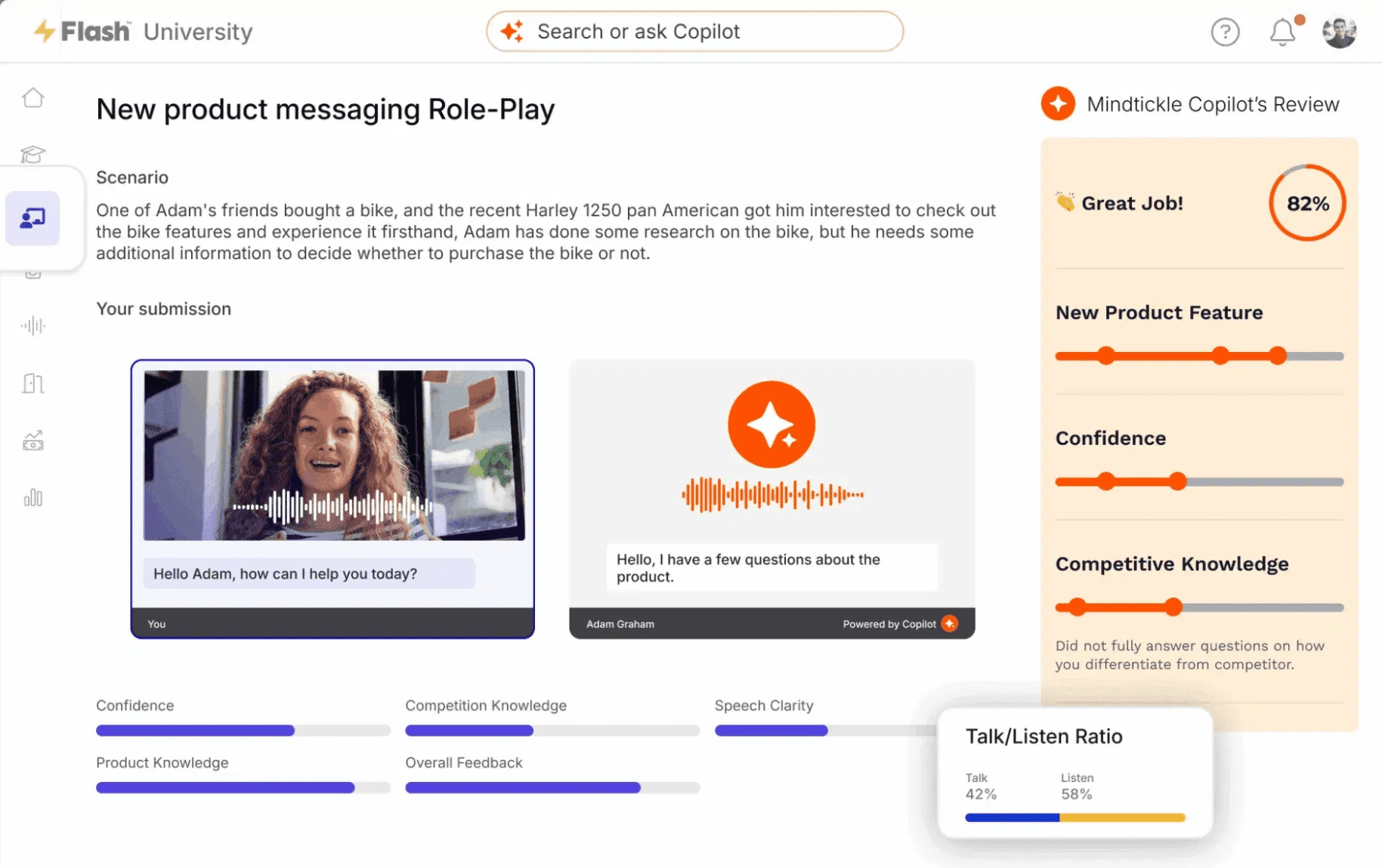
AI role-play: Lets reps rehearse real selling scenarios before they are in front of a buyer. Feedback is immediate and does not depend on manager availability, which matters at scale.
-
Mindtickle Copilot: An AI assistant that handles call prep, surfaces answers to rep questions, takes notes during customer calls, and drafts follow-up communication. Reduces time spent on tasks that do not directly advance deals.
-
Sales content management: Centralizes approved content and surfaces recommendations based on deal context. Reps can pull the right asset for the right scenario without hunting through folders.
-
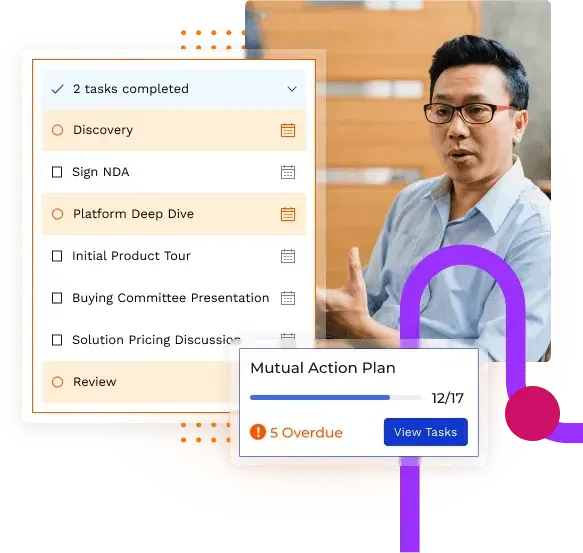
Digital sales rooms: Sellers can build customized buying experiences for individual deals, share content, and track how buyers engage with it. That engagement data feeds back into coaching and content decisions.
-
Conversation intelligence: Records and transcribes sales calls, surfaces behavioral patterns across the team, and gives managers the raw material for coaching conversations grounded in what is actually happening in the field.
-
Sales content analytics: Shows how buyers interact with shared content and how that interaction connects to deal outcomes, giving enablement and marketing teams a rational basis for content investment decisions.
Notable drawbacks: Pricing is not published and requires a direct conversation with the sales team. The platform's breadth means smaller teams without a dedicated enablement function may take longer to fully operationalize it.
🏆 Best for: Mid-market and enterprise revenue teams looking to consolidate their enablement stack and connect rep readiness directly to pipeline and revenue outcomes.
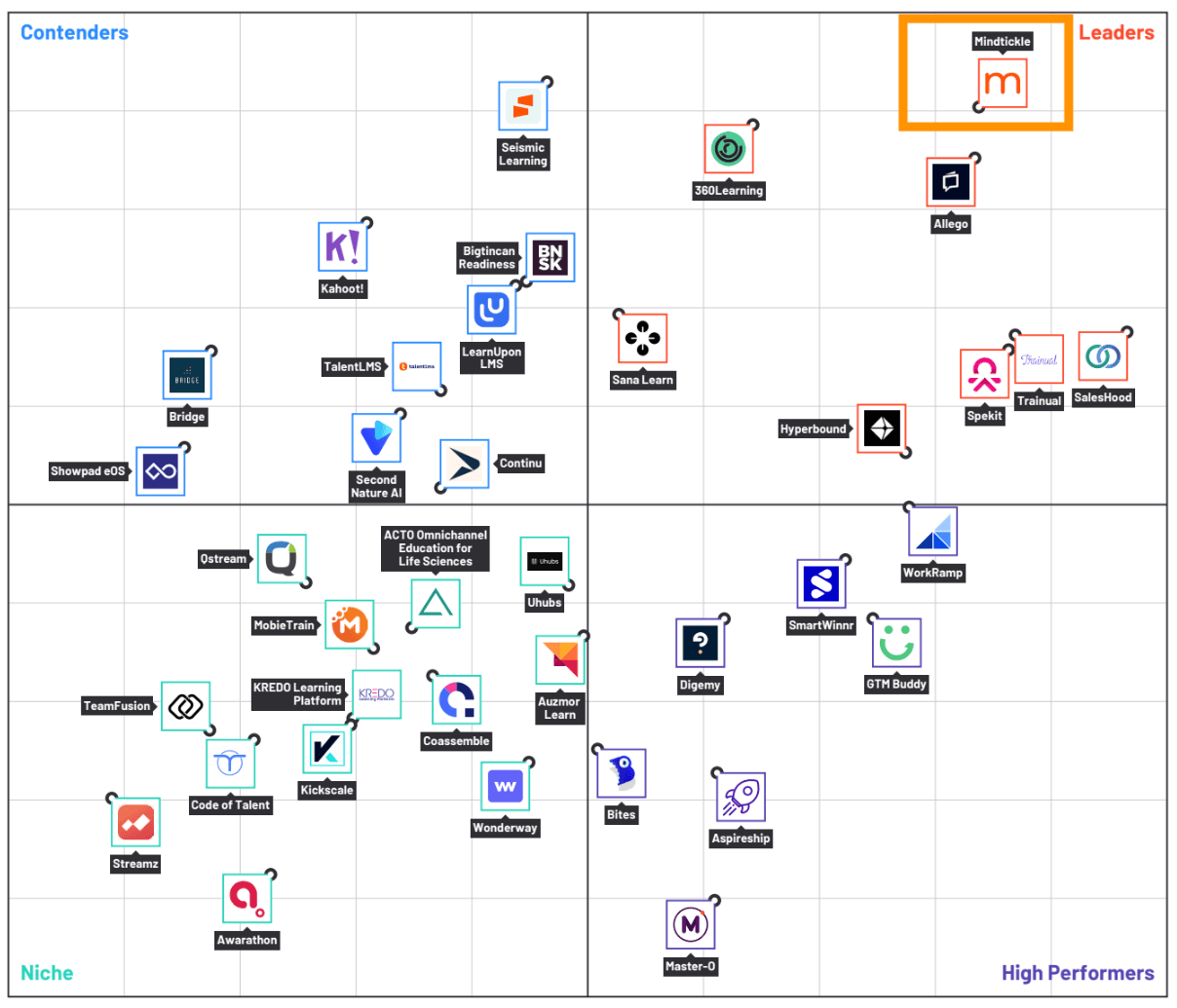
(Mindtickle is recognized as a Leader in the Gartner Magic Quadrant for Revenue Enablement Platforms)
Train, enable, and coach your revenue team to close more deals.
2. Seismic
G2 Rating: 4.6 out of 5
Price: Pricing depends on scope, industry, estimated Seismic user count, and which parts of the platform you need.
Seismic is a popular sales enablement platform that equips go-to-market teams with skills, content, tools, and insights. It is used by more than 2,200 companies worldwide, ranging from startups to large enterprises.
Top features
- Rich content management capabilities so enablement teams can build, maintain, and control content and sellers can find and share the right content with the right buyers.
- Robust analytics to optimize performance and prove the ROI of sales enablement.
- 150+ integrations so you can unify enablement with your existing tech stack.
Notable drawbacks: Users cite navigation difficulty and layout issues as the most consistent friction points with the platform. Several reviewers also flag that certain features feel limited relative to what enterprise teams need, and that the overall interface does not always feel intuitive for day-to-day use by reps without dedicated training or admin support.
🏆 Best for: Enterprises with 500 or more reps, dedicated enablement staff, and a content governance mandate. It is not the right fit for teams whose primary need is rep coaching, onboarding depth, or fast time to adoption.
3. Showpad
G2 Rating: 4.6 out of 5
Price: Custom plans available though exact pricing is not published publicly.
Showpad is the result of a late-2025 merger between Showpad and Bigtincan, both acquired by private equity firm Vector Capital. The combined platform now operates under the Showpad brand and covers content management, sales readiness, buyer engagement, and basic revenue intelligence in a single system. For teams currently on Bigtincan or Bigtincan Readiness, Showpad is where those capabilities have moved.
The platform's strongest suit has historically been sales content management and buyer engagement, particularly for field sales teams operating in environments where offline access matters — manufacturing floors, hospitals, and remote locations.
Notable features
- GenieAI: AI layer for content discovery, recommendations, and workflow support during active deals.
- Native offline capability for field teams that cannot rely on consistent connectivity.
- Centralized library with version control, permissions, and content usage analytics tied to deal outcomes.
- Native connectors with Salesforce, HubSpot, and Microsoft Dynamics with automated activity logging.
Notable drawbacks: Admin and reporting UX are the most consistent complaints across G2 and Gartner Peer Insights, with bulk user management and granular analytics requiring more manual effort than the rep-facing experience suggests. The Bigtincan integration is still in progress as of mid-2026, so teams should ask specifically which capabilities are fully unified versus running as separate modules before signing.
🏆 Best for: Field-selling organizations with 100 or more reps that need strong offline content access and basic training capabilities. Teams primarily looking for deep rep coaching, readiness analytics, or a platform that connects enablement directly to revenue outcomes will likely find Showpad's current offering limited relative to purpose-built alternatives.
📌 Deep Dive: Mindtickle vs Showpad
4. Allego

G2 rating: 4.6 out of 5
Price: Custom pricing. No public rates. Per-user, per-month model billed annually.
Allego started as a mobile video learning tool in 2013 and has since expanded into a broader revenue enablement platform covering training, content management, AI coaching, conversation intelligence, and digital sales rooms. Its origins in video-based learning still define its strongest suit, which helps reps build skills before they are in live selling situations.
Top features
- Reps practice selling scenarios and receive structured, AI-scored feedback without waiting for manager time.
- Structured onboarding paths, certifications, quizzes, and microlearning modules that embed into the flow of work across CRM, email, LinkedIn, and web browsers.
- Centralized content library with AI-powered tagging, GenAI search, CRM data auto-fill, and engagement tracking.
- Branded buyer environments where reps consolidate content, manage stakeholder communication, and track sales engagement across the buying committee.
Notable drawbacks: G2's aggregated review data flags a notable admin learning curve, with multiple mentions of missing features, a non-intuitive interface for administrators, and consistent feedback that search quality inside large content libraries needs improvement. A Gartner Peer Insights reviewer noted the actual platform felt meaningfully different from the demo experience, which is worth probing during evaluation.
🏆 Best for: Enterprise revenue teams in regulated industries — particularly financial services, life sciences, and medical devices — where compliance certification, structured onboarding, and governed content are core requirements alongside rep skill development. Teams whose primary need is connecting enablement activity to revenue outcomes through a unified readiness index, or who want deeper analytics beyond engagement and completion rates, may find Allego's measurement framework more limited than purpose-built alternatives.
📌 Deep Dive: Mindtickle vs Allego
5. Paperflite

G2 rating: 4.7 out of 5
Price: Transparent, published pricing starting at $30 per user per month for the Starter plan. CRM integrations, white labelling, and digital sales rooms are available on higher tiers.
Paperflite occupies a different position on this list from the platforms above it. Where Mindtickle, Seismic, Showpad, and Allego are built as full revenue enablement suites, Paperflite's core identity is content management, buyer engagement, and content intelligence. It does those things well and at a price point that is meaningfully lower than enterprise alternatives — which is a genuine advantage for teams whose primary problem is content discoverability and prospect engagement rather than rep readiness or coaching at scale.
Notable features
- Centralized content library with AI-powered search that surfaces the right asset based on deal context and rep intent.
- Reps can build personalized, branded content experiences for individual prospects combining case studies, videos, proposals, and product information into a single buyer-facing microsite rather than a chain of email attachments.
- Paperflite notifies reps the moment a prospect opens shared content, tracks time spent on individual assets, and maps the path a buyer took through a microsite.
- Engagement data connects to CRM records, showing which content assets influence deal progression and which do not. Marketing teams can use this to make evidence-based decisions about what to build and what to retire.
Notable drawbacks: Users flag missing features and limitations, slow loading, and layout issues. Reviewers also note that customization options feel constrained for teams with complex branding requirements, and that the initial admin setup — particularly around permissions and content organization — involves a steeper learning curve than the rep-facing experience suggests.
🏆 Best for: Mid-market sales and marketing teams whose primary challenge is content discoverability, buyer engagement visibility, and personalizing the content experience for individual prospects. However, teams that need structured rep onboarding, skills-based coaching, readiness analytics, or conversation intelligence as core requirements will find Paperflite's current offering narrow relative to purpose-built alternatives.
6. Salesloft

G2 rating: 4.5 out of 5
Price: Custom pricing. No published rate card.
Salesloft's core identity is sales engagement and revenue orchestration, helping reps execute outreach at scale, manage cadences across email, phone, and LinkedIn, and track buyer interactions through the sales cycle. In late 2025, it merged with Clari, the revenue forecasting platform, to form a combined entity now positioning itself as a Predictive Revenue System. The strategic ambition is to connect execution — what reps do every day — with forecasting intelligence, giving revenue leaders a unified view from first touch to closed-won.
Notable features
- Multi-step outreach sequences combining email, calls, LinkedIn touches, and manual tasks with branching logic based on prospect behavior.
- Records and transcribes sales calls, identifies key moments including pricing discussions, competitor mentions, and next steps, and surfaces coaching insights for managers.
- Connects pipeline signals and forecast data directly to seller execution workflows, so teams can act on at-risk opportunities in the same system where they identify them rather than switching between disconnected platforms.
- Assigns a score to each deal based on buyer engagement signals including email opens, replies, and meeting activity, helping reps prioritize follow-up on opportunities with real momentum.
Notable drawbacks: The absence of a native power dialer is the most frequently cited complaint across G2. The dialer is available but as a paid add-on, which adds to a total cost that multiple reviewers describe as steep, particularly for smaller teams. Some Gartner Peer Insights reviewers note the platform has grown stagnant in certain areas relative to newer competitors with UI feeling dated and could be more intuitive.
🏆 Best for: Mid-market and enterprise revenue teams with 50 or more reps, a dedicated RevOps function, and a Salesforce-centric stack, where the primary need is structured outbound execution, cadence management, and pipeline visibility in a single workspace. Teams whose primary requirement is rep readiness, skills-based coaching, onboarding depth, or content management will find Salesloft's current offering limited.
7. SalesHood

G2 rating: 4.6 out of 5
Pricing: Published and tiered. The Essential plan starts at $45 per user per month, the Pro plan at $65 per user per month, and the Unlimited plan at $85 per user per month. All plans are billed annually.
SalesHood, founded in 2013, covers training and onboarding, content management, sales playbooks, digital sales rooms, and AI coaching in a single system. In 2026, the platform expanded its AI capabilities to deliver real-time guidance during sales conversations.
Notable features
- Deliver real-time coaching guidance during sales conversations, drawing on the platform's content library to surface relevant responses and next-best actions.
- Reps can rehearse pitches and receive AI-scored feedback before engaging live buyers. Available on the Pro tier and above, these capabilities address the same practice-at-scale challenge that purpose-built coaching platforms tackle, though within a lighter framework.
- Just-in-time playbooks that guide reps on what to say, what to do, and what to share at each stage of a deal.
- Branded, collaborative buyer environments that centralize content, communication, and shared next steps.
Notable drawbacks: While the platform is generally regarded as user-friendly, some stakeholders have noted challenges with navigation and onboarding, particularly for administrators and enablement teams managing complex initiatives. Additionally, there have been reports of occasional system slowdowns during periods of high usage.
🏆 Best for: Teams whose primary needs are peer learning, onboarding, and just-in-time content access will find it accessible and straightforward to adopt. Teams that need deep readiness analytics tied to revenue outcomes, advanced conversation intelligence, or scalable coaching programs across large distributed sales organizations may find the platform's depth limited relative to purpose-built alternatives.
The list is complete. What's next?
Every platform on this list does something well. Seismic governs content at scale. Showpad serves field sales teams with strong offline needs. Allego coaches through video and conversation intelligence. SalesHood deploys fast for growing teams. Salesloft drives outbound execution. Paperflite makes content sharing elegant and trackable.
But most of them solve one part of the problem well and ask you to figure out the rest. And in a market where Highspot and Seismic have merged, where Showpad and Bigtincan are mid-integration, and where every vendor is racing to bolt AI onto a platform that was not built for it, the risk of picking the wrong tool just went up considerably.
The question worth asking before you book a single demo is not "which platform has the best features?" It is "which platform will actually move the needle on revenue, and can I prove it to my CFO in two quarters?"
That is a narrower filter. And it changes the shortlist.
Mindtickle is built around a single premise: that rep readiness is the most direct lever on revenue performance, and that measuring it should be as rigorous as measuring pipeline. The Readiness Index, AI role-plays, conversation intelligence, digital sales rooms, and content management are not separate modules stitched together. They are one connected system designed to show you not just what reps are doing, but whether it is making a difference.
If you want to see how Mindtickle handles your specific use case — whether that is cutting ramp time, scaling coaching across a distributed team, or finally connecting enablement activity to pipeline — the fastest way to find out is a focused 30-minute conversation with someone who knows the platform.
No obligation. No 12-slide pitch. Just a direct conversation about whether it fits.
FAQs

Subscribe to the blog
Get the latest sales enablement tips, guides, and industry best practices delivered to your inbox. Unsubscribe anytime.