




Sales Process Mapping: What it is and Why is it Important?



Let’s face it: B2B sales teams often operate in a state of organized chaos. Sure, reps find their way and deals get closed. But it’s rarely consistent and almost never scaleable.
Sales process mapping changes that.
Sales process mapping takes all the moving parts of your sales process and turns them into a clear, visual framework. Each stage is defined, every handoff is clear, and the entire journey is mapped to how your customers actually buy – enhancing the overall buyer experience and reducing friction at every stage.
But a sales process map isn’t just a pretty diagram. It’s a strategic tool that can help align teams, identify gaps, and build a powerful sales engine that drives consistent, high-impact sales engagement.
In this post, we’ll focus on what sales process mapping really means, how to build one that reflects your business goals and buyer behavior, and the key role sales enablement plays in bringing it all to life.
What is sales process mapping?
If you’re not entirely sure what sales process mapping is (or why it matters), you’re not alone. Let’s start with a clear definition.
Sales process mapping, defined
Sales process mapping is the process of evaluating and visually documenting the steps your revenue team takes – from their first interaction with a prospect all the way through to closing the deal.
Think of a sales process map as a detailed, step-by-step blueprint that shows how sales activities, roles, and decisions all fit together across the customer journey.
Sales process maps (also known as sales process flowcharts) can vary widely between organizations. Some are simple flowcharts. Others are more complex visual infographics. We’ll take a closer look at some sales process map examples later on.
Why does sales process mapping matter?
Revenue leaders have plenty on their plates. Is sales process mapping really worth the effort?
In a word, yes.
Successful sales organizations don’t get that way by winging it. Instead, they rely on a well-defined sales process to ensure everyone knows what needs to happen, when, and how to move deals forward consistently. Without that structure, teams risk:
- Missed opportunities
- Misaligned priorities
- Unpredictable results
A strong sales process is the foundation of scalable, repeatable growth, and the practice of sales process mapping is well worth the effort.
What does sales enablement have to do with it?
Sales process mapping and sales enablement go hand in hand. While sales process mapping defines the route, sales enablement provides the tools, content, and training teams need to navigate it effectively.
We’ll take a closer look at the connection between sales process mapping and sales enablement later in this post.
How to approach sales process mapping
Sales process mapping is an opportunity to create clarity, drive alignment, and build a more efficient revenue engine. But it can feel overwhelming – especially if you’re not sure where to start.
The good news is, mapping your sales process is fairly straightforward. Here are a few simple steps you’ll need to take.
1. Start with the end in mind
Before diving into the details of your sales process, you must first get clarity on your objective.
Identify the end goal (or goals) of your sales process. For example, you might have a goal to: 0
- Increase qualified leads
- Reduce sales cycle length
- Boost win rates
Once you’ve defined your goals, you can work backwards to determine how you’ll reach them.
2. Get the right people around the table
B2B sales is a team effort, and your sales process should reflect that.
Assemble a task force with stakeholders from teams including:
- Sales
- Marketing
- Customer success
- Sales enablement
- Product
- Customer Service
Each of these teams plays a role in shaping the buyer journey, and their input and insights will ensure your sales process flowchart reflects what’s really happening in the field.
3. Audit your existing sales process
Before designing your ideal sales process, you must first take a long, hard look at your existing one. This isn’t about what should be happening – it’s about what’s actually happening.
Don’t rely on guesses. Instead, use quantitative and qualitative data. Talk to go-to-market teams involved in different parts of the sales process. Dig into your CRM data. Look for inconsistencies, bottlenecks, and areas where deals tend to stall or drop off.
The goal here isn’t to make judgements. It’s just to understand what’s happening.
4. Define the stages of your sales process
Once you have a clear understanding of the components of your current sales process, you can break the journey into clear, logical stages. This might include stages like:
- Awareness
- Marketing qualified lead (MQL)
- Sales qualified lead (SQL)
- Discovery
- Proposal
- Closed-won
For each stage of the sales process, you’ll need to define:
- What qualifies a deal to be in this stage
- What actions or decisions happen during this stage
- What triggers the move to the next stage
Thinking through each stage from the buyer’s point of view supports better buyer engagement and helps identify opportunities for buyer enablement – such as sharing the right resources or tools at the right time.
There’s no right or wrong way to name or structure your stages. What matters most is that they’re clear, consistent, and meaningful to your team.
5. Create a visualization
Once you’ve defined the stages of your sales cycle and the components of each stage, it’s time to put this information into a visual format. This could be a simple sales process flowchart, a more detailed visual diagram, or a slide deck. It’s really whatever works best for your team.
Whatever format you choose, be sure to keep things clean and easy to digest. The goal is to make your sales process map as useful as possible.
6. Measure, optimize, and revisit
A sales process map isn’t set in stone. Be sure to revisit it regularly based on what the data is telling you and how your market, team, or product evolves. Loop in your stakeholders to keep alignment strong across all key functions.
Sales process mapping examples
Now that we’ve covered why sales processing mapping is important – and how to approach the process – it’s time to look at some sales process mapping examples.
The structure, design, and level of detail in a sales process map can vary widely. But the goal should always be the same: clarity, alignment, and repeatability.
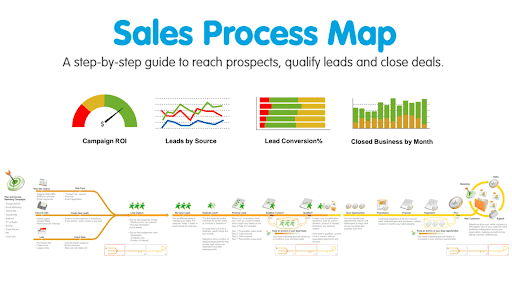
#1 Linear sales process flowchart
This is the most common and straightforward type of sales process mapping. Each sales stage is represented as a step in a horizontal or vertical sequence, typically moving from lead generation through closed-won or closed-lost.
#2 Swimlane diagram
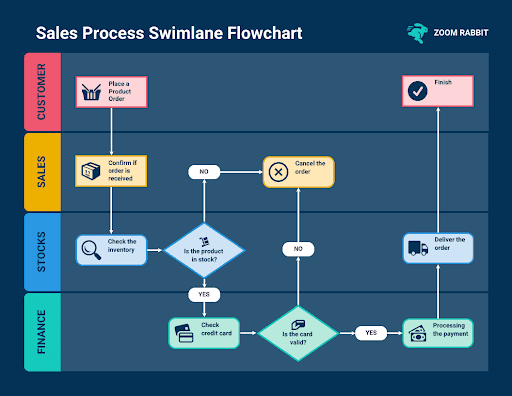
The swimlane format takes the basic flowchart a step further by organizing actions and responsibilities by role or team – such as sales, marketing, or customer success. Each “swimlane” shows who owns what at every stage.
This format can be great for organizations where multiple teams are involved in the sales process. It drives cross-functional alignment and ensures clarity around handoffs.
#3 Infographic style
Some companies choose to represent their sales process in a highly visual, infographic-style format. If you choose this style, just make sure form doesn’t outweigh function. Clarity should also be the priority.
How sales enablement helps with sales process mapping
A sales process map is foundational to sales enablement. But the relationship goes both ways.
Sales enablement doesn’t just use the sales process map. It also plays a critical role in shaping, maintaining, and operationalizing it.
Sales enablement helps with sales process mapping
Sales enablement teams have deep insight into what’s really happening in the field. They know how reps are selling, where they’re getting stuck, and what support they need at every stage.
This makes sales enablement a natural partner in sales process mapping. They bring rich insights to help define what’s really happening in the field – not just what you think is.
Sales enablement brings the sales process map to life
Once you’ve finished mapping your sales process, it’s sales enablement’s role to make it real. This involves building training programs around each stage, creating enablement content aligned to the buyer journey, and building and reinforcing skills and behaviors that support the process. Your sales process map becomes a core part of how sellers are onboarded, coached, and supported.
Sales enablement helps the map evolve
A sales process map shouldn’t be static. Instead, it must evolve over time. Sales enablement plays an important role in this ongoing evolution.
As products, markets, and buyer behaviors shift, enablement teams bring ongoing feedback and performance data that keeps your sales process – and your broader go-to-market strategy – agile and responsive. They connect what’s happening in the field to what’s on the sales process map.
Clearly, sales process mapping and sales enablement are deeply interdependent. A sales process map provides the structure, while sales enablement drives adoption, execution, and continuous improvement.
Build your sales process map – and bring it to life with Mindtickle
We get it: revenue leaders are juggling a lot. Finding time for sales process mapping isn’t easy.
But it’s well worth the effort.
Sales process mapping isn’t just a documentation exercise. It’s a strategic move that brings clarity to chaos and empowers your teams to move faster, collaborate more effectively, and sell more predictably.
Ready to see how Mindtickle can help you bring your sales process to life? Schedule a live demo to see how our AI revenue enablement platform helps you build, reinforce, and optimize every stage of your sales process.
See how Mindtickle stacks up against the competition:

Subscribe to the blog
Get the latest sales enablement tips, guides, and industry best practices delivered to your inbox. Unsubscribe anytime.
Related Articles

Best Unified Revenue Enablement Platforms for Enterprise Teams in 2026

5 Top Sales Methodologies & Types of Selling: The Complete Guide for 2026