




The Trinity of Modern Selling: AI Coaching, Copilots, and Conversation Intelligence


The Evolution of B2B Selling: Why "Rescue AI" Isn't Enough
The life of a B2B sales rep is harder than ever. Buyers spend less time with sellers, sales cycles keep getting longer, and buying committees continue to grow. And sellers are feeling the pressure. Recent research found that nearly three-quarters feel overwhelmed by the number of skills required for their roles, and half are overwhelmed by all the technology they’re expected to use.
It’s not surprising that many revenue organizations have turned to artificial intelligence for help. After all, reps who partner with AI effectively are 3.7 times more likely to meet quota. But at this point, it’s not a question of whether to use AI in enablement. It’s how to use it in a way that delivers a measurable impact on sales performance.
Many teams use AI to solve a single problem, reacting to gaps rather than building capacity and confidence over time. This approach might help get a rep through a tough call. But on its own, it doesn’t change performance in a meaningful, repeatable way.
AI must do more than intervene in the eleventh hour. It must:
- Prepare sellers before the conversation begins.
- Support them in the moment.
- Connect those efforts to real-world outcomes.
In this post, we’ll explore how AI coaching, copilots, and conversation intelligence are each essential, and why integrating all three is key to building a high-performing sales team.
Rescue Tactics Aren’t a Sales Readiness Strategy
Sales managers play an important role in ensuring readiness across the team. But they’re often stretched thin. Seven in ten say their team size has increased in the past year. So while coaching is widely recognized as the most important part of the role, many don’t have the time to do it well or consistently.
It makes sense that so many organizations have turned to AI to help deliver personalized training and coaching at scale without overburdening sales managers. But the way AI is used matters.
Often, AI is used reactively. This can take the form of in-call nudges or real-time prompts during live sales calls. For example, if a seller is struggling with an objection on a live call, AI can step in with suggested responses or other guidance.
These reactive interventions can help a seller get through a tough moment. But at the end of the day, they’re rescue tactics.
"Rescue can play a role, but it's not a replacement for skill development. When AI is used primarily to correct behaviors in the moment, sellers don’t develop the skills and confidence needed to navigate complex, dynamic conversations on their own."
This is especially true in enterprise sales. Enterprise account executives must navigate high-stakes, multi-threaded conversations every day. Real-time prompts can increase cognitive load or create dependency, rather than skill mastery. When the stakes are high, enterprise AEs can’t afford to learn on sales calls. They need to come to the table prepared.
To see real impact, revenue organizations must move beyond rescue. Top performing teams use AI to help sellers build skills and confidence before they pick up the phone, not just to step in when things go wrong.
3 Capabilities That Drive Modern Sales Performance
Outstanding sales performance is the result of preparation, execution, and reinforcement working together. This involves three essential components.
#1 AI Sales Coaching: Building skills and confidence before the call
Sales coaching, when it’s done well, can have a measurable impact on sales success. Research shows that high-performing sellers get more than 7x more coaching than average. That’s no coincidence.
- The Problem: Traditional coaching doesn’t scale. Feedback is often inconsistent, subjective, and late.
- The AI Solution: AI sales role plays allow sellers to practice in a low-risk environment.
- The Result: It takes a human manager about 17 minutes to review a recorded role play, compared to just 60 seconds for AI. This ensures every rep receives consistent, timely feedback.
#2 AI Copilots: Confident execution in the moment
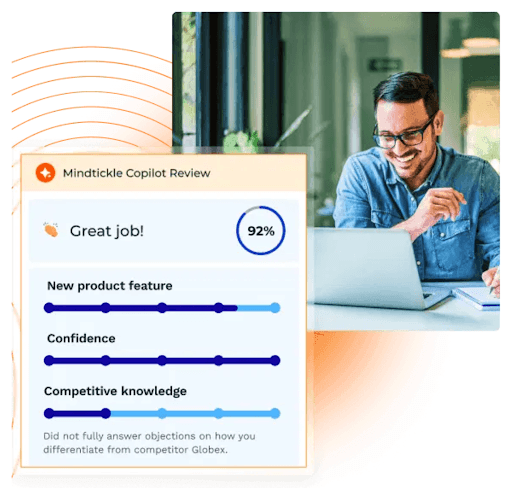
Ongoing sales coaching and training lay the foundation for sales readiness. But sellers also need support with execution. Copilots act as an “always on” AI teammate right within the sales workflow.
- Cutting through the noise: Reps who use AI search are 50% more likely to reuse the function to locate the training and content they need.
- Managing meetings: Copilots can reference past conversations to identify follow-up items, suggest next steps, and even draft emails.
- Performance Insights: They automatically highlight trends, strengths, and weaknesses across deals, removing the bottleneck of manual call reviews for managers.
Copilots don’t replace preparation; they complement it by providing execution support and actionable coaching insight.
#3 Conversation Intelligence: Understanding what’s actually happening in the field
B2B deals are getting more complex and buying committees are growing. According to Gartner, buying teams for enterprise technology range from 11 to 15 people, each with different priorities and perspectives.
Conversation intelligence provides visibility into every customer interaction so sales and enablement leaders can actually see what’s happening in the field.
How Conversation Intelligence Drives Strategy:
- Analyzing at Scale: It identifies patterns to show what’s working, where deals are stalling, and where sellers struggle to apply their training.
- Data over "Gut Feelings": Leaders gain a view of performance founded in data rather than anecdotes.
- The Reality Check: While leaders can see how reps engage with training or AI role plays, conversation intelligence shows whether that readiness is actually translating into execution.
Must Read: 7 Reasons Why Your Sales Teams Need Call Recording to Hit Revenue Targets
Integration is the Difference Between Activity and Impact
Modern sales performance isn’t driven by rescue efforts. Instead, it’s built through preparation, execution, and reinforcement working together.
AI coaching, copilots, and conversation intelligence each have an important role to play, but the real power comes from integrating these three key components.
The Problem with Point Solutions
Today, the market is flooded with tools that address only a single piece of the trinity. Organizations that take a piecemeal approach often struggle to see results because:
- Tool Fatigue: Sellers and managers are overwhelmed by toggling between tools, which creates friction and distracts from buyer engagement.
- Siloed Data: It is nearly impossible to connect activity to outcomes. A seller might score well on a role play but still struggle in the field, and without an integrated system, you can't see why.
The Power of a Continuous Loop
An integrated revenue enablement platform creates a continuous loop of improvement:
- AI Coaching builds the initial skills and confidence.
- Copilots provide real-time guidance and access to information.
- Conversation Intelligence validates the application of skills in the real world.
In an integrated platform, insights from customer conversations can automatically trigger targeted coaching. For example, if a rep struggles with pricing objections on a live call, the system can assign a specific role play to build that exact skill.
Must Read: Platform vs. Point Solution: Choosing the Right AI Role Play Tool for Your Team
It’s Time to Move from Activity to Impact
AI can help today’s B2B sales reps overcome their most pressing challenges, but rescue efforts aren’t a replacement for preparation.
Winning teams know that preparation, execution, and reinforcement must work together to impact business outcomes. Take RadNet, a medical device company that moved from fragmented tools to Mindtickle’s unified platform. By adopting an integrated approach, they:
- Cut onboarding time by 50%.
- Saw a marked increase in sales.
"We’ve seen an increase in PET scan sales after implementing role-plays and targeted training through Mindtickle. That’s a direct reflection of how practicing those conversations in a structured way leads to better outcomes in the field." — Brian E. Villacis, Associate Vice President at RadNet
By combining AI coaching, copilots, and conversation intelligence into a single system, revenue teams are moving beyond "busy work" and driving measurable performance.
Want to see how Mindtickle’s integrated revenue enablement platform can drive similar results for your business? Book a live demo today to see what Mindtickle can do for you.