




How to Use AI Role Play for Sales Recruiting



Most sales interviews are a performance review for storytelling. A candidate walks through how they'd handle a tough buyer, cites a deal they closed, and the panel nods along. None of that tells you what happens when an actual prospect interrupts them mid-pitch to push back on price.
That gap between describing a sales conversation and surviving one is exactly what trips up a lot of "great interview, rough first quarter" hires. It's also a gap that's hard to close in a 45-minute panel round, no matter how good the questions are.
AI role play gives hiring teams a way to test the actual skill instead of the story about it. Drop a candidate into a simulated buyer conversation, let them get pushed, interrupted, and challenged the way a real prospect would, and you're watching something closer to performance than to interview prep. Used in recruiting, that shifts the evaluation from "can they talk about selling" to "can they sell."
Key Takeaways
- Interviews test whether a candidate can describe selling. AI role play tests whether they can do it, since the AI buyer reacts in real time and won't follow a script either side prepared in advance.
- Not every skill deserves the same scrutiny. Cold calling is largely scripted and easy to baseline; discovery, objection handling, and negotiation are where the gap between a good talker and a good rep shows up.
- Used for hiring instead of coaching, the same tool falls under different rules. If a score meaningfully influences who gets hired, laws like NYC's Local Law 144 may apply, and the obligation to check sits with the employer, not the vendor.
What is AI role play for sales recruiting?
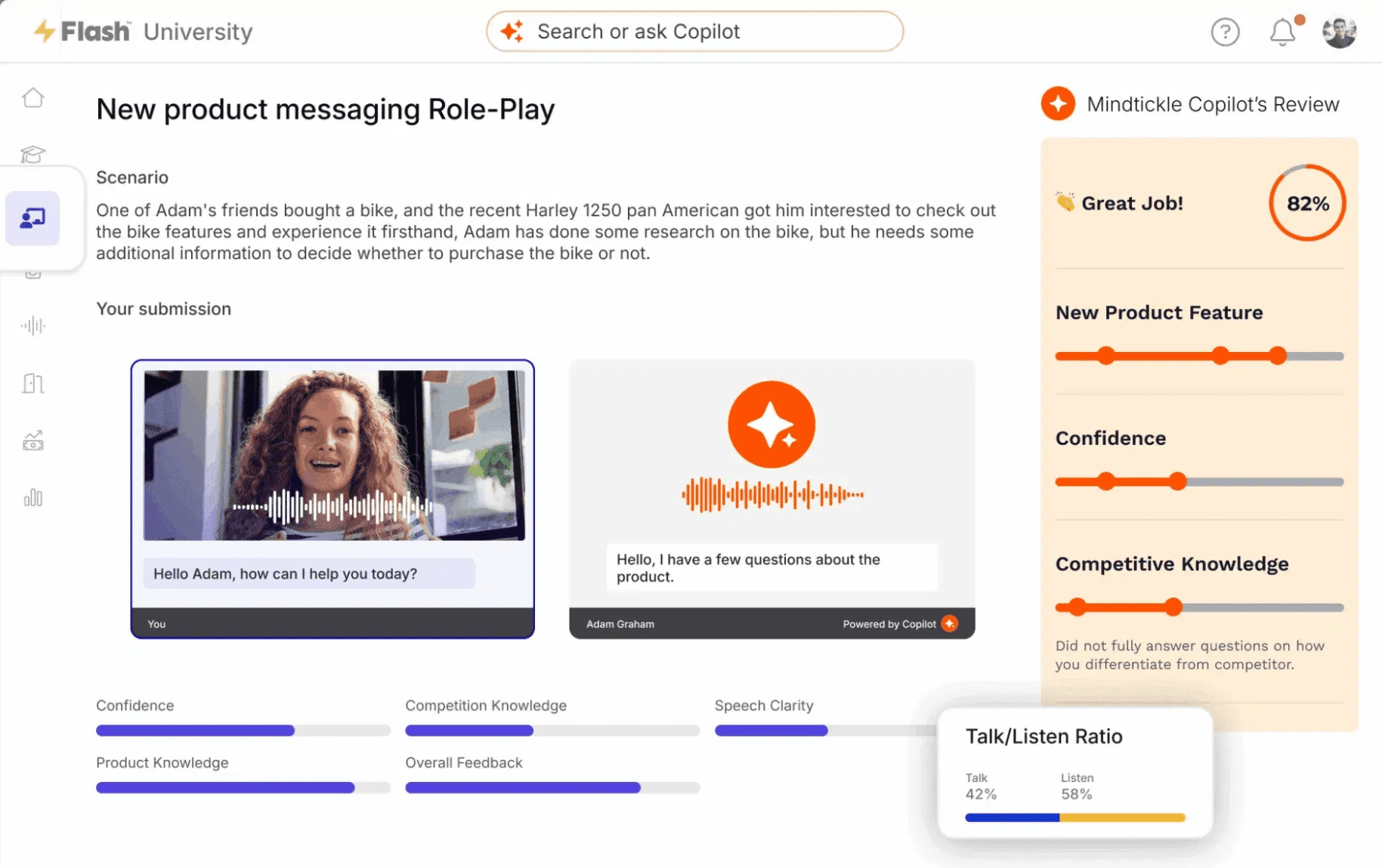
AI role play for sales recruiting uses conversational AI to run a buyer interaction, then scores how a candidate performs. The AI plays the buyer and reacts to whatever the candidate actually says — pushing back on price, raising an objection, or going quiet at the wrong moment.
That unpredictability does more than make the exercise feel real. A candidate can't fall back on a memorized script or a chatbot response typed into a separate window, because the AI buyer won't follow either. The only way through the conversation is to actually have the skill that's being tested.
The AI scores the conversation against criteria like:
- Talk-to-listen ratio, which shows whether a candidate actually listens or just waits for their turn to talk
- How a candidate responds to pushback they didn't see coming, rather than an objection they prepared for in advance
- Adherence to a structured methodology, such as MEDDPICC, which shows whether a candidate can guide a conversation toward a clear next step instead of just reacting to it
💡 Do you know?
Behaviors like talk ratio, how many questions a rep asks, and how long they monologue all predict deal outcomes. These are exactly the kind of signals an AI role play can observe and score, which a 45-minute interview can't.
Source: Mindtickle's 2026 State of Agentic Revenue Enablement Report
Why does traditional sales assessment fail?
Most sales interviews test the wrong skill. Sales managers have long leaned on unstructured, conversational interviews to evaluate candidates. That approach made sense when the job mostly required confidence and a good story.
It doesn't hold up against today's modern B2B sales funnel. A discovery call with a skeptical buyer requires specific, observable skills, like structured questioning and knowing when to stop talking and let the buyer fill the silence. An interview can only confirm that someone knows the theory.
That gap is where bias creeps in. A charismatic candidate can tell a polished story about closing a hard deal and never get pushed on whether the story holds up under pressure. Two managers interviewing the same person often reach different conclusions. One is swayed by the candidate's confidence, another by how well they name-drop the right methodology.
Manual mock pitches were supposed to fix this, but they inherit the same problem — one manager grades on energy, another on structure, and neither produces a score you can compare across candidates.
💡 What recruiters are seeing
61% of talent acquisition professionals believe AI can improve how they measure hiring quality, according to LinkedIn's 2025 Future of Recruiting report.
The number doesn't prove that AI role play works. It shows the industry already suspects traditional methods fall short and is looking for something more structured to replace them.
How it works: where AI role play fits in your hiring funnel
AI role play works as a filter, slotted in after an initial screening call and before the final round. The candidate has the conversation on their own time, with the AI playing the buyer, as many times as the process allows.
By the time a hiring manager sits down for the last interview, they're not evaluating communication skills from a blank slate. They're walking in with a recording and a breakdown of how the candidate handled specific moments of pressure — where they listened, where they pushed back, where they froze.
That's also where the human stays firmly in the loop. The recording and the breakdown inform the decision; they don't make it. The manager still listens, still reads context the AI can't pick up on, and still makes the final call.
😊 Good to know
Setting up a role play for your hiring funnel doesn't take a content team. With Mindtickle's AI Sales Role Play, you can build a scenario from a prompt or a ready-made template, and customize the persona to match the role you're hiring for.
Feed in company playbooks, battle cards, and product documentation, and the candidate gets tested against the actual objections your reps hear and the buyer personas they're up against.
Core use cases: What skills should you evaluate?
Not every skill deserves equal weight in a hiring process. Some selling skills are easy to learn on the job. Others are what separate a rep who ramps from one who stalls, and those are the ones worth testing before the offer goes out.
Cold calling for SDRs and BDRs
Cold calling still belongs in the process, but it doesn't need to carry much weight. It's the most scripted part of the sales motion, the one most candidates have already rehearsed cold, so a quick baseline check is enough. Save the harder testing for the conversations that don't follow a script.
The role play scenario itself can still be specific. A good one scores how quickly a candidate gets past the gatekeeper and secures a next step, and whether they're actually listening to the prospect's responses or just working through a pitch in their head. A candidate who talks over the buyer to get back to their script will show it in the talk-to-listen ratio, the same metric a manager would otherwise have to catch by listening to the whole call live.
AE discovery and objection handling
This is where the filter carries the most weight. There's no faking your way through pressure that doesn't follow a script.
A strong scenario puts the candidate in front of a buyer who won't volunteer their pain point. The test is whether the candidate asks a second and third follow-up question, or jumps straight to the pitch.
The harder version brings in a skeptical technical stakeholder who pushes back on something specific: a security concern, an integration limitation, a claim the candidate can't fully back up. That pressure is hard to fake in an interview, because nothing rehearsed in advance covers it. Following a structured approach to the conversation while someone is actively pushing back is a different skill than describing that approach in the abstract.
The same scenario can fold in a competitive angle without needing its own use case. If the buyer brings up a rival's pitch mid-conversation, the candidate has to defend value on the spot instead of leaning on a line they rehearsed beforehand. It's the same skill as objection handling, just with a different trigger.
Also Read: 12 of the Most Common Sales Objections (and How to Overcome Them)
Negotiation and closing
Discovery tests whether a candidate can uncover a problem. Negotiation tests whether they can hold their ground once the deal is real and the buyer is pushing on price or terms.
A useful scenario puts the candidate in front of a buyer asking for a discount they can't actually justify giving, or trying to add scope without adding budget. The test isn't whether the candidate says no. It's whether they can defend value calmly, propose a tradeoff, and still move the deal toward a close instead of stalling it. This is a late-cycle skill, and it's worth knowing whether a candidate has it before they're running full-cycle deals on their own.
Multi-threading and stakeholder management
Most discovery scenarios test a 1:1 conversation. Real deals rarely stay that simple.
A scenario built around two personas, a champion who's bought in and a skeptical economic buyer who hasn't, tests whether a candidate can hold a consistent value story across both. It's one thing to win over an enthusiastic contact. It's another to walk into the room and adjust the pitch for someone who needs a different kind of proof. Candidates who only know how to sell to one type of stakeholder tend to expose that gap here, well before it shows up on a real deal.
Read more: Top Sales Skills Every Rep Needs to Succeed
Does performance in an AI role play actually predict on-the-job success?
A role play approximates real performance. Nobody can watch a 10-minute simulated call and know for certain how someone will perform across a full pipeline a year from now. What it can do is replace a guess with a closer one.
An unstructured interview asks a candidate to describe how they'd handle a hard objection. They get to choose the example, polish the language, and skip the part where they'd actually stumble. An AI role play skips straight to the stumble. The buyer doesn't wait for a good answer, and the candidate doesn't get to pick which objection comes next.
That's a harder, more honest test, and it's the only one of the two that shows how someone behaves under pressure rather than how they talk about it.
How to implement objective sales skill validation
The same AI role play technology that helps coach employees under unscripted, measurable conditions can also be leveraged in the hiring process. If your team already uses AI role play for training, applying it to candidate evaluation simply requires developing new scenarios — no new technology is needed. If you are not yet using these tools, the calibration guidance below will be relevant once adopted.
1. Start with one role
Pick the position where the skill gap costs you the most. If AE discovery is a strong candidate, run it there before expanding anywhere else. That gives you a real answer to whether hiring managers actually trust the recordings and scores enough to act on them, instead of guessing based on a handful of candidates spread across five different open roles.
2. Calibrate the bar before you score a single candidate
Run a couple of current team members through the same scenario first, ideally a strong performer and someone newer. That gives you a real sense of what a good score looks like for your team, rather than picking a cutoff out of thin air and hoping it means something.
3. Decide how much weight the score carries
Make this call before the first candidate takes the role play. That might mean treating a strong score as a tiebreaker between two close candidates, or as a hard cutoff that ends the process regardless of how the rest of the interview went. Deciding it afterward means the score just confirms whatever you'd already decided about the person, which defeats the point of running it at all.
Is AI role play compliant with hiring regulations?
Using AI role play tools to coach a rep and using them to screen a job candidate aren't the same thing, even if it's the same tool. The moment a score starts influencing who gets hired, it falls into a different regulatory category, one that practice for existing employees doesn't touch.
New York City's Local Law 144 is the clearest example. If a tool's score substantially assists or replaces a hiring decision, the law requires an independent bias audit and advance notice to candidates, and the trigger is based on where the candidate lives, not where the company or the role is based, so a remote hire can still bring a fully remote employer into scope. Other states are moving in a similar direction, so it's worth checking what applies wherever your candidates actually live, not just where your offices are.
None of this is a reason to avoid using role play in hiring. It's a reason to treat the score as one input a human reviews, not the decision itself, and to check what your evaluation tool requires before you lean on its results.
📌 This isn't legal advice. Confirm current requirements with counsel before using any automated tool in a way that affects hiring decisions.
Vet your next rep like a buyer would
Every quarter brings a new batch of candidates and a new batch of reps already in the field. Most teams treat those as two separate problems with two separate tools: gut-feel interviews on one side, AI-scored practice on the other. There's no real reason to keep them apart.
Once a hiring manager has seen a real score instead of a polished answer, going back to judging candidates on vibes alone stops feeling acceptable. What works for coaching a rep works just as well for testing a candidate, one step earlier in the process.
The question worth sitting with isn't whether this approach works. It's which conversation in your hiring process is still running on guesswork that a 15-minute role play could replace with a number.
Frequently Asked Questions
About the Author
Senior Product Marketing Manager
Poornima Mohandas is a business journalist turned product marketer with over two decades of professional experience. At Mindtickle, she handles go-to-market for the market leading, Training, Coaching, AI Role Play products, and runs the company’s competitive intel program. Her writings have been published in reputed trade publications like Mind the Product and the Product Marketing Alliance.
Subscribe to the blog
Get the latest sales enablement tips, guides, and industry best practices delivered to your inbox. Unsubscribe anytime.