




AI Sales Role Play: What Makes It Realistic Enough to Change Rep Behavior



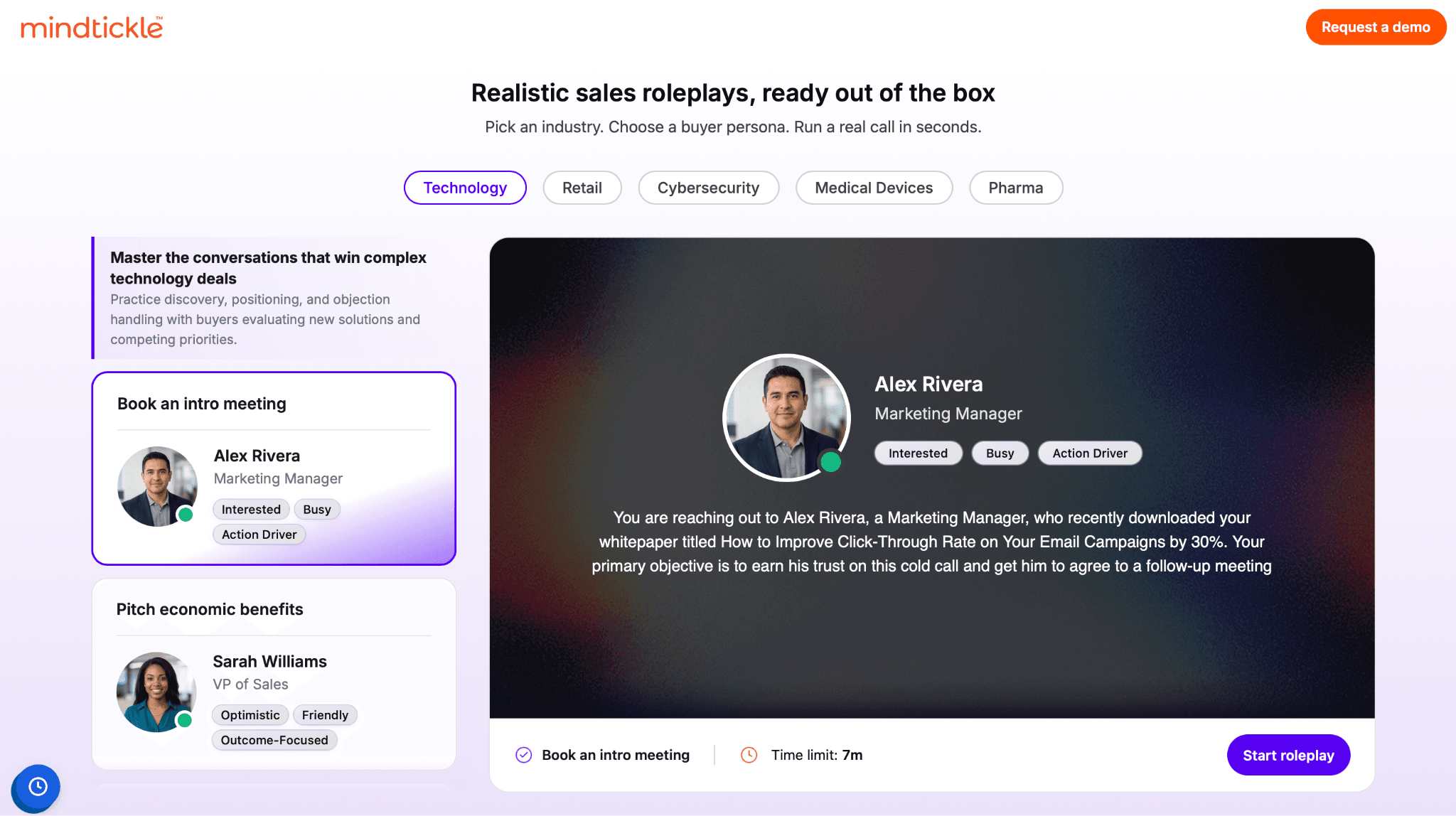
AI sales role play gets realistic when the AI buyer responds to what your rep says the way a live prospect would, so practice puts pressure on the same skills a real call does. That single quality decides how much the practice is worth to you. An AI buyer that reads a rep's answer and pushes on it builds the instincts a rep reaches for when a CFO questions the price or a champion goes quiet mid-deal. An AI buyer that repeats the same lines whatever the rep says teaches little, and reps stop taking it seriously within a few sessions.
So for a revenue leader, the useful question has moved past whether a tool offers AI role play, since nearly all of them do now. Most reps already know what a strong discovery call or a clean objection response should sound like. The harder part is doing it live, under pressure, when a real buyer pushes back. Practice closes that distance between knowing and doing only when it feels real enough to build habits that hold up on the call.
This piece walks through what makes AI role play realistic enough to do that: the elements that make an AI buyer feel real, whether that realism carries onto live calls, and how to size it up before you buy.
Key Takeaways
- Realism in AI sales role play comes from four things working at once: a buyer that responds to what the rep says, a believable persona, timing that keeps pace with a live call, and scenarios built from your own deals. Any one alone falls short of a real conversation.
- The responsive buyer carries the most weight. A buyer that adjusts to each answer builds real instincts, while a fixed-script buyer reads as a test that reps learn to game within a few sessions.
- Realism only proves out when practice connects to live-call behavior. A role play tied to your conversation intelligence can show whether a skill transferred from practice to the field, which is how you close the gap between what a rep knows and what they do.
- Match the tool to your motion. A single, high-volume motion can run well on a focused tool, and a complex, multi-persona motion where you need to tie practice to revenue points toward a connected platform.
What is AI sales role play?
AI sales role play is a sales enablement tool that puts a rep in a simulated sales conversation with an AI buyer, so they can rehearse pitches, work through objections, and get feedback the moment the call ends. The simulation runs unscripted. The AI plays the buyer, keeps track of what the rep has said, builds on it, and decides its next move based on where the conversation is heading.
How to tell if an AI role play is hyper-realistic: Practical tips
You can tell whether an AI role play is hyper-realistic by testing it the way a real conversation would test it: push the buyer off-script, switch the persona, check the timing, build a scenario from your own deals, and ask how practice connects to live calls. Realism shows up fast when you probe for it in a demo or a trial.
This table summarizes five practical tests to evaluate an AI role play tool's realism, with detailed explanations of each below.
| Action to take | Realistic tool response | Shallow tool response |
|---|---|---|
| Push the buyer off-script | Notices and reacts | Moves to its next scripted line |
| Switch the persona | Runs feel like two different people | Conversation plays out the same way |
| Check the latency | Keeps up | Noticeable lag between your words and the reply |
| Ask whether you can build a scenario from your own deals | Lets you load your terminology | Pre-built, generic scenarios drift |
| Ask how practice connects to real-call performance | Ties practice data to what happens in the field | Stands on its own with no line of sight |
Push the buyer off-script
Give a deliberately weak or evasive answer and watch what happens next. A realistic buyer notices and reacts, pressing on the soft spot or circling back to the question you dodged. A shallow one moves to its next scripted line as if nothing happened. This test tells you the most, since a responsive buyer sits at the core of realistic practice.
Switch the persona and watch the behavior change
Run the same scenario twice, once as a guarded, time-pressed economic buyer and once as a friendly champion who still needs convincing. The two runs should feel like two different people, with different questions, tone, and priorities. If the persona label changes and the conversation plays out the same way anyway, the realism is skin-deep.
Check the latency in a live exchange
Talk at a natural pace, interrupt, pause mid-sentence, and see whether the buyer keeps up. Noticeable lag between your words and the reply breaks the sense of a real call quickly, and it slips past easily in a scripted walkthrough. A short hands-on run surfaces it right away.
Ask whether you can build a scenario from your own deals
A realistic simulation should let you load your terminology, competitor names, buyer personas, deal stages, and industry, so a rep practices the objections your real buyers raise. Pre-built, generic scenarios drift from how your team sells, and reps feel that gap the moment they start. Read: How to Master Objection Handling With AI Sales Role Play
Ask how practice connects to real-call performance
This is the test most buyers skip. A realistic simulation earns more when its results show up on live calls, so ask whether the tool ties practice data to what happens in the field, or whether it stands on its own with no line of sight into real conversations. A role play connected to your conversation intelligence can show whether the skill transferred. One that stands alone can only tell you how the rep did in the simulation.
Run these five tests during a trial, and you can see the realism for yourself before you commit. The tool that holds up under all five will still feel real to your reps on their tenth session, and to their buyers on the next live call.
Does realistic practice carry over to live calls?
Realistic practice carries over to live calls only when you can see it happen, which means connecting what a rep does in role play to what they do in front of a real buyer. A simulation that feels real is the starting point. The proof is whether the skill shows up when the deal is on the line.
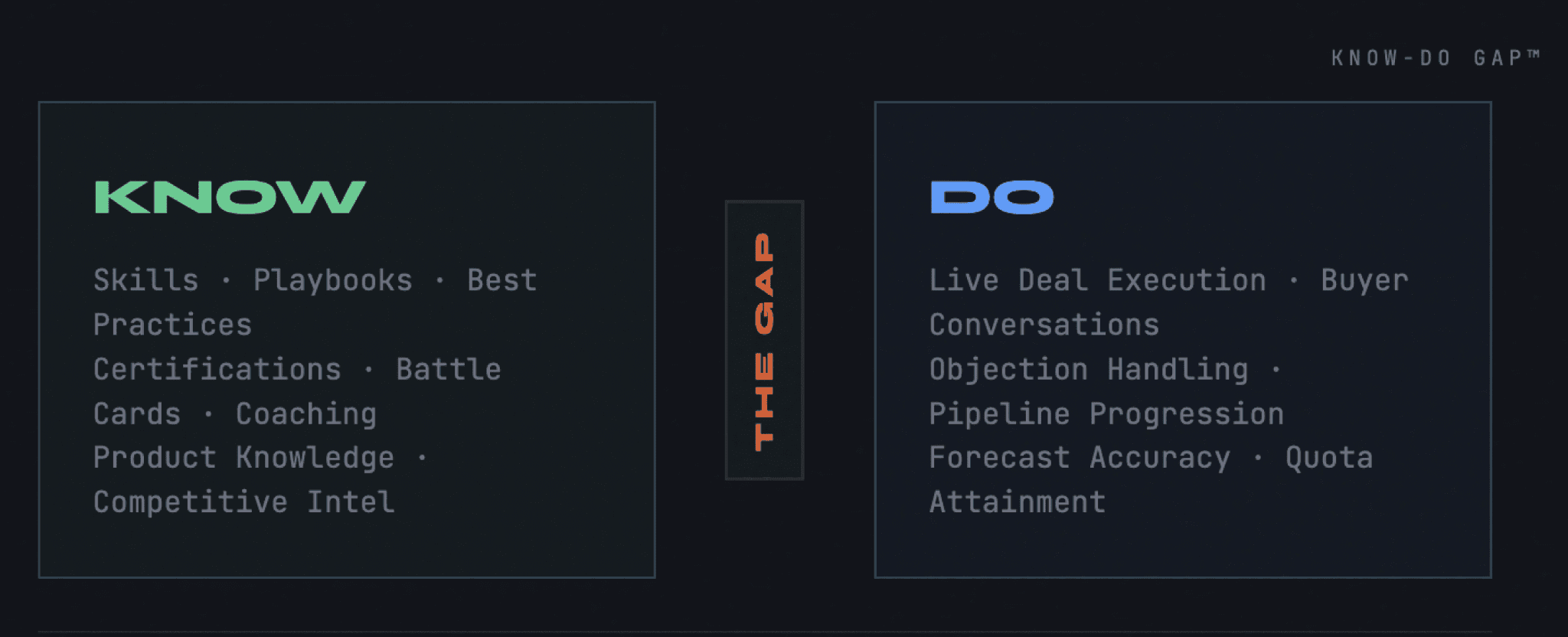
Here's the gap to watch for. A rep can score well in a lifelike role play and still stumble on a real call. A high practice score on its own tells you the rep put in the reps and hit the rubric. It says little about whether the new habit holds up under real pressure, with a real buyer, on a deal that matters. This is the pattern behind what Mindtickle calls the Know-Do Gap™, the space between what a rep has learned and what they carry out once a live buyer is in front of them. Realistic practice is one of the levers that narrows it, since a simulation that mirrors a real call builds habits sturdy enough to survive one.
Closing that gap takes a line of sight into real calls. When your role play sits in the same platform as your conversation intelligence, you can hold practice behavior up against live-call behavior and see whether the two match. A role play that only sees the simulation can flag that a rep struggled, and it leaves you guessing whether the cause is a product-knowledge gap, a coaching gap, or a habit showing up across their calls. A rep who handles a pricing objection cleanly in practice and then folds on the same objection in the field is telling you the skill hasn't transferred yet, and you can catch that early enough to do something about it.
That connection also turns practice into a loop. You analyze real calls to find where reps struggle, say a competitor keeps winning or reps keep talking past the value story. You assign targeted role plays built around that exact gap. Then you check the next set of live calls to see whether the fix landed. Mindtickle runs this as an identify-and-fix loop, where conversation intelligence surfaces the gap from real calls and role play delivers the targeted practice to close it.

💡For you as a revenue leader, this is what ties practice to outcomes you report on. When skill gains in practice line up with movement in live deals, you can connect role play to the numbers that matter, like ramp time, win rates, and quota attainment. Left unconnected, a role play stays a training metric that no one downstream trusts. A realistic simulation earns its budget when its results show up on the call recording.
What the data says about realistic practice
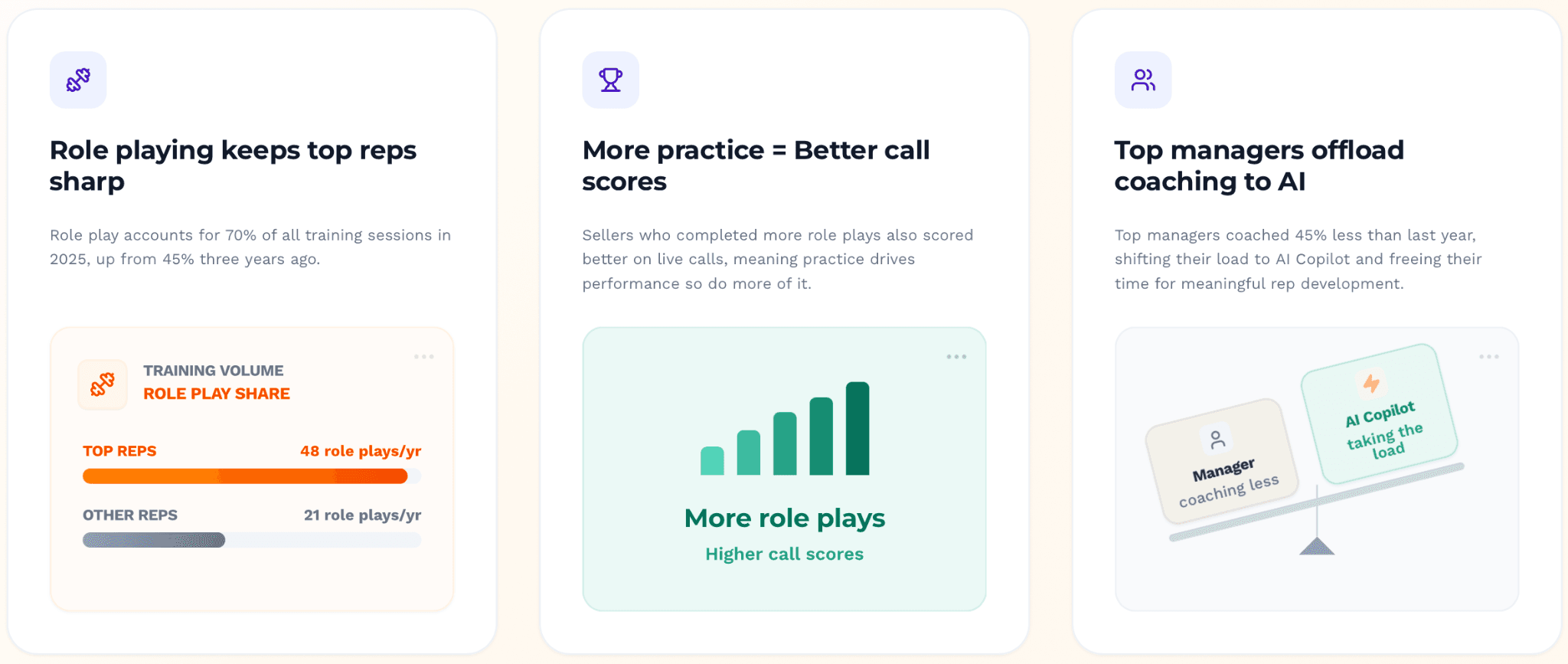
The link between realistic practice and live-call performance shows up in the data, too. Mindtickle's 2026 State of Agentic Revenue Enablement Report, built on real product-usage data across more than 400 companies and over a million recorded calls, found that reps who ran more role plays went on to score higher on their live calls. Practice had also become the core of how teams train, with role play reaching 70% of all training sessions in 2025.
If you want the full benchmark behind that pattern, including how top-performing teams use practice to close the gap between what reps know and what they do on live deals, you can download the 2026 State of Agentic Revenue Enablement Report.
Do you need a standalone role play tool or a unified platform?
Whether a standalone role play tool is enough or you need a unified platform depends on how complex your sales motion is and whether you need proof that practice carries onto live calls. Both can deliver realistic practice. They differ in what they can show you once the practice ends.
A role-play-only tool has real advantages. It is often quicker to stand up, it can cost less, and a tool built for a single motion can go deep on it. If your main goal is high-volume cold-call practice for an SDR team, a specialized tool may cover what you need without the weight of a broader platform.
However, the limit shows up after the session. A standalone tool sees the simulation and stops there. It can tell you how a rep performed in practice, and it has no line of sight into whether that skill held up on a real call. As the transfer question earlier in this piece covered, realism only proves out when practice connects to live-call behavior, so closing the gap between what a rep knows and what they do takes a tool that can see both sides.
That is where a unified platform earns its place. When role play, conversation intelligence, coaching, and training sit in one system, you can trace a skill from practice into the field and run the loop that turns a gap on real calls into targeted practice. For complex enterprise selling, with multiple personas, longer cycles, and pressure to tie coaching to revenue, that connection tends to be worth more than the depth of any single-motion tool.
You can book a Mindtickle AI Sales Role Play demo today and our experts can help you make an informed decision.
FAQs
About the Author
Senior Product Marketing Manager
Poornima Mohandas is a business journalist turned product marketer with over two decades of professional experience. At Mindtickle, she handles go-to-market for the market leading, Training, Coaching, AI Role Play products, and runs the company’s competitive intel program. Her writings have been published in reputed trade publications like Mind the Product and the Product Marketing Alliance.
Subscribe to the blog
Get the latest sales enablement tips, guides, and industry best practices delivered to your inbox. Unsubscribe anytime.