




How to Master Objection Handling With AI Sales Role Play



A rep can spend weeks building a deal, getting the champion onside, navigating procurement, building internal consensus, only to lose it in seconds when a pricing objection lands and the response doesn't hold up.
It's not a knowledge problem. The rep had seen the playbook. They'd sat through the training. But knowing the right response and delivering it under pressure are two completely different things, and that gap is where deals die.
Most sales organizations aren't closing it. Training budgets go toward content: workshops, slide decks, certification modules. Reps learn what to say. What they don't get is enough deliberate practice to make the right response feel automatic when the pressure is real and the stakes are high.
That's what AI sales role play for objection handling is built for, giving reps a realistic, repeatable environment to practice difficult conversations until the right responses become reflexes, not recollections.
Key Takeaway
- AI sales role play for objection handling closes the gap between knowing the right response and delivering it under real pressure. Most training builds knowledge. Repeated, realistic practice builds the reflexes.
- The objections most likely to stall a deal, including pricing, competitive pushback, ROI doubt, and timing resistance, require different handling at different deal stages. Practicing them in context is what makes preparation transfer to live calls.
- Effective AI role play scenarios are built from real data, including conversation intelligence and CRM context, not generic templates. The closer the scenario mirrors what a rep will actually face, the more the practice sticks.
- The right measure of effectiveness is not completion rates or practice scores. It is whether improvements in simulation are showing up in real call performance, win rates on contested deals, and new hire ramp time.
Why does objection handling keep breaking down despite training?
Most sales organizations diagnose objection handling as a knowledge problem. So they build playbooks, run workshops, and brief reps before big calls. The assumption is straightforward: if reps know the right response, they'll deliver it when it counts.
That assumption is where the breakdown starts.
A rep who walks out of an SKO feeling ready for any objection is a different rep on a live call two weeks later. The playbook is in their head, but so is the pressure of a real conversation with a skeptical CFO challenging the price in real time. Under those conditions, recalled knowledge isn't enough. What holds up is a practiced response, one that's been rehearsed enough times that it doesn't require thinking.
Most sales training programs never get there. The format stops at content delivery: slide decks, certifications, pre-call briefs. Reps learn what to say. They don't get the deliberate, repeated practice that turns the right response into something automatic.
Sales coaching could fill that gap, but it rarely does at the pace reps need it. Managers are spread thin, and meaningful one-on-one coaching time is hard to protect. When a rep does get feedback on how they handled an objection, it takes an average of 7 to 8 days to arrive, according to Mindtickle's 2026 State of Agentic Revenue Enablement Report. By then, the rep has already been on several more live calls carrying the same gap the feedback was meant to close.
That's the real problem. It's not that reps don't know what good objection handling looks like. It's that they don't get enough practice doing it before it matters.
Read more: 12 of the Most Common Sales Objections (and How to Overcome Them)
What AI sales role play does for objection handling
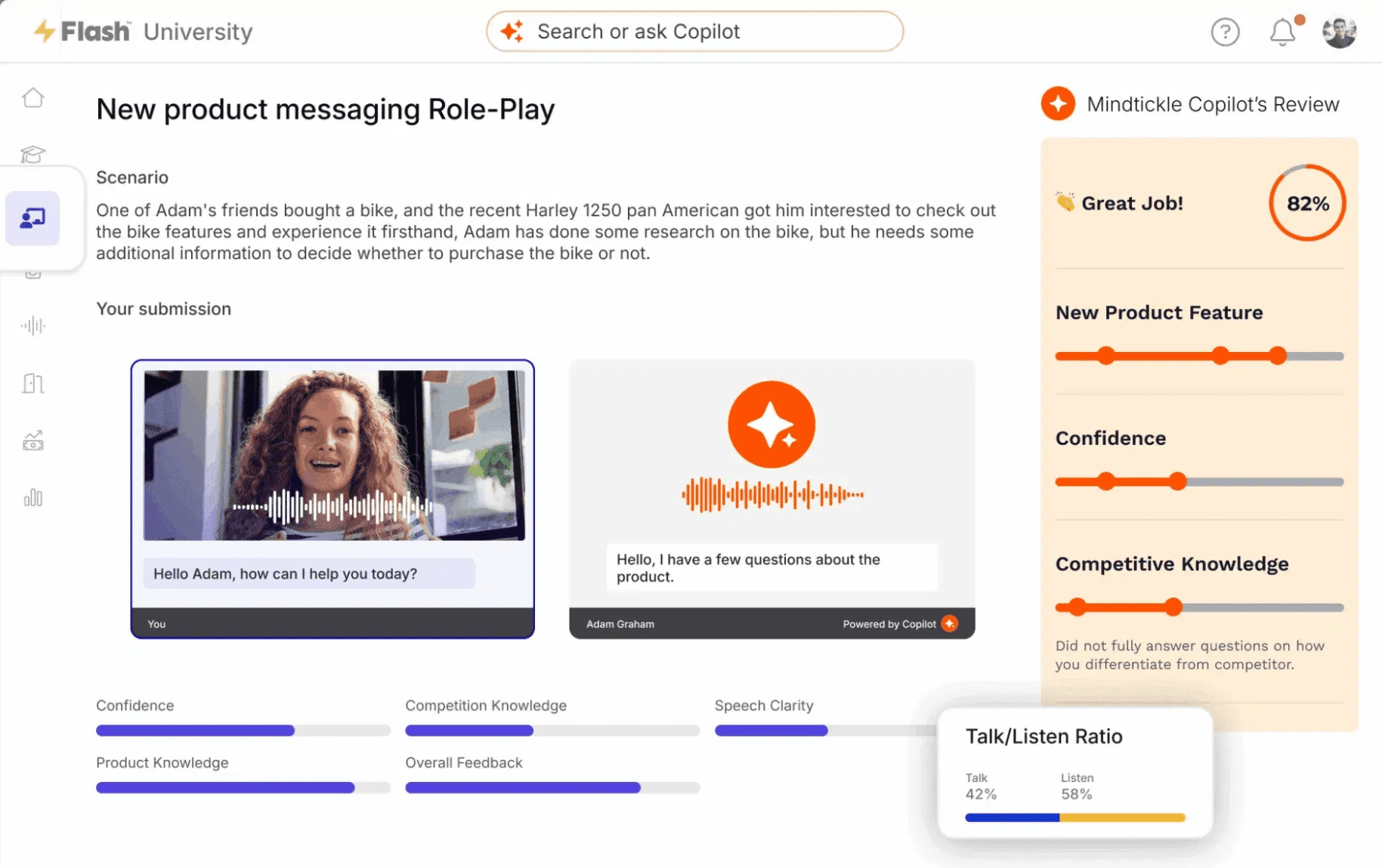
AI sales role play gives reps a safe place to practice the toughest conversations in sales repeatedly, independently, and with feedback that arrives in the moment rather than days later.
An AI role play simulator for sales replicates a real call. Your rep faces a dynamic AI buyer who pushes back with realistic objections and the rep has to respond in real time. The AI responds to what the rep says, pushes back, follows up, and keeps the pressure on until the rep finds a response that holds.
When the conversation ends, feedback arrives immediately. Not in a week. Right then. The rep gets a clear picture of how well they handled the objection, whether their messaging landed, how their tone and pacing came across, and where the response broke down. They can adjust, run the same scenario again, and keep going until the right response stops feeling like something they have to think about.
This is the repetition that traditional training never delivers. Reps can work through the same objection from multiple angles, against different buyer personas, at different deal stages, until handling it becomes a reflex rather than a recall exercise.
💡Managers can't be everywhere. AI role play can.
Reviewing role play submissions manually is time-consuming enough that most of it simply doesn't happen at scale. AI handles the scoring and feedback on every session, which means managers are no longer the bottleneck between practice and improvement. Their time goes toward the coaching conversations that genuinely require human judgment, rather than administrative review.
Do you know - AI sales role plays are now scalable to a point where the best managers are coaching 45% less, saving their time for high-impact interventions. For more such interesting findings, check out Mindtickle's 2026 State of Agentic Revenue Enablement Report 👇
ACCESS FULL REPORT
Some common objections and what realistic AI role play looks like for each
Here are the objection types that come up most in complex B2B sales, and what practicing them with AI actually looks like.
Pricing objections
This is the one that trips up even experienced reps. Not because they don't know the value story, but because a CFO pushing back hard on price in a live call creates a specific kind of pressure that reading a playbook never prepares you for.
In an AI role play scenario for pricing objections, the AI buyer doesn't just say "it's too expensive." It follows up. It asks how the number was arrived at. It compares your price to a competitor. It pushes on ROI. The rep has to navigate each layer of that challenge in real time, not deliver a pre-rehearsed line and move on. That's what makes the practice transfer to actual calls.
Competitor preference objections
"We're already talking to your competitor" or "we've used them for years" are conversations where reps often get defensive or over-pivot to feature comparisons. Neither works well.
Practicing this scenario with an AI buyer who expresses genuine loyalty to a competitor forces reps to ask better questions, uncover where the current relationship is falling short, and position the alternative without disparaging the competition. That nuance is hard to teach in a workshop. It has to be practiced.
ROI and value objections
"We're not sure we'll see the return" is one of the most common mid-funnel objections in enterprise sales, and one of the hardest to handle well. More than the numbers, it's about confidence, and the rep's ability to make the business case feel concrete rather than theoretical.
AI role play scenarios for value objections can be built around specific industries, deal sizes, and stakeholder personas, so a rep practicing for a healthcare deal isn't working through the same scenario as one selling into financial services. The more specific the scenario, the more the practice transfers.
Timing objections
"Not right now" or "let's revisit next quarter" feels like a soft no, but it's often a solvable problem if the rep knows how to explore what's actually behind it. Is it budget cycle timing? A competing internal priority? A stakeholder who isn't bought in yet?
Practicing timing objections through AI role play helps reps get comfortable asking the questions that surface the real issue, rather than accepting the objection at face value or pushing too hard and damaging the relationship.
Risk and change objections
In enterprise deals especially, "we've tried something like this before and it didn't stick" or "our team won't adopt a new tool" are objections rooted in fear, not logic. They require a different response than a pricing objection does.
Reps who practice these scenarios learn to acknowledge the concern genuinely before trying to address it, which is a conversational instinct that takes repetition to build. No amount of reading about it gets you there.
Which brings up the question every enablement leader should ask before building any of these scenarios: are they specific enough to actually prepare reps for what they'll face? Because the objection type is only half the equation. Context is the other half.
How to build objection handling scenarios that actually work
Generic role play scenarios fail for the same reason scripted responses do. They're built around a version of the objection that may never show up in a live deal. A pricing objection in a first discovery call needs completely different handling than the same objection raised by a CFO three weeks into procurement. Scenarios that don't account for that context don't prepare reps for what they'll actually face.
The starting point is your own data. Conversation intelligence from past calls tells you which objections are coming up most and where in the deal they're surfacing. CRM data adds another layer, pulling in deal stage, competitor presence, and account context to make the role play scenarios even more specific to what a rep is actually walking into.
😊 Good to know
Mindtickle's AI Sales Role Play makes this practical for teams of any size. Company playbooks, battle cards, and product documentation feed directly into the scenarios so the AI buyer reflects your actual messaging. It integrates with CRMs like Salesforce and HubSpot to pull in deal stage and competitor context. This means a rep practicing a pricing objection practices it against the right buyer, at the right stage.
BOOK AI SALES ROLE PLAY DEMO
How to know if AI sales role play is actually improving objection handling
Adoption metrics are easy to report. Rep completion rates, sessions logged, scenarios attempted. But none of that tells you whether reps are handling objections better on live calls than they were six months ago. Here's how to track what actually matters.
| Signal to track | What to measure | What it tells you |
|---|---|---|
| Improvement across practice attempts | Rep scores across repeated attempts at the same scenario | Whether the feedback loop is working and reps are actively applying what they're learning |
| Practice frequency vs. call quality | Correlation between role play activity and objection handling scores on real customer calls | Whether practice is transferring to the field, and if not, where the program design needs to change |
| Objection resolution by deal stage | Whether pricing, competitive, or value objections are appearing later or earlier in the deal cycle over time | Whether reps are getting more proactive and confident rather than reactive when objections surface |
| New hire ramp time | How many live calls new reps need before objection handling becomes consistent | Whether onboarding role play is compressing the learning curve or just adding a training activity |
| Manager coaching patterns | Whether managers are spending less time on reactive objection coaching and more time on strategic deal conversations | Whether reps are arriving at calls more prepared, shifting the coaching conversation from remediation to strategy |
| Win rates on contested deals | Close rates on deals where pricing, competitive, or value objections were raised | Whether improved practice scores are actually translating to revenue outcomes in the field |
What to look for in an AI sales role play solution for objection handling
There's no shortage of tools in this space right now, and the marketing language across most of them sounds nearly identical. The difference between a tool that genuinely improves how reps handle objections and one that generates practice activity without changing behavior comes down to a few things worth evaluating carefully.
1. How dynamic is the AI buyer?
This is the most important question, and the answer tells you a lot quickly. A scripted AI buyer that follows a fixed path regardless of what the rep says isn't simulating a real conversation. It's running a multiple-choice test with extra steps.
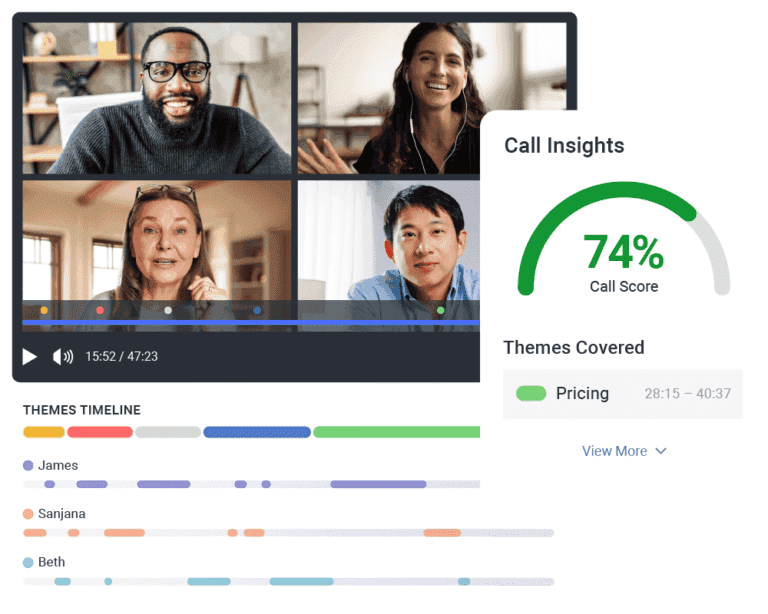
A good AI buyer responds to what the rep actually says. If the rep concedes too quickly on price, the buyer pushes further. If the rep asks a strong clarifying question, the conversation shifts accordingly. That dynamic quality is what makes practice feel like preparation rather than a checkbox exercise. Here's a good read: How Realistic is the AI Bot in Your AI Sales Role Plays?
2. Is feedback immediate and specific?
Delayed feedback, as we covered earlier, is one of the core reasons traditional coaching fails to close skill gaps fast enough. An AI role play solution should return feedback the moment a session ends, and that feedback should be specific enough to act on.
"Good job on tone" is not useful. Feedback that tells a rep their response to a pricing objection lacked a concrete ROI anchor, or that they used filler language when the buyer challenged their value story, gives them something to fix on the next attempt.
3. Does it connect practice to real call performance?
This is where a lot of standalone tools fall short. A rep can score well on a role play and still struggle on live calls. Without a way to connect practice data to what's actually happening in customer conversations, you're measuring activity, not readiness.
The more useful question isn't how did the rep do in the simulation. It's whether the improvements showing up in practice are showing up on real calls. That requires the role play tool to be connected to conversation intelligence, not sitting in a separate system with no line of sight to field performance.
4. Can scenarios be tailored to your actual sales motion?
Generic objection handling scenarios have limited value for teams selling complex enterprise solutions, regulated products, or industry-specific use cases. A rep at a healthcare technology company faces different objections than one selling into financial services, and the practice environment should reflect that.
🎯 Pro Tip
Look for an AI sales role play tool that allows scenarios to be built around your specific buyer personas, deal stages, industries, and objection types, rather than relying on pre-built templates that don't map to how your team actually sells.
5. Is it a standalone tool or part of a broader platform?
This distinction matters more than it might initially seem. A standalone AI role play tool can tell you how a rep performed in a simulation. It can't tell you whether that performance gap is rooted in a product knowledge gap from training, a coaching deficit, or a pattern showing up consistently across their calls.
When practice is connected to training content, coaching workflows, and performance analytics inside a single platform, enablement leaders can see the full picture. They can identify which reps need more work on pricing objections before a major product launch, assign targeted practice, and track whether it's moving the needle on real deals.
6. What does the security and data posture look like?
Role play sessions involve real sales conversations, real objection language, and potentially sensitive deal context. Understanding how the vendor handles data, whether your content is used for model training, and what compliance certifications are in place should be part of any evaluation conversation.
Get your rep ready before their next call starts
Most sales organizations will keep investing in training. More playbooks, better onboarding, stronger SKO content. None of that is wrong. But if the investment stops at content and never reaches deliberate practice, the gap between what reps know and what they can deliver under pressure stays open.
Objection handling is where deals are won or lost in real time. A rep who has practiced a pricing challenge from a skeptical buyer twenty times before they face it live is a fundamentally different rep than one encountering it for the first time on a call that matters. That difference doesn't come from knowing more. It comes from having been in that conversation enough times that the right response is already there.
AI sales role play from Mindtickle doesn't replace good training, strong coaching, or smart enablement programs. It fills the one gap those things have never been able to close at scale: the space between learning something and being ready to use it when it counts.
The reps who win the hardest objection conversations aren't the ones who remembered the playbook in the moment. They're the ones who didn't have to.
Frequently Asked Questions

Subscribe to the blog
Get the latest sales enablement tips, guides, and industry best practices delivered to your inbox. Unsubscribe anytime.