




AI Sales Role Play: 2026 Guide for Enablement Leaders



AI sales role play is a training method in which sales reps rehearse live selling conversations with an AI that plays the buyer and then gives them scored feedback on their performance.
The AI can take on a cold prospect, a skeptical economic buyer, a procurement lead, or a current customer, and it reacts in real time to what the rep says and how they say it. Reps can run these sessions on demand and repeat them as often as they need, without pulling a manager or a peer into the room.
For enablement leaders, the value lands as a fix to a capacity problem they already know well. Coaching is the highest-leverage thing a frontline manager does, and it is also the first activity that gets squeezed when the quarter gets tight. Very few teams can give every rep enough live practice before the conversations that decide a deal. AI role play lifts that ceiling. Reps get a private space to work through the exact calls on their calendar, and you get a clear read on who is prepared well before they connect with a live prospect.
Mindtickle's 2026 State of Agentic Revenue Enablement report highlights a clear link between practice volume and results, with top-selling reps completing about twice as many role plays as the rest of their teams.
For most leaders, the open question is operational. You have to stand up a program reps will actually use, connect it to your sales methodology and live pipeline, choose a platform that fits how your team sells, roll it out across regions and roles, and show finance a defensible return. This guide walks through those decisions in the order you will face them.
What is AI sales role play?
AI sales role play is a form of sales training where a rep practices a full selling conversation against an AI buyer and receives a scored assessment of how they handled it. The AI holds a persona, responds to the rep's words in real time, and pushes back the way a real prospect would when a rep skips discovery or presents price too early.
Every session produces a record the rep and their manager can review, which turns practice into something you can measure and coach against instead of a one-off exercise that lives only in the room where it happened.
How AI sales role play works
A typical AI sales role play session follows the same four steps regardless of the platform you choose.
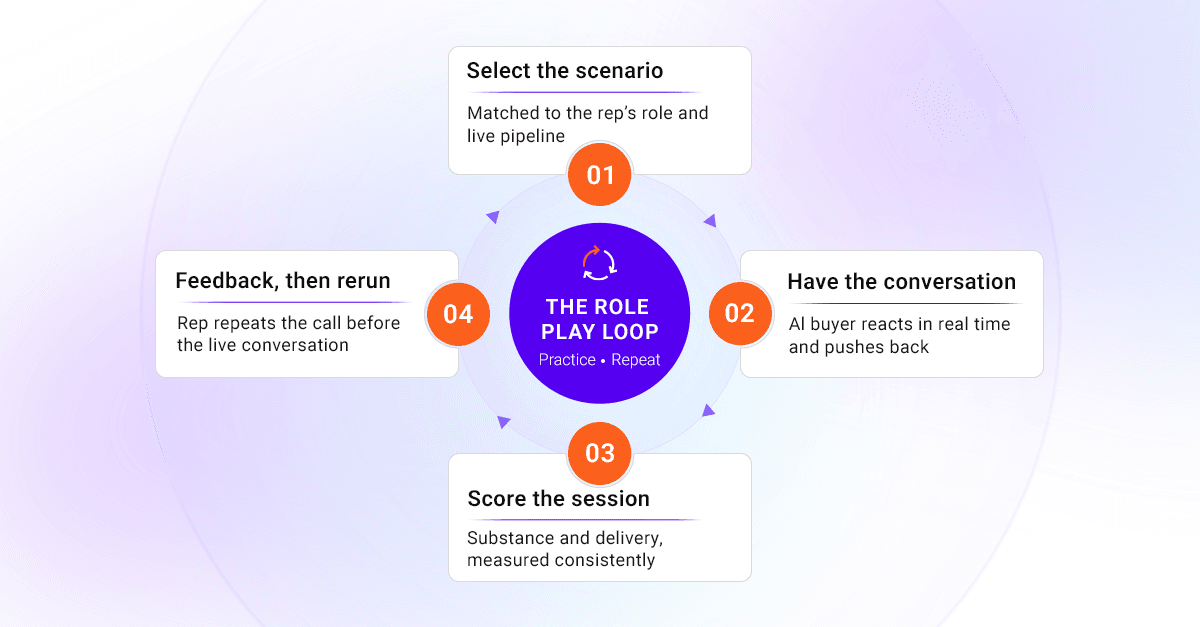
Step 1: First, the rep selects a scenario. This might be a cold call to a VP of Finance, a discovery call with a technical evaluator, or a pricing conversation with procurement.
Step 2: The rep has the conversation. The AI buyer opens with a realistic posture, asks questions and raises objections, and reacts to how the rep responds. If the rep handles an objection well, the buyer moves forward. If the rep talks past a concern, the buyer stays stuck, the same way a live prospect would.
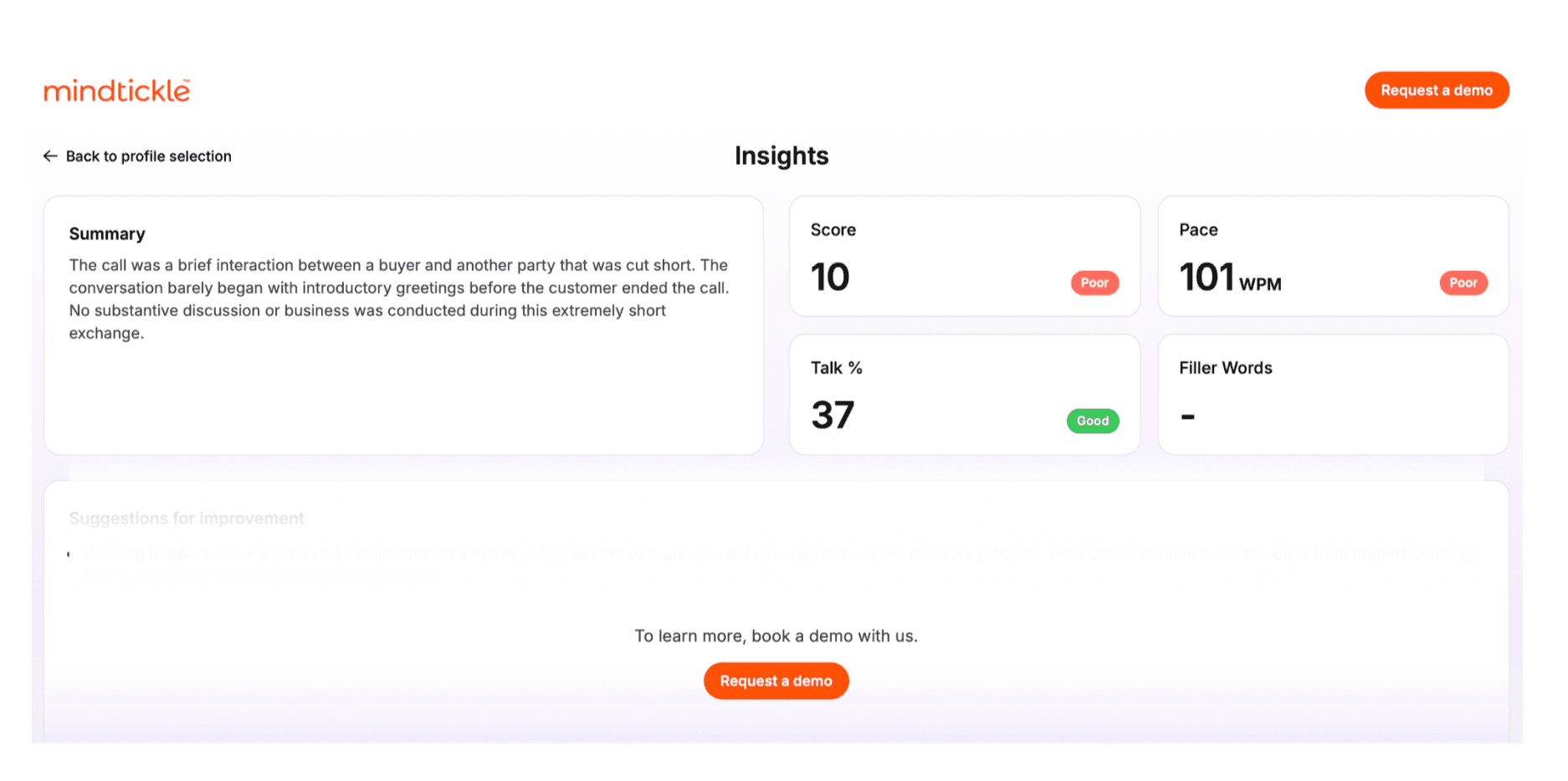
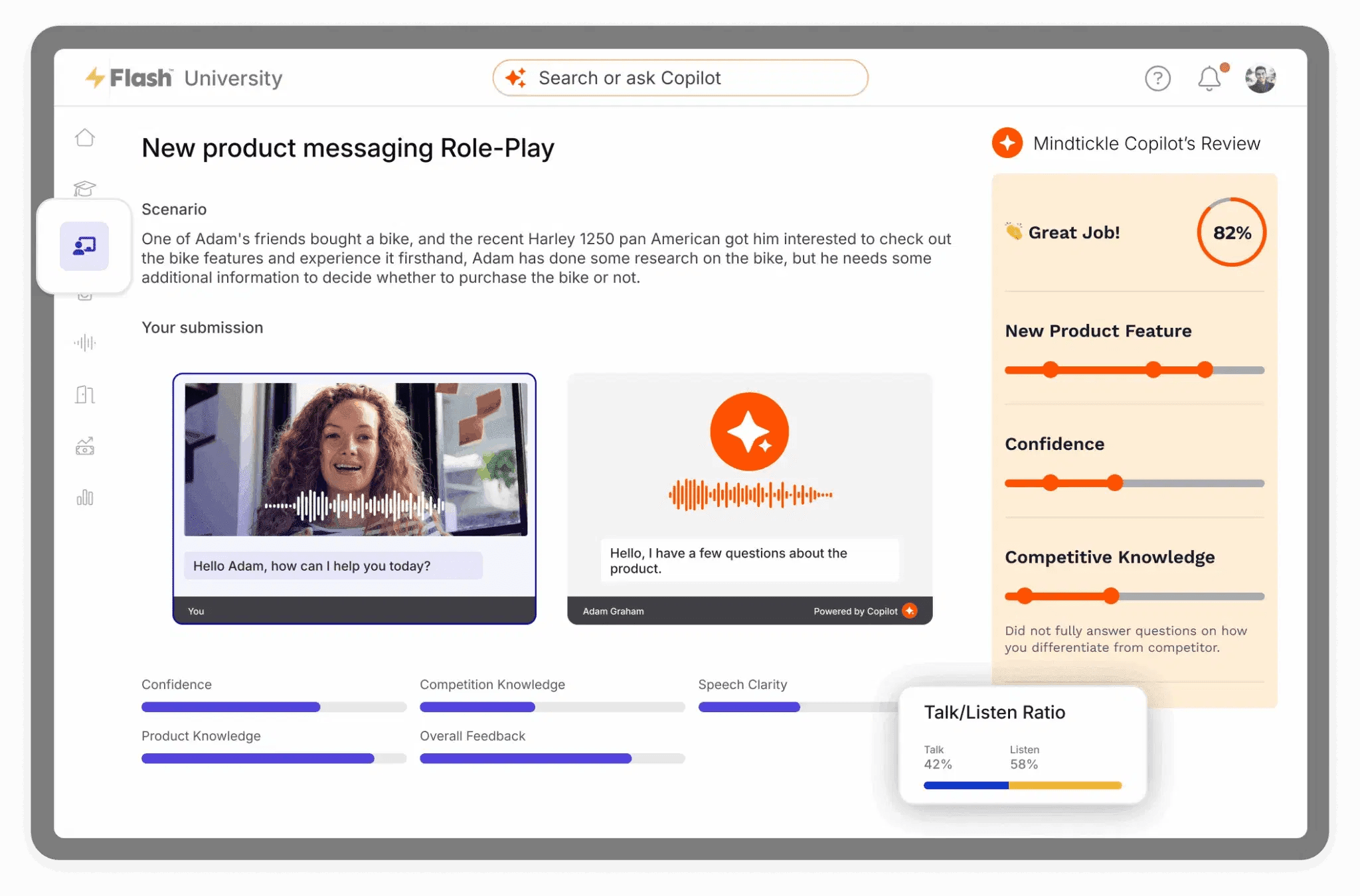
Step 3: The platform scores the session against a rubric you define. Scoring can cover the substance of the call, such as whether the rep qualified the opportunity or covered the required sales discovery questions, alongside delivery signals like talk-to-listen ratio, filler words, and pacing.
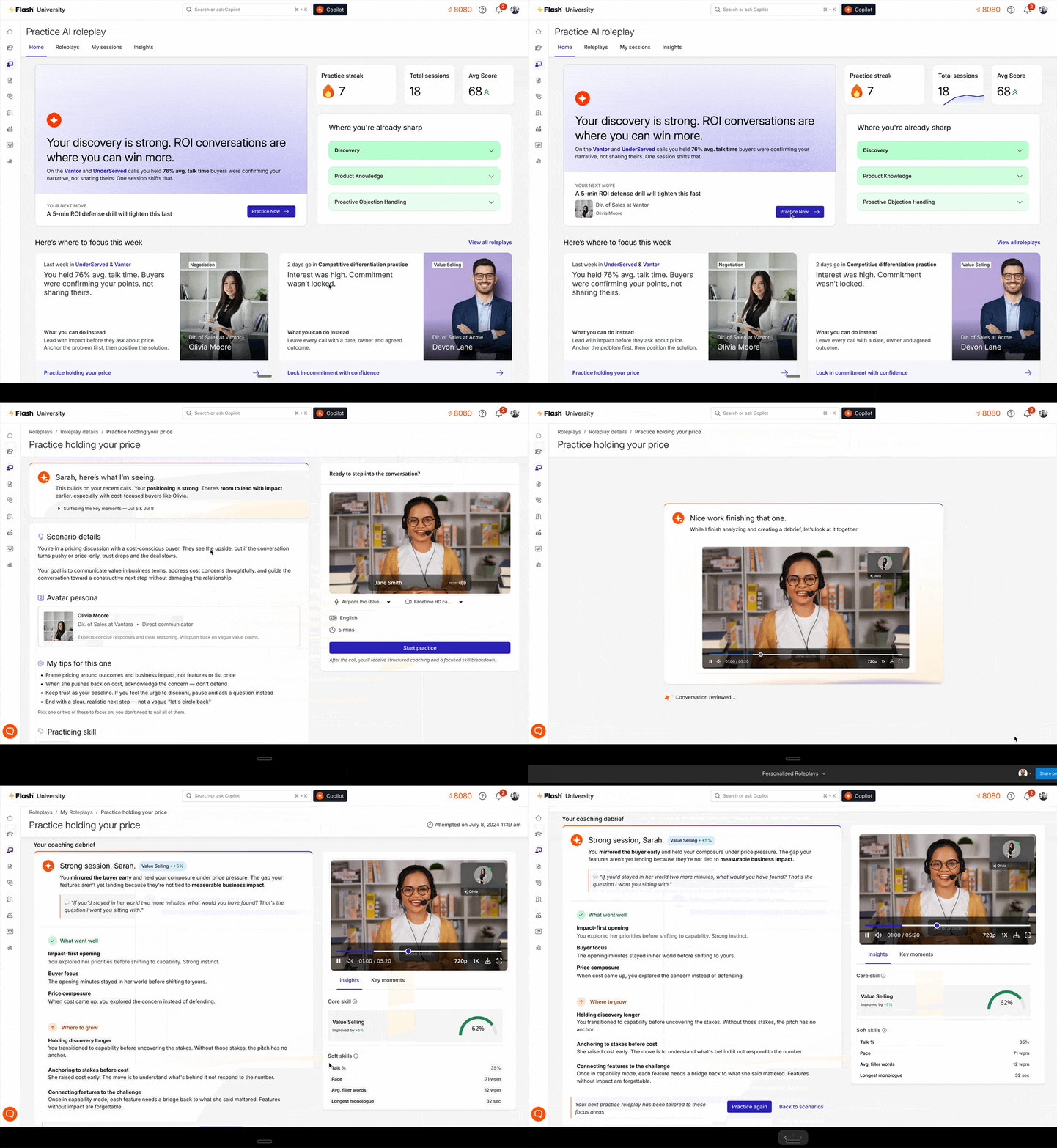
Step 4: The rep gets feedback and repeats. Because there is no manager to schedule and no peer to recruit, the rep can run the same scenario five more times before a real call and watch the score climb.
AI sales role play versus traditional sales coaching
Traditional sales coaching, where a manager works with reps through one-on-ones, call reviews, and live practice, still does what nothing else can. The problem enablement leaders run into is capacity and consistency.
A manager coaching fifteen reps for thirty minutes a week spends more than seven hours on coaching alone, and the quality of that time drifts depending on their skill, their bandwidth, and how well they remember each rep's deals. AI role play removes the scheduling constraint and holds the practice and the scoring standard steady across every rep and every region, which frees the manager's coaching time for the conversations that actually need a person.
The table below lays out where the two approaches differ in practice.
| Dimension | Traditional sales coaching | AI sales role play |
|---|---|---|
| Availability | Limited to manager schedules | On demand, any hour |
| Repetitions per rep | A handful per cycle | Effectively unlimited |
| Consistency | Varies by manager and their bandwidth | Same standard every time |
| Scoring | Subjective, from memory | Structured against a fixed rubric |
| Coverage across regions | Uneven | Identical for every rep |
Deep Dive: AI Sales Role Play Vs. Traditional Sales Coaching: A Quick Comparison
AI sales role play versus conversation intelligence
These two often get grouped because both analyze sales conversations and both produce scores, though they operate at different points in the deal.
AI sales role play is practice that happens before a call. The rep rehearses against a simulated buyer, makes their mistakes in a setting where nothing is at stake, and builds the skill ahead of the live conversation.
Conversation intelligence typically comes to the scene after a call. It records and analyzes real customer conversations, then shows managers where reps are winning or losing in the field.
Strong teams run both and let them feed each other. Conversation intelligence tells you where reps are struggling on real calls. That signal tells you which role play scenario to assign. The rep then practices the exact moment they keep fumbling, and the next round of call analysis confirms whether the fix is holding. On a unified revenue enablement platform, that loop runs without anyone stitching the data together manually.
Why AI sales role play matters today
The case rests on three realities every sales organization is living with right now.
1. Reduced in-person coaching time
Reps need repeated, realistic practice to perform when a deal is on the line, and there has never been enough manager time to give it to them. Live in-person role plays sit at the expensive end of that thin coaching budget, because every session needs a manager or a peer in the room in real time. When the quarter tightens, structured practice is usually the first thing to go. Read: Why It’s Almost Impossible to Get Sellers to Remember Sales Training
2. Rapid skill decay
Sales training carries a retention problem that learning science has documented since the original research on the forgetting curve. Knowledge decays fast without repeated use, and a single kickoff or workshop leaves little behind within a few weeks. Most enablement teams recognize this from experience. The energy right after a training event fades, and behavior on live calls settles back into old habits.
Read: Why It’s Almost Impossible to Get Sellers to Remember Sales Training
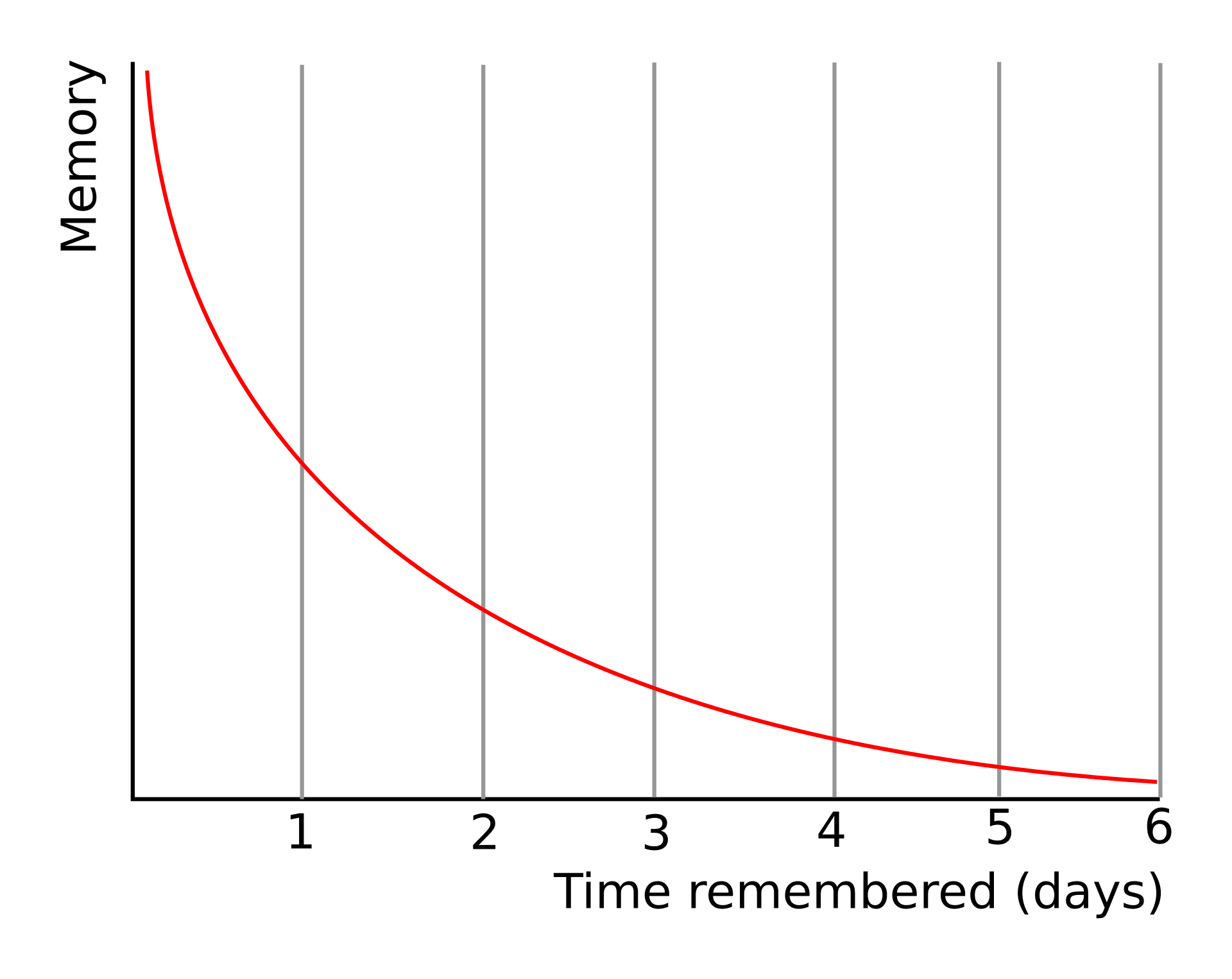
Source: Wikipedia
Reinforcement is the accepted fix, and it only holds if reps practice often enough for the skill to stick. Delivering that frequency at scale has been the hard part. AI sales role play turns reinforcement into something a rep can do in ten minutes between meetings, as many times as the skill requires, which is what moves retention from an aspiration to a routine.
3. How practice volume tracks with performance
Reps who rehearse more walk into calls with sharper messaging and recover faster when a conversation goes sideways. The constraint was never willingness. Most reps will practice when practice is available and low friction, and until recently it was neither. AI role play gives everyone on the team the same access to unlimited repetitions, which is how more reps build the habit that top performers already have.
Also Read: AI Sales Role Play: How to Shift From Generic Scenarios to Contextual Practice
Benefits of AI sales role play, and the honest limits
The value of AI sales role play splits across three audiences, and enablement leaders usually have to make the case to all of them.
For reps
Reps get unlimited practice with no one watching. They can run the same discovery call ten times before the real one, fumble an objection without it costing a deal, and build confidence on their own schedule. The practice is judgment-free, available at any hour, and matched to the conversations actually on their calendar.
For managers and enablement
Managers get their time back. Instead of running repetitions, they review results and spend their coaching hours on the developmental conversations only a person can have. Scoring stays consistent across every rep and region, so a manager in Austin and a manager in Dublin hold the same standard. Enablement gets visibility into where skills are breaking down team-wide, which turns coaching from guesswork into something aimed at a known gap.
For the business
The business gets faster ramp, tighter message consistency, and better-prepared reps in the conversations that decide deals. When a new product or pricing change ships, the whole team can rehearse the new talk track before it reaches a buyer, rather than learning it live across dozens of accounts.
⚖️ What AI role play cannot do
AI role play does not replace human coaching, and treating it that way is how programs stall. It builds skill through repetition, but it does not read a rep's motivation, mentor them through a career slump, or make the judgment call on a complex, high-stakes negotiation the way an experienced manager can.
Another thing to keep in mind is that the AI buyer may be convincing, but it is still a simulation, and reps who only practice against it can be caught off guard by the emotional pressure of a real deal on the line. The strongest programs use AI for volume and consistency, and keep managers focused on the coaching that requires a human.
AI sales role play scenarios: the practice map
Scenarios are where a role play program lives or dies. A generic "handle the price objection" drill teaches little, while a scenario built from a real deal your team keeps losing changes behavior. The practice map below organizes scenarios along three lines enablement leaders actually plan against.
1. By stage of the sales journey
The most useful scenarios track the deal from first touch to renewal.
- Prospecting and cold calls build the nerve to open with a stranger and earn the next few minutes.
- Discovery scenarios drill the qualification and questioning that decide whether an opportunity is real.
- Demo and presentation practice keeps reps tight under scrutiny. Sales objection handling, negotiation, and closing rehearse the moments where deals stall or slip.
- Renewal and expansion conversations, often ignored in training, get the same treatment.
Mapping scenarios to stages this way shows reps where they are weak across the sales cycle rather than only at the top of the funnel.
2. By buyer persona
The same call changes entirely depending on who is across the table. A skeptical economic buyer weighing ROI, a technical evaluator probing the product, a procurement lead pushing on price and terms, a gatekeeper deciding whether the rep gets through, a champion who needs arming for an internal sell. Each persona brings a different posture, a different set of objections, and a different definition of a good outcome. Building scenarios around the personas your team actually faces, tuned to their real language and pushback, is what makes the practice transfer to live calls.
3. By difficulty
Reps should not start against the hardest buyer. Early scenarios build fluency in a low-pressure setting, then the difficulty climbs as the AI buyer grows more skeptical, more distracted, or more aggressive on price. This progression lets a new hire find their footing before facing a scenario that mirrors the toughest deal on the board, and it gives managers a clear read on who is ready to move up.
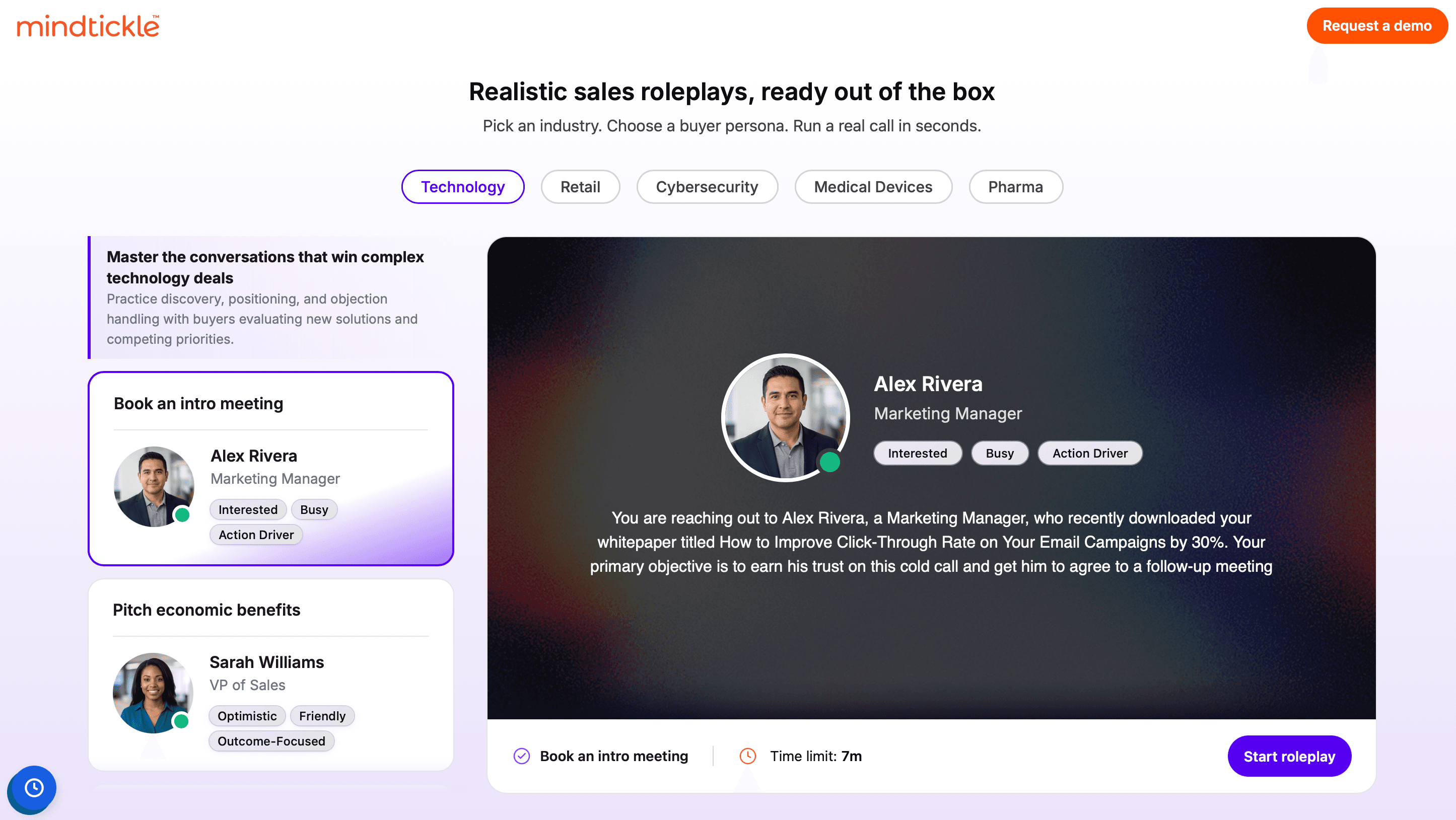
These lenses apply whether a team sells software, financial services, or medical devices. The personas and objections change by industry, and Mindtickle lets reps across different roles and industries try a free AI sales role play built around the buyer they actually sell to, which is the fastest way to see how a scenario should be shaped for your team.
How to build an AI sales role play program
Standing up a program is a different task from building a single scenario. Any rep can prompt an AI to play a buyer, but a program that changes behavior across the team needs outcomes, personas, scoring, and a cadence that holds. The framework below is the sequence enablement leaders should work through, in order.
Step 1: Define outcomes tied to real pipeline gaps
Start with the deals you are losing, not the skills you want to teach. Pull the patterns from your pipeline and your call reviews. If discovery is shallow and deals stall after the first call, that is the outcome the program targets. Tie each scenario to a gap you can point to, so the practice is aimed at a known problem rather than a generic skills checklist. This is also what lets you prove the program worked later, because you defined what it was supposed to fix.
Read: Deal Coaching vs. Skill Coaching: What’s the Difference?
Step 2: Build personas from real calls
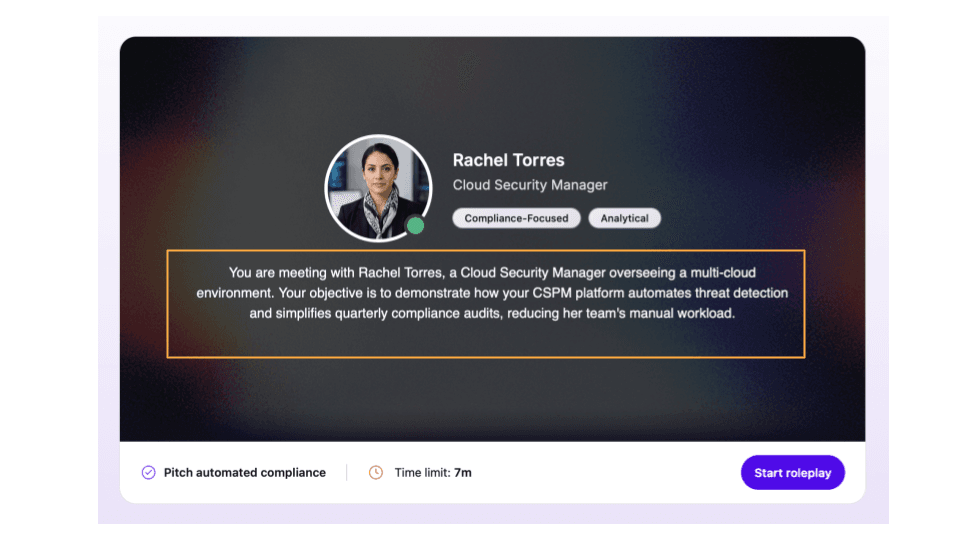
The AI buyer is only as useful as the persona behind it. Build personas from your actual customers, using the language, objections, and pushback that show up in recorded calls rather than an idealized script.
Give each one a job title, a company context, a set of priorities, and the specific concerns that buyer raises. A persona drawn from real conversations pressures reps the way a live prospect will, which is the whole point.
Step 3: Design scorecards to your methodology
A scenario without a scorecard produces practice you cannot measure. Build the scoring rubric around the methodology your team already sells with, whether that is MEDDIC, MEDDPICC, SPIN, or your own framework, so the practice reinforces the standard reps are held to on real deals.
Score both the substance of the call, such as whether the rep qualified the opportunity, and the delivery, such as talk-to-listen ratio and how objections were handled. Consistent scoring is what turns individual sessions into team-wide visibility.
Step 4: Set clear thresholds
Reps and managers need to know what good looks like. Set thresholds that mark a rep as ready, in need of coaching, or short of the bar, and make them visible to everyone. Shared thresholds set the same expectation across the team and remove the ambiguity about whether a rep has practiced enough. They also give managers a clean trigger for when to step in.
Step 5: Blend AI practice with human coaching
AI handles the volume and the scoring. Managers handle the coaching that requires judgment. Design the program so the two reinforce each other rather than compete: reps build reps and get instant feedback from the AI, and managers spend their time on the developmental conversations the scores surface. A program that positions AI as a replacement for the manager tends to lose buy-in from the people you need to run it.
Step 6: Set a cadence that holds
Short and frequent beats long and occasional. A rep practicing fifteen minutes most days builds skill faster than one who sits a long session once a quarter, because skills decay without reinforcement. Build the cadence into the team's routine, tie it to real upcoming calls, and keep the debrief immediate so the feedback lands while the session is fresh. The cadence is what separates a program that sticks from a launch that fades.
🤔 Okay, but can't ChatGPT help me? Why do I need a dedicated AI sales role play tool?
ChatGPT can run a basic role play. You write a prompt describing your product, the buyer, and the scenario, and it will play the part convincingly enough for a single rep to rehearse. What it cannot do is run a program. It does not score against your sales methodology, track who practiced or how they improved, show managers where the team is weak, or meet the security requirements of a regulated sales org.
A dedicated AI Sales Role Play platform adds the scoring, reporting, and integrations that turn individual practice into something an enablement leader can measure, coach against, and defend. ChatGPT is where you prove the idea. A platform is where you scale it.
BOOK AI SALES ROLE PLAY DEMO
🧑🎨 The DIY route
Building your own role play is a real option, and for the right situation it is the sensible one. Write a master prompt or a custom GPT that describes your product, the buyer persona, and the scenario, and the model will hold the role and respond to what the rep says. For an individual rep or a small team experimenting, this is a legitimate starting point that costs little beyond the seats you already pay for.
However, the limits show up once you try to run it across a team. Nothing scores whether the rep actually qualified the deal or handled the objection, so the practice produces no measurement. There is no feedback tied to your methodology, no record of who practiced or how they improved, and no way for a manager to see patterns across reps. Every persona and scenario is rebuilt by hand, which does not scale past a few. Data governance is whatever the consumer tool offers, which rarely clears the bar for a regulated sales org. The DIY route proves the concept. But, it does not become something you can manage or defend.
🔭 When a dedicated platform is worth it
A platform earns its cost when practice has to become measurable, consistent, and connected to the rest of your stack.
Scoring against your methodology, thresholds that define sales readiness, manager dashboards, CRM and conversation intelligence integration, multilingual support, and the security certifications a regulated buyer requires are the features that separate a program from an experiment.
The clearest sign you have outgrown the DIY route is when you need to answer:
- who is ready
- where the team is weak
- whether practice is improving real-call performance (a custom GPT cannot tell you any of it.)
🔀 Which path fits your team
| If your situation is | The likely fit |
|---|---|
| A single rep or a handful, experimenting | DIY custom GPT |
| A small team with no reporting or compliance needs | DIY, with a plan to graduate |
| Dozens of reps who need consistent scoring and visibility | Dedicated platform |
| A methodology you enforce and want reinforced in practice | Dedicated platform |
| A regulated industry with data privacy and access requirements | Dedicated platform |
| A goal of tying practice to ramp time and win rates | Dedicated platform |
For most enablement leaders, the honest reading of that table points to a unified revenue enablement platform, because the reason you are building a program in the first place is the visibility and consistency the DIY route cannot give you.
The low-risk way to test that conclusion is to run a scenario built for your own buyer before committing, which is what a free AI sales role play is good for: seeing how the platform experience differs from a custom GPT with your own team's conversation in front of you.
How to choose an AI sales role play tool
Once you have decided to buy, the platforms start to look alike on the surface. They all promise realistic AI buyers and instant feedback. The differences that matter show up in how well the tool fits the way your team sells and whether it holds up as a program rather than a demo. The criteria below are the ones worth weighing before you shortlist.
Response realism and latency decide whether the practice transfers. A buyer that answers instantly and stays in character pressures the rep the way a live call does, while lag and scripted replies break the effect. For phone-heavy teams, voice quality carries the same weight, since a stilted voice session builds the wrong muscle memory.
Scorecard and methodology fit is where most tools quietly diverge. The platform should let you score against the framework your team already sells with, not a generic rubric, so practice reinforces the standard reps are held to on real deals.
Feedback specificity matters more than the score itself. A score tells a rep how they did, not what to fix. Feedback that points to the exact moment they talked past an objection is what changes the next call, so judge a tool on how precise its feedback is, not just whether it scores.
Integrations determine whether the tool lives inside your workflow or beside it. CRM and conversation intelligence connections enable real-call gaps to drive practice assignments and close the loop between what happens on live calls and what reps rehearse.
Analytics and manager visibility separate a program from a set of individual sessions. Dashboards that show who practiced, how they scored, and where the team is weak let managers and enablement coach against a known gap instead of guessing.
Security and compliance are non-negotiable for regulated teams. SOC 2, ISO 27001, GDPR, and, where relevant, HIPAA, along with role- and region-based access, decide whether the tool clears procurement at all.
📋 Questions to ask on the demo
- Ask how the scorecard maps to your methodology rather than a default one.
- Ask to see the manager dashboard, not just the rep experience, since the reporting is what you are actually buying.
- Ask how the tool ingests real calls and turns them into practice, which is where the strongest platforms pull ahead.
- Ask how much effort it takes to build personas from your own deals, because a tool that takes months to configure will stall before it launches.
- And ask which certifications they hold, before your security team does.
The fastest way to judge realism and feedback quality is to run a scenario yourself. A free AI sales role play lets you put the criteria above against a real session with your own buyer in front of you, which tells you more than a guided demo will.
When you are ready to compare specific platforms side by side, our guide to the top AI sales role play tools measures each one against these criteria.
Implementation and rollout playbook
Buying the platform is the easy part. The programs that fail rarely fail on the tool. They fail on rollout, when practice launches to the whole team at once, adoption stalls after week two, and the platform quietly becomes shelfware. The sequence below is how enablement leaders get a program to stick.
Roll out in phases
A full launch across every region and role on day one gives you no way to fix what is not working. Start small, prove it, then expand.
- Pilot with one or two teams whose managers are bought in, using scenarios tied to a real gap.
- Run it long enough to see whether reps practice without being chased and whether scores move.
- Tune the personas, scorecards, and thresholds during the pilot, before anyone else sees them.
- Expand to the next group with a program that already works, not one you are still debugging.
Drive adoption before you drive volume
Reps practice when starting is easy, the payoff is immediate, and where they stand is visible. In the first weeks, aim for a habit, not a leaderboard number.
- Make the first scenario relevant to a call actually on the rep's calendar.
- Keep thresholds and results visible, since reps respond to a clear bar and to where they stand.
- Tie certification to something real, like clearing a readiness threshold before a launch or before working live accounts. Refer to Mindtickle's Readiness Index™
- Keep friction low until practice becomes routine.
Get managers coaching on top of the AI, not around it
Managers make or break adoption, because reps take their cue from whether their manager treats the program as real.
- Bring managers in before the reps and show them the dashboards first.
- Make the split clear: the AI handles repetitions, the manager's time goes to the coaching the scores surface.
- Have managers open one-on-ones with what the scorecards flagged, so the practice visibly matters.
🤓 Expert speak
A manager who ignores the data teaches the team to ignore it too. Getting managers to use what the tool shows them is the step most rollouts skip, and it is what makes or breaks the program.
The failure modes to design against
Most stalled programs fail in a handful of predictable ways, each with a fix you can build in from the start.
- One-off launch that fades → build a recurring cadence tied to live calls.
- Scripted personas that break realism → build them from real calls and refresh as the market shifts.
- Set up and left alone → assign an owner for scenarios and results.
- Practice with no debrief → keep feedback immediate while the session is fresh.
Designing against these from the start is far cheaper than diagnosing them after adoption has stalled.
Measuring AI sales role play ROI
This is the section that decides whether your program gets renewed. Enablement leaders can feel a program working, but feeling is not what a CFO funds. Measuring ROI means connecting practice to indicators you can show early and outcomes you can defend later, then doing the arithmetic that turns both into money.
📊 Leading indicators
These show the program is working before the revenue does, which matters because you will be asked for proof long before a sales cycle closes. Track practice frequency, scorecard trends across the team, and certification pass rates against your readiness thresholds. All three move within weeks, and they are what you report in the first quarter while the outcomes are still forming.
📉 Lagging indicators
These are the outcomes the program exists to change, and what a finance conversation turns on. Ramp-up time is usually the clearest, since faster time-to-productivity is measurable and tied directly to cost. Win rate, quota attainment, average deal size, and rep turnover complete the picture. None of these change in a week. So measure them before you launch, then measure the same group of reps again later, instead of scrambling for a number when someone asks.
Deep Dive: Metrics to Measure your AI Sales Role Plays
A simple way to model the return
The math does not need to be elaborate to be persuasive, just a defensible before-and-after on a metric you already track. Mindtickle experts say, ramp time is the strongest place to start.
Take a rep on a one-million-dollar annual quota who ramps in six months. Every month you cut off that ramp recovers roughly eighty-three thousand dollars of pipeline capacity. Across thirty new hires a year, cutting ramp by a single month is a serious number set against the platform cost, before counting a single point of win-rate improvement.
Remember that the figures are an illustration, not a benchmark. Pick the metric your leadership already cares about, baseline it, and show the delta against the cost. A model built on your own numbers survives scrutiny in a way an industry average never will.
Closing the loop between practice and real calls
The strongest proof is the one most programs never build. When your conversation intelligence platform scores real calls against the same skills reps rehearse, you can see whether a rep who improved on an objection in practice now handles it better in the field. That turns ROI from an inference into an observation, and it is the difference between telling finance the program probably helped and showing them the deals where it did.

Governance, security, and compliance
In an unregulated B2B software team, standard security hygiene is enough. In pharma, financial services, healthcare, or insurance, governance decides whether the tool clears procurement at all, and no amount of product quality compensates for a missing certification. Sort this early, because it is the item most likely to stall a rollout after you have already chosen a platform.
A few things are worth confirming before you commit.
- Know where the data lives and what happens to it. Role play sessions capture how your reps sell and, in customized personas, details of your accounts and market. Confirm where recordings and transcripts are stored, how long they are retained, and whether session data is used to train external models. For regulated teams, the answers have to satisfy your security team, not just your own read of them.
- Require the certifications your industry demands. SOC 2 and ISO 27001 are the baseline for enterprise buyers. GDPR compliance matters for any team touching European data, and HIPAA becomes relevant the moment healthcare information enters the picture. Ask for these before your security review does, since a gap here can end an evaluation regardless of how strong the practice experience is.
- Match access controls to how you are structured. A global program needs role- and region-based access so a manager sees their team and their region, and sensitive scenarios stay with the people meant to run them. This matters most in industries where what a rep is allowed to say is itself regulated, and where practice content has to stay inside defined boundaries.
AI sales role play use cases across industries
The mechanics of AI sales role play hold steady across industries. The buyer, the objections, and the rules of the conversation are what change.
Automotive. Reps handle everything from dealer and fleet negotiations to financing and leasing conversations, usually over a long cycle with several decision-makers involved. Role play lets them rehearse pricing pushback and complex fleet deals before they sit across from a buyer who negotiates for a living.
Read: Why AI Sales Role Play is a Game-Changer for Automotive Sales Training
Healthcare & medical devices. These are technical, high-consideration sales to clinical and procurement buyers who scrutinize every claim. Practice against a demanding, well-informed persona builds the composure to handle detailed questioning and stay within what a rep is permitted to say.
Read: Integrace Health Enables Sales Team From the Top Down with Mindtickle
Consumer goods. Reps sell into retail buyers and category managers where price, promotion, and shelf space are contested on every call. Role play sharpens the negotiation and the value case against a buyer whose default move is to press on margin.
Chemical. Long cycles, specification-driven decisions, and safety and regulatory constraints define the conversation. Practice helps reps carry a technical, compliant discussion with procurement and engineering stakeholders without losing the commercial thread.
Technology. Fast-moving products and frequent message changes make consistency hard to hold across a team. AI sales role play keeps reps current on new positioning and competitive objections, and lets them practice against the technical evaluator who probes the product before buying.
Read: How Qlik Scaled Sales Readiness with AI Role Plays
Across all of them, the pattern is the same. The industry sets the buyer and the rules, and the practice is only as useful as the persona it is built on.
How Cisco scaled sales training for 7200 reps with Mindtickle AI sales role play
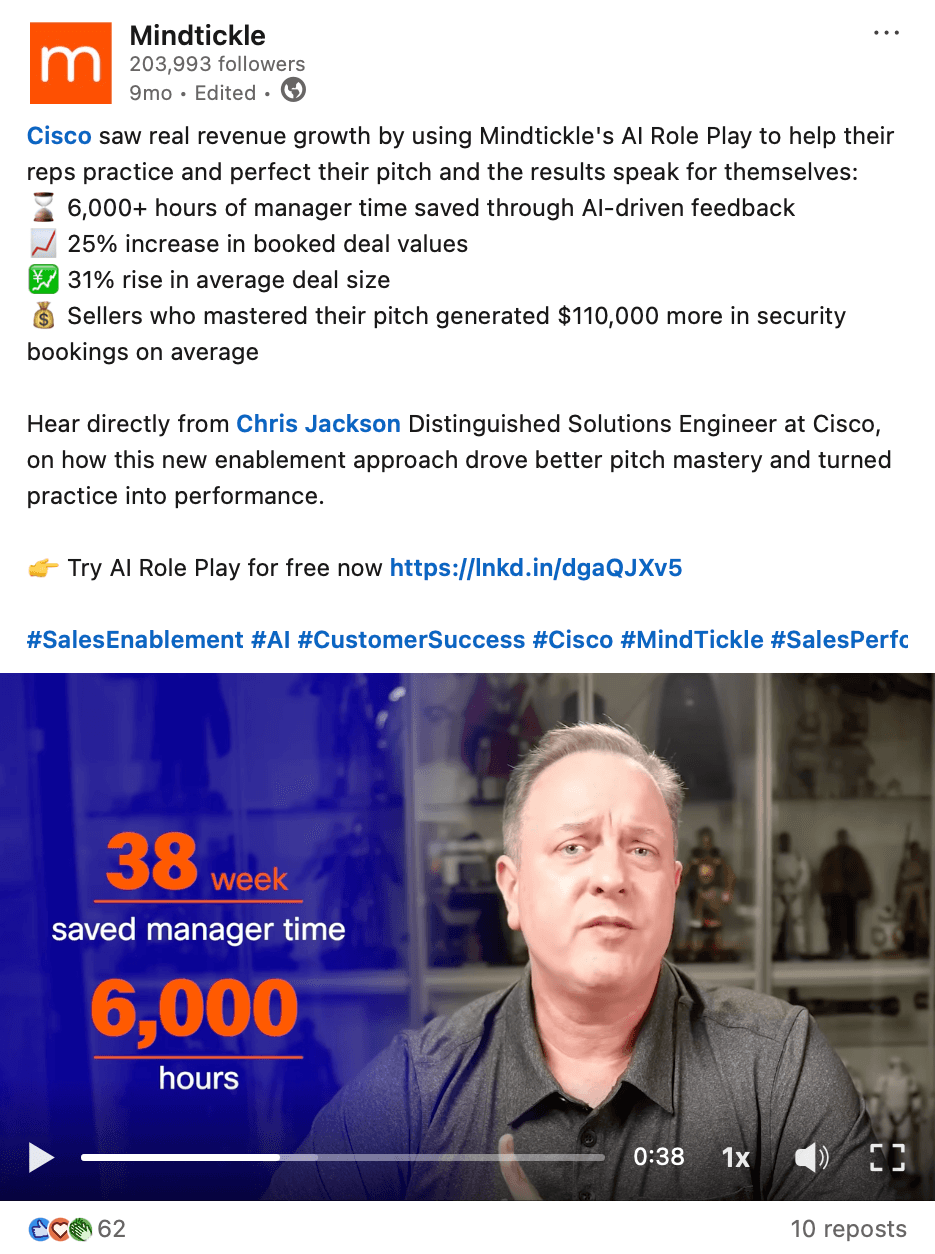
WATCH FULL VIDEO
The future of AI sales role play
Where this goes next is a shift in what the practice is connected to. Today most role play runs as a standalone activity a rep opens, completes, and closes. The direction of travel is toward practice that is assigned, informed, and measured by the rest of the revenue system, so that what a rep rehearses is driven by how they are actually performing on live deals.
The clearest sign of that shift is the move toward agentic sales enablement. Instead of a manager deciding who practices what, the system reads the signals, such as a rep whose deals stall whenever pricing comes up, and assigns the scenario that addresses it, then checks whether the next round of real calls improved.
Mindtickle's 2026 State of Agentic Revenue Enablement report points to this as the near-term direction, where enablement stops being a calendar of events and becomes a continuous loop that runs on its own.
Closing that loop between practice and real calls is the second shift, and it is already underway. As role play scoring and conversation intelligence increasingly run on the same platform and against the same skills, the line between rehearsing a conversation and reviewing a real one starts to blur. Practice data and performance data become one record, which is what lets a leader see not just that a rep practiced, but that the practice changed what happened in the field.
The formats will keep getting richer, with more natural voice, video, and eventually more immersive practice for high-stakes conversations. Those are worth watching, though they are not the point.
The change that matters for enablement leaders is that AI sales role play is becoming infrastructure that connects to everything else you run, rather than another tool reps visit and leave. Building your program now, with that direction in mind, is what positions your team to take advantage of it as it arrives.
Frequently asked questions
About the Author
Lead Content Marketer
Jayadeep brings over a decade of experience in B2B content and product marketing, with expertise in editorial leadership, messaging strategy, and agency management.
He has built and scaled content operations, led agency partnerships, and collaborated across marketing, product, and demand generation teams to deliver integrated campaigns. His "process-first, execution-next" philosophy has made him a trusted resource at Mindtickle, where he helps shape content strategy, thought leadership programs, and flagship marketing initiatives.
Subscribe to the blog
Get the latest sales enablement tips, guides, and industry best practices delivered to your inbox. Unsubscribe anytime.