





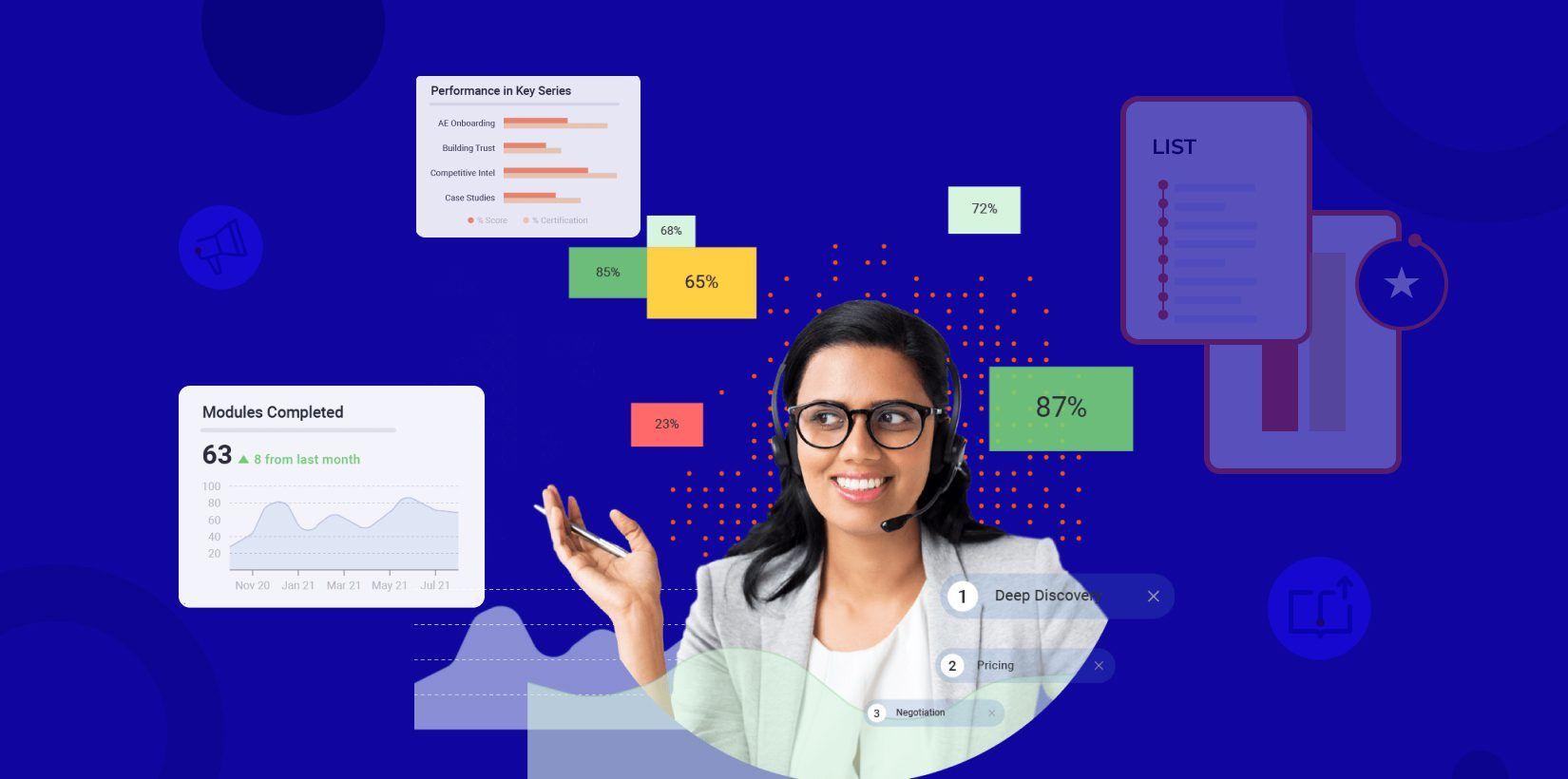
In 2026, sales enablement is a core growth function for modern revenue teams. It plays a direct role in improving seller productivity, strengthening buyer engagement, and driving predictable revenue outcomes.
When executed well, sales enablement equips sales teams with the skills, content, and readiness they need to perform consistently and close more deals.
Sales enablement prepares sellers to overcome key challenges, effectively engage buyers, and land more deals when done well. According to a recent report, 76% of sales reps feel their enablement prepares them to make quota.
Sales enablement tools greatly impact the success (or failure) of any sales enablement program. It’s important to choose your tools wisely.
But sifting through all the options can feel pretty overwhelming. There is tons of information, from review sites and analyst reports to the good old Google search. Whether you’re running short on time or just beginning your search, we’re here to help.
Today, we’ll explore 19 of the best sales enablement tools. We’ll break down each tool so you can determine which is best for boosting your sales performance and taking your sales enablement program to the next level. Before we dive in, here is a quick takeaway from the blog.
Key Highlights
-
AI sales enablement now connects rep skills, buyer actions, and revenue results in one clear system.
-
Too many tools slow sellers down. Unified platforms like Mindtickle eliminate chaos by replacing multiple point solutions.
-
Modern enablement uses data, not guesswork. AI finds deal risks early and suggests the right coaching.
-
Sales coaching now happens in real time through AI role plays that help every rep improve faster.
-
Content alone does not close deals. Smart platforms recommend the right content based on live buyer behavior.
Moving on, let’s first look at how the leading sales enablement platforms stack up.
Quick comparison: 19 sales enablement platforms
| # | Platform | Primary Use Case | Key Differentiator | G2 Rating |
|---|---|---|---|---|
| 1 | Mindtickle | Enterprise Sales Enablement | Unified Readiness Index | 4.7/5 |
| 2 | Seismic | Enterprise Content Management | Deep integration with financial services & banking workflows | 4.7/5 |
| 3 | Highspot | Sales Content Governance | "Spot" technology for organizing complex content libraries | 4.7/5 |
| 4 | Gong | Revenue Intelligence (CI) | Reality-based deal visibility & forecasting AI | 4.7/5 |
| 5 | Allego | Learning & Content Hybrid | Mobile-first video coaching focus | 4.6/5 |
| 6 | Showpad | Mobile/Field Sales | Offline capabilities & mobile-first design (acquired Brainshark) | 4.4/5 |
| 7 | Paperflite | Content Engagement | "Clever Content" intelligence & microsites | 4.5/5 |
| 8 | Salesloft | Sales Engagement | "Rhythm" workflow to prioritize seller actions | 4.5/5 |
| 9 | Chorus | Conversation Intelligence | Deep ZoomInfo integration for contact data enrichment | 4.5/5 |
| 10 | Spekit | Just-in-Time Learning | In-app overlays that surface training inside Salesforce/Slack | 4.7/5 |
| 11 | Whatfix | Digital Adoption (DAP) | Interactive walkthroughs overlaying software apps | 4.6/5 |
| 12 | Outreach.io | Sales Execution | Sales execution workflows & sentiment analysis | 4.3/5 |
| 13 | Klue | Competitive Intelligence | AI curation of competitor news & battlecards | 4.8/5 |
| 14 | SalesHood | Sales Process Replication | "Huddles" for peer-to-peer learning | 4.6/5 |
| 15 | Guru | Knowledge Management | Enterprise search & wiki that lives in your browser extension | 4.7/5 |
| 16 | Intercom | Customer Service/Chat | "Fin" AI Agent for instant customer resolution | 4.5/5 |
| 17 | Storylane | Interactive Demos | No-code product demo creation for presales | 4.8/5 |
| 18 | HubSpot | CRM & SMB Enablement | All-in-one ecosystem (Marketing + Sales + Service) | 4.4/5 |
| 19 | Salesforce | CRM Foundation | The ecosystem of record (Sales Cloud) | 4.4/5 |
While the table provides a snapshot, choosing the right platform requires a deeper look. Below, we break down each tool in detail, covering use cases, strengths, and limitations.
The top sales enablement platforms, tools, and software
Now, let’s look at 19 of the most popular sales enablement tools to increase sales productivity and drive revenue growth.
1. Mindtickle: Best for end-to-end sales enablement on enterprise scale
G2 rating
4.7 out of 5 (Read Reviews)
Price
Mindtickle offers multiple pricing tiers. Contact sales for customized pricing.
Description
Mindtickle is an integrated revenue enablement platform that empowers your go-to-market team to deliver outstanding experiences that drive revenue and retain happy customers.
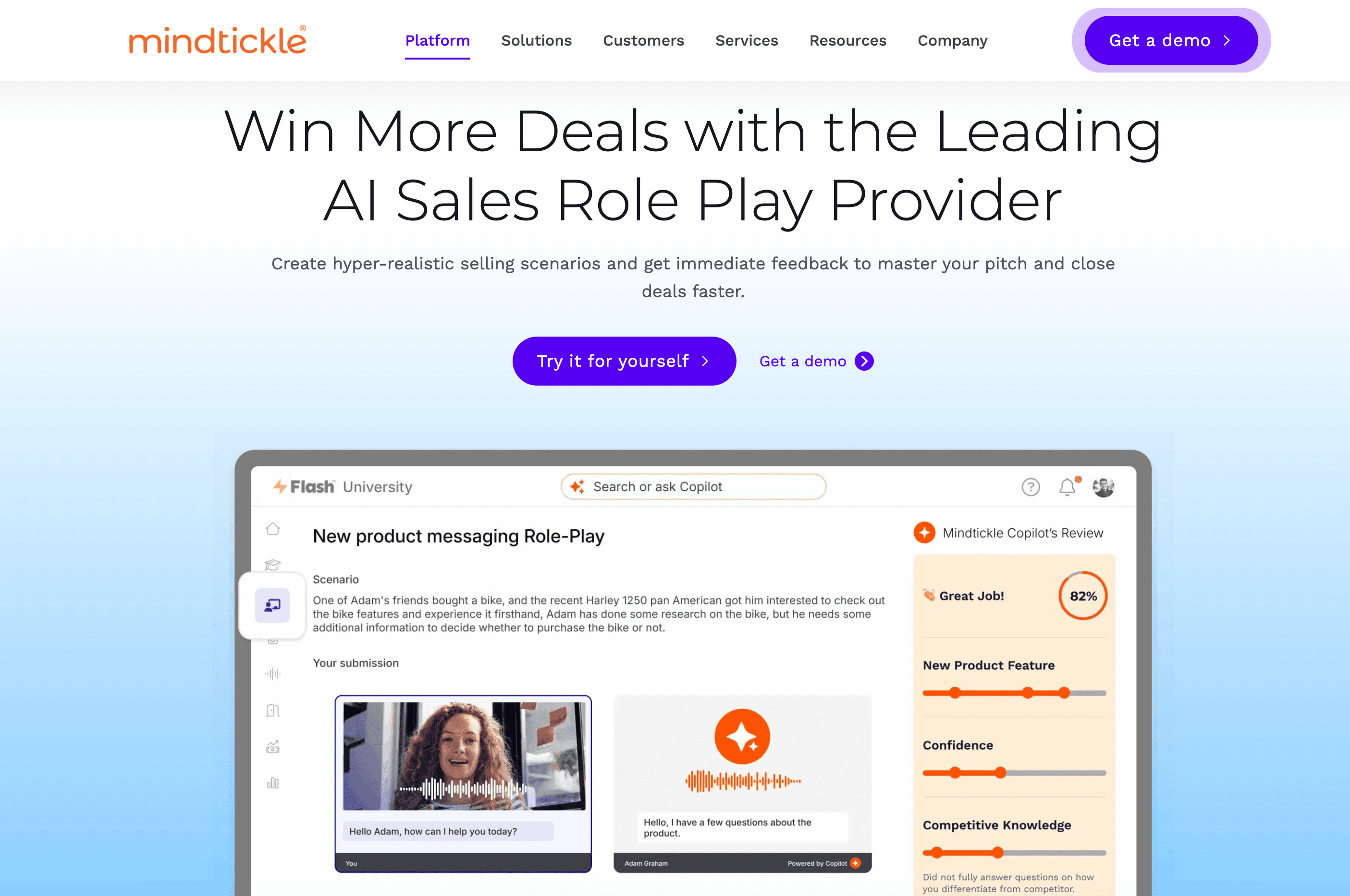
Enablement professionals turn to Mindtickle to deliver personalized sales enablement programs and report the impact enablement has on revenue outcomes. Mindtickle Copilot, our AI-powered assistant, makes it even easier for teams to create and deploy large scale programs.
Sellers use Mindtickle to access sales onboarding, training, content management, sales coaching, digital sales rooms (DSRs), conversation intelligence, AI role plays, and more from one platform. Mindtickle leverages AI to streamline tedious, time-consuming tasks so sellers can spend more time building authentic customer relationships. The DSRs enable sellers to create tailored rooms for every opportunity and accelerate deal closings.
Teams can also measure sales enablement KPIs and use those insights to optimize their programs accordingly.
Key AI Capabilities:
-
Mindtickle Copilot: An AI sales assistant that enables sellers to ask questions and get instant, accurate answers as well as surface relevant content and training.
-
AI Role Plays: Empower sellers to practice their skills in hyper-realistic simulated scenarios while getting real-time feedback for improvement.
-
Generative Content Creation: Makes it faster and easier to develop new sales enablement modules and draft contextual emails.
Notable features
-
Sales onboarding helps your new sellers hit the ground running and start contributing to revenue growth faster.
-
Ongoing individualized training allows each seller to strengthen key skills.
-
Sales coaching enables sellers to access individualized coaching that improves long-term behaviors and performance.
-
Digital sales rooms provide a single source of truth for everything related to a deal. Sellers can share relevant content with buyers, and both parties can collaborate and communicate in one central location. Sellers can see how buyers engage in the digital sales room, which can help them adapt their strategy for better outcomes.
-
Rich analytics enable teams to measure the impact of enablement. They can see how sellers engage with enablement and how that engagement impacts the metrics that matter most.
Customer Testimonials
“Our vision was to have all learning happen in one portal. With Mindtickle, sales reps can easily go in, find what they need to learn, and go out and do their work. And we have visibility into how they’re engaging with the platform. It’s a one-stop shop for everyone.”
Dr. Somnath Datta, Head of Commercial Excellence, Janssen
Want to see how Mindtickle optimizes enablement programs and helps demonstrate their ROI? Request a demo today.
2. Seismic: Best for AI content management
G2 rating
4.7 out of 5 (Read Reviews)
Price
Seismic offers multiple pricing tiers. Contact the company for customized pricing.
Description
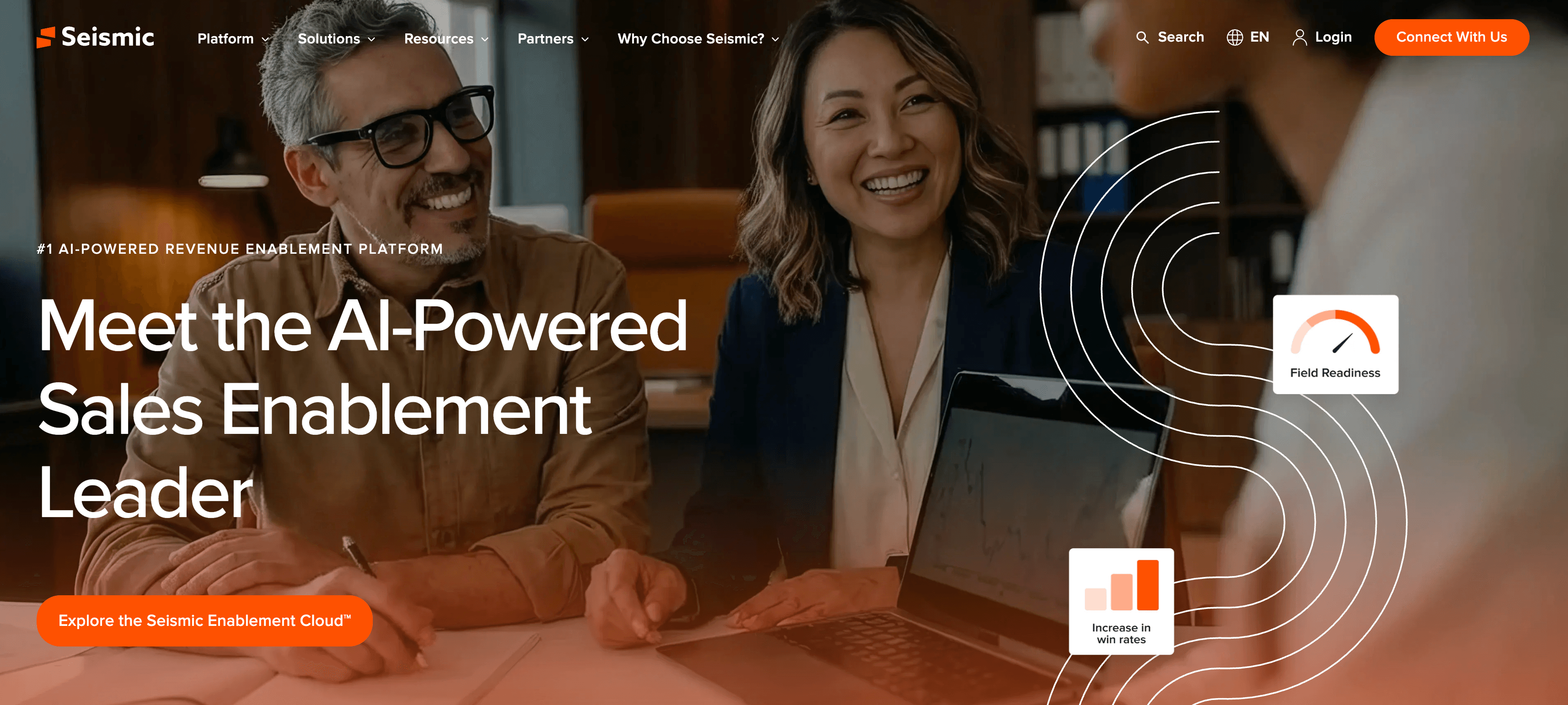
Seismic is a unified sales enablement platform that helps organizations engage customers and grow revenue. It equips customer-facing teams with the right skills, tools, content, and data to win more deals. Marketing teams leverage Seismic to create more effective content that’s actually used by sellers and buyers.
Key AI Capabilities:
-
Seismic Aura: An AI engine that predicts the best content for specific selling situations.
-
Generative Search: Allows sellers to find specific answers hidden inside long documents.
Notable features
-
Robust content management features that make it easy for enablement professionals to develop new content.
-
Extensive reporting and analytics, including the ability to see how content is being used.
-
Integrates with your business-critical tools, including Microsoft, Salesforce, Google, and Adobe.
Cons
-
Navigation can be confusing for users new to the platform
-
Interface isn’t always intuitive, making discovery slower
-
Users report a steeper learning curve compared with simpler tools
3. Highspot: Best for AI-driven sales plays
G2 rating
4.7 out of 5 (Read Reviews)
Price
Highspot offers several different pricing options. Contact the company to discuss the right model for your organization.
Description
Highspot is a unified enterprise sales enablement platform. Highspot incorporates many key components of a holistic sales enablement practice, including sales training, content management, sales playbooks, and analytics.
Key AI Capabilities
-
Generative AI Descriptions: Automatically generates descriptions for assets to improve searchability.
-
AI Recommendations: Suggests the next best action or content piece within a specific sales play.
Notable features
-
Learning management capabilities to quickly onboard new sellers and ensure knowledge retention.
-
Detailed reporting helps sellers understand when deals are at risk, enabling them to take corrective action.
-
Highspot leverages AI across workflows to help teams work smarter.
Cons
-
The layout and organization of features can feel cluttered
-
Navigation difficulties for users unfamiliar with the UI
-
Steep learning curve during initial setup and adoption
4. Gong: Best for AI conversation intelligence
G2 rating
4.7 out of 5 (Read Reviews)
Price
Gong pricing varies based on several factors. Contact the company for a customized price quote.
Description
Gong is an “all-in-one” revenue intelligence platform. Gong leverages AI to empower businesses to capture and analyze customer interactions, including calls, emails, and live chat. Gong then delivers actionable insights to go-to-market teams, which they can use to drive better outcomes and increase revenue growth. Gong is trusted by 4,000+ customers worldwide.
Key AI Capabilities
-
Ask Anything: A generative AI feature that allows you to query your database of calls (e.g., "What objections did Acme Corp raise?").
-
Smart Trackers: AI that identifies concepts and trends across thousands of calls, not just keywords.
Notable features
-
Gong collects and analyzes customer interactions from various sources, including phone calls, emails, text, and web chat.
-
More than 40 AI models to help you understand your customers’ interactions.
-
Robust insights help you coach buyers, understand your customers' voice, and improve sales outcomes.
-
Gong may seamlessly integrate into your existing tech stack.
Cons
-
Lacks built-in training and onboarding capabilities that enablement teams expect
-
AI insights are sometimes inaccurate, leading to mixed feedback quality
-
Occasional issues with call recording reliability
-
No ability to pause live recordings during meetings
5. Allego: Best for AI learning and content
G2 Rating
4.6 out of 5 (Read Reviews)
Price
Allego offers its products a la carte or bundled.
Description
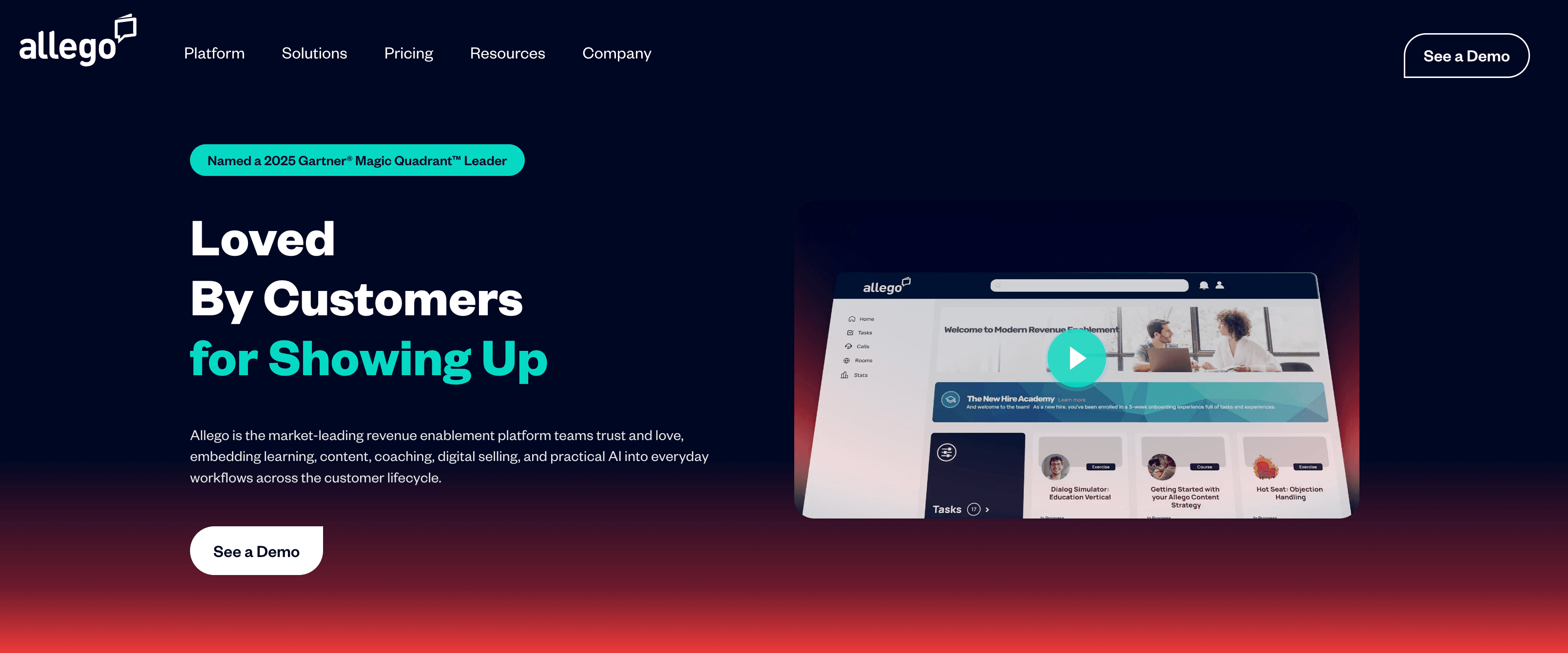
Allego is a revenue enablement platform that empowers go-to-market teams to deliver experiences that meet modern buyers' expectations. It includes content management capabilities, which ensure sellers can find the right content at the right time. Allego also incorporates sales training and coaching, as well as conversation intelligence to analyze what’s happening in the field. Digital sales rooms round out Allego, enabling buyers and sellers to communicate and collaborate throughout the purchase journey.
Key AI Capabilities
-
AI Virtual Coach: Gives simulated role-play scenarios for reps to practice handling objections.
-
Dialog Simulator: Generative AI creates realistic conversation partners for training.
Notable features
-
Tools to easily create and deliver personalized training, enablement, and reinforcement.
-
Digital sales rooms enable collaboration between buyers and sellers and enable sellers to understand buyer engagement.
-
Conversation intelligence records and analyzes calls and delivers real-time coaching to sellers.
-
Content management capabilities allow you to easily create, organize, and personalize sales content. Sellers can also track the performance of sales content.
Cons
-
Moderate learning curve for administrators and new users
-
Platform organization can feel disjointed or hard to navigate
-
Missing some features offered by more mature enablement competitors
6. Bigtincan: Best for XR and readiness
Note: In a significant market shift, Bigtincan and Showpad merged in late 2025 to create a unified AI-powered revenue enablement platform under Vector Capital. This merger combines Bigtincan's sales readiness strengths with Showpad's content management capabilities.
Bigtincan G2 rating
4.4 out of 5 (Read Reviews)
Price
Contact the company for detailed pricing information.
Description
Bigtincan offers sales enablement tools that prepare customer-facing teams to deliver great buying experiences. The Bigtincan platform has three parts: Readiness, Content, and Engagement. It can be customized to your organization's needs.
Key AI Capabilities
-
GenAI Assistant: Helps authors rapidly create training courses and quizzes.
-
Voice Analysis: Brainshark’s legacy machine analysis scores rep video submissions for filler words and speed.
Notable features
-
Centralized repository for all sales content, so sellers can easily find what they need, when they need it – and tailor it for each buyer.
-
Tools to quickly create and deliver just-in-time training and enablement so sellers can master the necessary skills.
-
AI-powered sales coaching so sellers can perfect their skills before they take them into the field.
-
Robust analytics to understand how buyers engage with sales content so sellers can adapt their strategies.
-
Content authoring capabilities make it easy to develop and deploy new learning content.
-
Onboarding and ongoing training help sellers learn and retain the skills they need to be ready for any deal.
-
Readiness scorecards help sales leaders identify sellers’ skills gaps, enabling them to proactively address them and improve performance.
Cons
-
Feature set is narrower compared with leading sales enablement suites
-
Users report needing multiple clicks for simple tasks
-
Reporting capabilities feel limited in depth and customization
7. Paperflite: Best for content ROI
G2 rating
4.5 out of 5 (Read Reviews)
Price
Pricing starts at $50 per user per month.
Description
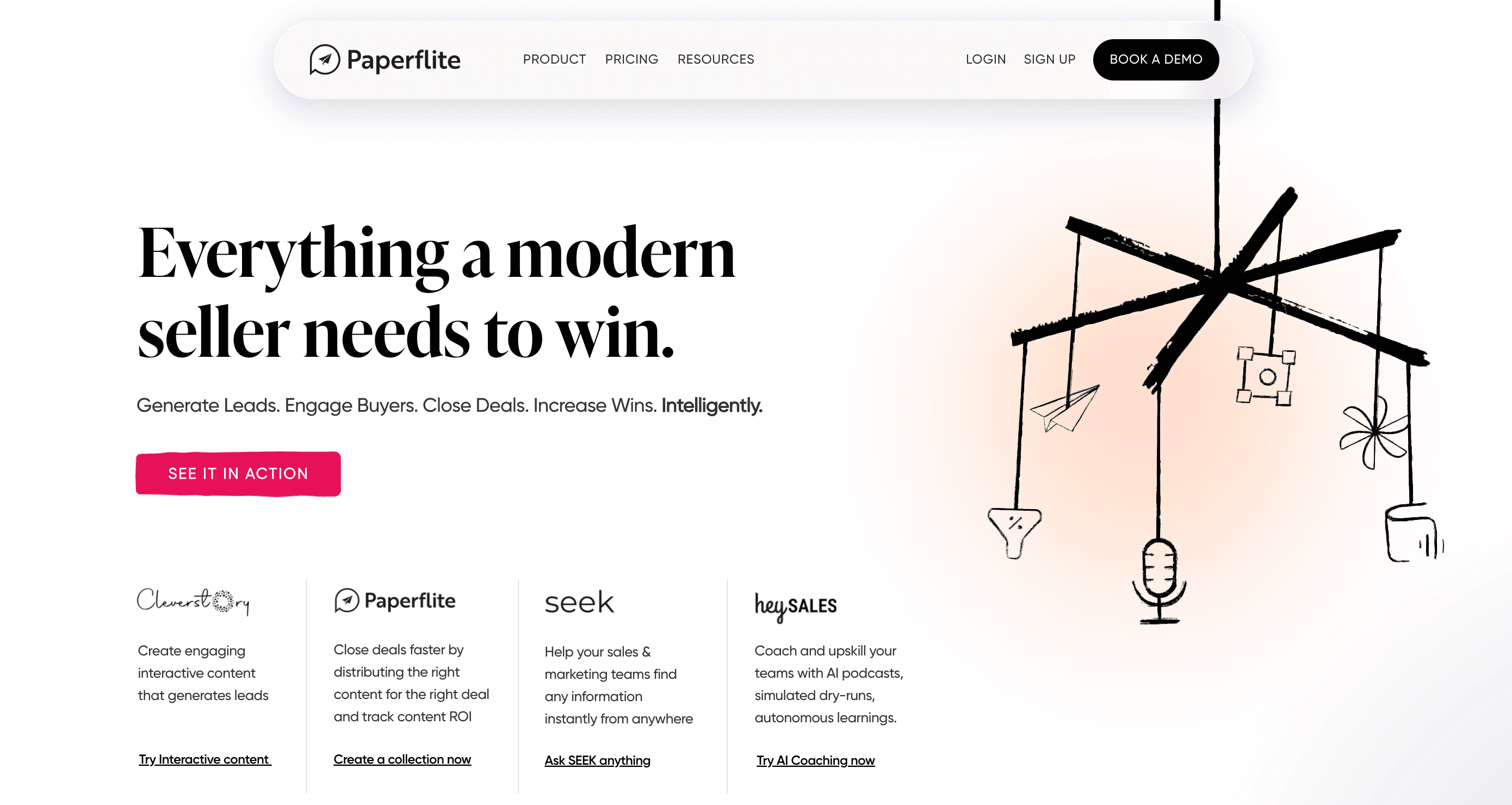
Paperflite is a sales enablement tool that’s primarily focused on sales content management. Paperflite centralizes all sales content into a single hub and leverages AI to help sellers surface the right content at the right time for the right prospects. Paperflite delivers insights into how content is used and its impact on deals. That way, marketing teams can optimize their content programs for greater impact.
Key AI Capabilities
-
Cleverstory: Uses AI to turn static content into interactive storytelling experiences.
-
SmartSearch: AI algorithms that combine indexing and user behavior to predict the best content.
Notable features
-
This sales enablement tool leverages algorithms, user behavior, and AI to help sellers surface the right content for each sales scenario.
-
Engaging, personalized microsites enable sellers to share relevant content with buyers.
-
Sellers can access real-time insights on how buyers engage with content, enabling them to tailor their follow-up properly.
-
Insights on content ROI help marketing teams focus on content that makes an impact.
Cons
-
Focused primarily on content management, not full enablement
-
Limited capabilities for training and coaching outside content
-
Some users have trouble with the platform layout and organization
-
Not ideal for teams needing a comprehensive enablement suite
8. Salesloft: Best for revenue orchestration
G2 Rating
4.5 out of 5 (Read Reviews)
Price
Contact the company for pricing information.
Description
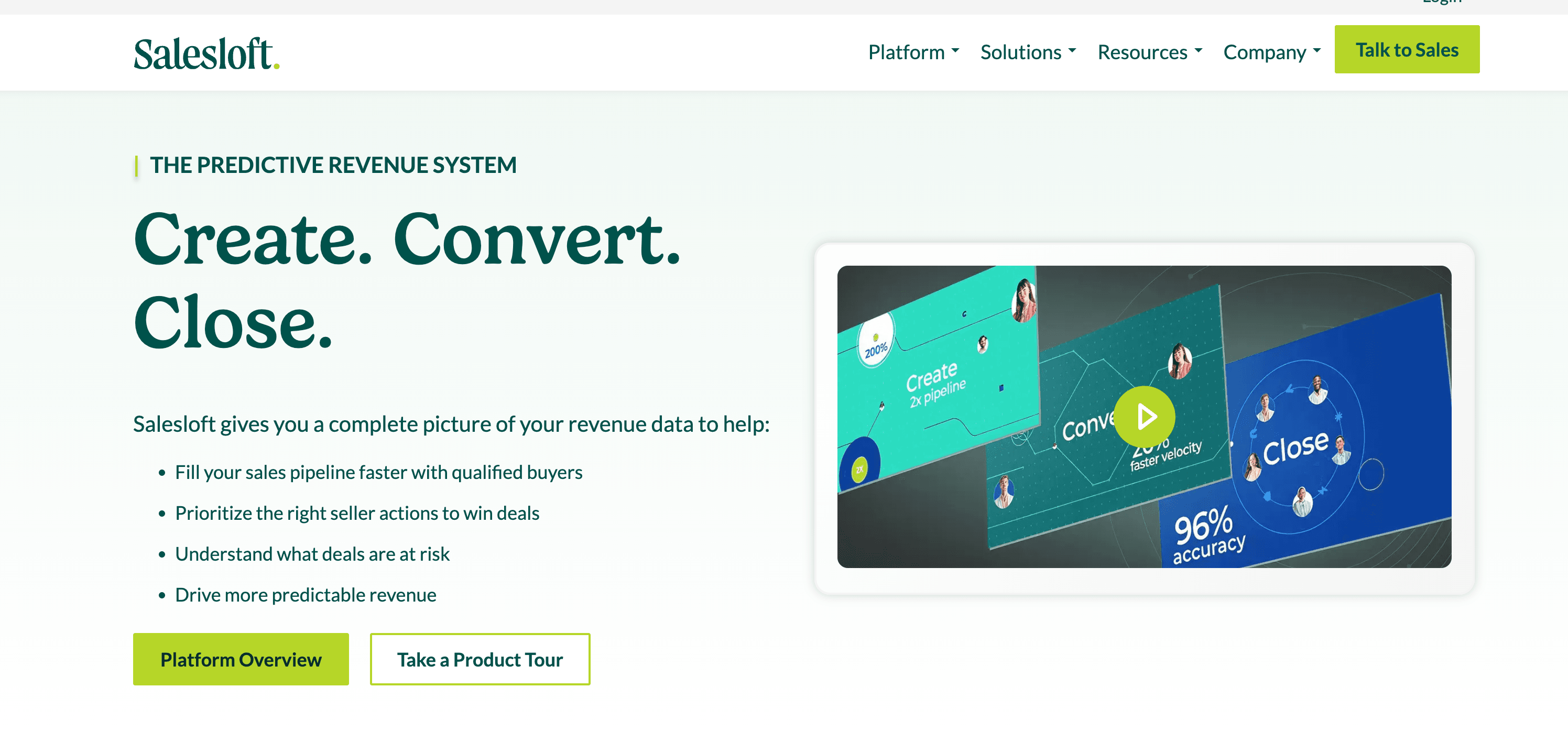
Salesloft is a “revenue orchestration platform” that helps sellers engage prospects more effectively. The platform leverages AI to analyze buyer signals, then delivers insights that help sellers take the right steps at the right time to engage prospects. Salesloft has more than 500 customers across the globe, including Google, IBM, and Cisco.
Key AI Capabilities
-
Rhythm: An AI engine that prioritizes a seller's day based on buyer signals (not just a static to-do list).
-
Generative Email: Drafts personalized outreach emails based on context.
Notable features
-
Salesloft’s AI-powered engine integrates buyer signals so sellers can understand the urgency and act immediately.
-
Conversation intelligence transcribes and analyzes customer calls, enabling sellers to tailor their follow-up.
-
Robust reporting and analytics enable organizations to improve processes and sell better.
Cons
-
Lacks robust training and onboarding functionality found in other tools
-
Call quality issues can interrupt workflow and analysis
-
Integration challenges with certain external systems
9. Chorus by ZoomInfo: Best for deal risks
G2 Rating
4.5 out of 5 (Read Reviews)
Price
Chorus does not publish pricing information.
Description
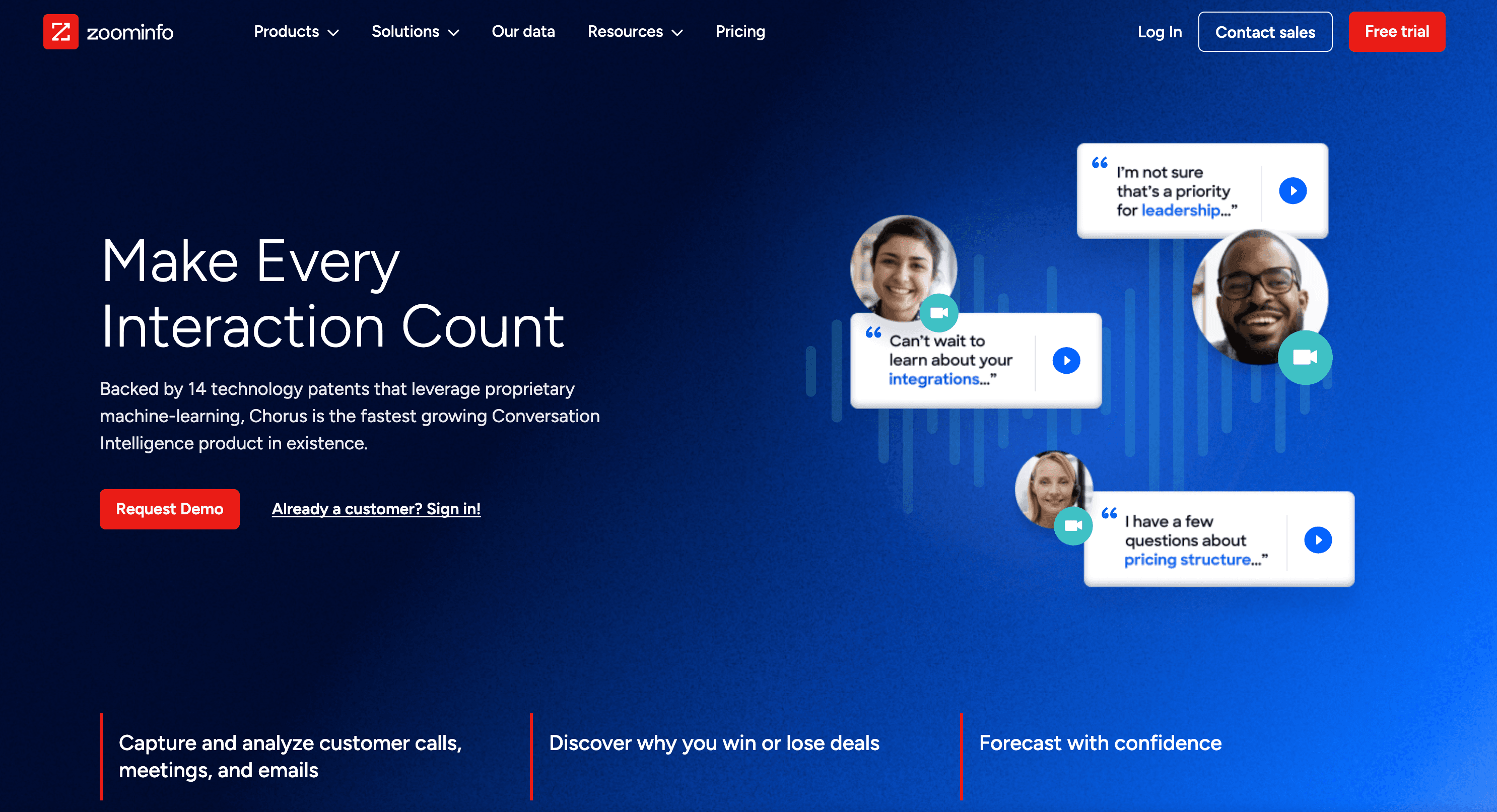
Chorus is an AI-powered conversation intelligence tool. The platform records and analyzes customer engagement across phone calls, email, and video meetings.
Key AI Capabilities
-
Momentum Insights: AI that identifies deal risks based on communication patterns.
-
Smart Playlists: Automatically curates the "best of" calls for training purposes using AI.
Notable features
-
Instant insights on any customer interaction help sellers tailor their follow-up.
-
Sellers get instant feedback to improve their behavior.
-
Data enables teams to benchmark sales conversations using metrics such as talk-to-listen ratios and filler-word usage.
-
Powerful insights inform more accurate sales forecasting.
Cons
-
Limited focus on enablement and training features beyond conversation analytics
-
Technical issues were reported with the call and recording performance
-
AI predictions and insights can feel inconsistent or imprecise
-
Not designed as a full enablement platform
10. Spekit: Best for just-in-time learning
G2 Rating
4.7 out of 5 (Read Reviews)
Price
Contact the company for customized pricing information.
Description
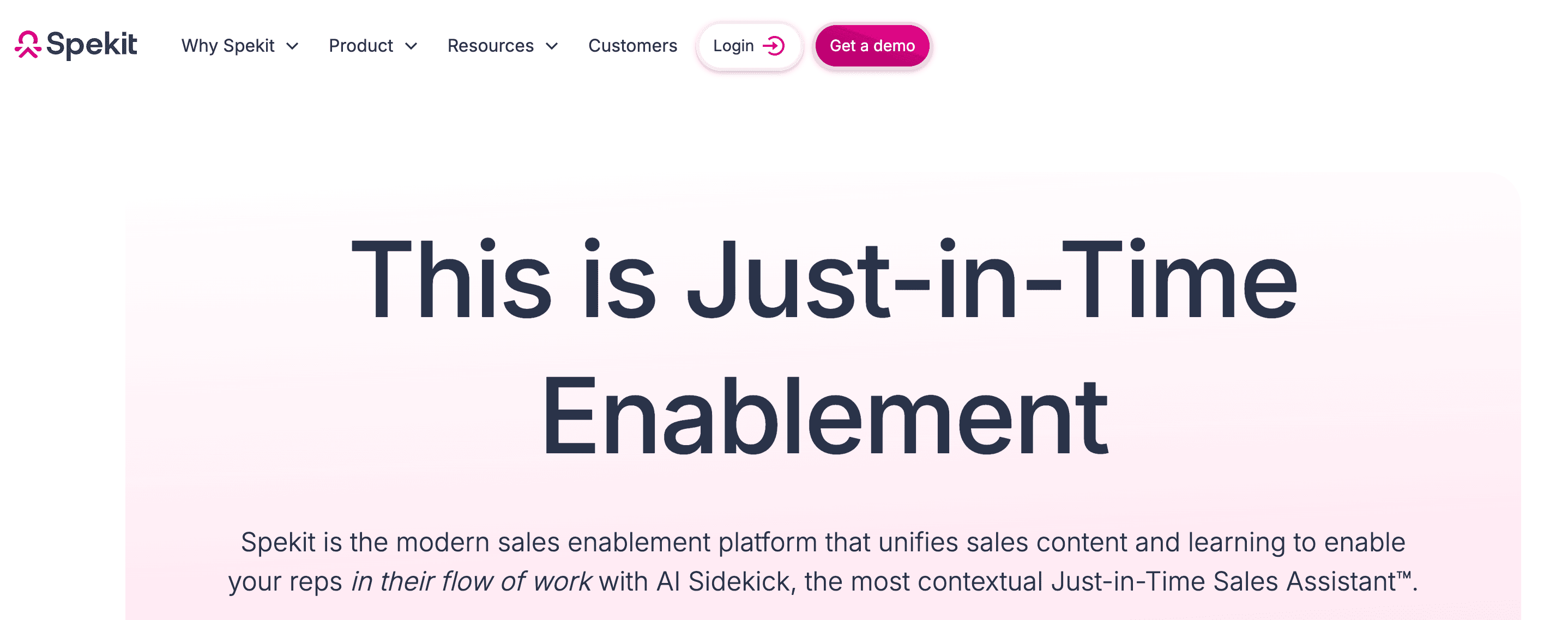
Spekit is an AI-powered sales enablement platform. Spekit centralizes everything related to enablement and makes it easy for sellers to find the answers, training, and content they need – whenever and wherever they need it.
Key AI Capabilities
-
SpekitAI: Automatically generates training content, summaries, and knowledge base articles from existing documentation to speed up content creation.
-
AI-Driven Search: allows reps to ask questions in natural language and receive instant, summarized answers within their workflow.
Notable features
-
Delivers "just-in-time" learning through in-app overlays and pop-ups directly within tools like Salesforce and Slack.
-
A central knowledge base ensures that process changes and new information are instantly available to the entire team.
-
Bite-sized training cards ("Speks") make information easier to consume and retain than long-form documents.
Cons
-
Heavy reliance on browser extensions can lead to conflicts with web pages
-
Reporting and analytics are less advanced than full LMS platforms
-
Not a standalone learning platform for complex training needs
11. Whatfix: Best for digital adoption
G2 Rating
4.6 out of 5 (Read Reviews)
Price
Contact the company for personalized pricing information.
Description
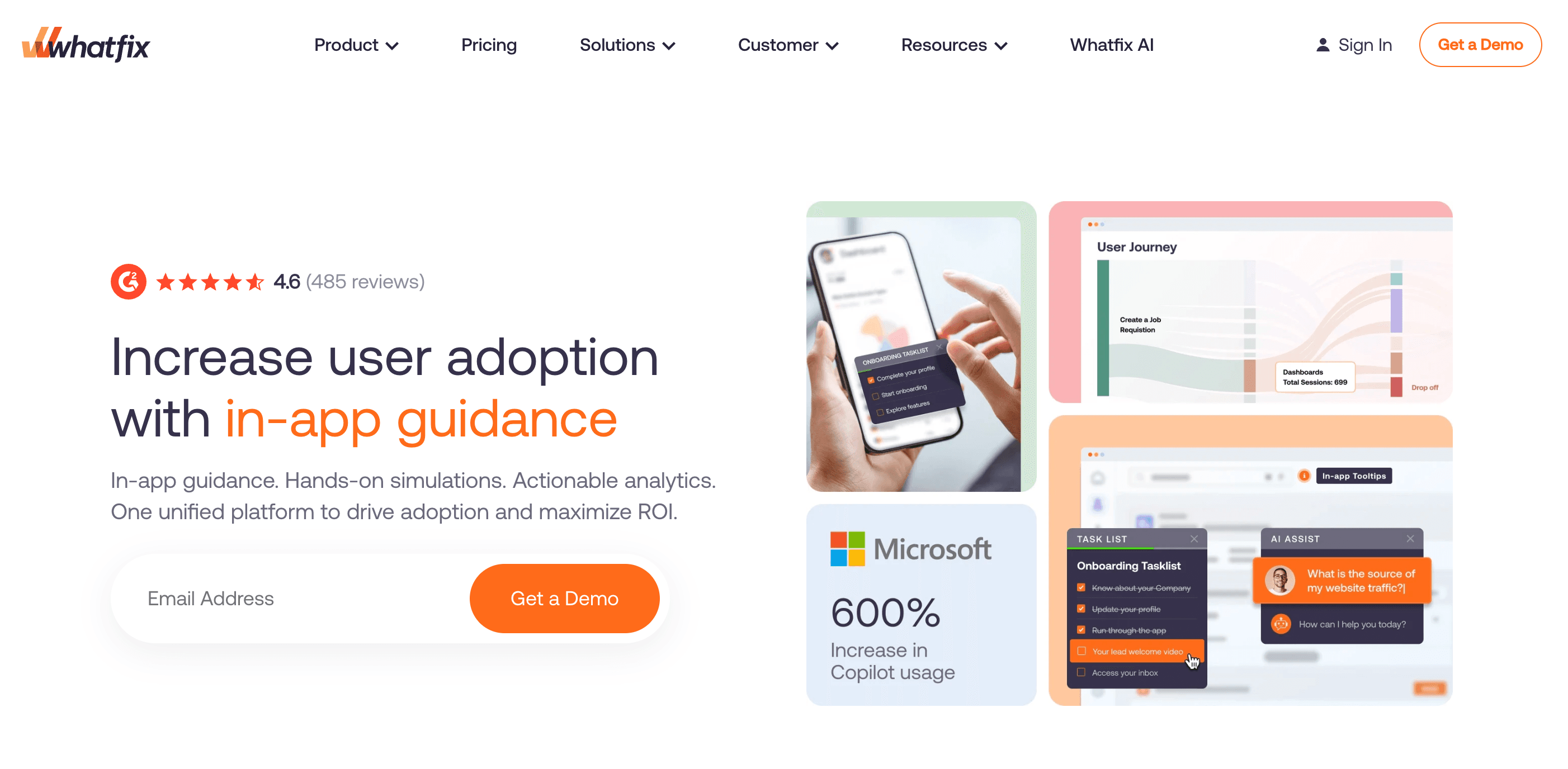
Whatfix is a digital adoption platform that helps companies onboard, support, and train their application users. With Whatfix, businesses can create and deliver customized content – such as videos, help tips, links, and text – within the app experience. Users don’t have to leave the platform to get the information they need, which increases user engagement.
Key AI Capabilities
-
Product Analytics AI: Analyzes user behavior to suggest where guidance or training is needed within the software.
-
AI-driven contextual guidance: Automatically delivers personalized, in-the-moment walkthroughs and tips based on user actions to improve adoption and reduce friction
Notable features
-
In-app guidance enables users to learn within the flow of work.
-
Self-help, which integrates with existing knowledge repositories, provides users with quick answers whenever a question arises.
-
In-app surveys collect user feedback to inform product and process optimizations.
-
Guidance analytics help you understand how users are engaging with in-app content.
Cons
-
Designed more for digital adoption than full sales enablement
-
Initial setup and onboarding can be difficult for some teams
-
Users cite a significant learning curve to use all features effectively
-
Interface isn’t always intuitive for new users
12. Outreach.io: Best for sales execution
G2 Rating
4.3 out of 5 (Read Reviews)
Price
Outreach offers multiple pricing packages.
Description
Outreach is a “sales execution platform” that increases sales productivity and empowers sales teams to create and close more pipeline. Outreach equips teams with AI-powered workflows to understand what steps to take when and which messages will resonate with which prospects. AI also streamlines tedious, time-consuming work so sellers can focus on engaging with prospects.
Key AI Capabilities
-
Kaia: An AI sales assistant that joins meetings, takes notes, and surfaces real-time battle cards during calls.
-
AI-powered deal and activity insights: Analyzes sales activities, engagement signals, and pipeline data to recommend next-best actions and improve deal execution.
Notable features
-
Sequences and playbooks empower sellers to build a healthy pipeline.
-
Conversation intelligence helps sellers pinpoint trends, competition, and deal threats.
-
Rich insights help teams prioritize winnable opportunities, identify at-risk deals, and take action to increase win rates.
Cons
-
Missing key training and onboarding capabilities compared to dedicated enablement tools
-
Steep learning curve impacting adoption and productivity
-
Technical issues reported, affecting reliability
-
Integration challenges with other systems
13. Klue: Best for competitive intelligence
G2 Rating
4.8 out of 5 (Read Reviews)
Price
Klue does not publish pricing information.
Description
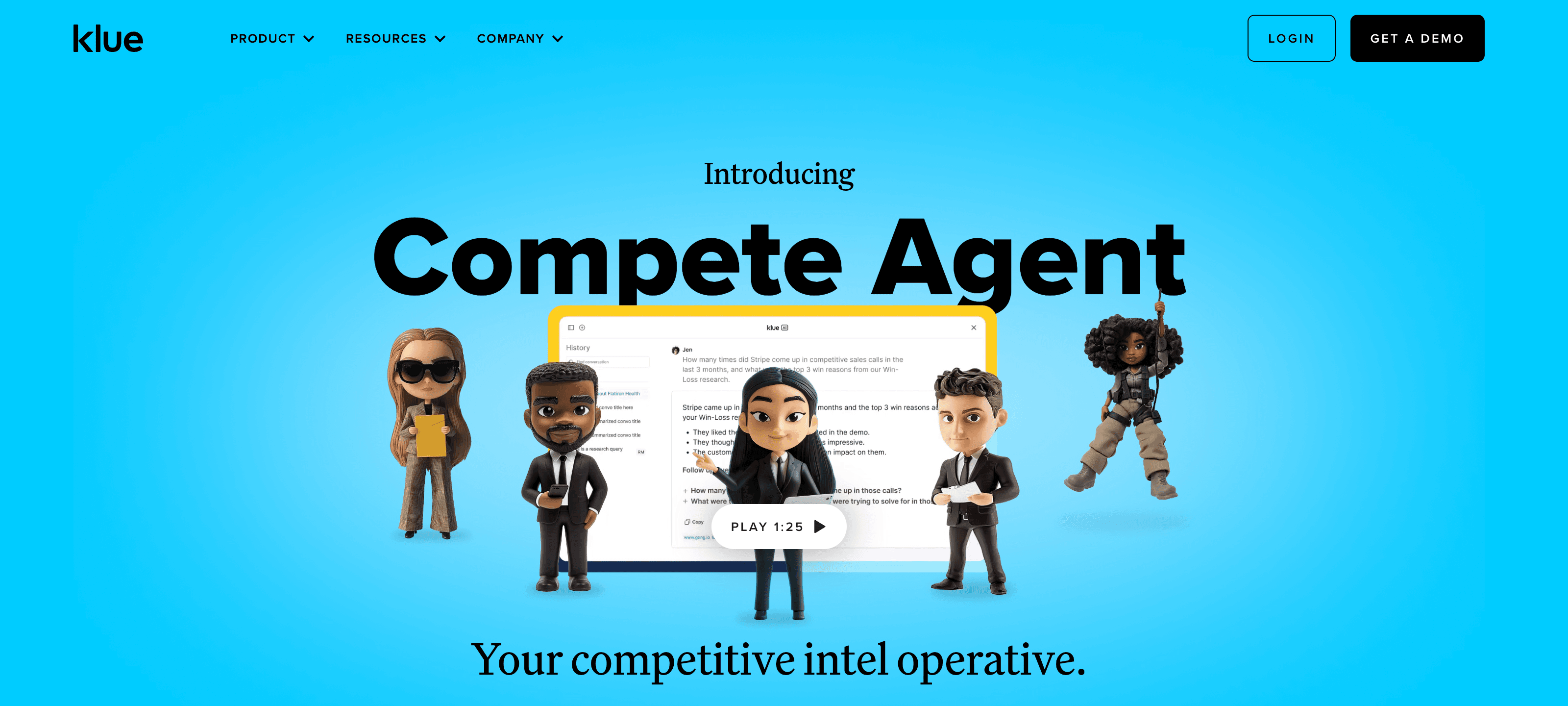
Klue is a competitive intelligence solution that combines market, competitor, and buyer insights into one AI-powered platform. With Klue, businesses understand what they’re up against and what they need to do to win.
Key AI Capability
- AI Summarization: Digests millions of news articles and competitor pages to provide concise battle cards for reps.
Notable features
-
Competitor tracking from millions of sources – all in one platform.
-
Battlecards and other content feature quick-hit competitive insights that help sellers position their solution as the best choice.
-
In-depth reporting on your competitive program’s ROI can help you make data-based optimizations.
Cons
-
Lacks training and onboarding features typical of enablement platforms
-
User interface can feel confusing across different modules
-
Users feel some features are incomplete or missing
-
Limited customization options for workflows and dashboards
14. SalesHood: Best for peer learning
G2 Rating
4.6 out of 5 (Read Reviews)
Price
Starts at $40 per user per month.
Description
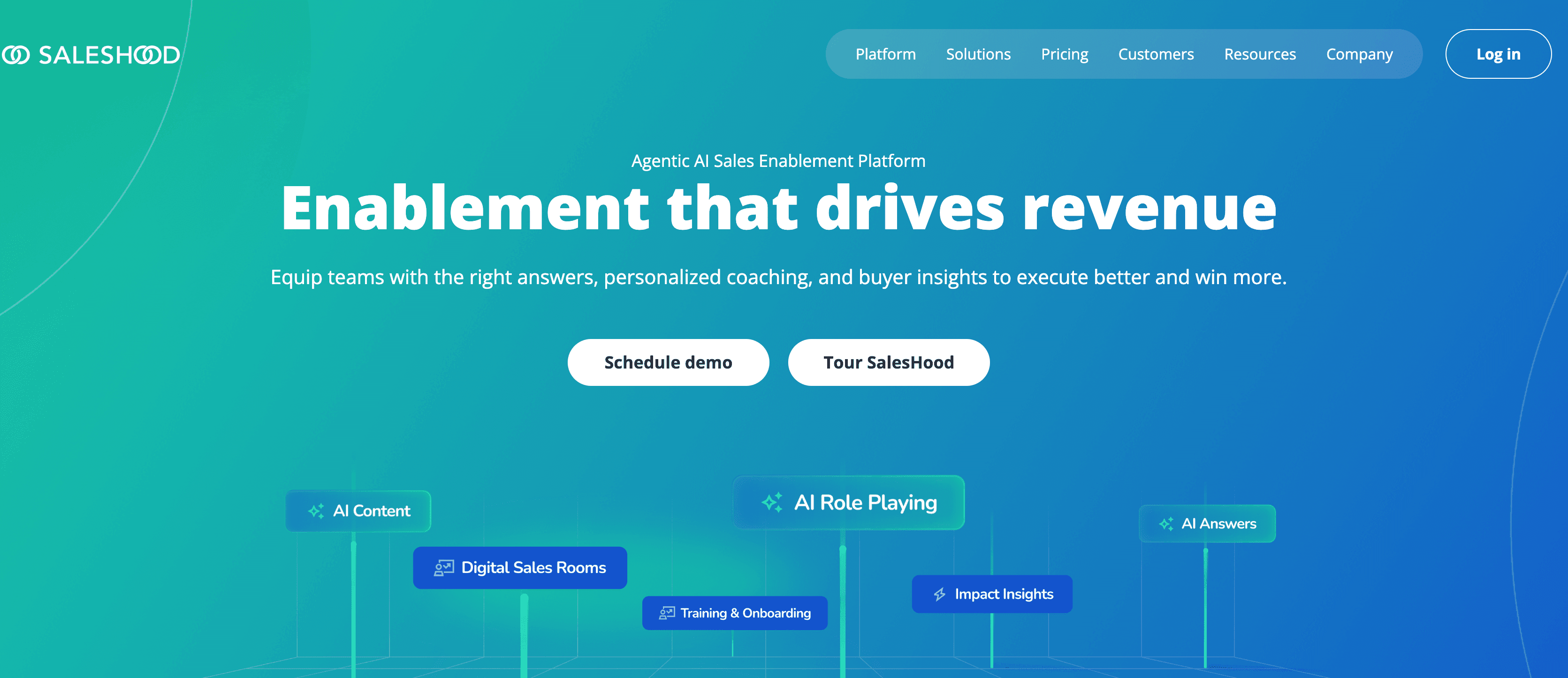
SalesHood is a revenue enablement tool that helps sellers understand what to do and what to share to effectively engage buyers throughout the purchase journey. SalesHood incorporates many sales enablement components, including sales content, answers, digital sales rooms, training, and coaching – all in one, integrated platform.
Key AI Capability
- AI Coach: Provides automated feedback on pitch practice, checking for keywords, pace, and sentiment.
Notable features
-
Digital sales rooms enable reps to deliver engaging buying experiences and track prospects' engagement with content.
-
Sales content management capabilities enable organizations to centralize and organize all content in a single location and understand its impact on sales outcomes. AI also provides recommendations to help sellers share content that resonates with buyers.
-
AI-powered role plays allow sellers to practice and hone their pitches.
-
Robust reporting and analytics help you understand the impact of enablement, enabling you to optimize programs accordingly.
Cons
-
Navigation challenges due to the number of features and modules
-
Users find the platform overwhelming when first using it
-
Customization options are limited compared with other unified suites
15. Guru: Best for knowledge management
G2 Rating:
4.7 out of 5 (Read Reviews)
Price:
Starts at $15 per user per month.
Description
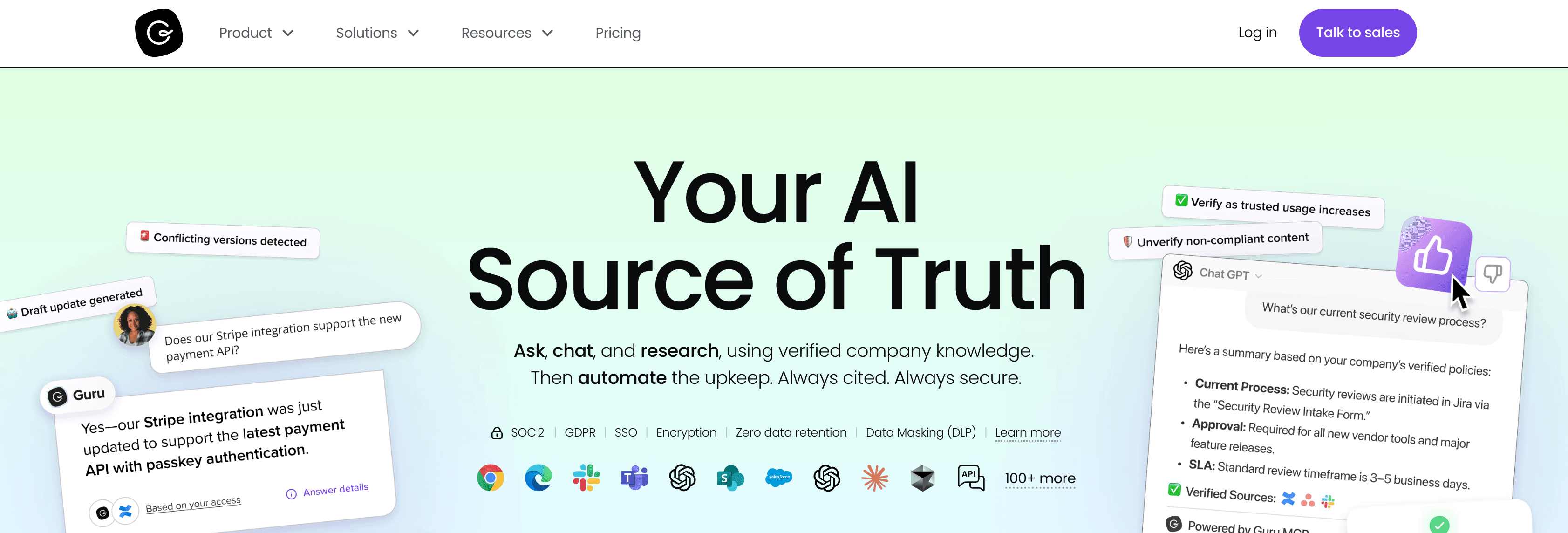
Guru is an AI-powered knowledge management platform that enables users to get answers and assistance right within the flow of work. That means your sellers can spend less time switching between tools to hunt down information and answers and more time engaging with buyers and closing deals.
Key AI Capability:
- Answers: An AI-powered search that allows reps to ask natural language questions and get verified answers from the company wiki.
Notable features
-
Provides a single source of truth by connecting existing apps.
-
Generative AI makes it easy to create new content.
-
Integrates with existing tools and technologies, including Slack, Google Chrome, ChatGPT, OneDrive, Salesforce Service Cloud, and more.
-
Enterprise governance keeps your knowledge safe and sound.
Cons
-
Lacks core training and onboarding capabilities that many enablement teams need
-
Search can return too many results, making it hard to find the right content
-
Difficulty surfacing the most relevant answers quickly
16. Intercom: Best for customer support enablement
G2 Rating
4.5 out of 5 (Read Reviews)
Price
Starts at $39 per user per month.
Description
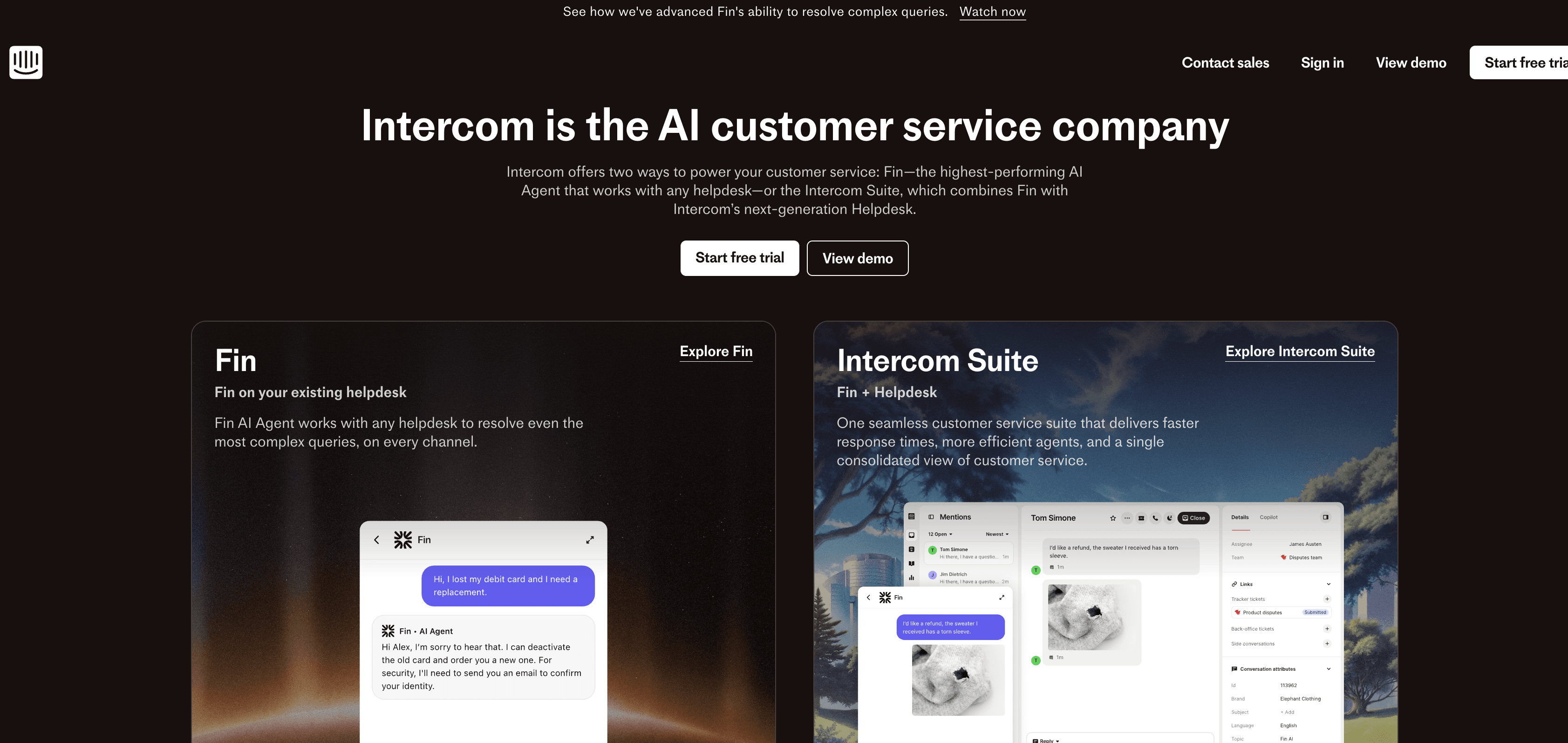
Intercom is an AI-first customer service solution that enhances the customer experience and increases operational efficiency. With Intercom, customers get fast, accurate answers to most questions, and agents no longer have to dig around for answers and information.
Key AI Capability:
- Fin AI Agent: An AI chatbot that instantly resolves customer challenges and provides fast, accurate answers.
Notable features
-
Fin AI Agent, Intercom’s chatbot, instantly resolves customer challenges and provides fast, accurate answers, decreasing case volume for live agents.
-
AI tools enable your agents to find quick answers so they can spend less time hunting down information and more time fostering relationships with customers.
-
Reporting and insights enable organizational leaders to pinpoint opportunities for improvement.
-
Intercom integrates with over 100 apps.
Cons
-
Not focused on sales enablement, so missing key enablement features
-
Users note the absence of CRM health metrics needed for deeper insights
-
Integration challenges with some external systems and workflows
17. Storylane: Best for interactive demos
G2 Rating
4.8 out of 5 (Read Reviews)
Price
Paid editions start at $40 per user per month.
Description
Storylane is a sales enablement tool that allows sellers to build interactive demos for prospects. With Storylane, you can create a frontend copy of your product, edit it without code, add widgets to call out specific product elements, and share with prospects.
Key AI Capability
- AI Demo Generation: Helps create demo flows and text automatically to speed up the creation of sales assets.
Notable features
-
Sandbox demos create an instant copy of your app in a customizable environment.
-
Demo hub allows prospects to explore different use cases – all in one spot.
-
Rich insights allow sellers to understand how prospects engage with demos and which are most likely to convert.
Cons
-
Does not include training and onboarding capabilities typical in enablement platforms
-
Some users experience technical issues during setup
-
User interface could be more intuitive, especially for beginners
18. HubSpot Sales Hub: Best for SME CRM
G2 Rating
4.4 out of 5 (Read Reviews)
Price
Various tiers available.
Description
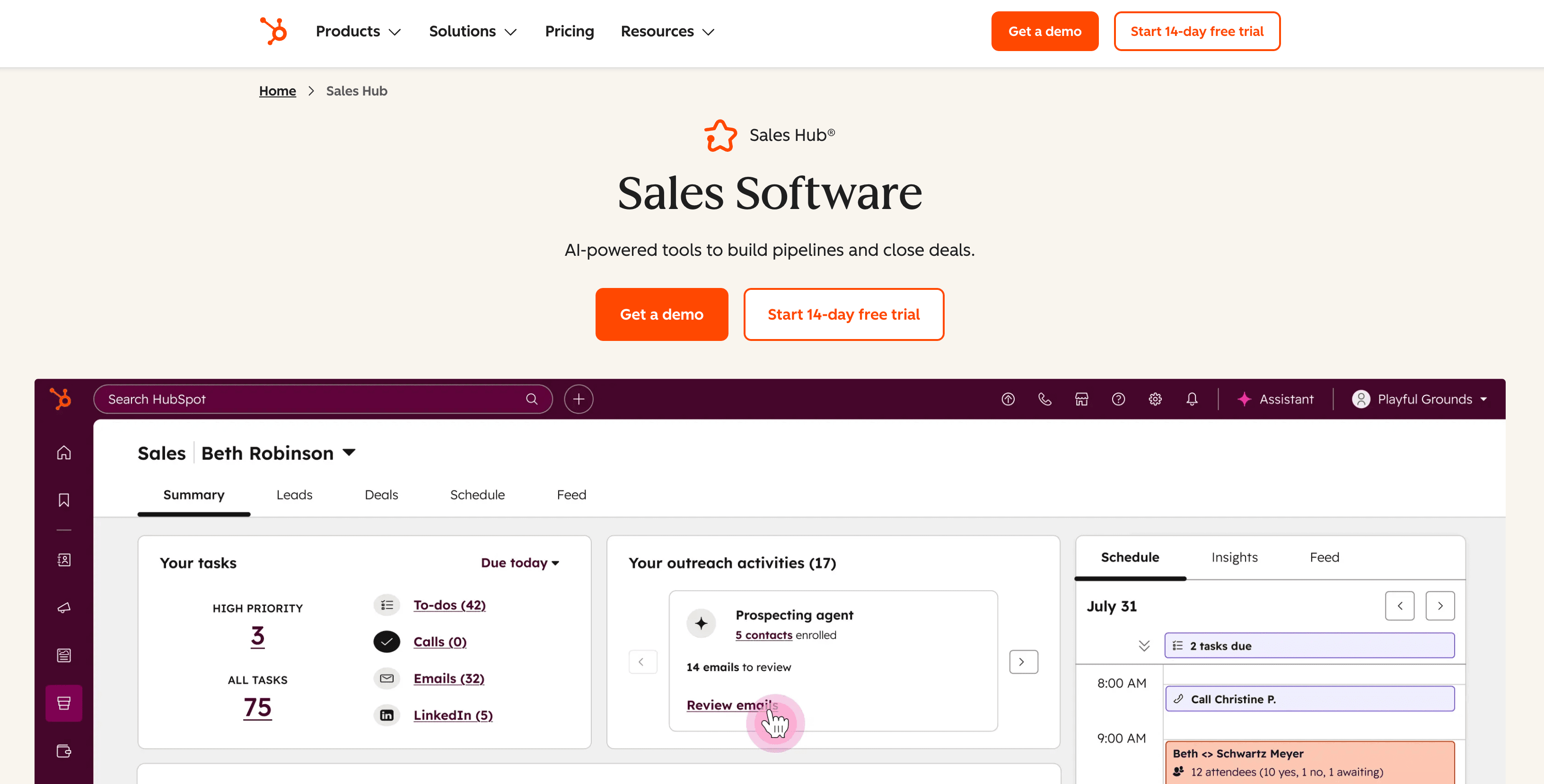
HubSpot Sales Hub is a customer relationship management (CRM) platform. Its free plan includes content management capabilities so sellers can access the right content at the right time. Enablement content, such as playbooks and battle cards, can help sellers engage buyers and close more deals.
Key AI Capabilities
- ChatSpot: A conversational AI bot that allows you to ask your CRM questions and draft follow-up emails.
Notable features
-
Email templates that can be personalized to each sales scenario, as well as AI to help sellers draft communication.
-
Content management so sellers can find what they’re looking for and understand how it’s used.
-
Automated workflows so sales reps never miss a beat.
-
Integration with myriad other sales enablement tools.
Cons
-
Not a standalone sales enablement solution; core training features are limited
-
Steep learning curve for new users to master workflows
-
Important features are missing compared with dedicated platforms
-
Higher cost when stacking advanced functionality
-
Can require additional tools to fill enablement gaps
19. Salesforce: Best for enterprise CRM
G2 Rating
4.4 out of 5 (Read Reviews)
Price
Varies across different tiers.
Description
Salesforce is a widely used customer relationship management (CRM) platform that supports various business functions, including sales, marketing, and service. It offers powerful tools to manage customer interactions and streamline sales processes.
Key AI Capability
- Einstein GPT: Generative AI that powers predictive forecasting, email drafting, and opportunity scoring across the platform.
Notable features
-
Lead and opportunity management to track prospects through every stage of the funnel.
-
AI-powered Einstein analytics to provide predictive insights and recommendations.
-
Customizable dashboards and reports to visualize key sales metrics in real-time.
-
Extensive integrations with third-party tools enable seamless workflows.
Cons
-
Complex setup and ongoing management requirements
-
Steep learning curve for admins and users alike
-
Extensive customization options can overwhelm without expert support
-
Many advanced features require expensive add-ons
-
The total cost of ownership can be high for smaller organizations
Now that we’ve reviewed the leading tools on the market, let’s step back and clarify what a sales enablement platform actually is.
What is a sales enablement platform?
Let’s define a platform before discussing the 19 best sales enablement tools.
Modern B2B buyers have high (and ever-growing) expectations. Meeting those expectations isn’t always easy. Sales enablement is a practice that equips sellers with the sales training, tools, information, and content they need to engage with buyers effectively and efficiently and close more deals.
A sales enablement platform is a software solution that helps organizations build and deliver enablement programs to ensure sellers have what they need to engage buyers and convert more of them into customers.
Some sales enablement tools focus on a single aspect of sales enablement. For example, a learning management system (LMS) focuses on delivering training content, while other enablement platforms focus more on delivering, tracking, and sharing sales content.
There are also integrated sales enablement platforms that address all of the different elements of sales enablement – all in one software solution. Some of the key components to look for in an integrated sales enablement platform include:
-
Sales onboarding
-
Ongoing training
-
Sales coaching
-
Role plays
-
Sales content
-
Conversation intelligence
-
Digital sales rooms
-
Robust data and analytics
Understanding the definition is one thing, but selecting the right platform depends on your specific goals, budget, and workflows.
How do you choose the right sales enablement tool?
There are countless vendors, each offering solutions that promise to increase the effectiveness of your sales enablement program. But not all sales enablement tools are the same. Each has its own set of features, functionality, and support.
How can you choose the right sales enablement tool for your organization? First, consider your organization’s most important use cases.
Let’s examine a few.
Your sales enablement goals and program scope
When choosing sales enablement tools, you must consider your sales enablement program's goals and scope. Then, you can look for a sales enablement solution with features and functionality that’ll properly support your program and help you achieve your sales enablement goals.
For example, if content delivery, sharing, and tracking are part of your sales enablement purview, be sure to find a solution with robust sales content management capabilities and analytics.
Your budget
Nearly all sales enablement tools have a cost. It’s important to find one that fits your budget. But don’t make your decision solely based on price. It’s important to determine the value of a solution for your business.
Point vs. integrated sales enablement tools
Some organizations use different tools to address different aspects of sales enablement. For example, they might use different tools for sales content management, training, and coaching.
But, using disparate tools may not be the right approach to achieving your sales enablement goals. A recent survey found that around 70% of sales reps are overwhelmed by the number of tools they’re expected to use to do their jobs. Also, according to a report, sellers who feel overwhelmed by technology are 43% less likely to meet their quotas.
Many go-to-market organizations are streamlining their tech stacks (and increasing adoption) by investing in an integrated sales enablement solution. These all-in-one solutions holistically address the many elements of sales enablement – all from one platform.
To ensure this list reflects real-world value, not just feature checklists, here’s how we evaluated each platform.
How we selected these platforms (2026 methodology)
With over 1,000+ tools in the sales tech landscape, choosing the right platform is no longer about just checking boxes. To curate this list of the top 19 platforms for 2026, we analyzed vendors based on four critical maturity criteria that define the modern revenue enablement category:
-
AI Maturity and Practicality: We looked beyond generic AI buzzwords. We selected platforms that use AI for practical, time-saving tasks—specifically automated role-plays, instant content creation, and predictive revenue signaling.
-
Integration Depth: A tool is only as good as its workflow. We prioritized platforms that offer deep, bi-directional sync with major CRMs (Salesforce, HubSpot) and collaboration tools (Slack, Microsoft Teams), ensuring data flows seamlessly between your systems of record and systems of action.
-
Verified User Sentiment: We analyzed 2025-2026 data from G2 and TrustRadius, specifically filtering for Enterprise and Mid-Market reviews to ensure these tools scale effectively. We paid special attention to "Ease of Admin" scores, as this is often the #1 cause of shelfware.
-
Revenue Impact vs. Feature Bloat: We distinguished between Point Solutions (great for a single task, like call recording) and Unified Platforms (great for connecting training to revenue). The tools on this list are ranked not just by features, but by their ability to prove ROI through data.
Supercharge your sales performance with the right sales enablement platform
When done well, sales enablement can have a large, measurable impact on the metrics that matter most to your business. But a winning sales enablement strategy requires the right tools.
There’s no one-size-fits-all sales enablement tool that’ll work for every organization. But it’s important to remember that many sales enablement tools are point solutions. In other words, they address a single element of sales enablement – such as conversation intelligence or sales training.
Consider streamlining your tech stack by replacing point solutions with an integrated revenue enablement platform like Mindtickle.
With Mindtickle, your sellers always have the training, tools, and AI-powered insights they need to build the right skills to engage buyers effectively and efficiently. Also, when all your sales enablement lives under one roof, it’s easy to holistically measure the impact of your programs so you can optimize them for even bigger results.
See Mindtickle in Action
Now that you've seen what's on the market, are you ready to see what makes winning sales orgs choose Mindtickle as their revenue enablement platform? Request Your Demo!
Frequently asked questions
What features define the best AI sales enablement software?
The best AI sales enablement platforms go beyond simple automation. Look for Generative AI to create training content and emails, Conversation Intelligence to analyze call sentiment, and Predictive Analytics to forecast deal health and rep readiness. A top-tier platform like Mindtickle combines all three to provide a holistic "readiness" score.
How does Generative AI specifically improve sales coaching?
Generative AI transforms coaching from reactive to proactive. Instead of waiting for a manager to review a call, AI tools can instantly generate a simulated role play scenario based on a real customer objection. It then acts as the buyer, listens to the rep's pitch, and provides immediate, objective feedback on tone, keywords, and handling — scaling coaching across the entire organization.
What is the difference between sales enablement and revenue intelligence AI?
Sales Enablement AI focuses on preparing the seller (training, content, coaching) while Revenue Intelligence AI focuses on analyzing the deal (forecasting, pipeline health, call recording). Integrated platforms are now merging these two categories, using intelligence data to automatically trigger enablement actions.
Can AI sales tools replace human sales managers?
No, AI tools are designed to be a copilot, not a replacement. AI handles the data crunching, grading of standard role-plays, and surfacing of insights. This frees up human managers to focus on high-level strategy, complex deal negotiations, and the emotional intelligence aspects of mentorship that software cannot replicate.
How does AI impact the ramp time for new sales reps?
AI drastically reduces ramp time by personalizing the onboarding experience. Instead of a "one-size-fits-all" course, AI analyzes a new rep's baseline skills and tailors their learning path. AI-driven "just-in-time" learning surfaces answers and battle cards exactly when a rep needs them during a deal, allowing them to sell effectively while continuing to learn.
Do AI enablement platforms integrate with CRMs like Salesforce?
Yes, deep integration is standard for top AI tools. Platforms like Mindtickle, Seismic, and Highspot integrate directly with Salesforce and HubSpot. They use data from your CRM (deal stages, win rates) to train their AI models, ensuring that coaching and content recommendations are aligned with actual revenue outcomes.
Is my proprietary sales data safe with AI tools?
Enterprise-grade AI sales platforms are built with strict governance and security protocols (SOC 2, GDPR). Unlike open public AI models, these vendors typically use "walled garden" approaches where your sales data is used to train your instance of the AI, ensuring your competitive secrets and customer data remain private.