




What Is a Virtual Sales Room: Everything You Need to Know



Enterprise deals involve multiple stakeholders, long evaluation cycles, and a steady flow of content, conversations, and decisions. Buyers need a simple way to access information, collaborate internally, and stay aligned throughout the purchasing process. Sales teams need visibility into engagement and confidence that momentum is building between meetings.
A virtual sales room brings both sides together in a shared digital workspace built around the deal. It centralizes communication, content, action items, and buyer activity in one place. As digital selling becomes the standard, revenue teams increasingly rely on virtual sales rooms to create better buying experiences and move deals forward with greater consistency.
In this guide, you'll learn what virtual sales rooms are, how they work, and how leading sales organizations use them to improve buyer engagement and accelerate revenue, with data points to support it.
Key Takeaways
- The best virtual sales rooms do more than share content. Features like buyer engagement intelligence, Mutual Action Plans, CRM integrations, AI-powered insights, and enterprise-grade security help revenue teams manage deals more effectively.
- Buyer engagement data is a key advantage of virtual sales rooms. Understanding who is engaging, what they're consuming, and how stakeholders participate helps sellers make more informed decisions.
- The future of virtual sales rooms lies in connected revenue execution. When buyer engagement signals connect to coaching, AI guidance, and sales workflows, revenue teams can turn insights into action.
What is a virtual sales room?
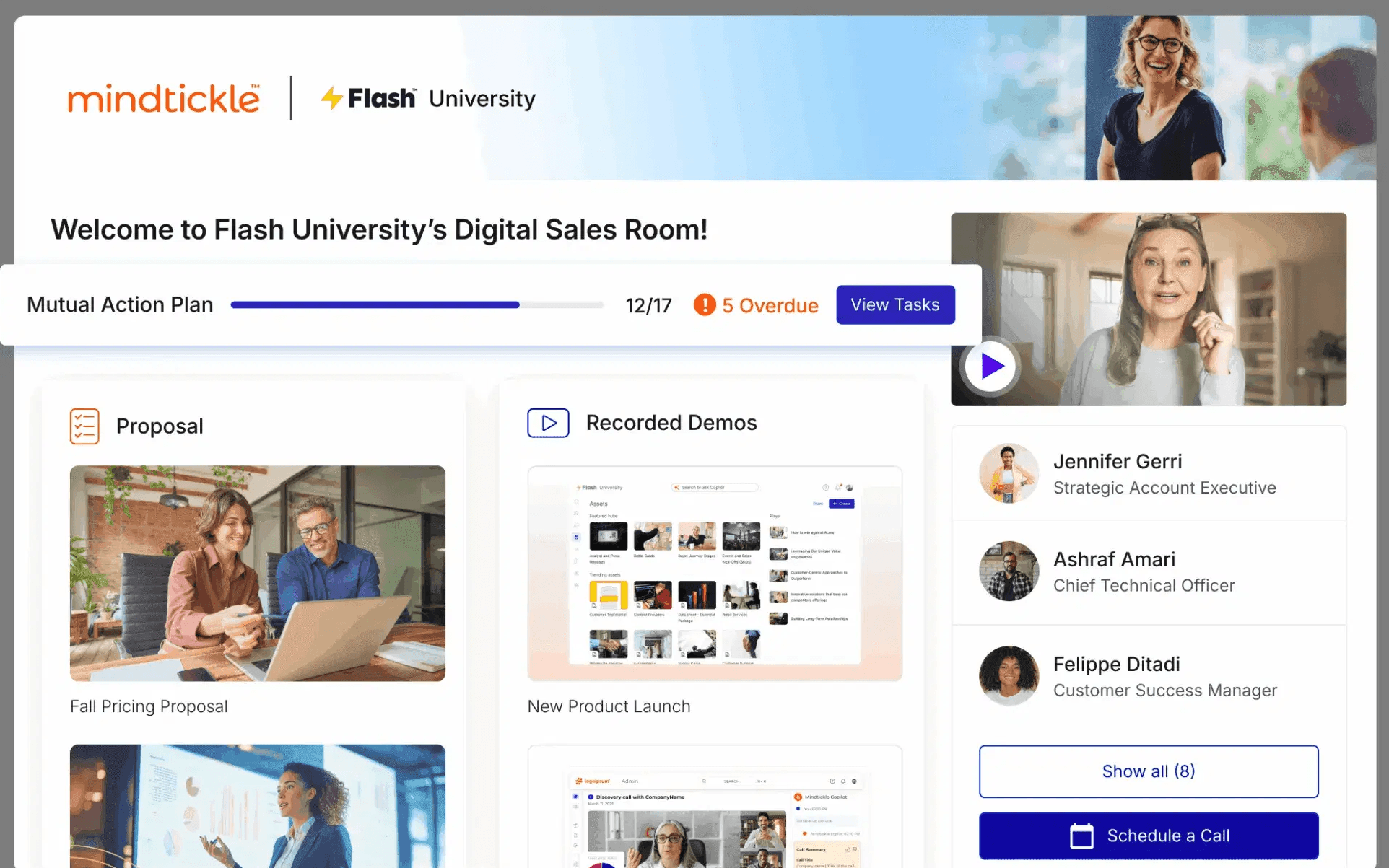
A virtual sales room, or digital sales room (DSR), is a secure digital workspace where buyers and sellers collaborate throughout the sales process. It serves as a central hub for conversations, content, meeting recordings, action plans, timelines, and stakeholder communication related to a specific deal.
Unlike email threads, shared folders, or standalone content portals, a virtual sales room brings every deal-related interaction into a single, organized environment. Buyers can easily access the information they need, involve internal stakeholders, revisit discussions, and track next steps. Sellers gain visibility into how stakeholders engage with content, which resources attract attention, and where buying momentum is building or slowing down.
What's driving the adoption of digital sales room software?
Today's purchase decisions involve larger buying committees, longer evaluation cycles, and greater scrutiny from multiple stakeholders. According to Forrester's The State of Business Buying, 2024 Report, the average B2B purchase today involves 13 stakeholders, and nearly 89% of purchases involve two or more departments.
At the same time, buyers increasingly prefer self-service access to information. They expect the same convenience and transparency in B2B purchases that they experience as consumers. Constantly searching through email chains, requesting documents, or scheduling meetings to find answers creates friction in the buying journey.
Virtual sales rooms address these challenges by giving every stakeholder a shared source of truth throughout the deal lifecycle. Virtual sales rooms help you:
- Improve stakeholder alignment across complex buying groups
- Create a more structured and consistent buying experience
- Increase visibility into buyer engagement and content consumption
- Reduce friction caused by scattered communications and resources
- Keep deals moving between meetings and sales interactions
- Accelerate decision-making through better collaboration and transparency
💡 Do you know
According to Gartner, by 2028, 30% of all B2B sales cycles will be primarily run through a Digital Sales Room, which will be used to manage the entire customer lifecycle.
Source: State of Agentic Revenue Enablement 2026 report
Essential features of virtual sales rooms
Not all virtual sales rooms are created equal. The best platforms do more than organize content. They help buyers navigate complex purchasing decisions while giving revenue teams the visibility, intelligence, and structure needed to move deals forward. Here are the capabilities that matter most.
Centralized buyer-seller collaboration
A virtual sales room should act as the single destination for everything related to a deal. Buyers need easy access to presentations, recordings, documents, next steps, and key contacts without searching through email threads or shared drives. When all stakeholders can collaborate from a shared workspace, communication becomes clearer, alignment improves, and decision-making becomes easier.
Mutual action plans (MAPs)
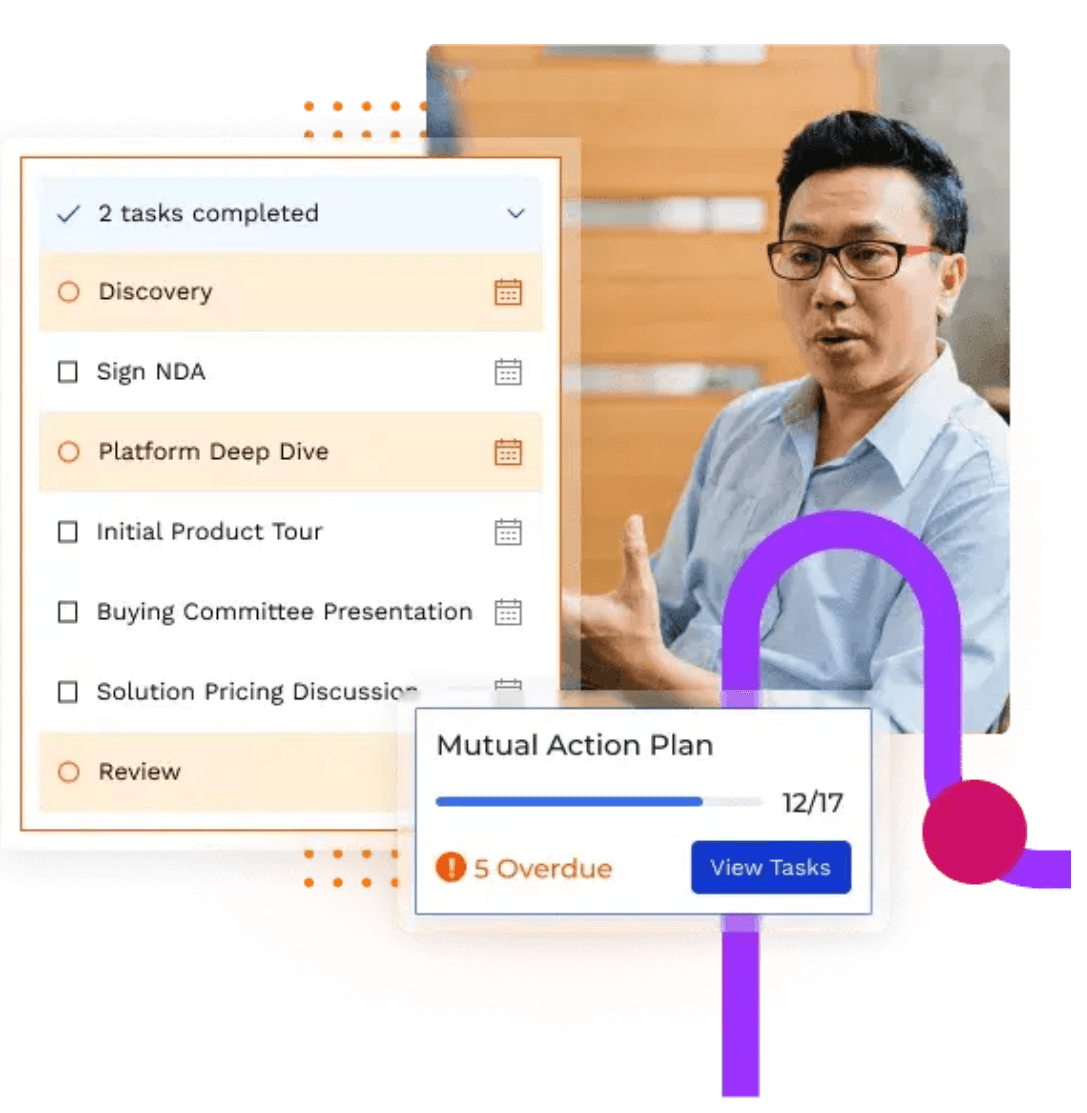
Complex deals often involve dozens of tasks, approvals, and dependencies across multiple teams. Built-in mutual action plans help buyers and sellers stay aligned on milestones, responsibilities, and timelines throughout the sales cycle. A shared view of progress creates accountability and helps maintain momentum from discovery through close.
💡 Do you know:
Mutual action plans (MAP) or next actions are critical to virtual sales rooms' engagement and effectiveness. Rooms with a MAP get twice as many visits as those without because a next step gives buyers a reason to return. A room without one is a document drop. A room with one is a live deal.
Source: State of Agentic Revenue Enablement 2026
Buyer engagement intelligence
One of the biggest advantages of a virtual sales room is visibility into what happens between meetings. Look for platforms that provide stakeholder-level engagement insights, including content consumption, activity trends, and participation across the buying committee. These signals help sellers identify engaged stakeholders, uncover gaps in buyer involvement, and better understand deal health.
AI-powered deal intelligence
Buyer activity generates valuable signals. The right digital sales room platform helps sellers turn those signals into action. AI-powered insights can highlight engagement patterns, surface recommended content, identify influential stakeholders, and flag opportunities that may require attention. This helps your sales team prioritize their efforts and engage buyers with greater precision throughout the deal cycle.
CRM integration and stakeholder visibility
A digital sales room software should fit naturally into existing sales workflows. Seamless CRM integration ensures buyer engagement data, stakeholder activity, and deal interactions remain connected to opportunity records. Advanced platforms can also help uncover previously unknown stakeholders, giving sellers a more complete view of the buying committee.
Reusable room templates
Consistency matters, especially across large sales organizations. Pre-built room templates allow you to standardize messaging, content, and best practices while reducing setup time for sellers. Reps can launch professional, buyer-ready deal rooms in minutes without starting from scratch.
Enterprise-grade security and governance
Enterprise deals often involve sensitive business information, including pricing, contracts, implementation plans, and procurement documents. Look for capabilities such as role-based permissions, single sign-on (SSO), dynamic watermarking, audit trails, and secure access controls. Strong governance protects your confidential information while maintaining a seamless buyer experience.
Deal-to-customer continuity
The customer journey doesn't begin after the contract is signed. It continues from the conversations that happened during the sales process. Leading virtual sales rooms support a smooth transition from sales to team onboarding and customer success by preserving documents, decisions, action plans, and stakeholder context. This continuity reduces friction and helps you deliver a more connected experience from day one.
📖 Read more: How Digital Sales Rooms Help Reps Win More Deals
How a virtual sales room works across the sales cycle
A virtual sales room is not a static repository of files. Instead it evolves alongside the deal, adapting to the needs of buyers, sellers, and stakeholders at each stage of the purchasing journey.
Early stage: Establishing alignment
Following an initial discovery conversation, the seller creates a dedicated space for the deal and populates it with relevant content, meeting recordings, introductions, and next steps.
Instead of relying on stakeholders to forward emails or summarize conversations, buyers can access a single source of truth from the start. Internal champions can share information confidently while preserving the context behind the seller's recommendations. At this stage, the virtual sales room helps establish alignment and creates a foundation for future collaboration.
Middle stage: Understanding buyer engagement
As the evaluation progresses, additional stakeholders begin participating in the buying process. Some join meetings directly. Others engage independently by reviewing content, proposals, technical documentation, or implementation plans.
Engagement insights provide sellers with visibility into these interactions. For example, repeated activity around security documentation may indicate that risk and compliance teams are becoming actively involved in the evaluation.
This visibility helps sellers identify emerging priorities, tailor follow-up conversations, and engage the right stakeholders at the right time.
💡 Do you know:
Top-performing reps build DSRs early and buyers show up fast. Quota-hitting reps build DSRs within hours of a discovery call. Half of all buyers visit the DSR within 24 hours of its creation.
Source: State of Agentic Revenue Enablement 2026
Late stage: Driving decision readiness
As deals move toward validation, procurement, and final approval, coordination becomes increasingly important. Mutual action plans help buyers and sellers stay aligned on deliverables, timelines, approvals, and decision milestones. Technical reviews, security assessments, proof-of-concept activities, and commercial discussions can all be managed from a shared workspace.
By the time executive stakeholders and economic buyers become involved, they can quickly access the business case, supporting documentation, stakeholder discussions, and agreed-upon next steps in one location. The result is a clearer path to consensus and a more informed purchasing decision.
👥 Buying committee spotlight
Organizations managing large and complex buying groups often use virtual sales rooms as a central coordination hub. Sirion, for example, supported a Fortune 100 buying committee through a Digital Sales Room that facilitated more than 1,000 hours of buyer engagement across 100+ participants.
Post-sale: Preserving context and continuity
The value of a virtual sales room doesn't end when the contract is signed. The same workspace can support onboarding, implementation, customer success initiatives, and ongoing business reviews. Documents, decisions, action plans, and stakeholder context remain accessible, reducing handoff friction between teams. Rather than starting over after the sale, customers and internal teams continue building on a shared foundation of information and collaboration.
🔭 Inside the deal
GoTo uses Mindtickle Digital Sales Rooms to support high-value deal cycles, creating a more streamlined buying experience for stakeholders while improving engagement throughout the sales process. In their own words:
"We had three deals that were really on the line, totaling just under two million ACV," explained Medeiros. "All three of those deals cited the DSRs as being a competitive advantage because it presented so well and so buttoned up and allowed communication flow to be that much easier."
READ FULL STORY
Who uses virtual sales rooms and when
While virtual sales rooms are often associated with sales teams, their impact extends far beyond individual deal execution. As buying journeys become more complex, multiple customer-facing teams rely on virtual sales rooms to engage stakeholders, coordinate activities, and maintain continuity throughout the deal.
Account executives: Managing complex deals
Account executives typically introduce the virtual sales room early in the sales process. They use it to share content, coordinate stakeholder engagement, manage mutual action plans, and maintain a centralized record of deal activity. As buying committees grow, the room helps AEs keep everyone aligned without relying on long email threads or scattered documents.
Sales engineers: Supporting technical evaluations
Technical evaluations often involve product demonstrations, security reviews, architecture discussions, and proof-of-concept activities. Sales engineers use virtual sales rooms to organize technical resources, answer stakeholder questions, and provide buyers with easy access to documentation throughout the evaluation process.
Revenue leaders: Gaining visibility into deal health
For sales leaders, virtual sales rooms provide a window into buyer engagement that traditional CRM reports often miss. Stakeholder activity, content consumption patterns, and engagement trends can help leaders understand which opportunities are progressing, where deals may be stalling, and which accounts require additional support.
Customer success teams: Ensuring smooth handoffs
Customer success managers use virtual sales rooms to access deal history, stakeholder context, implementation plans, and agreed-upon outcomes. This continuity reduces onboarding friction and helps teams deliver a more seamless customer experience.
Marketing Teams: Delivering buyer-ready content
Marketing teams play an important role in supporting virtual sales room programs. They create and optimize the content that buyers consume throughout the sales cycle, while engagement insights help them understand which assets influence stakeholder participation and buying decisions.
To ensure this content addresses the questions prospects are searching for, teams can analyze search intent and related keywords beforehand. Tools like SE Ranking help marketers identify relevant topics and search terms, enabling them to create more targeted sales room collateral.
How virtual sales rooms connect to a broader revenue system
A virtual sales room generates valuable signals throughout the buying journey. Knowing that a buyer repeatedly viewed a pricing proposal or spent significant time reviewing implementation documentation is useful. Knowing how a seller should respond is even more valuable. This is where virtual sales rooms become part of a broader revenue system.
Mindtickle's Digital Sales Room Platform connects buyer engagement data with ElevateOS™, its AI-powered revenue operating system. By combining buyer activity, conversation intelligence, and sales execution data, the platform helps you identify what is happening in a deal and determine the actions most likely to move it forward.
For example, if buyer engagement suggests that commercial discussions are becoming a priority, sellers can receive targeted coaching and guidance tailored to that stage of the deal. Conversation intelligence can help identify skill gaps, while AI Sales Role Play enables reps to prepare for upcoming conversations using realistic scenarios aligned to their opportunities. During live buyer interactions, sellers can also access real-time guidance and recommendations, helping them apply best practices when they matter most.
Perfect Your Pitch with AI Sales Role Play
The result is a connected revenue system where buyer engagement insights inform seller development, coaching, and execution. Instead of treating deal activity and seller readiness as separate initiatives, you can bring them together to improve both buyer experiences and revenue outcomes.
To experience Mindtickle's virtual sales room, book a demo today!
Win bigger deals faster with digital sales rooms
Frequently Asked Questions
About the Author
Director of Product Marketing
Christian Pieper is the Director of Product Marketing at Mindtickle from 2021.

Subscribe to the blog
Get the latest sales enablement tips, guides, and industry best practices delivered to your inbox. Unsubscribe anytime.