




What Is Buyer Engagement (+KPIs That Actually Matter)



A salesperson can send dozens of emails, run multiple meetings, and update every CRM field, and still have no clear idea whether a deal is actually moving forward.
That's because buyers today conduct research independently, share content internally, compare vendors, and build consensus across multiple stakeholders long before they communicate their intentions to a rep. Revenue teams can easily measure seller activity, but they struggle to measure buyer progress.
Buyer engagement solves this problem.
This article defines what buyer engagement actually means in B2B sales, outlines the KPIs that signal real deal health, and shows how a closed-loop system turns buyer signals into targeted seller action.
Key Takeaways
- Buyer engagement goes beyond activity metrics. The most valuable signals reveal how actively buying groups are evaluating solutions, building internal consensus, and progressing toward a purchase decision.
- The most effective buyer engagement strategies track four dimensions of deal health: content engagement, stakeholder engagement, buying momentum, and decision progression.
- Buyer engagement data becomes more powerful when connected to seller readiness. Combining buyer signals with conversation intelligence, coaching, and AI guidance helps revenue teams improve deal execution and outcomes.
What is buyer engagement?
In B2B sales, buyer engagement is the continuous, measurable interaction between a buying group and a seller's digital or conversational touchpoints. These interactions can include attending meetings, consuming content, responding to outreach, involving additional stakeholders, participating in product demonstrations, or revisiting evaluation materials. The more engaged the buyer, the better the probability of conversion.
Why does buyer engagement matter so much in B2B Sales?
Today, B2B purchasing decisions rarely rest with a single individual. According to Gartner, complex B2B purchases typically involve a buying group of 6 to 10 decision-makers, with some enterprise deals reaching 11 to 20 stakeholders. As a result, revenue teams need visibility into not just whether someone is engaging, but who is engaging, how deeply they're engaging, and whether engagement is spreading across the buying committee. That's what makes buyer engagement such a critical revenue signal.
For sales and enablement leaders, buyer engagement provides a measurable way to understand deal health before revenue outcomes are visible. It helps teams identify momentum, uncover buying committee gaps, prioritize coaching opportunities, and focus attention on opportunities that are genuinely progressing.
Simply put, buyer engagement answers one of the most important questions in B2B sales: Are buyers moving closer to a decision, or just interacting with your team?
Also Read: Your Guide to the B2B Sales Funnel: What is it and How to Optimize Yours
How to Measure Buyer Engagement in 2026
Sales teams have long measured seller output, such as emails sent, calls made, and content shared. These metrics don't correlate to win rates because they track rep activity, not buyer intent. Historically, they made sense because rep activity was the only easily trackable data available, but the B2B buying process has fundamentally changed.
Consider a rep who marks a deal as likely to close based on a strong last call. Meanwhile, the buyer hasn't accessed the shared workspace in three weeks, the champion stopped completing mutual action plan tasks, and two stakeholders who were active early in the evaluation have gone silent. The CRM shows the deal as healthy, but in reality, it's at risk.
This is why revenue teams must trust objective buyer signals over subjective, rep-reported information. The shift that matters is to per-person analytics that measure content consumption patterns, stakeholder involvement, and response behavior tied to deal stage. These behavioral signals tell a rep more about deal health than any CRM field manually updated after a call.
The buyer engagement KPIs that actually matter
To get a complete picture of deal health, you must track four distinct categories of buyer engagement. Each one maps to a critical dimension of how buying decisions are actually made: how buyers interact with information, who is involved in the evaluation, whether the group is building or losing momentum, and how far along they are in committing to a decision.
Content engagement signals
When a buyer spends significant time on a specific asset, such as a pricing page or security document, it reveals where their interest and objections are concentrated, setting the agenda for the next call.
Stakeholder engagement signals
Revenue teams should measure how many stakeholders are actively participating in the buying process, whether engagement spans multiple departments, and whether executive decision-makers are involved. Broad engagement indicates that buyers are building internal consensus, while engagement concentrated around a single champion often creates deal risk.
💡 Do you know
Mindtickle's 2026 State of Agentic Revenue Enablement Report found that Digital Sales Rooms associated with closed-won deals averaged 7 visits per buyer compared to 3.7 visits in lost deals, highlighting the relationship between broader stakeholder participation and successful outcomes.
Buying momentum signals
Revenue teams should track whether buyer activity is growing, remaining steady, or declining over time. Metrics such as buying group activity scores and engagement recency provide an early indicator of deal momentum by aggregating interactions across stakeholders, meetings, content consumption, and Digital Sales Room activity.
✌️ Two Cents from Mindtickle
A healthy deal typically shows consistent engagement from multiple stakeholders throughout the evaluation process. When activity levels decline after a period of strong engagement, it often signals shifting priorities, internal roadblocks, or competitive influence.
Because these changes appear in buyer behavior before they appear in CRM updates or forecast reviews, they give sales teams an opportunity to intervene early. Re-engaging key stakeholders, introducing new value drivers, or addressing unresolved concerns can help restore momentum before the opportunity stalls.
Decision progression signals
Completed tasks signal a buyer moving from evaluation to active commitment. Overdue or stalled tasks signal disengagement, and the rep should address it directly with the champion before it reaches the forecast.
| KPI / Metric | What It Measures | What It Tells Revenue Teams |
|---|---|---|
| Dwell Time | Time spent consuming sales content | Indicates which topics, concerns, or priorities buyers are actively evaluating. |
| Time-on-Page | Engagement with specific assets such as pricing, ROI, implementation, or security content | Reveals where buyers are investing attention and where questions or objections may exist. |
| Buying Group Coverage | Number of stakeholders actively engaging with the deal | Shows whether engagement extends beyond a single champion and reflects organizational interest. |
| Multi-Threading Score | Engagement across departments and functions | Indicates the strength of internal consensus and reduces deal risk associated with single-threaded opportunities |
| Buying Group Activity Score | Aggregate engagement activity across stakeholders over time | Measures whether buyer interest is increasing, stable, or declining. |
| Engagement Recency | How recently stakeholders interacted with content, meetings, or Digital Sales Rooms | Helps identify stalled opportunities before they appear in pipeline reviews. |
| Repeat Visits | Frequency of return engagement with Digital Sales Rooms or deal resources | Indicates sustained buyer interest and ongoing evaluation activity. |
| Mutual Action Plan (MAP) Completion Rate | Percentage of agreed milestones completed | Demonstrates whether buyers are taking concrete actions toward a purchase decision. |
| Milestone Velocity | Time taken to complete evaluation milestones | Measures how efficiently the buying process is advancing. |
| Overdue Tasks | Number of missed or delayed MAP commitments | Highlights potential deal blockers, internal misalignment, or declining commitment. |
💡 How Digital Sales Rooms help in engaging buyers
Measuring buyer engagement is only half the challenge. Revenue teams also need a way to consolidate engagement signals across stakeholders, content, and deal activities — and act on them before momentum fades.
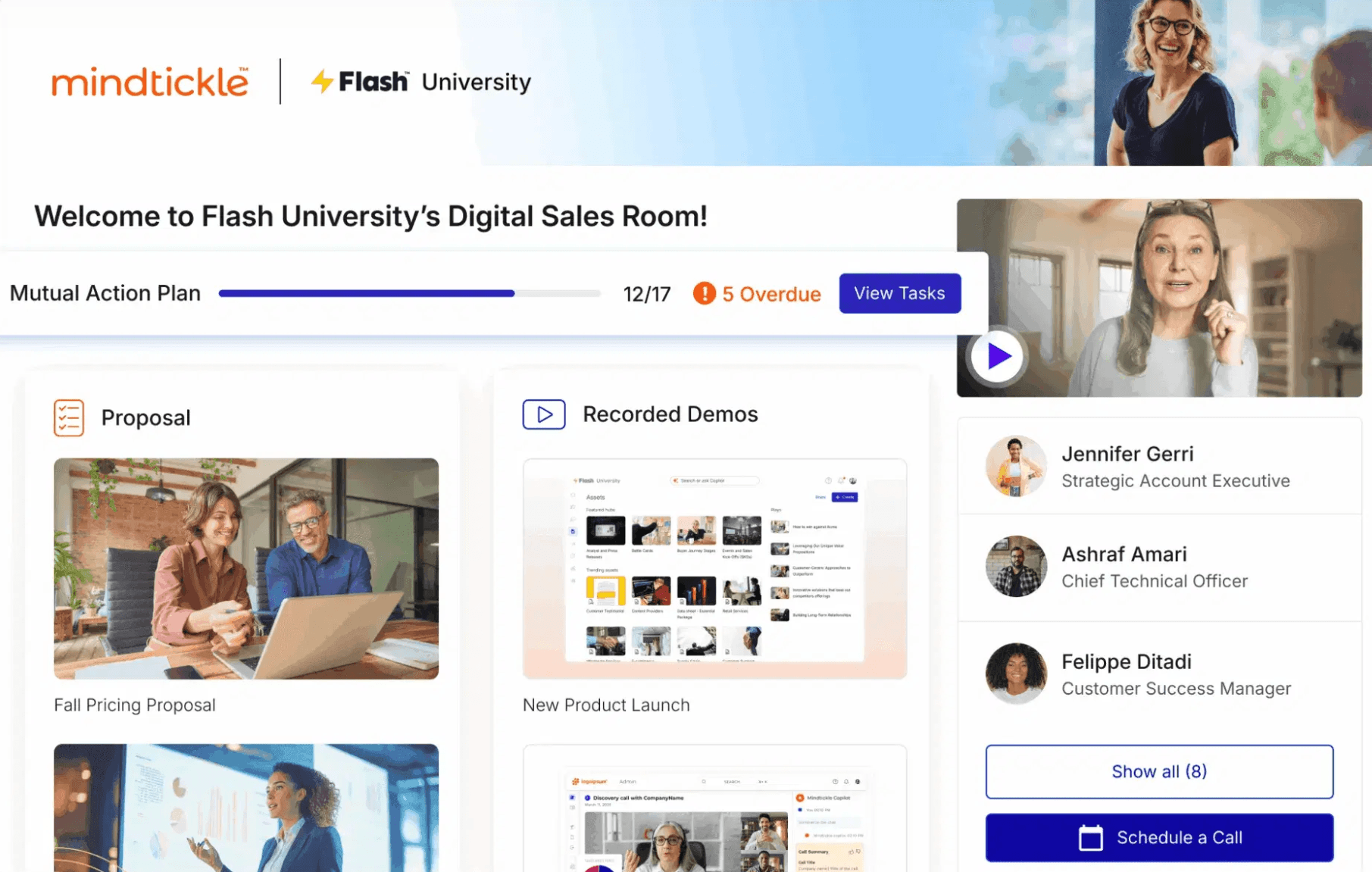
A Digital Sales Room (DSR) helps centralize these interactions in a shared buyer workspace, making it easier to track stakeholder participation, content engagement, buying-group activity, and MAP progress in one place.
Platforms like Mindtickle's Digital Sales Rooms go a step further by combining buyer engagement analytics, mutual action plans, and AI-powered buyer assistance to help sellers identify deal risks earlier and respond based on actual buyer behavior, not CRM assumptions.
Book a Digital Sales Room Demo
How buyer engagement connects to seller readiness and deal outcomes
Buyer engagement data is only useful if the rep knows what to do with it. That requires connecting buyer signals from the DSR to seller readiness signals from call recordings, closing the loop between what buyers do and what reps do next.
Consider this scenario: a buyer's CFO spent 12 minutes reviewing the pricing slide and ROI calculator in the DSR. Conversation intelligence data shows the rep consistently struggles to articulate business value against executive pricing objections.
Most DSR platforms stop at flagging this. Mindtickle's DSR feeds this data into ElevateOS™, the AI revenue operating system. It identifies the gap and delivers a targeted coaching module directly to the rep, including a deal-specific AI roleplay built around the CFO's actual objections.
The rep also gets real-time guidance during the live conversation, so they are supported while the deal is happening. The result is a system where seller development ties directly to buyer engagement and revenue outcomes.
Read more: How to Analyze Sales Call Recordings to Uncover Valuable Customer Feedback
Turn buyer signals into deal wins
When buyer engagement data is connected to conversation intelligence, coaching, AI roleplay, and real-time guidance, reps gain the context and support they need to navigate complex buying journeys with confidence. Managers gain deeper visibility into deal health, while enablement teams can focus development efforts where they will have the greatest impact.
Mindtickle ElevateOS™ brings these capabilities together in a single AI-powered revenue operating system. By combining Digital Sales Rooms, buyer engagement intelligence, conversation intelligence, and AI-powered coaching, ElevateOS™ helps you stay aligned with buyer needs at every stage of the deal cycle.
Want to see how leading revenue organizations are using buyer engagement insights to improve seller readiness, accelerate deal execution, and drive more predictable revenue growth? Request early access to Mindtickle ElevateOS™ and explore what's possible.
Frequently Asked Questions
About the Author
Director of Product Marketing
Christian Pieper is the Director of Product Marketing at Mindtickle from 2021.

Subscribe to the blog
Get the latest sales enablement tips, guides, and industry best practices delivered to your inbox. Unsubscribe anytime.