




What is a Digital Sales Room? How It Helps Reps Win More Deals


Today's buyers are more informed than ever. That's why any buying decision made today is rarely seller-led.
According to a 2026 Gartner survey, 67% B2B buyers now prefer a rep-free experience which reflects that customers know their stuff. When buyers can self-serve their way through a deal, two things determine whether sellers stay relevant: engagement and seamlessness.
Digital sales rooms do just that. They make information exchange collaborative and friction-free, which directly improves deal velocity, a metric revenue leaders track closely.
This piece breaks down what digital sales rooms are, how they work, and how they help your reps win more deals.
Key Takeaways
- Digital sales rooms centralize everything in a deal. Content, conversations, mutual action plans, and stakeholder access all live in one shared space, accessible through a single link.
- Deals move faster because buyers get async access to content and reps get real-time signals to follow up when it matters.
- Multi-stakeholder deals are easier to manage when each stakeholder gets role-specific content, questions are answered in a shared space, and all engagement data is trackable.
What is a digital sales room, and how does it work?
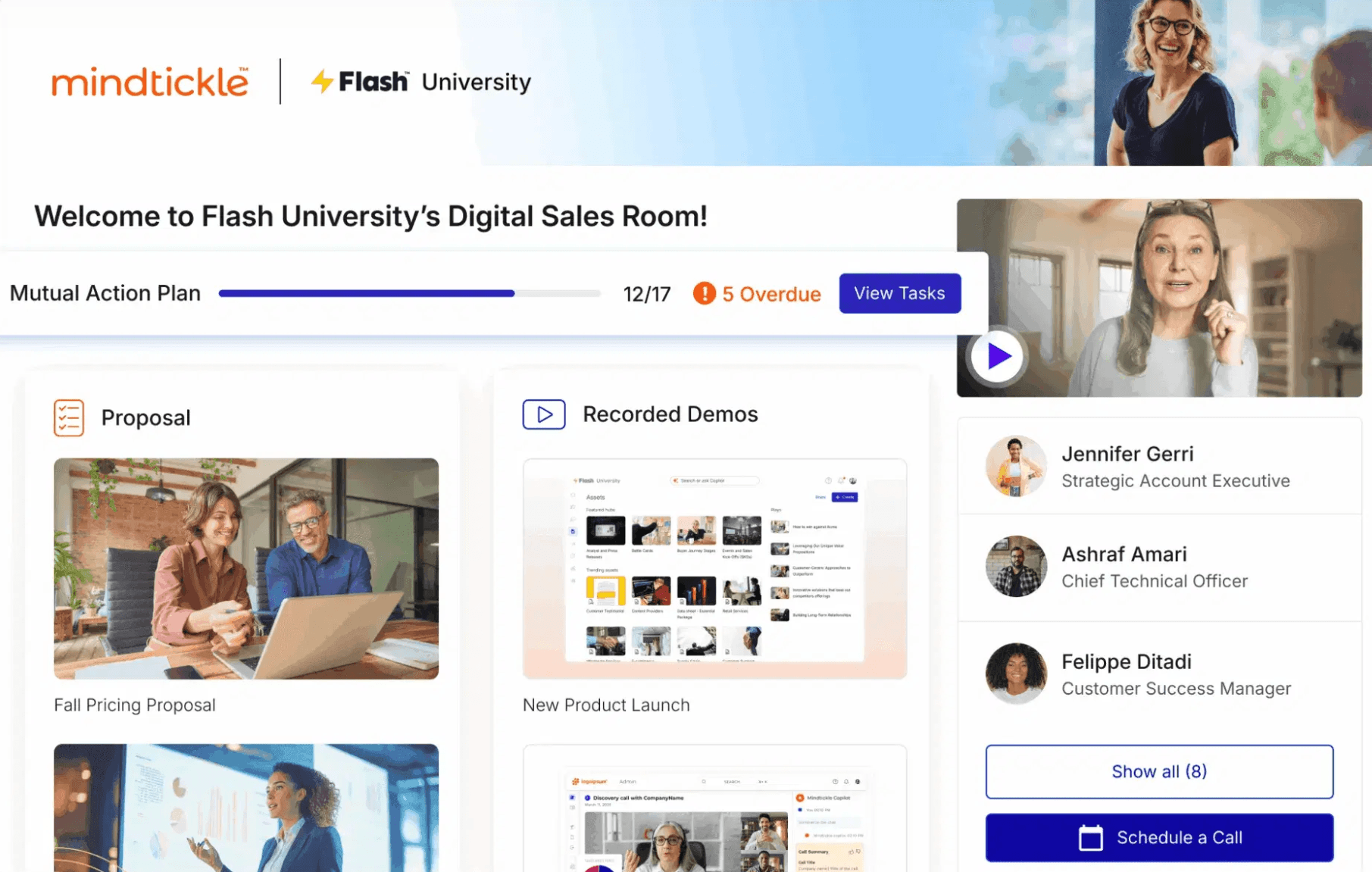
A digital sales room (DSR) is a private, shared workspace where buyers and reps manage everything related to a deal in one place. Instead of content scattered across email threads and shared drives, a DSR centralizes it. Product demos, proposals, pricing docs, meeting recordings, and contracts are all accessible to everyone involved through a single persistent link.
Reps build the room, control what goes in it, and decide who can access it. Buyers get an organized, always-on space where they can review content, ask questions, and share materials with other stakeholders at their own pace. When a rep updates a document, everyone in the room sees the latest version automatically, with no manual updates required.
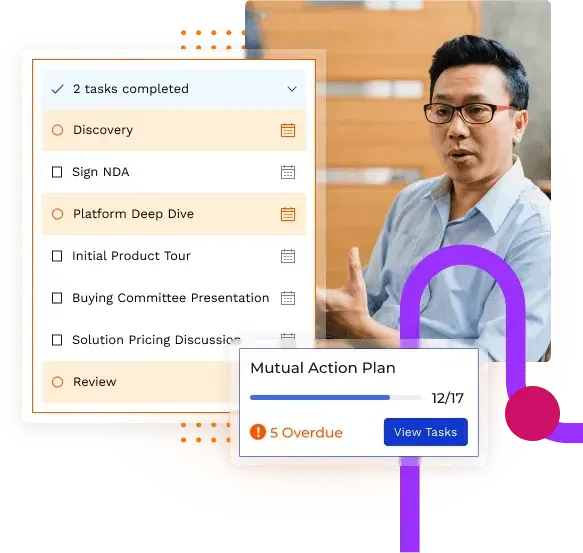
Beyond content storage, DSRs include mutual action plans (MAPs) where the deal is actively managed. Milestones, deadlines, and next steps sit in the same space as all the deal content, visible to both sides.
DSRs are available as standalone tools and as part of broader sales enablement platforms. While a standalone DSR centralizes content and communication, one built into a sales enablement platform turns it into data. Every buyer interaction inside the room generates signals about which content got viewed, by whom, and what that says about where the deal stands.
Those signals are part of what makes DSRs one of the more reliable ways sales teams have found to move deals forward faster.
Read: How to Manage Complex B2B Deals With Multiple Stakeholders Using Digital Sales Rooms
Essential features to look for in digital sales rooms
Not every platform that calls itself a "digital sales room" does the same job. Some are closer to a branded folder of links; others function as a genuine shared workspace. Here's what separates the two, and what's worth checking for when you're evaluating options.
| Feature | What to look for | Why it matters |
|---|---|---|
| Room creation & templates | The ability to spin up a customized room in minutes from a template, tailored to a sales motion, region, or deal type | If room creation takes hours, reps won't use it consistently. Adoption depends on it being faster than the alternative, not just better |
| CRM integration (two-way sync) | Buyer engagement data flowing into the CRM automatically, and CRM data (contacts, deal stage) feeding into the room | Without this, someone's manually re-entering data, and engagement signals stay disconnected from the rest of the sales process |
| Mutual Action Plans (MAPs) | A shared, editable plan inside the room that breaks the deal into milestones with owners and deadlines, visible to both sides | MAPs replace scattered "what's next" email threads with one plan both buyer and seller have actually agreed to. This is often what keeps multi-stakeholder deals from stalling |
| Engagement analytics | Visibility into who viewed what, for how long, and which content actually drove conversation — not just whether the room was opened | Granular data tells a rep when to follow up and what's resonating with the buying group, instead of guessing |
| Stakeholder enrichment | When an unfamiliar visitor opens the room, the platform identifies them and adds them to the deal record | In deals with a dozen-plus stakeholders, manually tracking who's involved becomes its own job — this should happen on its own |
| Access controls | Options to restrict by email domain, require verification, or set expiration dates on sensitive content | Pricing, contracts, and security documentation need different access rules depending on deal stage and how risk-averse the buyer is |
📌 Note: A platform that checks most of these boxes individually still leaves a gap if those pieces don't talk to each other. Engagement data that doesn't reach the rep's coaching or training workflow is a missed signal, not a feature.
Best Digital Sales Room Platforms for 2026: Reviewed for B2B Buyer Engagement
How digital sales rooms shorten the sales cycle
Digital sales rooms shorten the sales cycle by removing the friction points that cause deals to stall in the first place. Most of that friction comes from information being in the wrong place at the wrong time. A decision maker who wasn't on the original call needs to be brought up to speed. A rep sends a follow-up three days after a buyer was actively reviewing content, and by the time they reconnect, the moment has passed.
A DSR changes that math.
- Buyers can review and share content internally without waiting for a rep to be available, so the deal moves even when no one is on a call.
- Reps get real-time signals when a buyer engages with content, so follow-ups are timed to actual buyer behavior rather than a fixed cadence.
- Rooms can be built from a template in under five minutes, so the deal starts moving from the first conversation.
- Mutual action plans give both sides a shared timeline with clear owners and milestones, so next steps never get missed.
💡Do you know
According to Mindtickle's 2026 State of Revenue Enablement report, deals with a digital sales room see a 26% higher win rate and close 30% bigger than deals without one. That speed comes partly from how DSRs reposition the rep. Instead of being present in every conversation, they shape what the buyer sees and what happens next. That matters even more when the buying group involves more than one or two stakeholders.
How to manage multi-stakeholder deals with DSRs
According to Forrester's 2026 State of Business Buying report, the average B2B purchase involves 13 internal stakeholders and nine external participants, most of whom a rep would never speak to directly.
The rest of the buying group is typically managed through an internal champion who distributes information, relays questions, and builds internal consensus on the rep's behalf. It's an unreliable system. Champions share what they remember and answer what they can, but the rep never really knows what got communicated clearly and what got lost along the way.
A digital sales room removes that dependency. Reps build a customized space where each stakeholder can access what's relevant to their role. A CFO reviewing budget implications sees different materials than a technical lead assessing implementation. Questions get answered in a shared space visible to everyone rather than across five separate email threads, where context gets lost.
With everyone in the buying group having visibility into the key materials, consensus forms around the same information. A CFO and a technical lead reviewing the same proposal, seeing the same answers to their questions, work toward the same decision rather than forming separate opinions that delay the deal. MAPs then turn that consensus into a committed plan both sides agree to.
When a stakeholder the rep has never spoken to opens the room, the platform captures it. The rep can see who they are, which content they viewed, and for how long. That data gives them enough context to know whether to add materials, adjust messaging, or bring them into the conversation before the deal moves without them.
💡 A deal with 100 stakeholders, a DSR and what happened next.
Sirion, an enterprise contract lifecycle management company, ran into exactly this problem with a Fortune 100 tech company: a buying group that spanned multiple business units, with no clear edge to who needed to be looped in. Instead of routing every document and question through a single point of contact, Sirion gave the buying group its own digital sales room, built on Mindtickle.
Over the course of the deal, more than 100 stakeholders visited the room and logged over 1,000 hours of self-service engagement with the content inside it. The deal closed. Afterward, members of the buying group reached out to ask what technology had powered their room.
How to create compelling custom buying experiences using DSRs
A digital sales room is only as effective as the experience inside it. A few practices make the difference between a room buyers actually use and one that sits ignored after the first share.
Personalize content to the buyer's stage
Content should match where the buyer actually is in their journey, not just what's convenient to upload. Early on, prospects respond to product explainers, competitive comparisons, and case studies from similar companies. Closer to a decision, they need implementation details, pricing options, and onboarding timelines — different questions call for different content.
Format matters as much as topic. Early-stage buyers tend to engage more with videos and interactive demos that make the product tangible; late-stage buyers need documents they can share internally and reference during approval. Where possible, use industry-specific language and reference the buyer's company by name. A room that feels built for them gets more engagement than one that feels recycled from the last deal.
Read more: How to Develop a Solid Sales Enablement Content Strategy
Keep the room on brand
Buyers spend a significant amount of time inside a DSR during evaluation, and its look and feel shape their impression of the seller as much as the content does. Customizing the room with their brand's colors, logo, and layout means every interaction reinforces what you stand for, building familiarity before the conversation even starts.
Keep support accessible
If a buyer can't find what they need right away, they'll look elsewhere, sometimes straight to a competitor. An in-room chat keeps questions and answers in one place, visible to everyone involved, so nothing gets lost across separate email threads. It also gives the rep a running record of every question the buying group has asked, useful context for every conversation that follows.

Why digital sales rooms by Mindtickle is worth exploring
Pull the thread back through this whole piece: buyers are doing more of the evaluation themselves, deals stall when information sits in the wrong place at the wrong time, and that complexity compounds fast once a dozen-plus stakeholders are in the mix.
A standalone tool can host content and log who opened what; it usually can't feed that buyer behavior back into how a rep gets coached or prepared for the next call.
Mindtickle's Digital Sales Rooms sit inside its broader revenue enablement platform rather than existing as a separate product, so engagement signals from the room connect to the same system that handles training, coaching, and conversation intelligence. Results vary by company, but the direction is consistent: GoTo saw a 35% boost in win rates after rolling DSRs out across its sales team, and Sirion used one to manage a Fortune 100 deal with more than 100 stakeholders without losing track of who needed what.
If you're evaluating digital sales room software, the more useful question isn't whether a platform can create a shareable space, since most can, but whether that space connects to everything else your reps already rely on. That's the gap Mindtickle's Digital Sales Rooms are built to close, and worth a closer look if an integrated approach is what you're after.
Frequently Asked Questions
About the Author
Director of Product Marketing
Christian Pieper is the Director of Product Marketing at Mindtickle from 2021.

Subscribe to the blog
Get the latest sales enablement tips, guides, and industry best practices delivered to your inbox. Unsubscribe anytime.