




The 20-Second Pitch Problem: Why Pharma Reps Lose HCPs Before They Start and How AI Role Play Fixes It



Pharma field teams now operate on limited HCP access. A typical interaction runs about 20 seconds, and how a rep uses that time determines whether the physician engages further or moves on.
And when the physician moves on, the damage rarely stops at that one interaction. The relationship becomes harder to rebuild, and any improvised messaging creates compliance exposure that outlasts the conversation itself.
Most teams respond by adding training. More modules, more certifications, more product content. Although rep knowledge improves, the field results stay flat. The gap sits where training was never designed to reach, and it shows up most clearly in the reps who know the product best.
Key Takeaways
- Pharma reps get roughly 20 seconds with an HCP, and that window tests delivery under pressure rather than product knowledge. Most reps who fumble it could pass a written exam on the same material.
- AI role play simulates the exact HCP conversation and scores every practice run against approved messaging. Reps rehearse privately against a physician who interrupts, raises competitors, and questions efficacy data, repeating until the right version becomes the reflex version.
- Practice data shows sales leaders which reps are ready and which need intervention before their next HCP call. The same data surfaces messaging drift early, while it's still a coaching note rather than a compliance problem.
Why product knowledge fails in a 20-second window
Your reps know their product. Most could pass a written exam on the clinical data without blinking. The window tests a different skill entirely: recalling the right message while a physician interrupts, asks something nobody scripted, or names a competitor and waits.
Standard preparation never touches that skill. Slide decks and modules teach facts. Ride-alongs let a manager observe a handful of calls a year. All of it is useful, and none of it puts a rep under pressure with someone pushing back in real time, which is the only condition the 20-second window ever offers.
Knowing the material and using it under pressure are two separate skills, and the window only tests the second one. AI role play trains that second skill directly, by putting reps in the pressured conversation repeatedly before the real one happens.
💡 Do you know?
Mindtickle's 2026 State of Agentic Revenue Enablement Report reveals that the average rep completed 21 role plays in 2025, up from 13 the year before. Discovery and product pitch top the list of practiced scenarios, and reps name these among the hardest conversations they face. Across the market, reps are already gravitating toward practicing the conversations that decide outcomes.
GET FULL REPORT
What AI role play looks like for a pharma rep
Most reps avoid practice for a simple reason. Practicing in front of people is uncomfortable, and every traditional format involves an audience. A manager in the passenger seat, three peers in a classroom, a trainer with a clipboard.
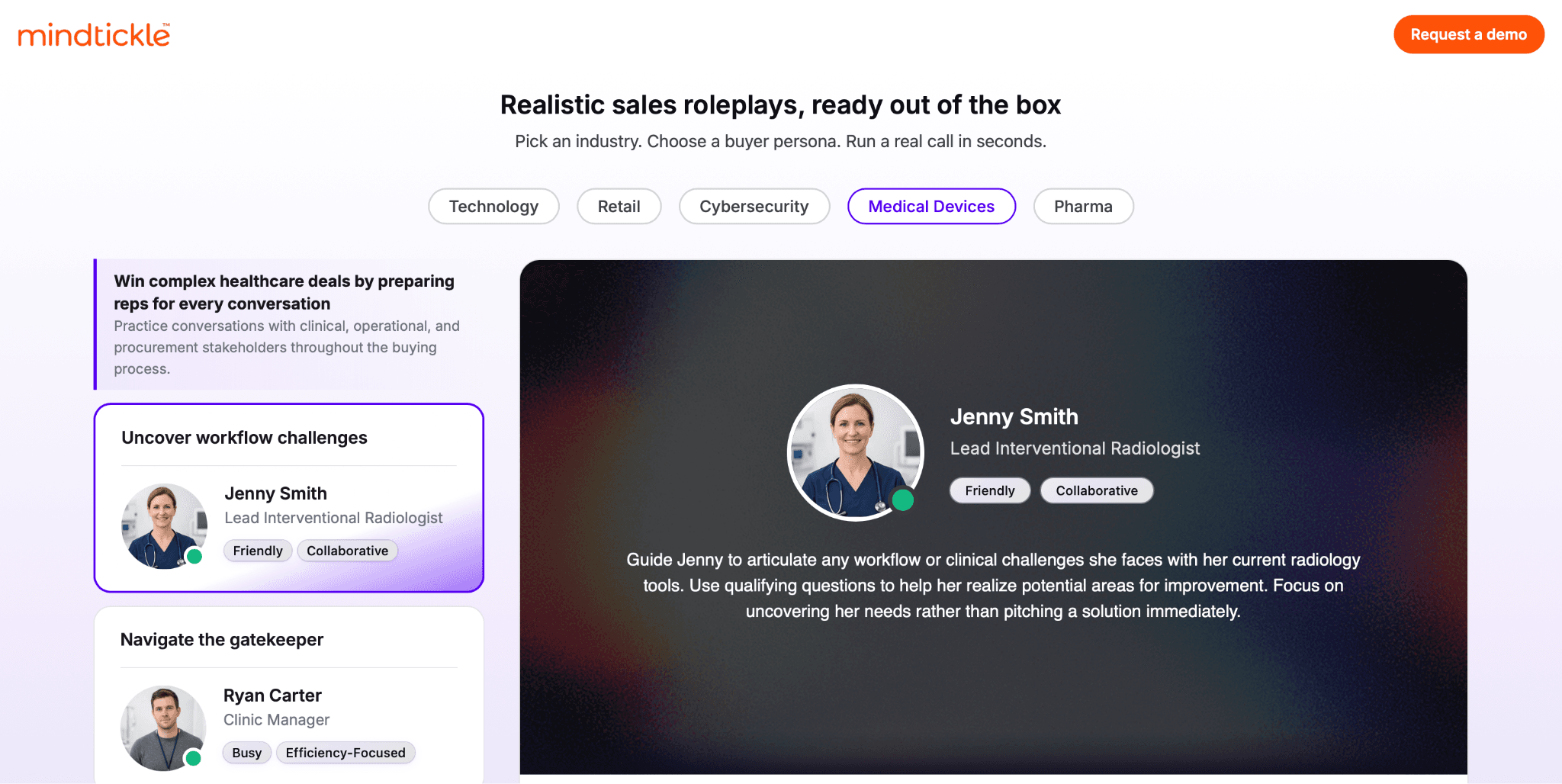
AI role play removes the audience. A rep opens a scenario alone and lands in the conversation they are about to face: an HCP who interrupts, stays loyal to a competitor's drug, and wants the regional trial data now. The scenario reflects the rep's own products, buyer personas, and skill gaps, and it runs in the same short window the real physician will give them. The rep can be wrong, restart, and run it ten more times, because there is no deal on the line and nobody watching.
Every run gets scored against your approved messaging and compliance standards, so sales readiness becomes something you can see rather than something a manager estimates.
Ride-alongs still build relationships, classroom sessions still teach the moves, and managers still coach. However, AI sales role play covers the one condition none of those can create on demand: real pressure, repeated as often as a rep needs it, available the night before the call.
Read more: AI Sales Role Play Vs. Traditional Sales Coaching: A Quick Comparison
🤔 You must be thinking
"My reps barely finish their assigned modules. Will they actually practice with an AI?"
The data says they already are. Across 400+ organizations in Mindtickle's 2026 State of Agentic Revenue Enablement Report, the average rep completed 21 role plays in 2025, up from 13 the year before. Discovery and product pitch top the list, the same conversations reps name among their hardest. When practice is private and available on demand, reps choose it without being chased.
Three HCP scenarios pharma reps must be ready for
Generic advice doesn't help a sales leader staring at a Tuesday afternoon territory report. Real HCP conversation readiness for pharma teams is built on specific conversations.
| HCP Scenario | Unprepared rep | Rep Who's Practiced With AI Role Play |
|---|---|---|
| The corridor conversation | Opens with a full data dump, loses the physician before making the point that matters | Leads with what's relevant to this physician's patients, sets up the next conversation |
| The formulary objection | Hears "not approved," says "let me know if that changes," and walks away | Stays in the conversation, asks what reconsideration would take, and keeps the door open |
| The competitive name-check | Dismisses the competitor, or edges into an off-label comparison | Works with the physician's trust in the competitor and builds a case for a specific patient profile |
1. The corridor conversation: 20 seconds to earn two minutes
The 20 seconds a rep gets to earn a physician's attention rarely buys a sit-down meeting. It buys, at best, two minutes in a hallway before the physician's already moving toward the next patient. An unprepared rep spends those two minutes the way they'd present at a conference, saying, "This new indication shows a 14% improvement in the Phase III data, and the mechanism of action works by..." It's technically accurate, but completely irrelevant to the physician standing in front of them, who's already half-turned away.
A prepared rep opens with, "I know you've got patients on [existing therapy] who aren't responding well to the GI side effects. This new indication was built for exactly that population." Same material, same data, but one leads with the most relevant point to this physician's actual patients, and the other spends the two minutes setting up the next conversation instead of trying to win this one.
2. The formulary objection: staying in a conversation most reps leave
A physician's hospital or payor keeps a formulary, the list of treatments they'll actually reimburse. When a drug isn't on it, most reps hear the conversation ending. "I understand, let me know if that changes" closes the door on every patient the physician sees between now and whenever that change happens on its own.
The rep who has run this objection before stays in it: "What would a reconsideration take on your end? And in the meantime, what are you reaching for with these patients?" The physician's answers tell your rep where the case is strongest and who else needs convincing. Staying in the conversation comes from having rehearsed this exact pushback against a persona built to press the way a real formulary conversation does, and getting scored on the response afterward.
3. The competitive name-check: working with loyalty instead of against it
A physician name-checks a competitor mid-conversation, and an unprepared rep reaches for one of two bad options: dismissing the drug, which reads as insecure, or comparing specifics closely enough to edge toward an off-label claim, which creates a compliance problem on top of a sales problem.
The rep who has rehearsed this moment starts from the physician's trust in the competitor: "It's worked well for a lot of your patients, and I get why you've stuck with it. For patients with [specific profile], here's where we've seen a real difference." The rep has run this line enough times in practice that it lands like a conversation. The physician keeps their loyalty and gains a reason to try something different for a defined slice of their caseload.
📖 Read more: The Five Pillars of Pharmaceutical Sales Training Excellence
What sales leaders see when reps practice with AI
A manager riding along can tell you how one rep did, on one day, in front of one physician. Pharma field teams spread 40 reps across three regions, and no manager's calendar covers that ground in person.
AI role play reviews close the gap at a different speed. Managers take 7 to 8 days to review a rep's role plays, and AI does the same review in 1 to 2 minutes, according to Mindtickle's 2026 State of Agentic Revenue Enablement Report. You can see which reps are ready for a launch conversation and which need a specific intervention before their next HCP call, while there's still time to make that intervention.
The same data answers territory-level questions that individual observation never reaches: which product line carries the highest gap rate this month, which region is falling behind on a new indication, and where the next coaching investment should go. Visibility at that scale used to require a manager in every hallway. Now it requires reps who practice.
Practice the conversation before it costs you one
Every unprepared HCP conversation risks the same two things: the relationship it was supposed to build, and the exposure that shows up when a rep improvises around approved messaging. AI role play gives your reps a way to meet that pressure in practice, as many times as they need, before it arrives in a hallway with a physician already half-turned away.
In a field this regulated, the practice itself has to hold up to the same scrutiny as the job. Mindtickle is HIPAA compliant and aligned with 21 CFR Part 11, the FDA's regulation for electronic records, alongside ISO 42001 and EU AI Act compliance for its AI systems. Visit Mindtickle Trust. Your role play data is never used to train outside models, is never retained by the AI that scores it, and stays under your control. Your managers see everything. The models keep nothing.
Frequently Asked Questions
About the Author
Senior Product Marketing Manager
Poornima Mohandas is a business journalist turned product marketer with over two decades of professional experience. At Mindtickle, she handles go-to-market for the market leading, Training, Coaching, AI Role Play products, and runs the company’s competitive intel program. Her writings have been published in reputed trade publications like Mind the Product and the Product Marketing Alliance.
Subscribe to the blog
Get the latest sales enablement tips, guides, and industry best practices delivered to your inbox. Unsubscribe anytime.