




AI Role Play for Pharma Reps: A 30-Day HCP Readiness Model



How to Get Pharma Sales Reps HCP-Ready with AI Role Play: A 30-Day Model
AI role play gets pharma reps ready for HCP conversations by having them practice real scenarios against an AI buyer, scored against your approved messaging, until the right response holds up under pressure. It closes the gap between a rep who has completed training and a rep who can actually carry a live physician conversation.
This guide lays out a 30-day model for running that practice as a focused push, and for producing sales readiness proof you can show Legal and leadership before the field reaches a single physician.
The model below is a template, not a mandate. Pharma readiness is continuous, gated by MLR review and tied to launch calendars that rarely fit a clean month. What a focused 30-day cycle gives you is a way to concentrate practice, move a specific skill, and generate a before-and-after readiness record inside a window a launch can actually run on. Adapt the timing to your own cycle. The structure is what matters.
Key takeaways
- Readiness is a measure of capability, not completion. The output that matters is whether a rep can handle a live HCP conversation within approved messaging, which a completion rate cannot tell you.
- Diagnose before you train. Running a rep's first role play uncoached reveals the real gap instead of the rehearsed pitch reps perform when they know they are being scored.
- Practice the individual gap, not the group average. Targeting each rep's highest-impact scenario is what makes a focused month long enough to change behavior.
- The design decisions carry the result. Scoping one conversation type, keeping MLR involved from the start, and measuring behavior change over time separate a real readiness push from a check-the-box exercise.
Why run readiness as a focused 30-day cycle
Pharma launches run on a clock. From the moment a new indication clears, every week before reps can discuss it accurately with physicians is a week of revenue exposure and compliance risk. Continuous readiness programs have no forcing function against that clock, which is why practice often gets deprioritized until a launch is already on top of the team.
A focused cycle creates the forcing function. Fixing a start, a finish, and a readiness bar concentrates a dispersed field team on the same objective at the same time, which is hard to sustain in an open-ended program that competes with everything else on a rep's week. Thirty days is long enough to move specific sales skills through repetition and short enough to hold attention from start to finish.
It also changes what you can report. A continuous program tends to produce participation data. A bounded cycle produces a before-and-after on each rep's readiness, scored against the messaging your organization approved. That record is what turns a readiness conversation with Legal and Regulatory from an assurance into evidence.
💡 The 10-role play line
There is evidence that practice volume tracks with field performance. Mindtickle's 2026 State of Agentic Revenue Enablement Report found that reps who complete ten or more role plays a year score higher on live calls than those who practice less. A focused cycle is one way to get a whole team past that threshold in a defined window, instead of hoping practice happens on its own.
Before you start: the decisions that make or break the cycle
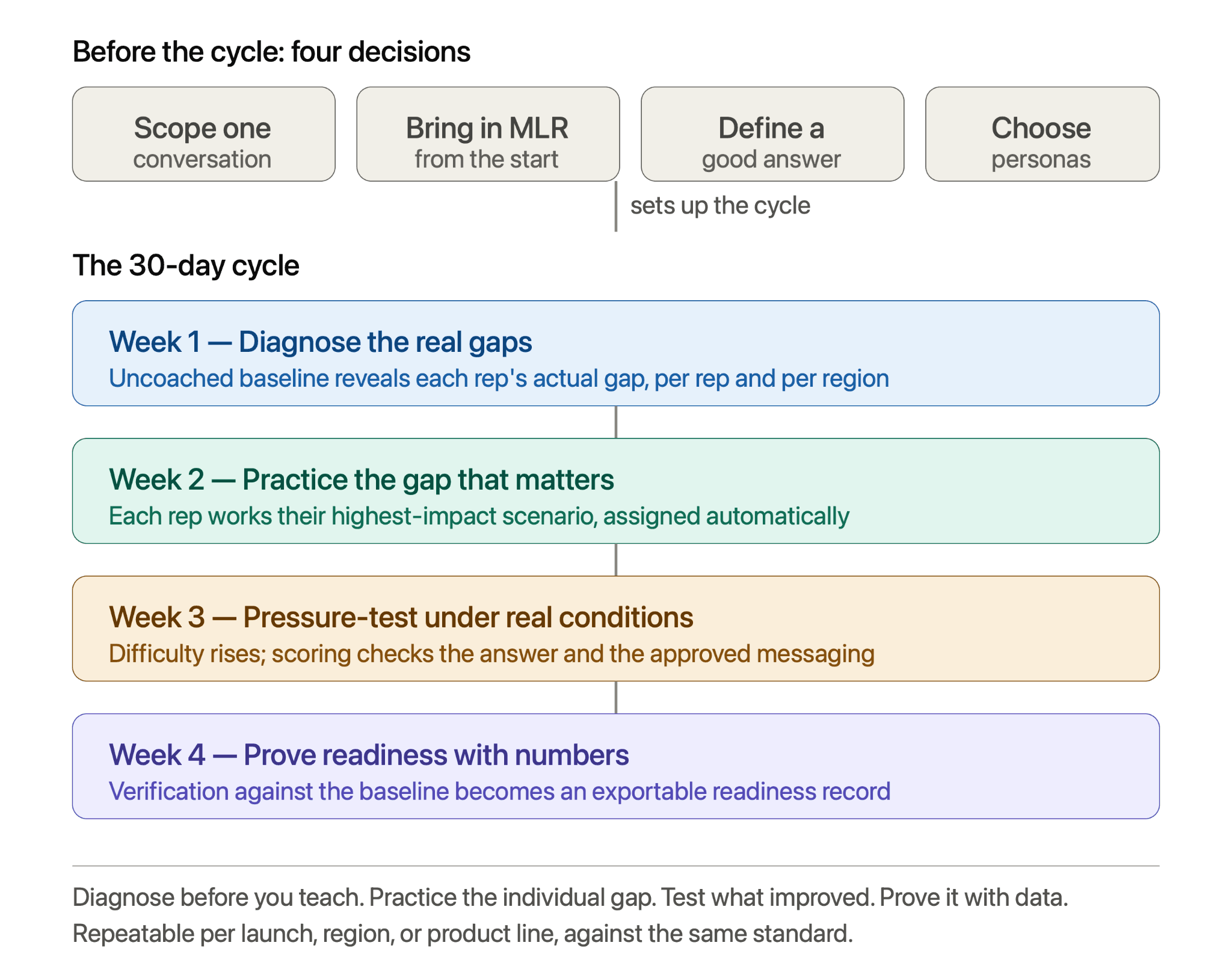
Four decisions matter most, and rushing them is the most common reason a readiness push turns into activity nobody trusts.
Decide which conversation you are fixing.
A field team has many HCP conversations that go wrong, and trying to improve all of them in one cycle improves none of them. Pick one that carries real exposure or real revenue.
For example, the gatekeeper conversation where reps lose physician access by leading with product instead of relevance. The first meeting with a new physician, where reps push clinical data in the first 20-second pitch before they have earned the right to. The competitive conversation where a rep loses ground by dismissing the drug a physician already trusts instead of earning consideration for a specific patient profile.
Note that each is a defensible choice. Choosing all three at once is not.
Bring MLR in before scenario design, not after.
This is the decision that separates people who have run pharma enablement from people who have only run sales enablement. Every scenario a rep practices, and every model answer the AI scores against, encodes approved messaging.
So think about what happens if Medical, Legal, and Regulatory review that content after reps have already practiced it. You have taught the field something you may now have to unteach. Bring MLR in to define the approved messaging and evaluation criteria at the start, and scenario approval stops being the thing that holds up your launch at the end.
Define what a good answer actually sounds like.
The AI scores rep submissions against the criteria you set, which means those criteria carry the weight. Vague standards produce vague scores.
Get specific, then. Spell out the messaging that has to show up, the claims that cannot, the off-label lines a rep must not cross, and what staying inside approved language sounds like when a physician pushes back. This is also where a serious sales enablement platform earns its keep, because scoring against your own compliance criteria is a different thing from scoring generic sales delivery.
Choose the personas reps will actually face.
Sales readiness comes from practicing against real buyers. So build each scenario around someone your reps recognize: the physician, the clinic practice manager who controls access, the specialist loyal to a competitor.
The closer a persona sits to the buyer a rep meets on Tuesday, the more the practice transfers. Ground it in an actual buyer type and the rep's own sales motion, and the scenario stops feeling like an exercise.
How to run the 30-day AI sales role play cycle
The month breaks into four weeks, each with one job. The weeks build on each other, so the sequence matters more than the exact dates. Diagnose first, practice the gap you find, pressure-test what improved, then prove it. Adjust the timing to your own calendar, but keep the order.
Week 1. Diagnose the real gaps
🎯 Goal
Finding out where each rep actually stands before you try to change anything.
Most readiness programs skip this and go straight to teaching, which is why they so often invest in the reps who needed it least. You cannot target practice at a gap you have not measured. So the first week is diagnosis, and the way you run it decides whether the data is worth anything.
Run the baseline role play uncoached. You can start here. A rep who knows they are being evaluated performs the version of themselves they think you want to see, reciting the polished pitch. Left to their instinct, they show you what actually comes out when a physician interrupts or raises something they did not plan for. That unrehearsed version is the only one worth measuring, because it is the one the physician gets.
Tell reps plainly that this is a baseline, not a test. The system is gathering a read on where each person can improve, and no one's standing depends on the first score. Reps who understand that stay honest in the exercise. Reps who think their job is on the line will game it, and gamed data sends you into week two aiming at the wrong targets.
💡 Pro tip
Let reps run it privately, on their own time between calls, so the whole team is not pulled off territory to sit through this together. Privacy is also what makes an honest attempt possible. A rep will try, stumble, and show you the real gap when no manager is in the room watching them do it.
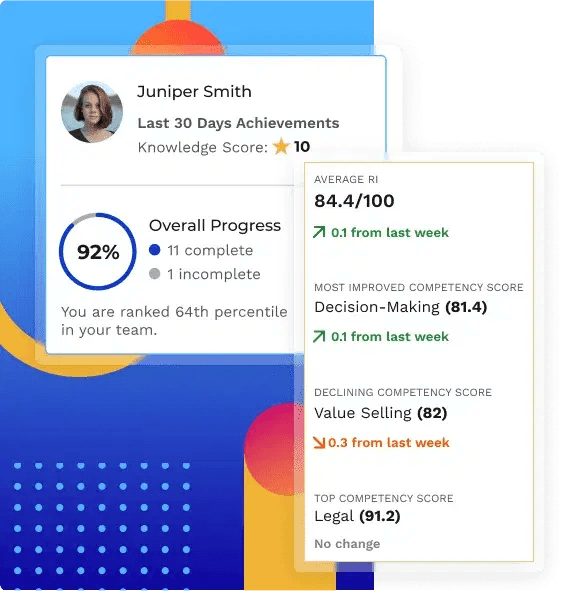
Once the baselines are in, the picture comes back on two levels. The manager sees a gap profile per rep. Not a single grade, but where specifically each person is strong and where they are not: messaging accuracy, where their language drifts from what is approved, where they hesitate when the clinical questions get hard. A manager ends week one knowing exactly who is ready and who needs work, without having ridden along on a single call.
By the end of week one, you have something a completion report never gives you. A specific, per-rep, per-region read on where the field actually stands, and the foundation the rest of the month is built on.
Week 2. Practice the gap that matters
🎯 Goal
Turning each rep's diagnosed gap into targeted practice, without a manager having to assign it by hand.
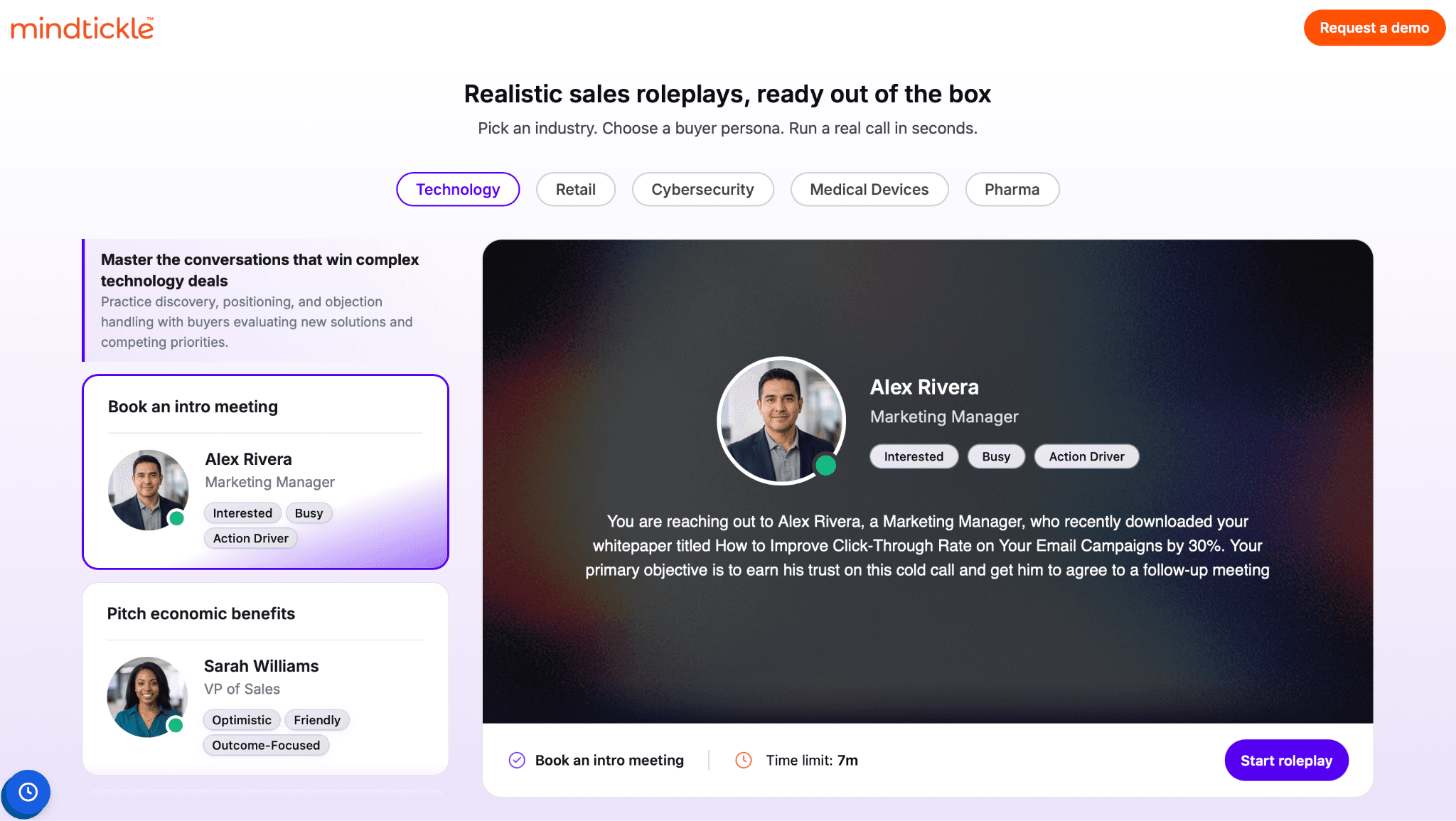
This is where the per-rep gap profile from week one does its work. Instead of one generic drill sent to the whole team, each rep practices the single scenario that will move their number most. The rep who lost the gatekeeper in the first thirty seconds works the access conversation. The rep who pushed clinical data too early works discovery with a physician persona. Nobody spends the week rehearsing a skill they already have.
Good AI Sales Role Play tools handle the assignment automatically. Mindtickle AI Sales Role Play surfaces this as a Next Best Action, the one role play that addresses a rep's highest-impact gap, so the rep opens their dashboard and sees exactly what to practice and why, with the gap named in plain numbers. That matters at field scale, because a manager overseeing forty reps across three regions cannot hand-build a practice plan for each one every week.
Reps practice in the same private setting as their week-one baseline. Each attempt ends with a debrief: what worked, the one focus area to fix next, and a score that rolls into their trend over time. The rep sees their own progress build session over session, which is usually enough to keep them practicing without being chased.

The load on managers stays light by design. The system assigns the practice and delivers the feedback, so a manager spends the week coaching the few reps who need a human, not reviewing every submission from everyone.
📌 A note on data governance
Practice content is sensitive, because it is reps rehearsing real messaging against real competitive and clinical scenarios. Before you run a cycle, confirm where that data goes.
Mindtickle's AI Role Play is aligned with ISO 42001 and the EU AI Act, and role play data is not manually reviewed, retained, or used to train outside models. For a pharma organization with strict data governance, that is a requirement, not a nice-to-have. Visit Mindtickle Trust
By the end of week two, every rep has worked their specific gap at least a few times, and the scores are moving. What you do not yet know is whether that improvement holds when the conversation gets harder. That is week three.
Week 3. Pressure-test under real conditions
🎯 Goal
Finding out whether a rep's improvement holds when the conversation gets hard, because a physician under time pressure is nothing like a calm practice run.
By now a rep has practiced their gap and their score has moved. Real HCP conversations do not stay easy, and no two physicians apply pressure the same way. One is open after two visits. Another questions the trial design for months before their prescribing shifts at all. A rep who looks ready against a cooperative buyer can still come apart when the buyer stops cooperating.
So week three raises the difficulty on the same scenario the rep has been working. The AI physician takes a harder line, gives the rep less room, interrupts, and brings up a competitor unprompted in the middle of the conversation. The rep has to hold their message while the ground keeps shifting, which is the actual condition of a live call.
🤓 Expert speak
This stage is where compliance gets tested properly, and it is the part that matters most in a regulated field. Under pressure and short on time, a rep reaches for a claim that sounds close enough to approved language to keep the physician engaged.
However, close enough is where off-label problems start. A good scenario checks both things at once: whether the rep handled the objection, and how they handled it. A rep can win the exchange and still get flagged for stepping outside approved messaging to do it, which is exactly the behavior you want surfaced in practice rather than discovered in the field.
The read for managers shifts in week three too. The number to watch is not whether a rep passed, but whether the score held as the difficulty climbed. A score that stays steady under harder pushback is real readiness. A score that drops the moment the AI pushes tells you precisely where that rep still needs a person, and there is still time to give them one before a launch.
By the end of week three, you know which reps hold up under pressure and which fold, scored against the messaging your organization approved. That is the evidence week four turns into proof.
Week 4. Prove readiness with numbers
🎯 Goal
The goal of week four is to verify the improvement and turn it into proof you can hand to someone else.
The week starts with one more role play, the same scenario type each rep began with, scored the same way. This run counts. Comparing it against the rep's week-one baseline shows whether the month actually moved the number, per rep, in language anyone can read.
The output is the part that matters outside the sales cycle. You end with a readiness record for the field: who is verified ready, who still needs a person, and how far each rep moved, scored against your approved messaging. That record is what a readiness conversation with Legal and Regulatory has been missing. It replaces "everyone completed the training" with evidence of what reps can actually do before they reach a physician.
This is also where a tool built to track behavior over time earns its place. Tied to the Readiness Index™, the month's scores become a baseline you carry forward, so readiness is something you monitor into the next launch rather than a number that expires when the cycle ends. And because the structure is repeatable, the same four weeks run again for the next indication, the next region, or the next team, against the same standard.
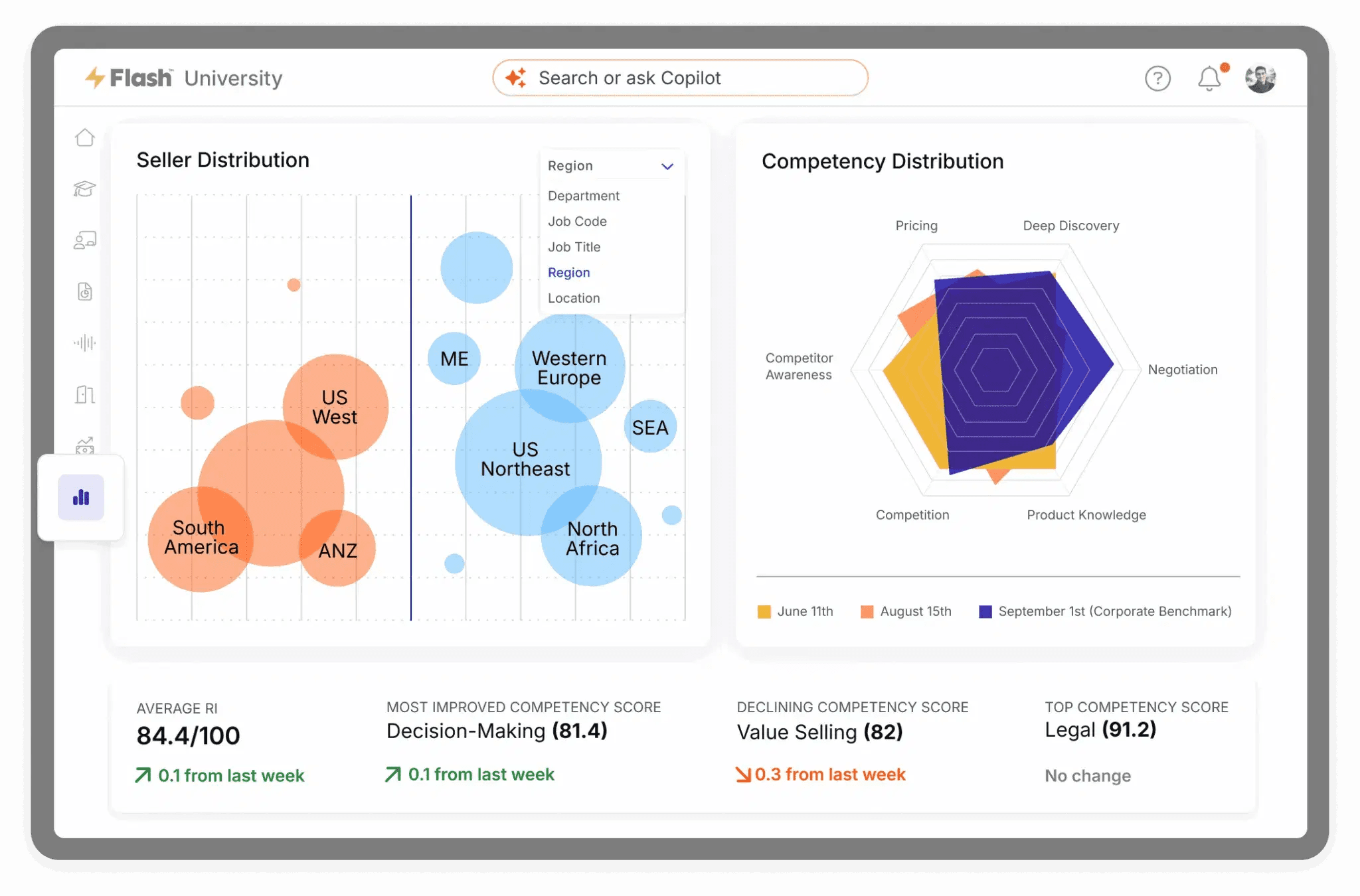
By the end of week four, you hold a before-and-after on the field's readiness. Not a report that training happened, but proof it worked.
How Janssen India Cut Rep Ramp Time in Half with Mindtickle
Get your reps HCP-ready, one conversation at a time
A completion report tells you a rep sat through the training. It cannot tell you whether that rep can hold a physician who interrupts, questions the data, or names a competitor and waits. The gap between those two things is where launches slip and compliance risk builds, and closing it is what a focused practice cycle is for.
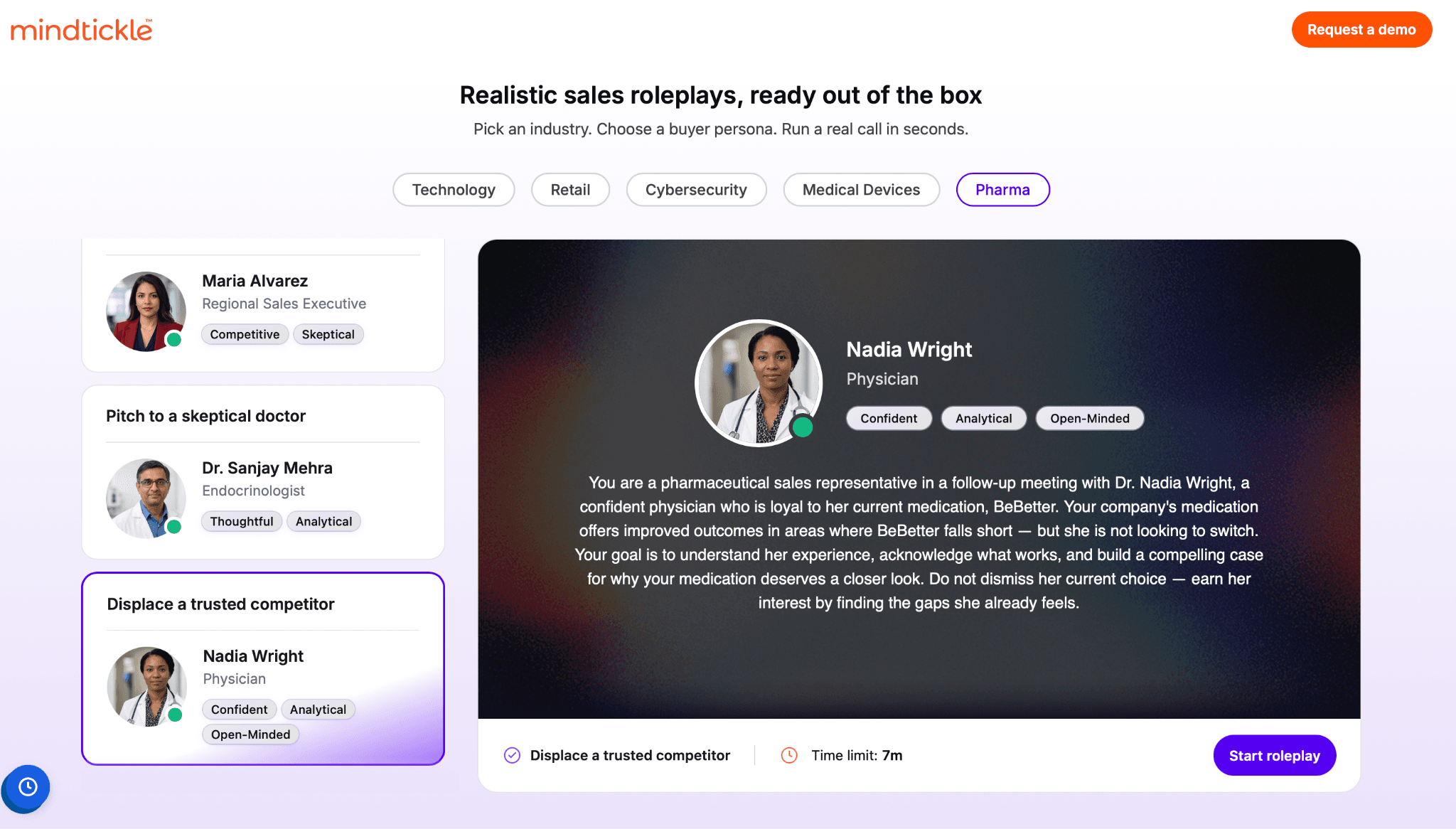
The model in this guide is one way to run that cycle. You do not have to commit to the full month to see how it works. The fastest way to understand what AI sales role play does for a pharma rep is to try one yourself.
Mindtickle's AI Sales Role Play offers a free role play platform where you can practice against pharma buyer personas, work a real HCP scenario, and get scored the way your reps would be. It lets you practice for 7 minutes and shows you exactly what your field team would experience in week one of the 30-day cycle.
FAQs
Subscribe to the blog
Get the latest sales enablement tips, guides, and industry best practices delivered to your inbox. Unsubscribe anytime.