



6 Best Allego Competitors & Alternatives in 2026



Mindtickle, Seismic-Highspot, Showpad, SalesHood, Letter AI, and Gong are the top Allego competitors and alternatives in 2026.
Allego is built around asynchronous video coaching and peer review, and reps tend to like it. But it has consistent gaps, like admin work that grows heavier as programs scale. Its coaching model is also peer-driven rather than manager-led, which won't suit teams that want real-time, consistent feedback.
This guide breaks down all six alternatives, what each one does best, and how to figure out which fits your team, so you can walk into a demo already knowing what to ask.
At a glance: Top Allego alternatives
| Platform | What it does | Best for | G2 rating |
|---|---|---|---|
| Mindtickle | Unified AI Enablement connecting training to performance and revenue outcomes | Scaling training and performance tracking without heavy admin work | 4.7 |
| Seismic-Highspot | AI-powered content hub with Aura AI for dynamic, compliant documents | Enterprise teams with ungoverned content libraries or heavy compliance needs | Seismic 4.6, Highspot 4.7 |
| Showpad | Offline-first and AR presentation platform | Field sales teams selling complex products with poor connectivity | 4.6 |
| SalesHood | Learn-by-doing and peer sharing | Mid-market teams wanting fast peer coaching and low admin lift | 4.6 |
| Letter AI | Generative AI co-pilot platform | Quickly generating training and content with minimal build time | 4.9 |
| Gong | Call analytics and forecasting engine | Visibility into real customer conversations and pipeline risks | 4.7 |
Why revenue leaders are looking for Allego alternatives
Allego holds up well on the fundamentals. The reasons teams look elsewhere usually come down to what happens once a platform scales past the initial rollout.
-
The most common one is the admin experience. Reps generally find Allego easy to use day-to-day, but building out courses, configuring coaching workflows, and keeping a growing content library organized take real, ongoing effort from whoever is running the platform.
-
Adoption and integration add another layer. Enablement teams running multiple tools alongside Allego report the familiar friction of retraining reps and reconciling data across systems. Some teams also find that embedding enablement directly into daily sales workflows, rather than as a separate destination, feels smoother on other platforms.
-
Coaching philosophy is another driver. Allego's roots are in asynchronous, video-based coaching: reps record pitches and submit them for manager or peer review on their own time, which suits collaborative, self-paced learning and distributed teams. Allego has since added real-time AI role play through its Live Dialog Simulator, so in-the-moment practice is part of the platform. The question for buyers is less whether live practice exists and more which coaching model a platform is built around, and whether that matches how your managers actually coach, whether that's a consistent live cadence, structured peer review, or real-time feedback on live customer calls.
The 6 best Allego alternatives evaluated
1. Mindtickle
G2 rating: 4.7/5 (2,300+ reviews)
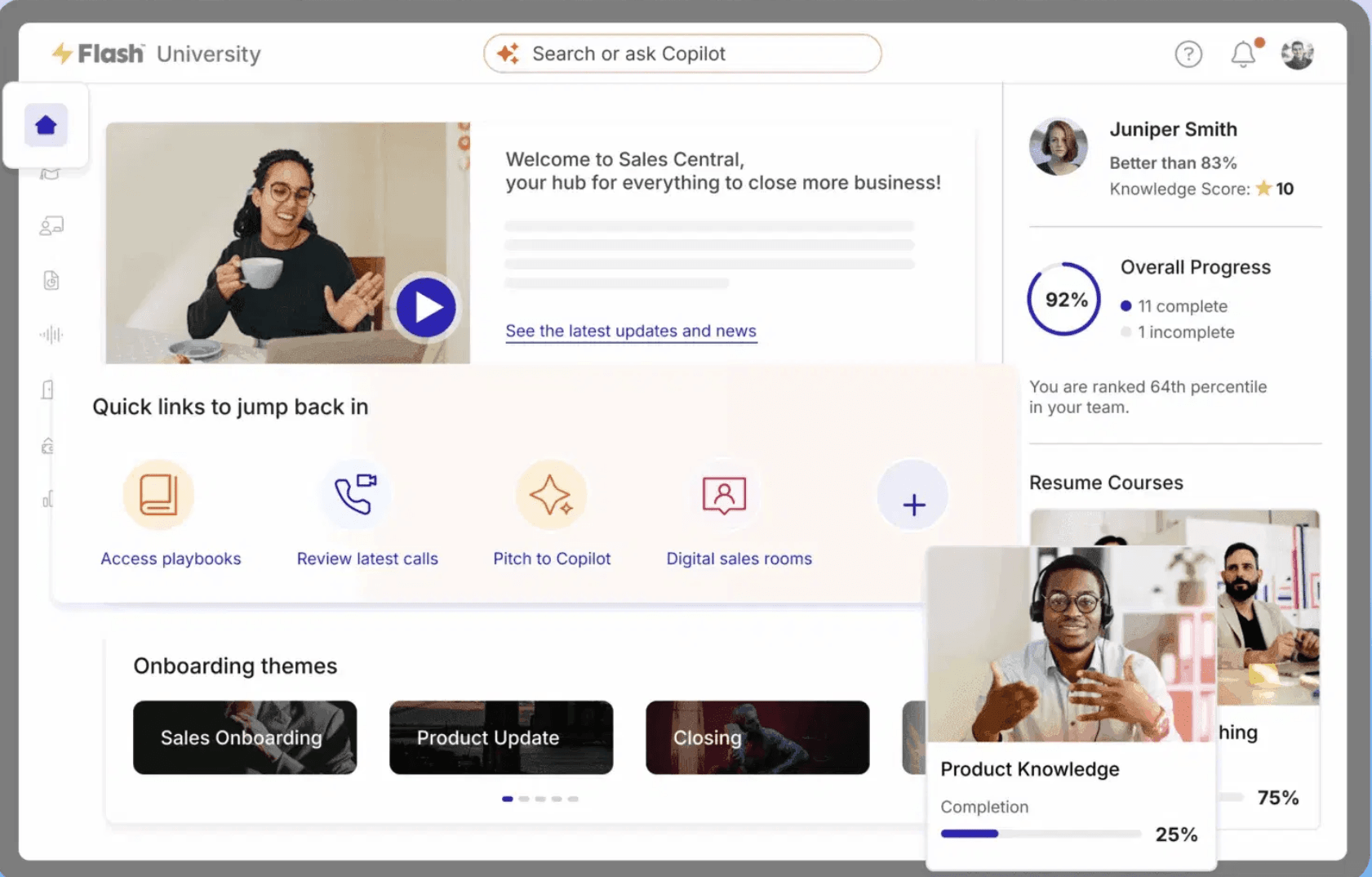
Mindtickle is a revenue enablement platform built on ElevateOS™, the agentic revenue operating system. Most platforms treat training, coaching, content, and CRM data as separate systems, so admins spend real time reconciling them, and nobody can say for sure whether the training actually changed how a rep sells. ElevateOS™ connects those pieces into one workflow instead, so the same connective thread runs through how content gets managed, how reps practice role plays, and how that practice gets reviewed.
Core features:
- Easy setup and upkeep: Mindtickle automates much of the admin work with templates, fast scenario generation, automatic gap detection, and system-assigned practice paths. This keeps the human work concentrated on review and approval. The team spends a little time up front and then only requires brief check-ins as the workflow scales.
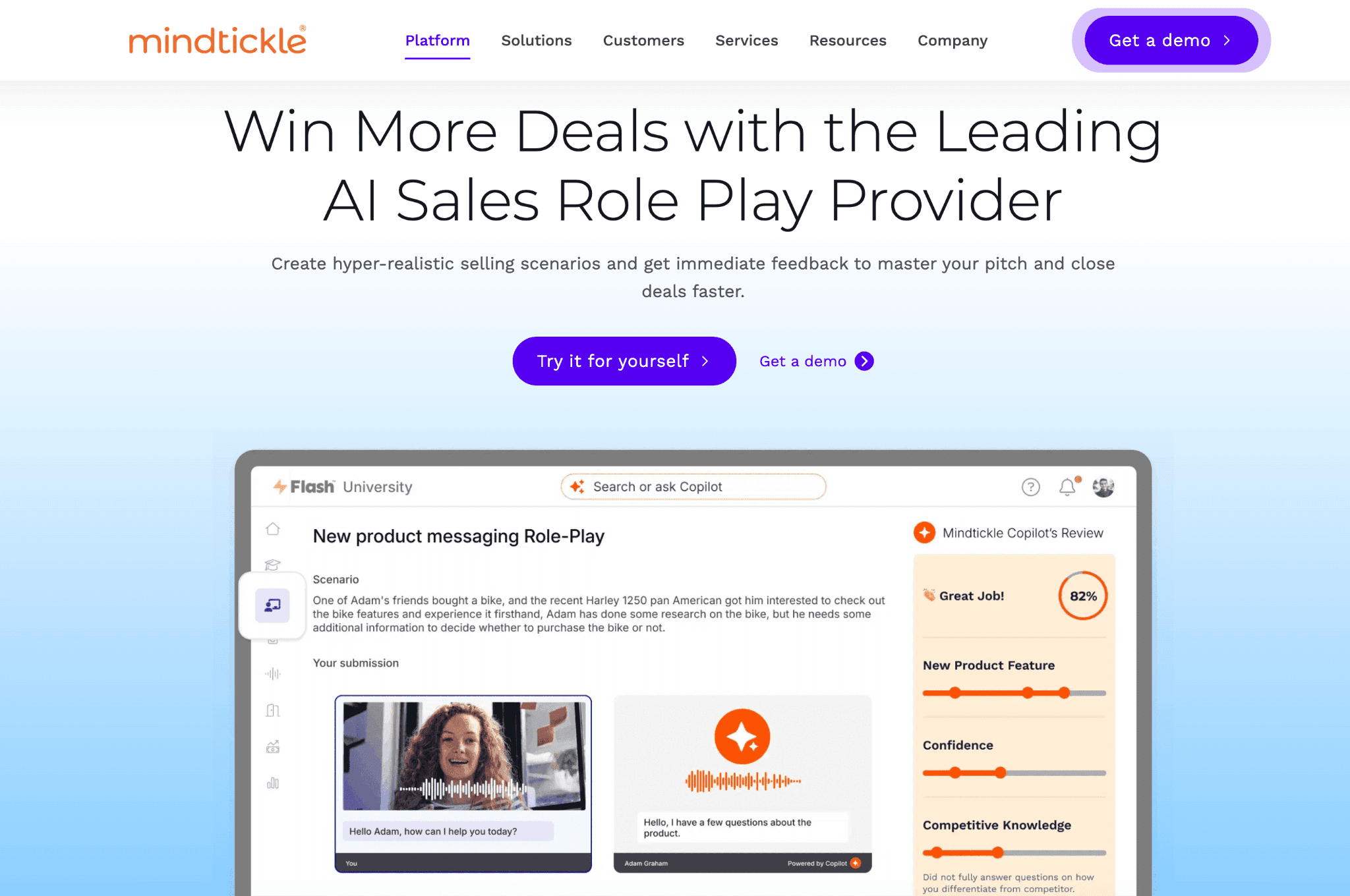
- Skill-driven practice: Mindtickle's AI Sales Role Play starts by running an evaluation role play to build each rep's skill profile from day one, and that profile keeps shaping every session after. Reps automatically get a score right after each session, so feedback doesn't wait on a manager's schedule. If they keep fumbling on a specific objection, they get a practice scenario for that exact gap instead of whatever everyone else is practicing. ElevateOS™ connects conversation intelligence directly to role play, so real call data decides what a rep practices next. You can try Mindtickle AI sales role play for free
- Real-time content support: When a buyer asks a question or asks for a detail that a rep isn’t prepared for, reps get the support they need while the actual call is happening. The AI catches the cue and pulls the relevant documents, be it a battlecard about a competitor or a pricing document, without the rep having to search for it. This reduces the stress for a rep who would otherwise rummage through the content library.
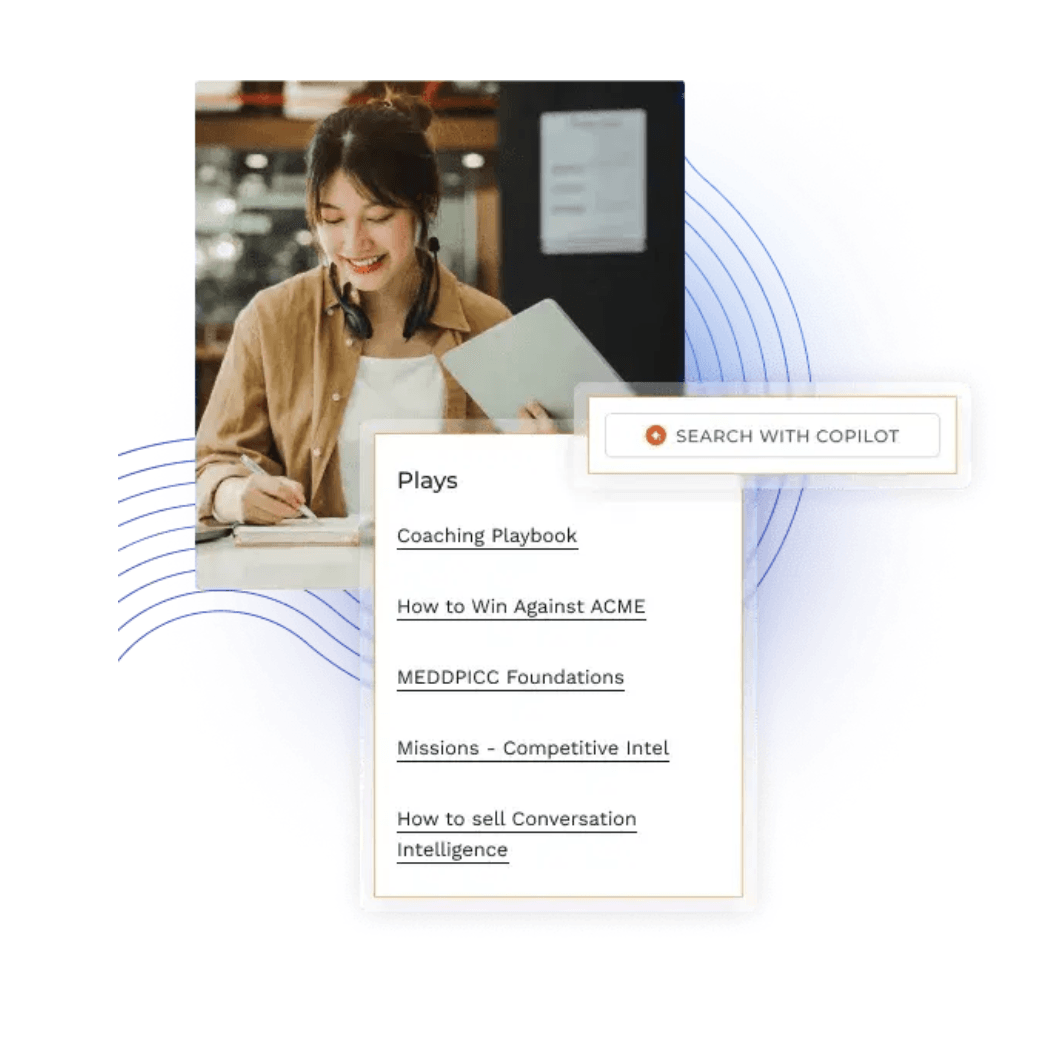
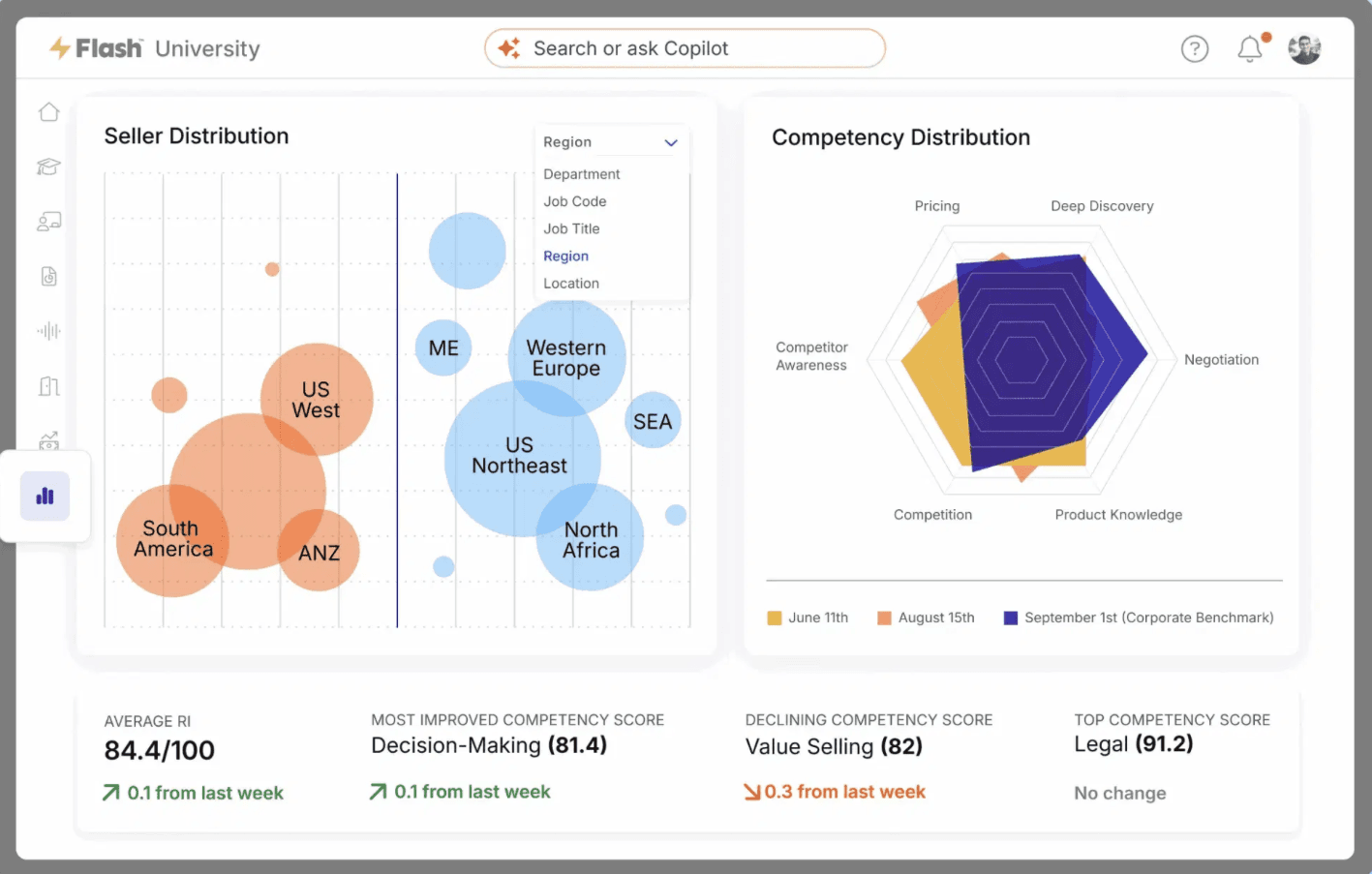
- Analytics tied to real outcomes: Unlike dashboards that report completion rates, the Readiness Index reveals whether the practice actually worked. It correlates role play scores and call behavior against quota attainment and win rates in the CRM.
- Enterprise-grade security: Call recordings, pricing talks, and internal playbooks are all sensitive data points that shouldn’t leave your organization. Mindtickle runs under zero data retention, with SOC 2, ISO 42001, and EU AI Act compliance built in, plus industry-specific certifications like HIPAA and FINRA for regulated teams. Learn about Mindtickle’s compliance in detail on the Trust page.
Trade-off: Because it's a full operating system, Mindtickle takes strategic planning to roll out, compared to a single-purpose tool, though a dedicated customer success manager guides that process.
🏆 Best for: Enterprise teams that want training, coaching, and content in one platform, without admins losing time managing it.
🌟 From pitch chaos to a $110K bump per seller: Cisco's security sales story
Cisco, the networking and cybersecurity giant, had over 7,200 reps who needed their pitches evaluated for the "Security Sales Superstar" contest.
Doing that manually meant inconsistent scoring and exhausted managers, with no real way to know if the coaching was working. Mindtickle's AI Sales Role Play and Copilot changed that by scoring every pitch on tone, pacing, and content relevance instantly.
The results held up. Cisco got back 38 weeks, north of 6,000 hours, of manager time. Booked deal values rose 25%, average deal size climbed 31%, and reps who nailed their pitch through the program brought in $110,000 more in security bookings on average.
How Cisco Scaled Sales Training for 7200 Reps with Mindtickle AI Sales Role Play
Want to compare the tools in further detail? Read this in-depth Mindtickle vs. Allego comparison.
2. Seismic-Highspot
G2 rating: Seismic 4.7, Highspot 4.7
Highspot and Seismic completed their merger in August 2026, with the combined company operating under the Seismic brand and led by Seismic's CEO. Both platforms are still supported, but the two product lines, and their separate AI engines, are being consolidated, so treat today's feature distinctions as a moving target. Historically, Highspot has been built around its Nexus AI engine, which surfaces next-best content based on deal signals across a large, frequently changing library. Seismic is built around its Aura AI engine and LiveDocs, which auto-populate documents with account-specific details pulled from the CRM.
Core features:
- Content organization (Highspot): Content lives in flexible, tagged collections called Spots, and engagement activity syncs back to the CRM, with a Salesforce integration reviewers single out.
- Dynamic content (Seismic): LiveDocs pulls CRM data to keep personalized documents current automatically wherever they're shared.
- Compliance and governance (Seismic): Role-based permissions, detailed audit trails, legal hold, and automated approval workflows, a genuine strength in regulated industries.
Trade-off: Seismic's depth comes with heavier setup, with implementations often running several months and typically needing dedicated enablement staff. Highspot is more content- and guidance-led, so teams with serious coaching and readiness needs may still want a dedicated tool for skill development. And because the merger is still integrating, get specifics on contracts and roadmap straight from whichever team you're talking to.
🏆 Best for: Teams that need sales content organized, findable, and governed, especially in regulated industries with heavy compliance needs.
Read more: Mindtickle vs Seismic-Highspot
3. Showpad
G2 rating: 4.6
Showpad is built around the reality of field selling, where reps often work in locations with inconsistent Wi-Fi or cellular coverage. Its Field Meeting AI includes capabilities aimed at capturing and acting on those conversations offline.GenieAI runs underneath the whole platform, powering content recommendations and roleplay coaching.
Core features:
- Offline access: Field reps in medical devices or manufacturing can pull up and present large files, specs, and full catalogs with zero connectivity, an area where Showpad is rated ahead of its rivals.
- 3D and AR built in: Native support for 3D product models and AR environments, gained through the Bigtincan merger, lets reps walk a buyer through equipment.
- Bi-directional CRM sync: Shared content, buyer engagement, and program activity log back to the CRM automatically.
Trade-off: Teams that sell mostly over video or remote calls may not get as much from the field-first design. It's also worth noting that Showpad's merger with Bigtincan is still being integrated, so the two product lines aren't fully unified yet, and reviewers commonly flag reporting and admin experience as areas that need work.
🏆 Best for: Field sales teams selling complex, physical products in places where a stable internet connection isn't a given.
Deep Dive: Mindtickle vs Showpad
4. SalesHood
G2 rating: 4.6
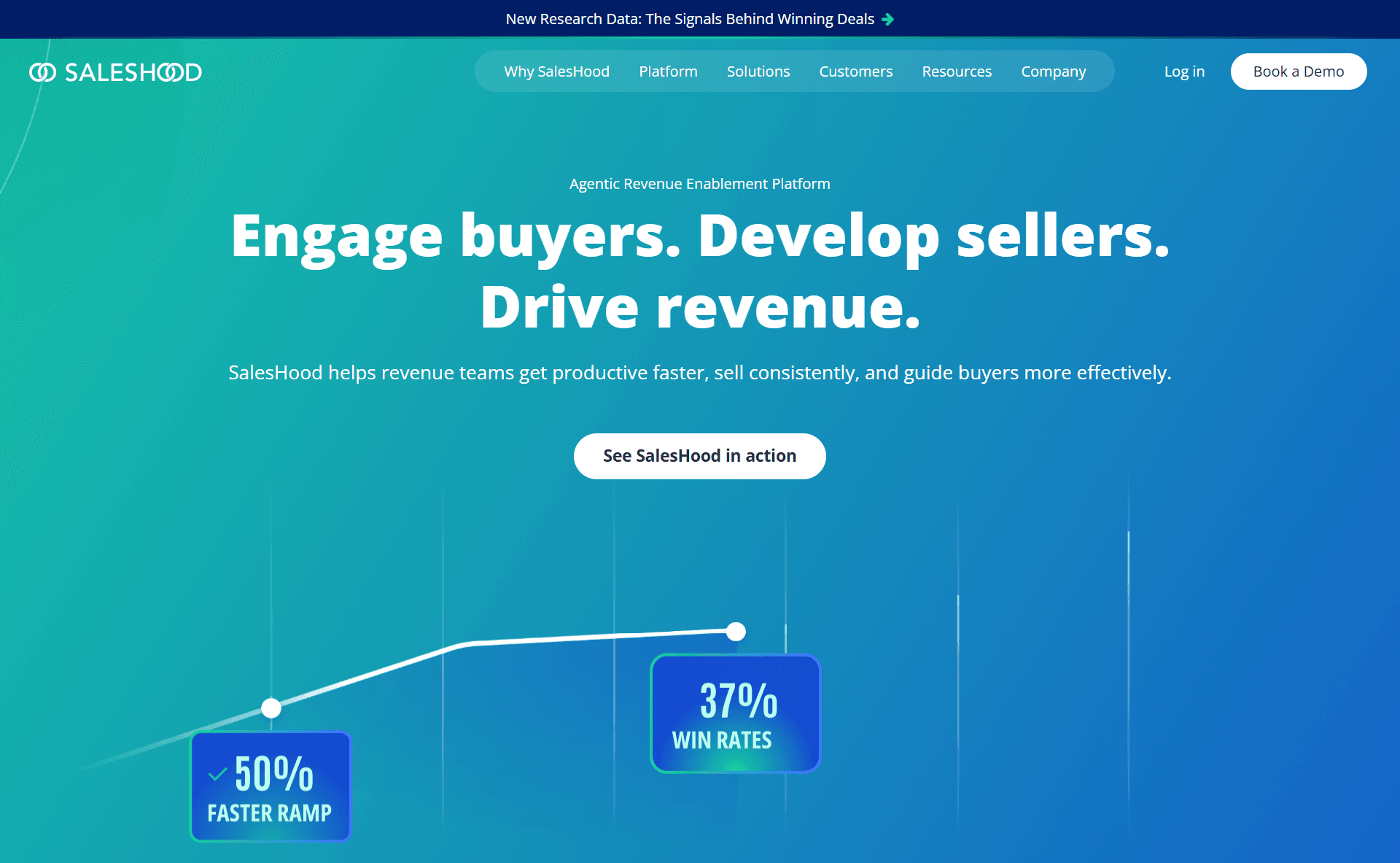
SalesHood was built by a former Salesforce enablement leader who felt that rolling out a training program the old way was slow and expensive to maintain. That origin has shaped the product today. Instead of a platform built around deep customization, SalesHood leans on templates and pre-built structure so a team can get a program running in days rather than months.
Core features:
- Huddles for peer learning: SalesHood's core learning unit, where reps work through exercises, pitch practice, and video, sharing and getting feedback from managers and peers rather than routing everything through a single coach. The peer-to-peer emphasis is where the company name comes from.
- Template-based setup: Programs launch from pre-built templates and drag-and-drop tools instead of custom-building a structure from scratch, so a team can be running in days rather than months.
- Built-in deal coaching: Deal reviews and coaching follow a structured framework inside the platform, so reps and managers work within it rather than bolting coaching onto a generic pipeline view.
Trade-off: The templates and pre-built structure that make SalesHood fast to launch mean less deep customization than the heavier enterprise suites, so very large or highly complex organizations may find it less configurable.
🏆 Best for: Mid-market teams that want fast, peer-driven enablement without a heavy admin lift.
5. Letter AI
G2 rating: 4.9
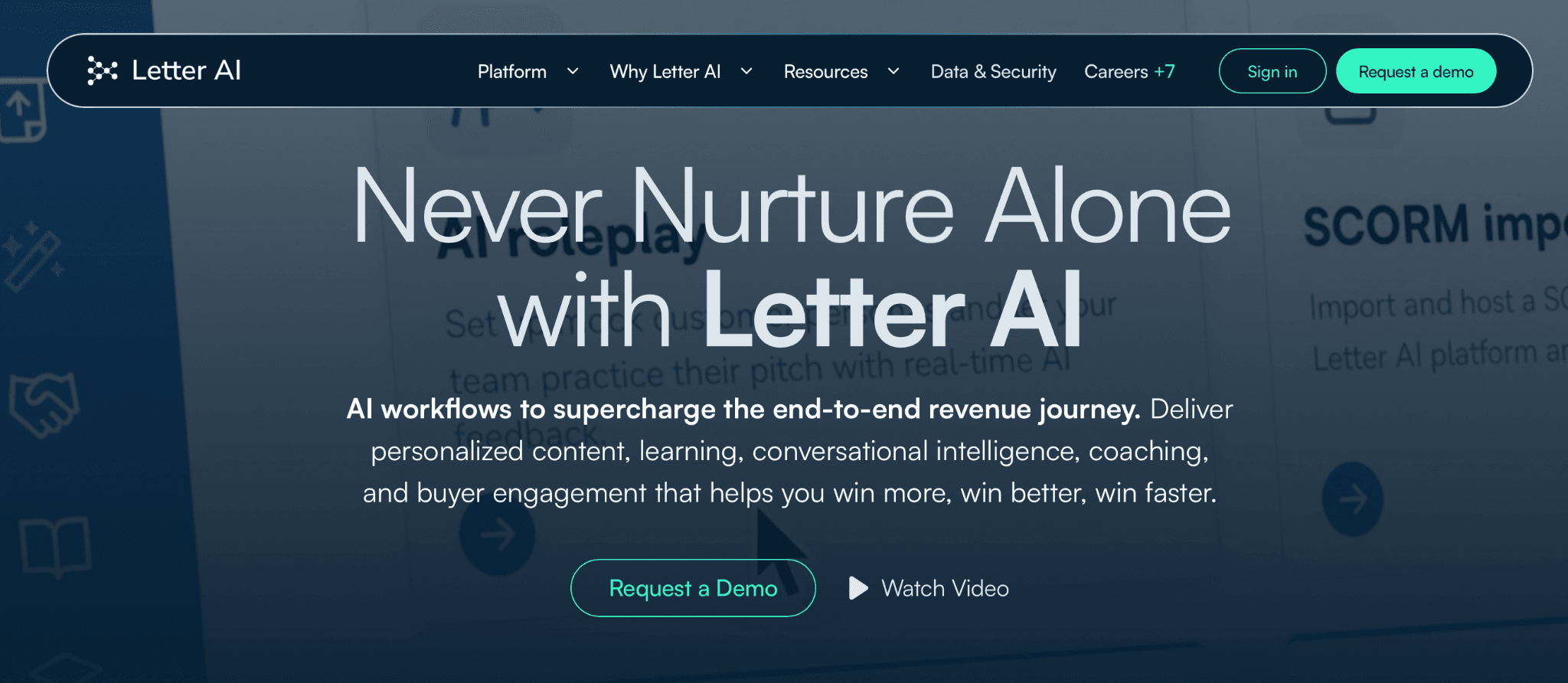
Letter AI is a newer, AI-native platform built around one core idea: turning existing materials into finished training and content without a lengthy build process. Instead of an admin building a course or a rep a pitch deck from scratch, the platform pulls from decks, docs, and product specs that already exist and turns them into something usable right away. It's a much smaller company than the other platforms on this list, but a growing one.
Core features:
- Response-based role play: The AI buyer responds based on what the rep says in each role play scenario, so every rep gets a different conversation.
- Buyer spaces on demand: Proposals, digital sales rooms, and account-specific materials get generated and personalized quickly rather than assembled by hand.
- A co-pilot for quick answers: Reps can ask a question mid-deal and get a response pulled directly from company and product knowledge.
Trade-off: Letter AI leans toward speed and a simpler, unified workflow rather than the granular controls of a legacy platform, so teams that need deep customization may find it limiting.
🏆 Best for: Lean enablement teams that need to stand up training and content fast, without a long build cycle.
6. Gong
G2 rating: 4.7
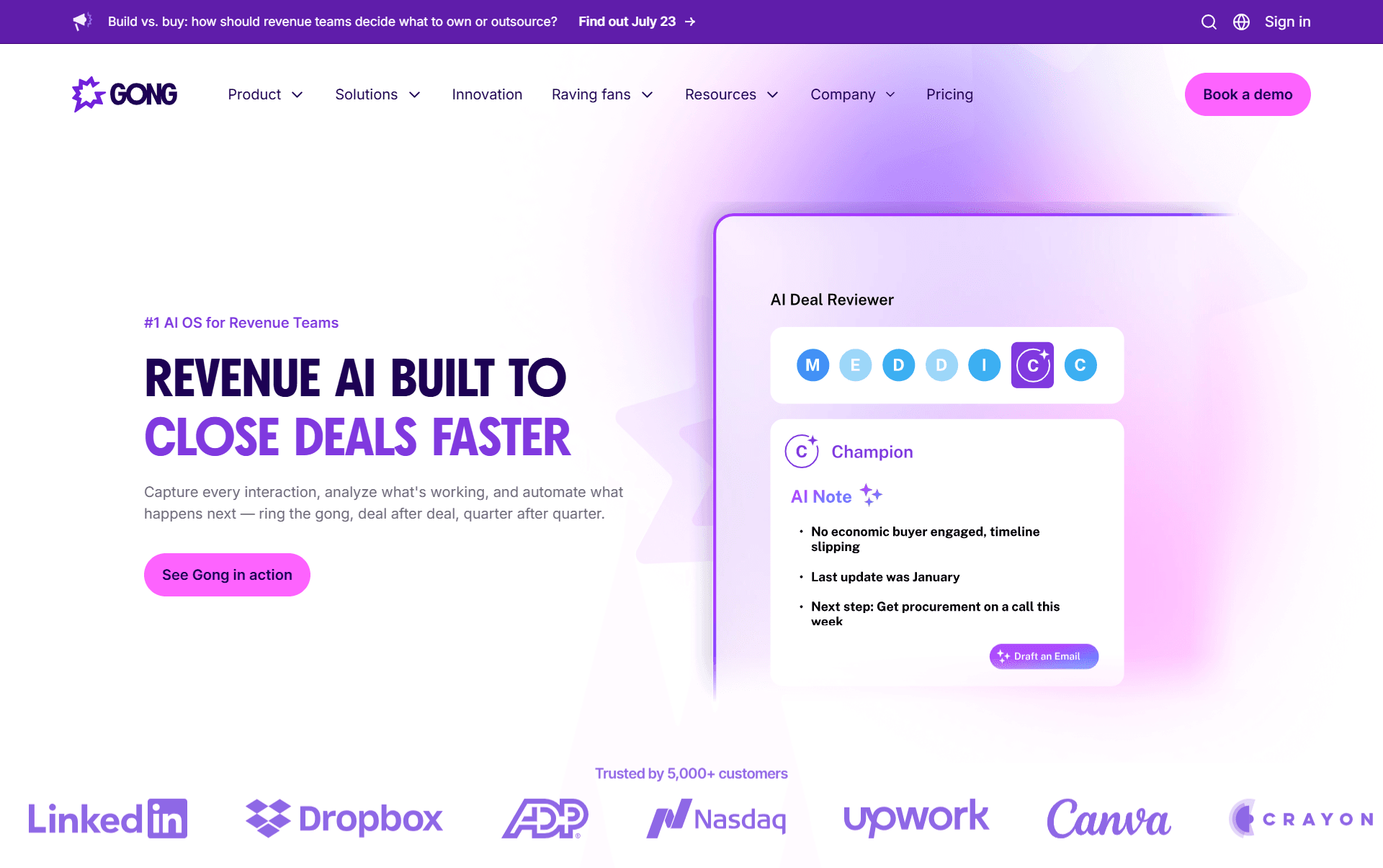
Gong captures customer interactions across calls, email, and video, and turns that data into forecasting, deal-risk signals, and coaching built from real conversations rather than a static training library. Gong has also extended beyond conversation intelligence into enablement directly through a module called Gong Enable, which builds coaching and training simulations from what top performers actually do on live calls.
Core features:
- Automatic call reads: Keywords, pricing sensitivity, and competitor mentions get flagged across every conversation.
- Pipeline risk surfaced early: Deep CRM sync flags exactly why a deal is stalling or moving, giving a manager something specific to act on.
- Coaching built from real calls: Onboarding and coaching draw from what top performers actually say and do on live calls.
Trade-off: Gong's foundation is conversation intelligence, and its enablement and training capabilities, while real as of 2026, are a newer, separately priced layer on top of that. Teams that want deep, mature content management and structured learning as the core of the platform may find dedicated enablement suites more established, and Gong's mandatory platform fee and modular pricing make it a significant investment.
🏆 Best for: Teams whose biggest gap is visibility into what's actually happening on calls and in the pipeline.
Final verdict: Which Allego alternative should you choose?
Six platforms, six different reasons to look past Allego. Some teams want to tone down the admin work. Others look for real depth in one specific spot, like content governance or conversation intelligence.
Mindtickle is chasing a simpler idea. It connects the whole workflow, so practice and feedback feed into the rep data and create a performance improvement loop. The Readiness Index backs that up, showing whether it actually changes how a rep performs.
If you've got one specific gap, one of the other six might be the better fit. If you want a platform that makes your practice amount to something and keeps getting more useful the longer your team's on it, that's Mindtickle.
Frequently Asked Questions
About the Author
Lead Content Marketer
Jayadeep brings over a decade of experience in B2B content and product marketing, with expertise in editorial leadership, messaging strategy, and agency management.
He has built and scaled content operations, led agency partnerships, and collaborated across marketing, product, and demand generation teams to deliver integrated campaigns. His "process-first, execution-next" philosophy has made him a trusted resource at Mindtickle, where he helps shape content strategy, thought leadership programs, and flagship marketing initiatives.
Subscribe to the blog
Get the latest sales enablement tips, guides, and industry best practices delivered to your inbox. Unsubscribe anytime.