




Mindtickle vs. Highspot: Which Enablement Platform Drives Revenue Readiness in 2026?


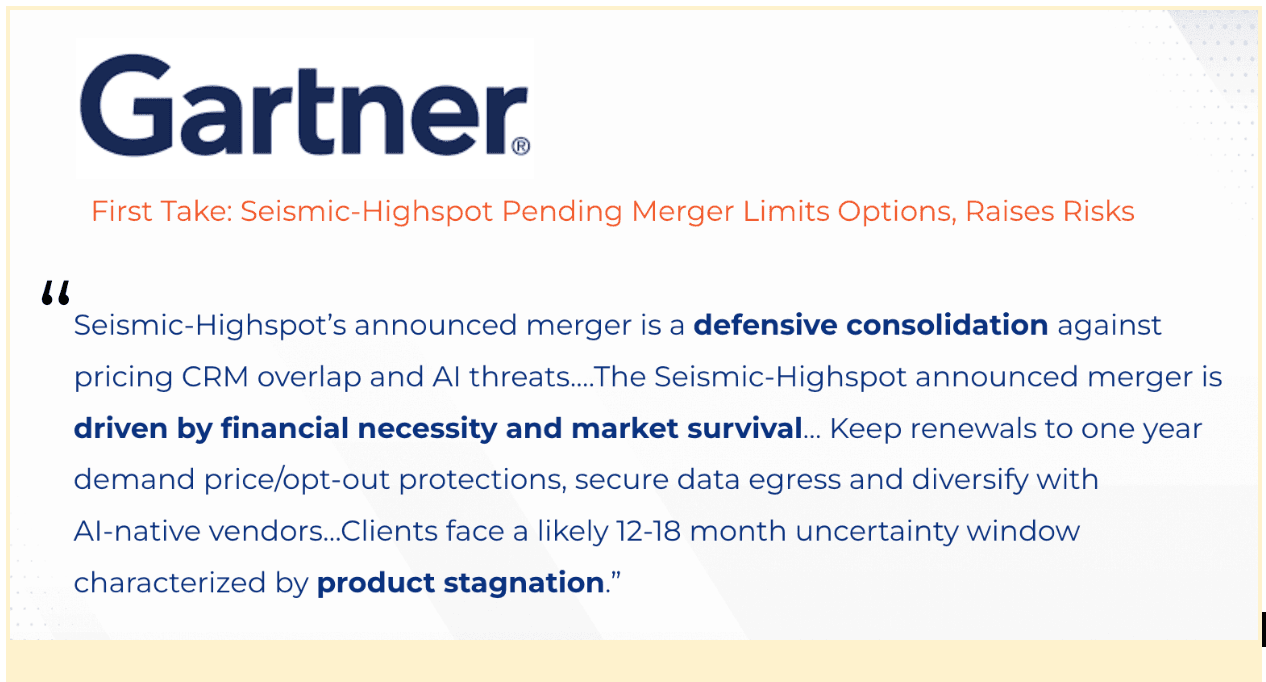
Highspot recently announced a merger with Seismic, introducing real questions about roadmap continuity and platform stability over the next 18-24 months. For existing and prospective Highspot users, be prepared for rocky times as integration takes priority and innovation takes the backseat. The question now is not which platform is better—Mindtickle or Highspot. It is—do you see wisdom in investing in a platform that champions a dying category?
Going into nuts and bolts, there's a fundamental architectural split between Highspot and Mindtickle. Highspot builds excellent content management systems and has added training features over time. Mindtickle is designed as a Revenue Enablement platform that diagnoses rep skill gaps and gives teams the tools to fix them.
Highspot focuses heavily on organizing and surfacing sales content for sellers, which Copilot and AI are automating anyway. Mindtickle approaches enablement differently by focusing on how sellers develop skills, utilize content, and improve readiness over time. Our DNA is different.
But the bottom line is all about which platform drives revenue outcomes. That’s what this article will reveal by comparing Mindtickle and Highspot across four critical dimensions: platform unification, AI maturity, training architecture, and buyer engagement.
Quick verdict: Should you choose Mindtickle or Highspot in 2026?
For executive buyers and ops leaders who want the bottom line, here's the answer based on the 2026 technical and business landscape.
Choose Highspot if you need content governance first
Your primary requirement is strict document management and content governance for marketing teams. Highspot's still a strong choice for organizations where enablement means asset management and brand control.
But you'll need to accept roadmap paralysis and migration friction as the merger unfolds over the next two years.
Choose Mindtickle if you need stability, innovation, and revenue impact
Your mandate is to close revenue gaps and show enablement ROI. Mindtickle is the better choice for revenue leaders who need an integrated system connecting conversation intelligence, skills development, and coaching.
If your priority is AI sales role play, surfacing skill gaps from real calls, and linking seller competencies directly to revenue outcomes, Mindtickle is the clear winner.
Bottom line: Highspot manages content, Mindtickle improves seller performance
If you need a PDF library, Highspot works. If you need a readiness engine that drives real behavior change in reps and turns enablement into revenue, buy Mindtickle.
How we compared Mindtickle vs. Highspot
In 2026, feature parity charts are largely useless. Both platforms claim to offer coaching, AI, and analytics. But these features differ wildly in depth and execution. A surface-level comparison masks the architectural realities that impact your daily operations.
We assessed how well each platform performs across four critical areas: platform unification, native AI capabilities, training, and buyer engagement and enablement. These categories aren’t random. Gartner identifies each of these as critical capabilities in its revenue enablement platforms report, making them the most credible lens through which to evaluate any platform in this space.
Platform architecture: Unified platform vs. integrated ecosystem
The structural integrity of your enablement platform determines whether your data tells a story or just fills a spreadsheet.
Highspot platform architecture
Highspot has historically relied on a partnership-heavy ecosystem to fill functional gaps. They offer a polished content repository. But their critical capabilities often rely on third-party integrations or acquisitions. For example, they rely on partners like Yoodli for advanced AI coaching. This creates data silos in which coaching interactions are separated from core content metrics.
The merger with Seismic makes this fragmentation worse. Merging two large, legacy codebases typically results in a fractured user experience. The training interface and analytics operate separately, with limited data flow between them.
For the next 18-24 months, Highspot's engineers will inevitably focus on reconciling redundant features rather than building new ones.
Mindtickle platform architecture
Mindtickle runs on a single codebase architecture. Conversation Intelligence (Call AI), content management (Asset Hub), and skill development (Sales Readiness) all share the same data moat. This architecture enables end-to-end automation and alignment that fragmented stacks simply can't match.
If Call AI detects that a rep failed to handle a pricing objection during a live negotiation, the system surfaces the gaps to managers who assign a remedial AI Role Play mission to fix that specific rep. The manager gets notified when the rep has practiced and passed the simulation. Let’s see how this happens step by step:
How Mindtickle works
-
Trigger: Call AI surfaces a skill gap (e.g., competitor mention without differentiation)
-
Action: Enablement team assigns targeted microlearning and AI role play to fix the gap
-
Verification: Rep practices and completes built-in assessments. The system scores performance and benchmarks against Readiness Index.
-
Outcome: Manager dashboard updates the Readiness Index and correlates improvement to win rate
Mindtickle integrates deeply with Salesforce and Microsoft Dynamics, keeping enablement connected to the tools your reps already live in. Sellers get just-in-time content and coaching surfaced directly within Slack and Outlook with no tab switching or friction.
Native AI capabilities: Content retrieval vs. role play simulation
Enablement has entered the agentic era. It’s a fundamental shift where AI no longer waits to be asked, but proactively guides, trains, and acts on behalf of revenue teams in real time. Intelligent agents now operate with full context across every deal, conversation, and rep, executing autonomously rather than simply surfacing recommendations. Where human capacity once set the ceiling, AI agents remove it entirely. The focus has shifted from AI assistance to the new level of performance revenue teams can now reach.
Highspot AI: content retrieval and deal assistance
Highspot's AI strategy tells a story of a company that has lost its innovation momentum. Their Deal Agents, announced in late 2025, focus primarily on content retrieval and administrative automation—useful for efficiency, but miles behind where the market is heading. With the Seismic merger, engineering resources are likely to focus on integration work rather than new product development. Code rationalization, architecture alignment, and customer migrations are expected to replace meaningful AI advancement. Customers evaluating Highspot today should consider how integration priorities could influence the pace of product innovation.
Their AI role play capabilities are often wrappers around partner technologies or basic text-to-speech modules. The AI acts as a passive evaluator rather than a dynamic life-like customer. It can tell you if you said a keyword. But it struggles to simulate the pressure and nuance of a real sales conversation.
Mindtickle AI: Role play simulation and enablement copilot
Mindtickle’s newer agentic AI features focus on simulation, coaching automation, and workflow assistance across the enablement process. Where earlier generations assisted, these agents act—autonomously executing across rep development, deal execution, and the buyer experience to drive revenue outcomes at every stage of the sales motion.
-
AI role play simulator: Reps practice with an AI buyer that listens, reacts, interrupts, and pushes back. Unlike static modules, the AI buyer changes its tone and objection strategy based on the rep’s responses. This creates a judgment-free, repeatable environment where reps practice the exact skills flagged by Call AI in live calls.
-
ElevateOS: Built on Behavior Intelligence, Mindtickle's ElevateOS unifies readiness and execution data into a single continuous loop that tracks activity, diagnoses why deals are won or lost and prescribes exactly what to do next. Its autonomous agents coach, guide, and act across every selling moment, so revenue teams can move at the pace of their buyers.
-
AI Tutor: Delivers personalized learning paths for every rep based on their specific skill gaps and performance data. It replaces one-size-fits-all training with coaching that adapts as the market and the seller evolve.
-
AI Content: Transforms long-form content into tailored training videos and branded slide decks. Translates video content into other languages to help localize assets at scale. Now enablement teams can deploy relevant material in hours, not weeks.
-
Buyer Copilot: Provides buyers with instant, approved-content answers so deals never stall waiting on follow-up. It turns the buying experience into a competitive advantage.
-
Deal Guides: An AI-driven playbook that unifies CRM, calls, emails, and content into a single view. It surfaces deal context, stakeholder maps, competitor intel, and AI-curated next best actions so reps always know exactly where to focus.
Mindtickle's AI is also built with enterprise-grade security and compliance (SOC 2 Type II, ISO 27001), addressing the data privacy concerns that often stall AI adoption in large enterprises — a detail competitor integrations often gloss over.
Training and readiness: Content-first learning vs. competency-based readiness
Enablement and Content Management are fundamentally different disciplines. Highspot’s strengths lie in content organization and governance. Mindtickle, by contrast, focuses on developing seller competencies through training, practice, and coaching.
Highspot training: Content-first learning and completion tracking
Highspot enters the training space from a document-centric perspective. Their learning management features feel like an extension of their library, designed to track who viewed a file or completed a generic module. They introduced Rep Scorecards in early 2025 to connect training to revenue, but the architecture is still reactive.
The platform excels at compliance tracking (e.g., ensuring a rep opened the new pricing PDF) but lacks the pedagogical depth required to change behavior. The connection between completing a module and applying a skill in the field remains tenuous and requires manual correlation by operations teams.
Mindtickle training: Competency-based readiness and the Readiness Index
True training goes beyond checkboxes. It should be a continuous, measurable reflection of whether your sellers are truly ready to win. That philosophy has a name: the Readiness Index™.
-
The Readiness Index™ is the market standard: Rather than simply tracking course completion, the Readiness Index™ built into Mindtickle's core architecture, aggregates multiple signals to evaluate a seller’s overall preparedness.
-
The trinity of readiness: The Index combines knowledge (quiz scores), skill (AI role play performance), and behavior (Call AI metrics) into a single view. This lets leaders say, "This rep knows the product (knowledge), but fails to articulate value (skill) and is getting beaten on price in live calls (behavior)."
-
Spaced repetition and gamification: Mindtickle combats the forgetting curve using spaced repetition and gamified missions. Features like leaderboard competitions keep engagement high, turning enablement into a continuous habit rather than a one-off event.
-
Manager augmentation: In large organizations, managers often lack the time to coach effectively. Mindtickle handles the first layer of feedback — AI scores and critiques practice submissions so managers can focus on the final mile of coaching.
Buyer engagement and enablement
In 2026, conversation is only the starting point. Much of the buying process happens as stakeholders review content, share materials internally, and evaluate vendors. Buyer engagement signals such as who accesses content, what they review, and how widely it is shared often reveal more about deal momentum than CRM updates.
Highspot’ Digital Sales Rooms: content portal and engagement analytics
Highspot's DSRs are seller-facing and unable to enable the buyer with content or assistance. They organize content effectively and provide a professional portal for the buyer. But the user experience often mirrors a folder structure, making it feel like a repository rather than a collaborative workspace. When buyers expect a smooth, personalized experience but receive a passive portal, deals stall. Every disengaged buyer means your revenue takes a hit.
The analytics focus heavily on passive signals: "Did they open the file?" and "How long did they spend on page three?" Valuable, sure. But this data often remains trapped in the content analytics dashboard, disconnected from the coaching loop.
Mindtickle Digital Sales Rooms: Deal rooms and intent-driven coaching
Mindtickle treats DSRs as active Deal Rooms, microsites designed to facilitate a frictionless buying experience.
-
Buyer copilot: Mindtickle’s Buyer Copilot is an AI-powered assistant embedded in the Digital Sales Room that gives buyers instant, contextual answers from shared content and assets. By delivering exactly the right information at the right moment, it turns the buying experience into a trust-building advantage that accelerates deals forward.
-
One-stop content shops: Mindtickle Digital Sales Room (DSRs) are mobile-first microsites that require no downloads. They act as a single source of truth for the buyer, aggregating meeting recordings, pricing proposals, and security documents.
-
Signal capture and loop integration: This is the critical differentiator. Mindtickle treats DSR engagement (e.g., a champion sharing the room with the CFO) as a high-fidelity intent signal. This data feeds into the broader enablement workflow. If a rep's DSRs show low engagement, enablement teams can identify a digital selling competency gap and assign targeted training on curating better deal rooms.
-
AI-guided selling: Mindtickle Copilot analyzes the deal stage and competitor presence detected in Call AI to recommend exactly which assets should be added to the DSR. It removes the guesswork and ensures every DSR is optimized for that specific deal's context.
Business considerations: Risk, cost, and enterprise readiness
Beyond the technical architecture, the decision between Highspot and Mindtickle affects your budget, timeline, and risk profile.
How fast can you implement and see value?
Implementing Highspot in 2026 carries a real risk of a forced migration or reimplementation if the combined entity (Highspot + Seismic) decides to deprecate Highspot's architecture in favor of Seismic's infrastructure. Your team could spend the next year implementing a system only to rebuild it. Now think about who will be there to support you through that implementation. Post-merger layoffs routinely leave customer support and services teams in disarray. New customers face the challenge of navigating a complex onboarding with a skeleton crew that's equally uncertain about the company's direction.
With Mindtickle, enablement teams can generate comprehensive onboarding programs from existing documentation in minutes using Copilot. Customers like Janssen India have reported a 50% reduction in ramp time for new hires after deployment. In a volatile market, the ability to deploy and see impact in weeks, not months, gives a decisive advantage.
What is the total cost of ownership (TCO) for Mindtickle vs. Highspot?
Highspot may appear cheaper per license for pure content management. But the TCO tells a different story. Highspot is a point solution for content that often requires customers to purchase separate licenses for conversation intelligence (e.g., Gong) and a learning management system (e.g., Cornerstone) to achieve full functionality. Furthermore, the merger with Seismic introduces significant financial overload. Seismic’s premium pricing model drives the combined entity’s TCO even higher, forcing customers to pay more for a fragmented tech stack rather than increased value.
Mindtickle is a consolidated revenue productivity platform. It replaces the need for separate LMS, CMS, and Conversation Intelligence contracts. By consolidating these capabilities into a single vendor, organizations often achieve significant hard-cost savings. Juniper Networks cited a 47% increase in revenue productivity directly attributed to their Mindtickle deployment. When the conversation shifts from license cost to revenue yield, the TCO advantage of a unified platform becomes clear. Plus, buyers avoid the potential professional services costs associated with data migration during the Highspot - Seismic merger.
Check out our blog showcasing Top Highspot Alternatives and Competitors
Is Mindtickle or Highspot more enterprise-ready?
Highspot maintains enterprise-grade security standards, including SOC 2 Type II, ISO 27001, and GDPR compliance. Its governance model is centered on its patented "Spots" architecture, which excels at organizing vast libraries of sales assets and enforcing version control. While Highspot supports global content distribution and basic multi-language support, its primary focus remains on the global-to-local content lifecycle.
Mindtickle is built for the global enterprise. The platform adheres to the strictest security standards, including SOC 2 Type II, ISO 27001, EU AI Act, and GDPR compliance, ensuring that sensitive sales data and call recordings are protected. Governance is granular — admins can control content versioning, user permissions, and expiration dates with precision. Mindtickle also supports global scalability with multi-language user interfaces. Moreover, it offers localized content delivery for multinational organizations running a single, unified enablement strategy across regions.
Mindtickle vs. Highspot: Quick feature comparison
| Feature | Mindtickle | Seismic + Highspot |
|---|---|---|
| Product Vision | Focused on agentic AI innovation | Focused on integration, code rationalization, customer migrations |
| User Experience | Clean, intuitive, built for the modern seller | Disconnected interfaces, broken reporting, and fragmented workflows |
| Core Focus | Revenue readiness. Closing the skill gap | Content management. Optimizing massive libraries |
| Stability | Stable, well-funded, well-resourced and focused | High uncertainty and risk. Post-merger integration and potential layoffs |
| Ideal For | Enablement teams intent on rep performance and sales excellence. | Marketing teams solving for brand consistency and content organization. |
Final recommendation: Which platform should revenue enablement teams choose in 2026?
Across the four areas evaluated in this comparison, the two platforms reveal fundamentally different approaches to enablement. Highspot remains strong in structured content management and governance, while Mindtickle focuses on connecting seller skills, coaching, and deal execution into an all-in-one enablement system.
Today, revenue teams face immense pressure to improve efficiency and productivity per head. The Highspot-Seismic merger introduces product, pricing, and support uncertainty that agile revenue organizations just can't afford.
Don't bet your 2026 strategy on a platform in flux. Choose the platform that gives the stability, unity, and intelligence required to close the gap between your potential and your performance.
Book a Demo with Mindtickle Today.
FAQs on Mindtickle vs. Highspot
Which is better in 2026: Mindtickle or Highspot?
A: Mindtickle is better for revenue enablement teams focused on improving seller skills and outcomes. Highspot is better for teams focused on content management and governance.
What changed in 2026 that impacts the Highspot vs. Mindtickle decision?
A: Highspot's announced merger with Seismic introduces potential roadmap uncertainty, integration disruption, and possible migration friction over the next 18-24 months.
Is Highspot a Revenue Enablement platform or a content management platform?
A: Highspot is strongest as a content management and content experience platform, with enablement and coaching features layered on top.
What is Mindtickle's signature workflow?
A: It's a workflow where the platform surfaces skill gaps from call analysis and real-world performance data, enabling teams to assign targeted training and AI sales role play to close those gaps, with improvement tracked against performance metrics.
Does Highspot offer AI role play and coaching?
A: Highspot offers AI-assisted features, but advanced role play and coaching often rely on partner tools or less immersive simulations compared to platforms built around skill practice.
Does Mindtickle include conversation intelligence (Call AI)?
A: Yes. Mindtickle includes Call AI to detect behaviors and gaps from real conversations and connect those insights to coaching and training actions.
Which platform is better for onboarding and ramping new sales reps?
A: Mindtickle is typically better for onboarding and ramp because it's competency-driven (knowledge + skill practice + behavior signals), not just content consumption tracking.
How do Mindtickle and Highspot compare on total cost of ownership (TCO)?
A: Highspot can look lower-cost for content-only use cases, but Mindtickle may reduce TCO when it replaces multiple tools (LMS + conversation intelligence + enablement workflows) in one platform.
What's the difference between Highspot and Mindtickle Digital Sales Rooms (DSRs)?
A: Highspot DSRs are strong for organizing and sharing content. Mindtickle positions DSRs as deal rooms that capture buyer intent signals and feed them back into coaching and enablement.
Who should choose Highspot over Mindtickle?
A: Choose Highspot if your primary goal is centralized content governance, brand control, and asset distribution, and you accept potential merger-related uncertainty.
Who should choose Mindtickle over Highspot?
A: Choose Mindtickle if your priority is improving seller performance through AI coaching, AI sales role play, readiness measurement, and automated remediation tied to outcomes.
Can Highspot natively automate skill-gap remediation from call insights?
A: Not typically as a native workflow. Highspot often requires multiple integrations to connect call insights to training and verification within a single platform.