




What Is a Mutual Action Plan (MAP)? How to Align Buyers, Shorten Sales Cycles, and Close Deals Faster



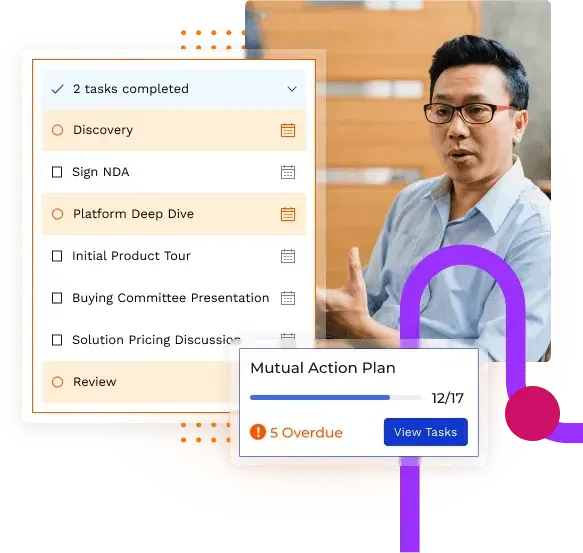
A mutual action plan (MAP) is a shared, step-by-step plan between a seller and a buyer that spells out everything needed to close the deal, who owns each step, and by when, through to go-live. Both sides can see it and update it, which is what makes it mutual. It replaces guesswork with a roadmap that keeps a deal moving.
Most deals don't have one, and it shows. Buying committees keep getting bigger, and stakeholders join at different points along the way, but there's rarely a clear roadmap of what happens next.
The champion builds buy-in internally and the deal feels like it's moving toward a yes, yet nobody mapped out who else needed to weigh in, so legal or IT enters late and the next step slips. Reps are left guessing whether to follow up today or wait another week. And buyers lean on that fog, because when there's no clear next move, "let me check with my team" becomes a comfortable place to hide.
A MAP clears that fog.
Key takeaways
- A mutual action plan is built around the buyer's outcome rather than a rep's quota, and it's visible to both sides.
- Reps get shorter sales cycles and more accurate forecasting. Buyers get a clear roadmap and easier internal consensus.
- A strong MAP covers outcomes, stakeholders, milestones, decision criteria, and procurement and legal steps, through to post-sale onboarding.
- Rep adoption takes deliberate effort from sales leadership: centralize templates, make MAPs part of pipeline reviews, and coach reps on how to pitch them.
What is a mutual action plan (MAP)?
A mutual action plan is a collaborative, step-by-step framework co-authored by the buyer and the rep. It details the responsibilities, deliverables, and deadlines required to reach a shared business outcome.
A MAP brings clarity to both sides. Your team owns deliverables like contracts, security reviews, and demos. The buyer owns milestones like internal sign-offs, budget approval, and stakeholder reviews. Everything sits on one timeline, with clear owners and deadlines attached.
Did you know?
Forrester's State of Business Buying, 2024 reports that 86% of B2B purchases stall at some point before closing, and 81% of buyers are dissatisfied with their chosen providers. A missing roadmap is one common cause.
You'll also hear a MAP called a joint execution plan, a mutual success plan, or a close plan. The name changes, but the idea holds: get everyone rowing in the same direction. One distinction worth knowing is that "close plan" can sound rep-focused, so some sellers stick to "mutual action plan" or "success plan" when talking with the buyer.
How is a mutual action plan different from traditional sales tracking?
The main difference is who can see it. Traditional sales tracking lives in the CRM. It's built for your team to monitor the deal through stage movements, activity logs, and close-date estimates. The buyer never sees it, so both sides work at their own disconnected pace.
That's fine when the goal is reporting. It falls apart when you're coordinating a complex deal with a large buying committee. A MAP is built for you and the buyer to run the deal together.
Many teams try to fill the gap with a spreadsheet in Excel or Google Sheets, emailed back and forth or dropped in a shared drive. It's familiar and free, so it's an easy default. But a spreadsheet was built to calculate numbers, not to be a shared workspace with a buyer. Versions drift, and it doesn't make a strong impression on a committee deciding whether to trust you with a six- or seven-figure purchase.
The difference is clear when you shift to a MAP.
| Traditional sales tracking | Mutual action plan (collaborative) | |
|---|---|---|
| Primary focus | Whether the rep is hitting quota this quarter | Whether the buyer is on pace to hit their target outcome |
| Visibility | Locked inside the CRM, seen only by sales and leadership | Shared openly, so the buyer sees exactly where things stand |
| Ownership | One rep, updating it whenever they remember to | Rep and buying champion, both accountable for keeping it current |
| Key milestones | Deal-stage checkboxes like contract signed, invoice sent | Real buyer milestones like security review, technical evaluation, go-live date |
| Tooling | A spreadsheet or CRM field filled in after the fact | Shared mutual action plan software where either side updates the moment something's done |
Traditional tracking ends the moment the contract is signed, because on paper that's where the rep's job ends. A MAP keeps going until the buyer is live and getting value, because that's the moment that matters to them.
What are the benefits of a mutual action plan?
A MAP changes real outcomes on both sides of the table.
Benefits for reps
The most obvious one is speed. When every next step has an owner and a deadline, deals stop sitting idle while someone tries to remember what's next. That structure tends to shorten sales cycles and gives you a close date you can stand behind.
The same structure fixes a forecasting problem most sales leaders already know they have. When milestones are tracked and co-owned, you're no longer forecasting off a rep's optimism. You're forecasting off steps the buyer has actually completed. That's a real shift from gut feel to evidence.
Because the evidence is visible to both sides, you catch risk early. A legal review that's quietly stalled, a security sign-off nobody scheduled, a stakeholder who's gone quiet: each shows up as a missed milestone while there's still time to act.
What does a MAP actually change?
According to Mindtickle's 2026 State of Agentic Revenue Enablement Report, digital sales rooms with a mutual action plan get twice as many visits as rooms without one. A clear next step gives buyers a reason to come back, and every visit is a signal you can act on.
Benefits for buyers
Buyers often get even more out of it. A MAP turns an intimidating process into a visible one. Instead of wondering what happens after this call, the buyer has a roadmap of what's done, what's next, and what's still to come.
That roadmap does heavy lifting internally. Winning over a committee is hard when the champion is the only one who sees the full picture. A shared MAP puts legal, IT, procurement, and finance in front of the same plan, so the champion can rally consensus instead of re-explaining the deal in every hallway conversation.
It also protects what the buyer cares about most: hitting their launch date. When every dependency, from technical evaluation to contract review to onboarding kickoff, is mapped in advance, no last-minute surprise stands between the buyer and going live on time.
The anatomy of an effective mutual action plan template
Every MAP looks a little different depending on the deal, the industry, and the buyer. But the building blocks follow the order a real deal moves through.
- Executive summary and outcomes
The plan opens with the business problem the buyer is trying to solve and the measurable goals that define success. These are targets specific enough to mark done or not done, like cutting onboarding time by 30%, consolidating three tools into one, or hitting a compliance deadline by Q3. Everything downstream traces back to them, which is what keeps the rest of the plan honest.
- Stakeholders and RACI matrix
Every MAP names the people involved on both sides and the role each one plays. A RACI matrix (Responsible, Accountable, Consulted, Informed) captures that cleanly: who does the work, who signs off, who weighs in, and who stays in the loop. This matters as much for the seller's side as the buyer's. When a security review needs input from someone the plan never listed, the delay tends to surface at the worst possible moment.
- Milestone schedule
The milestone schedule is the timeline itself, with each step in order and grouped into phases like evaluation, validation, procurement, and onboarding rather than one long list. Every milestone carries an owner and a date. The dates run backward from the buyer's target go-live, not forward from today, so they reflect when the buyer actually needs to be up and running.
- Decision criteria and technical validation
This is where the plan spells out what the buyer needs to see before they can say yes: security requirements, integration checks, technical evaluations, and proof-of-concept criteria. Putting it in writing early does two things. It keeps the seller from being blindsided by a requirement that surfaces late, and it gives the buyer's technical stakeholders a concrete bar to evaluate against instead of a vague sense they'll know it when they see it.
- Procurement and legal roadmap
Procurement and legal are where deals quietly stall, which is why they earn a dedicated section rather than a line in the general timeline. The section tracks the NDA, vendor onboarding, contract review, redlines, and final sign-off, each with its own deadline. These teams move at their own pace, and it's rarely fast, so surfacing the steps early gives both sides room to plan around them.
- Post-sale onboarding and go-live
The plan runs past signature. Its final section hands the relationship to whoever owns it next, usually customer success, and describes what has to happen for the buyer to realize the value they bought. Leave it out, and a won deal can turn into a lost account a few months later, because no one defined what success looked like once the ink dried.
How to drive Mutual Action Plan adoption
A great template means nothing if reps don't use it. Too often, sales enablement builds a template, shares it once in a Slack channel, and six months later half the team has forgotten it exists while the other half never knew. Adoption takes a deliberate push from sales leadership.
Centralize your templates
Reps won't hunt for a template buried in an old email or a shared drive nobody remembers. Store your MAP templates in a single enablement repository everyone knows to check, ideally the same place they go for other sales content and playbooks. If it isn't easy to find, it won't get used.
Make it part of the pipeline review
If a mutual action plan isn't part of how you review deals, it becomes optional. Managers should pull up the MAP during one-on-one deal inspections and ask real questions: Is this milestone on track? Who owns the next step? What's overdue? When reviewing the MAP becomes routine, updating it becomes routine too.
Coach reps on how to pitch it
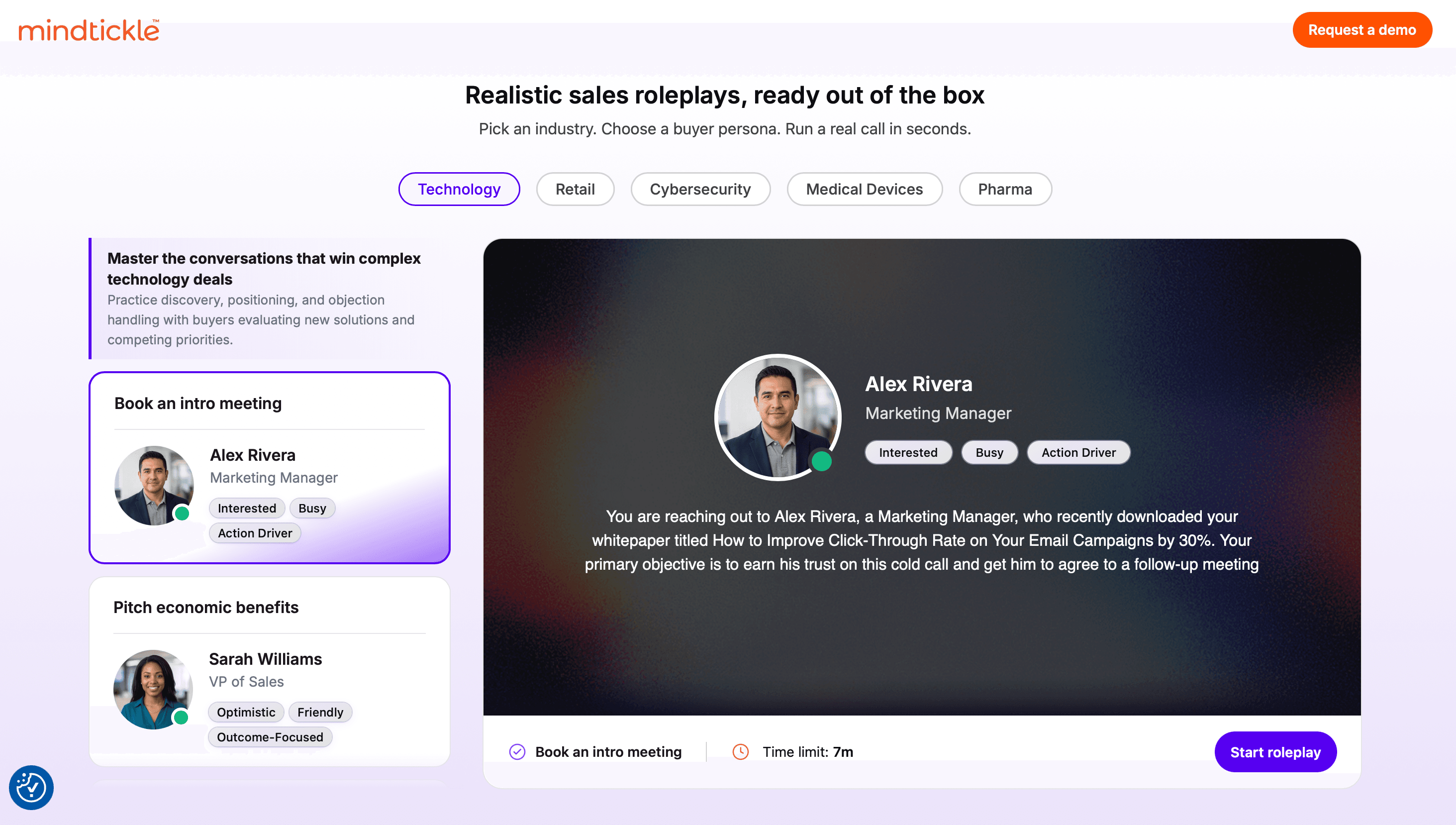
Introducing a mutual action plan to a skeptical buyer is its own skill, and most reps have never been trained on it. They know what a mutual action plan is, but not how to raise it without sounding like they're handing over homework. This is where sales coaching matters. Reps need to rehearse pitching a MAP to a prospect who pushes back, stalls, or asks why they need another document, before they do it live on a call that counts.
😊 Good to know
Mindtickle's AI Sales Role Play makes this practical to scale. Instead of one-off sessions that reach a handful of reps, managers set up realistic scenarios where reps practice introducing a MAP, handle objections, and get instant, specific feedback on what landed and what didn't. It turns "know your MAP" from an onboarding slide into a skill reps build through repetition.
Where the MAP lives matters as much as the plan
Many teams choose standalone mutual action plan software to host and track MAPs with buyers. These tools handle visibility and co-ownership well. What they lack is a connection to the coaching and deal context the rep is already working in, so you trade one silo for another.
Mindtickle's Digital Sales Rooms give the MAP a home inside the deal itself. The whole workflow sits on one platform: a rep rehearses introducing the MAP in AI Sales Role Play, gets feedback, and shares the MAP directly inside the room without switching tools. ElevateOS, Mindtickle's agentic revenue enablement system, connects it all by pulling in deal context from the digital sales room as things move.
Give your next deal a clear MAP
A mutual action plan won't save a deal that was never going to happen. But for the deals that could go either way, a MAP is often the difference between a buyer who quietly goes dark and one who stays engaged through to close. The teams that get the most out of MAPs build them into how reps sell and how buyers experience the process, from first call to go-live.
Ready to see how MAPs, content, and buyer engagement come together in one shared space?
Frequently asked questions
About the Author
Director of Product Marketing
Christian Pieper is the Director of Product Marketing at Mindtickle from 2021.
Subscribe to the blog
Get the latest sales enablement tips, guides, and industry best practices delivered to your inbox. Unsubscribe anytime.