




7 AI Role Play Scenarios for Automotive Sales Reps



AI role play scenarios for automotive sales reps are simulated customer conversations where sellers practice against an AI buyer, such as a price-conscious shopper, a fleet buyer, or someone considering an EV for the first time. The AI responds dynamically, allowing reps to practice product presentations, objection handling, financing conversations, and other selling skills in a safe, repeatable environment.
Today's automotive buyers often arrive with product and pricing information already in hand. Sellers also need to keep pace with frequent model and product changes across dealer networks. That makes practice important. Reps need to apply their product knowledge when buyers challenge the price, compare models, or ask unexpected questions. AI role play gives them a way to rehearse these conversations and receive feedback before facing customers on the showroom floor.
Key Takeaways
- Automotive sales moves too fast for generic training. A buyer can leave your lot and be at a competitor's showroom within the hour, so reps need reflexes built before that conversation starts, not during it.
- Buyers arrive pre-decided. Most walk in having already compared trims, priced financing, and picked which one or two dealerships are worth their time.
- AI role play gives reps a safe rep count before the real conversation. Reps can run pricing pushback, trade-in disputes, and F&I objections against a dynamic AI buyer as many times as they need, with no live deal on the line.
- Every rep gets scored the same way, at every dealership. AI feedback replaces inconsistent manager assessments, so a regional leader can see readiness across the whole network instead of guessing.
7 high-stakes AI role play scenarios for automotive sales reps
Automotive reps carry product knowledge, pricing discipline, and a read on the buyer's mood, all at once, in a single conversation. Below are nine scenarios that show up on the floor every week.
| Scenario Focus | AI Buyer Persona | Deal Outcome & Rep Benefit |
|---|---|---|
| Price and payment objection | Price-conscious buyer | Diagnose the real affordability concern before responding and explain relevant pricing, financing, or value considerations clearly. |
| New model walkaround | Curious, feature-focused buyer | Translate vehicle features and specifications into benefits relevant to the buyer's needs. |
| EV and powertrain objections | Anxious first-time EV shopper | Discover the buyer's concerns and explain relevant EV characteristics without overwhelming them with technical information. |
| Competitive cross-shopping | Buyer comparing competing models | Understand what the buyer values in the alternatives and communicate meaningful differentiation without disparaging competitors. |
| F&I product pushback | Skeptical buyer | Explain relevant F&I products clearly, respond to questions, and follow the dealership's approved process |
| Trade-in value disagreement | Disappointed vehicle owner | Explain the appraisal transparently, use relevant market evidence, acknowledge the buyer's expectations, and keep the conversation constructive. |
| Fleet and commercial buying | Fleet or commercial buyer | Understand different stakeholder priorities and connect the vehicle's value to operational and financial requirements. |
Scenario 1: Inbound price-focused buyer
A buyer calls or messages the dealership before scheduling an appointment and goes straight to price. They may already have a specific vehicle in mind and want to know what the dealership can offer.
Where reps can struggle: A rep may offer a discount too quickly in an attempt to win the conversation, or avoid discussing price altogether and push the buyer to visit the dealership first. Both approaches can make it harder to build trust.
What the rep should practice: Address the price question directly and provide accurate information the rep is authorized to share. Then ask focused questions to understand what the buyer is comparing and whether factors such as financing or a trade-in are part of the decision. If a precise quote requires additional information, explain what is needed and establish a clear next step.
🎬 Ready-to-use AI role play scenario
Buyer: Price-focused vehicle shopper
AI role: Start by asking for the best available price and remain focused on the financial side of the purchase. If the rep avoids the question completely, push back and ask why the dealership cannot provide a price. If the rep provides a number without clarifying relevant details, ask what is included. Reveal additional considerations, such as financing or a trade-in, only when the rep asks relevant questions.
Rep objective: Address the buyer's price question directly, understand the factors affecting the purchase, communicate pricing information accurately, and establish an appropriate next step.
What to assess: Directness of the response, quality of discovery, ability to discuss price without prematurely discounting, accuracy of the information provided, and effectiveness of the next-step conversation.
Also Read: 8 Sales Training Topics for Automotive Sellers That Drive Results
Scenario 2: New vehicle launch walkaround
A new model has launched, and a buyer wants to understand what has changed. They may ask about the updated infotainment system, safety features, powertrain, or differences between trims. What matters most will depend on what they want from the vehicle.
Where reps can struggle: A rep may default to reciting specifications and feature updates in the order they learned them. That gives the buyer information, but it may not help them understand why the new model is relevant to their needs.
What the rep should practice: Start with a question that reveals what brought the buyer to the model, then tailor the walkaround around those priorities. A buyer focused on family safety may need more context on relevant safety features, while a technology-focused buyer may care more about the infotainment experience. Product specifications should support the conversation rather than replace it.
🎬 Ready-to-use AI role play scenario
Buyer: Vehicle shopper considering a newly launched model
AI role: Ask questions about the features the buyer is most interested in and challenge the rep when they provide irrelevant information or rely too heavily on specifications. Shift the buyer's priorities during the conversation when appropriate. Ask follow-up questions that require the rep to explain how a feature affects the ownership experience rather than simply repeating its technical specification.
Rep objective: Discover what matters to the buyer, tailor the walkaround accordingly, and translate relevant vehicle features and specifications into buyer-focused value using current, approved product information.
What to assess: Quality of [discovery](https://www.mindtickle.com/blog/15-sales-discovery-questions-to-help-you-fill-your-sales-pipeline/), relevance of the walkaround, ability to translate features into customer value, accuracy of product information, and ability to adapt when the buyer changes direction.
Scenario 3: EV and new powertrain questions
A buyer is considering an EV alongside a hybrid or gas-powered vehicle. They ask about range, charging, battery life, and long-distance travel. Their questions may reflect a broader concern about whether the vehicle fits their daily routine and driving habits.
Where reps can struggle: A rep may respond to each question with a specification and move on. A range figure, for example, may answer the literal question without addressing whether the buyer has convenient charging access or how the vehicle fits their typical driving patterns.
What the rep should practice: Understand the concern behind the question before responding with information. The rep should ask about the buyer's driving habits, access to charging, typical trip length, and priorities, then explain the relevant vehicle characteristics using current and accurate product information. When discussing range, charging time, or ownership costs, the rep should provide context and avoid making assumptions that don't apply to the buyer's situation.
🎬 Ready-to-use AI role play scenario
Buyer: First-time EV shopper considering an EV alongside a hybrid or gas-powered vehicle
AI role: Act as a cautious but genuinely interested buyer. Raise concerns about range and charging, but reveal the underlying priorities gradually. If the rep responds with specifications without asking about driving habits or charging access, ask follow-up questions that expose the gap. Challenge unsupported claims and ask for clarification when the rep makes broad statements about charging, costs, or battery life.
Rep objective: Understand the buyer's concerns and driving needs, provide accurate and relevant product information, and help the buyer evaluate whether the vehicle fits their lifestyle without overstating its benefits.
What to assess: Quality of discovery, ability to uncover the concern behind the objection, accuracy of product information, and avoidance of unsupported comparisons or claims.
Good Read: Training Automotive Sellers Isn't Always a Smooth Ride (But it Can Be)
Scenario 4: Competitive cross-shop
A buyer mentions that they are also considering a competing model, sometimes with a specific trim, feature, or price already in mind. The rep now has to understand what is attracting the buyer to the alternative and explain where their vehicle may be a better fit.
Where reps can struggle: A rep may respond defensively, make negative comments about the competing brand, or immediately shift the conversation toward price. That can distract from what the buyer actually values and turn a product comparison into a price negotiation.
What the rep should practice: Ask what specifically appeals to the buyer about the competing vehicle before responding. Then identify the differences that are relevant to those priorities and explain them using accurate, verifiable product information. The goal is to help the buyer make a meaningful comparison rather than trying to dismiss the alternative.
🎬 Ready-to-use AI role play scenario
Buyer: Shopper comparing the dealership's vehicle with a competing model
AI role: Act as a well-informed comparison shopper. Mention specific features, pricing, or benefits of the competing vehicle based on the scenario's approved product information. If the rep immediately criticizes the competitor, challenge the claim. If the rep jumps to discounting, ask whether there is another reason to consider the vehicle. Become more engaged when the rep asks relevant questions and connects accurate points of differentiation to the buyer's priorities.
Rep objective: Understand what the buyer values about the competing vehicle, communicate relevant and substantiated differentiation, and help the buyer make an informed comparison without disparaging the competitor or defaulting to a discount.
What to assess: Relevance of competitive differentiation, accuracy of product information, handling of competitor claims, and ability to avoid unnecessary discounting.
Scenario 5: F&I product questions and pushback
The buyer has spent considerable time deciding on a vehicle and is now discussing F&I products. They may be interested in some options, uncertain about others, or simply ready to finish the purchase. The rep needs to explain relevant products clearly without making the conversation feel like a series of additional sales pitches.
Where reps can struggle: A rep may abandon the conversation after the first objection or continue presenting products after the buyer has clearly indicated they are not interested. Both responses can make it harder to have a productive conversation.
What the rep should practice: Explain relevant F&I products clearly, connect them to information the buyer has shared when appropriate, answer questions accurately, and give the buyer space to make a decision. The rep should follow the dealership's approved F&I process and avoid making unsupported claims about coverage, savings, or future costs.
🎬 Ready-to-use AI role play scenario
Buyer: Vehicle buyer who is evaluating F&I products
AI role: Act as a buyer who is interested in understanding the options but does not want to feel pressured. Question the relevance, cost, coverage, or value of the product when appropriate. If the rep gives a clear explanation and answers the question directly, remain open to learning more. If the rep becomes pushy or makes unsupported claims, become less receptive.
Rep objective: Explain the relevant F&I product clearly, answer the buyer's questions accurately, understand their concerns, and allow them to make an informed decision without pressure.
What to assess: Clarity of the explanation, relevance to the buyer's stated needs, accuracy of product information, [handling of objections](https://www.mindtickle.com/blog/objection-handling-with-ai-sales-roleplay/), adherence to the dealership's approved process, and ability to maintain a low-pressure conversation.
Scenario 6: Trade-in value dispute
A buyer receives a trade-in appraisal that is lower than the value they expected. They may have researched the vehicle online, seen different valuations, or simply believe its condition and history justify a higher number. The difference can quickly become a source of frustration.
Where reps can struggle: A rep may become defensive about the appraisal or offer concessions simply to keep the conversation moving. Neither approach addresses the buyer's underlying concern or helps them understand how the valuation was determined.
What the rep should practice: Acknowledge the buyer's expectations, explain the factors that influence the appraisal, and use relevant market and vehicle information to clarify the difference. The rep should also understand what adjustments, if any, they are authorized to make and communicate the overall transaction clearly rather than using one part of the deal to obscure another.
🎬 Ready-to-use AI role play scenario
Buyer: Vehicle owner who disagrees with the trade-in appraisal
AI role: Act as a buyer who is disappointed with the appraisal and asks the rep to explain the difference. Challenge vague explanations and ask how factors such as mileage, condition, market demand, and comparable vehicles affected the valuation. If the rep becomes defensive, push back. If the rep acknowledges the concern and explains the appraisal clearly, become more receptive to the conversation.
Rep objective: Understand the buyer's expectations, explain the appraisal using accurate information, acknowledge the buyer's concerns, and communicate any available options within the dealership's approved process.
What to assess: Empathy, clarity of explanation, use of relevant evidence, handling of disagreement, transparency about available options, and ability to keep the conversation constructive.
Scenario 7: Fleet and commercial buyer negotiation
A fleet or commercial vehicle purchase can involve multiple stakeholders evaluating the decision from different perspectives. Procurement may focus on pricing and contract terms, operations may care about vehicle availability and service requirements, while finance may evaluate total cost of ownership and the broader economics of the fleet.
Where reps can struggle: A rep may focus on the most vocal stakeholder and fail to surface concerns from others in the conversation. Those unanswered questions can become obstacles later in the buying process.
What the rep should practice: Identify the different priorities represented in the conversation and address them without losing sight of the overall buying decision. The rep should ask questions to understand each stakeholder's evaluation criteria, use accurate product and commercial information, and avoid making assumptions about what matters to a particular role.
🎬 Ready-to-use AI role play scenario
Buyers: Fleet procurement, operations, and finance stakeholders
AI role: Simulate multiple stakeholders with different priorities. Have them raise questions at different points in the conversation and occasionally interrupt one another. If the rep focuses exclusively on one stakeholder, have another stakeholder bring an unresolved concern back into the discussion. Challenge unsupported claims about pricing, service, operating costs, or TCO and ask the rep to explain the basis for them.
Rep objective: Understand the different stakeholder priorities, address relevant concerns with accurate information, and guide the conversation toward the organization's broader evaluation criteria.
What to assess: Multi-stakeholder discovery, ability to recognize different decision criteria, relevance and accuracy of responses, management of interruptions, and ability to keep the conversation aligned around the customer's buying objectives.
Practice for the buyer who's already done the research
Today's buyers often arrive further along in their decision process. Mindtickle's 2026 State of Agentic Revenue Enablement Report found that 88% of buyers enter a purchase conversation already solution-aware, while 40% already know which vendors they're considering.
For automotive sellers, that makes conversational readiness just as important as product knowledge. A buyer may already know the model, compare competing vehicles, or have a price in mind. The rep's job is to understand what matters to that buyer, respond accurately, and add value to a conversation that has already started.
That's where repeated practice can help. The same Mindtickle report found that role play accounted for 70% of all training sessions in 2025.
The seven scenarios above are a starting point. Teams can adapt them to their models, buyer personas, sales motions, and the conversations where reps need more practice.
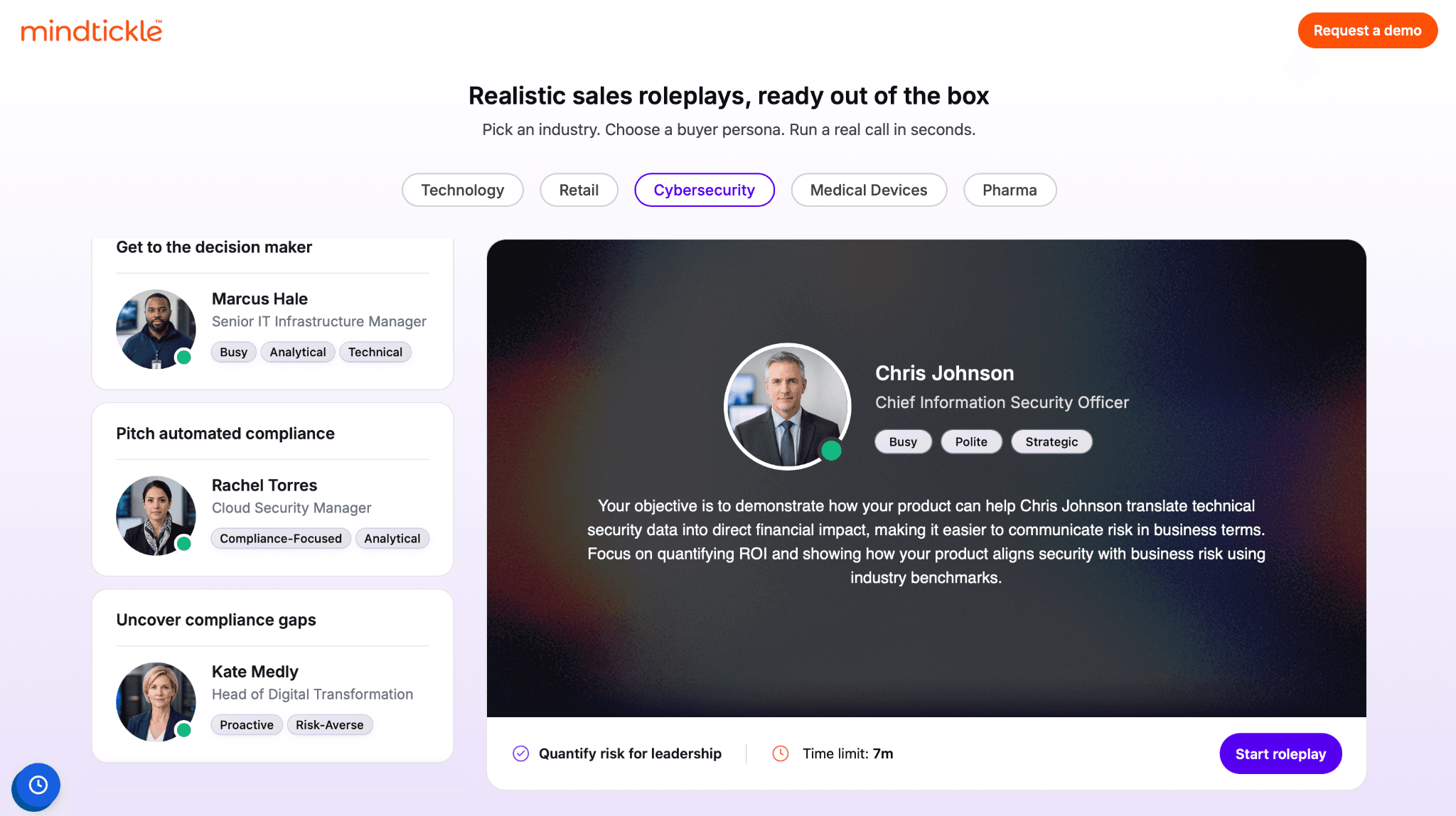
Want to see what that practice feels like? Try Mindtickle's free AI Sales Role Play and practice realistic buyer conversations before they happen on the showroom floor.
Frequently Asked Questions
About the Author
Lead Content Marketer
Jayadeep brings over a decade of experience in B2B content and product marketing, with expertise in editorial leadership, messaging strategy, and agency management.
He has built and scaled content operations, led agency partnerships, and collaborated across marketing, product, and demand generation teams to deliver integrated campaigns. His "process-first, execution-next" philosophy has made him a trusted resource at Mindtickle, where he helps shape content strategy, thought leadership programs, and flagship marketing initiatives.
Subscribe to the blog
Get the latest sales enablement tips, guides, and industry best practices delivered to your inbox. Unsubscribe anytime.