




How to Scale AI Sales Coaching and Role Play in Financial Services in 2026



To scale AI sales coaching and role play in financial services, set one compliance-approved standard for what a passing conversation sounds like across every line of business. Update scenarios as soon as products or rules change. Measure readiness by who can hold a compliant client conversation, not by who completed practice.
Most firms that adopt AI role play get the first part of the job right. Reps practice more often, feedback arrives in minutes, and nobody waits on a manager to find time for a review.
Then the program grows. The wealth team builds its own scenarios, the insurance team builds another set, and the branch banking team scores against a rubric nobody else uses. A year later, a compliance leader asks which advisors are ready to discuss the new annuity product with clients, and the best answer anyone can give is a completion report.
This article looks at what changes when AI role play moves from a promising program to something your entire field depends on, and how to keep it something compliance can stand behind as it grows.
Key takeaways
- AI role play gets harder to manage as it spreads. Each new team brings its own idea of what "passed" means, leaving compliance with different standards to defend.
- One compliance-approved rubric gives every team the same starting point. Individual teams can still add checks for their own products.
- Clear ownership keeps scenarios current. Named reviewers approve each scenario before launch and revise it within days whenever the products or rules behind it change.
- The most valuable practice covers conversations where compliance risk and revenue meet. Retirement income and annuity suitability conversations top that list, and experienced advisors benefit from them as much as new hires.
- Readiness shows when certification results hold up on live calls. A rep who handles real clients as well as they did in certification is ready for the field, and one who doesn't needs more coaching first.
Why does AI role play get harder to manage as financial services teams scale?
A pilot works because it's contained. One team, one product, and a small group of people agree on what a good client conversation sounds like. Scale changes that in two ways.
Each business line starts defining "passed" differently
As AI role play spreads across wealth management, insurance, and banking, each group adapts it to its own products and habits. That's reasonable on its own, but it means a passing score on the wealth side can reflect a different standard than a passing score in insurance. When an auditor or your own compliance team asks what "certified" means, there isn't one answer.
Much of this starts with how teams build scenarios. They begin with generic templates and customize them in isolation, which is why the shift from generic scenarios to contextual practice works best when it happens against shared standards rather than team by team.
Activity data hides who's actually ready
Practice volume climbs, dashboards fill with completions and average scores, and leaders still can't tell whether any of it reflects what reps say in front of clients. Over time, reps figure out what the AI rewards and learn to pass the simulation instead of the conversation. The numbers look healthy while the risk in the field stays where it was.
📌 Still building the foundations? Start with AI Sales Role Play: 2026 Guide for Enablement Leaders.
What do financial services teams need in place before scaling AI role play?
Before AI role play reaches every advisor, agent, and banker, two things need to be settled. Both are decisions you make once and revisit only when something changes.
One compliance-approved scoring rubric across business lines
Automated scoring is only as defensible as the standard behind it. For financial services, that means scoring each conversation the way a supervisor would review it. A rep passes only when they give the client every required disclosure and recommend what fits that client's situation.
The strongest rubrics separate disqualifying failures from coaching issues. A rep who rushes the close or leans on jargon needs feedback, but a rep who skips a required disclosure shouldn't pass, however well the rest of the conversation went.
Business lines can still add their own criteria. An annuity scenario might score how clearly a rep explains surrender charges, and a Medicare scenario might check whether the rep stayed within the agreed scope of the appointment. These criteria sit on top of the shared standard, so a pass means the same thing across the business.
✅ Pro tip
Build the shared rubric around the three to five behaviors your compliance team wants to avoid, then layer in skill criteria. It's far easier to agree on the non-negotiables first than to debate a 20-point scorecard line by line.
Approved source material and clear owners for every scenario
Build scenarios from material your compliance team has already reviewed. That includes approved talk tracks, disclosure language, product summaries, and objection responses. This keeps the AI grounded in what reps are allowed to say rather than what simply sounds persuasive.
Ownership matters just as much. Enablement usually builds the scenarios, but compliance and supervision should review them before they go live, and product marketing should flag when a change means a scenario needs to be retired. Writing those roles down early is what keeps scenarios from drifting the moment the first product update lands.
➕ Bonus read: Metrics to Measure Your AI Sales Role Plays
How does AI role play prepare financial services reps for real customer conversations?
Every leader weighing AI role play eventually lands on the same question: will practicing with an AI client change what a rep says in front of a real one?
It depends on how closely practice matches the field. Here's how that plays out in financial services.
Scenarios mirror the conversations that carry the most risk
Financial services conversations aren't generic, and practice shouldn't be either. The scenarios worth building first are the ones where revenue and compliance risk meet. For example, a pre-retiree worried about a market drop, an annuity suitability conversation, a 401(k) rollover, a client questioning advisory fees, or a Medicare call that has to stay within an agreed scope.
Each of these involves sales objections that reps can't answer from a script. Scenarios use fictional client profiles, so reps can work through sensitive situations without any real client data entering the practice environment.
AI clients push back, hesitate, and change direction like real ones
Reps won't take practice seriously if it feels like a quiz with a voice. Hyper-realistic AI role play works because the AI client behaves like a person. It interrupts, questions a fee, brings up something it read in the news, goes quiet at the wrong moment, or mentions a life event halfway through the conversation.
That realism matters most in emotional conversations. A client who recently lost a spouse, a retiree panicking after a bad month in the market, and someone who was burned by a previous advisor all need a different kind of response than a product question does. Practicing those moments tests a rep's judgment, not their memory of a script.
🎬 Sample scenario: The rollover client who wants a guarantee
Client: A 62-year-old operations manager planning to retire in three years
Situation: She's rolling over her 401(k) after a sharp market drop and has heard from a friend that annuities can't lose money.
AI role: Anxious and direct. She asks whether you can guarantee she won't lose her savings and pushes back as soon as fees come up.
Rep objective: Complete discovery on her goals, time horizon, and risk tolerance, answer the guarantee question accurately, and explain fees and surrender charges clearly before suggesting a next step.
What to assess: Discovery depth, required disclosures, avoidance of guarantee language, and how well the rep acknowledges her concern.
➕ Bonus read: AI Sales Role Play for Persona-Specific Objection Handling
New reps build compliant habits before their first client meeting
Most sales training for new reps ends with a knowledge check. Knowing that a disclosure is required is different from delivering it naturally while a client pushes back on price.
Scenario-based practice shows whether a new rep completes discovery, makes the right disclosures, and handles objections without drifting into risky language. Since it happens before the first real meeting, reps can get it wrong, see exactly why, and try again until the right approach feels like their own. For Medicare and insurance teams, this is also how reps prove they can pitch compliantly instead of just passing a multiple-choice test.
Experienced advisors change habits in private
Veterans often find this shift harder than newer reps do because their habits come from years of success. Many built successful books of business with a product-first, transactional style, and training that treats them like new hires or exposes their gaps in front of colleagues tends to backfire.
AI role play gives experienced advisors a private place to practice. Personalized scenarios target their specific habits, like pitching before understanding the client, skipping parts of discovery, or talking past a concern, and repeated sessions show whether those habits are actually changing. The goal is a consultative selling approach that holds up when a supervisor asks how a recommendation was reached.
Practice fits into the selling week instead of pulling reps out of it
Advisors and agents protect their calendars for good reason. Traditional role play needs a manager, a scheduled slot, and often a half-day workshop, which is why it rarely happens as often as it should. AI sales role play removes that constraint, since reps can run a short session before a client meeting, after a product update, or whenever a manager spots a gap.
Managers spend coaching time where it counts
AI role play doesn't replace managers, but it does change where their time goes. The AI reviews each submission against your rubric and gives reps feedback right away, and every session ends with a debrief covering what went well and a skill score. Managers can see which reps and skills need attention, so their time goes to judgment calls, client relationships, and the reps who need a human conversation most.
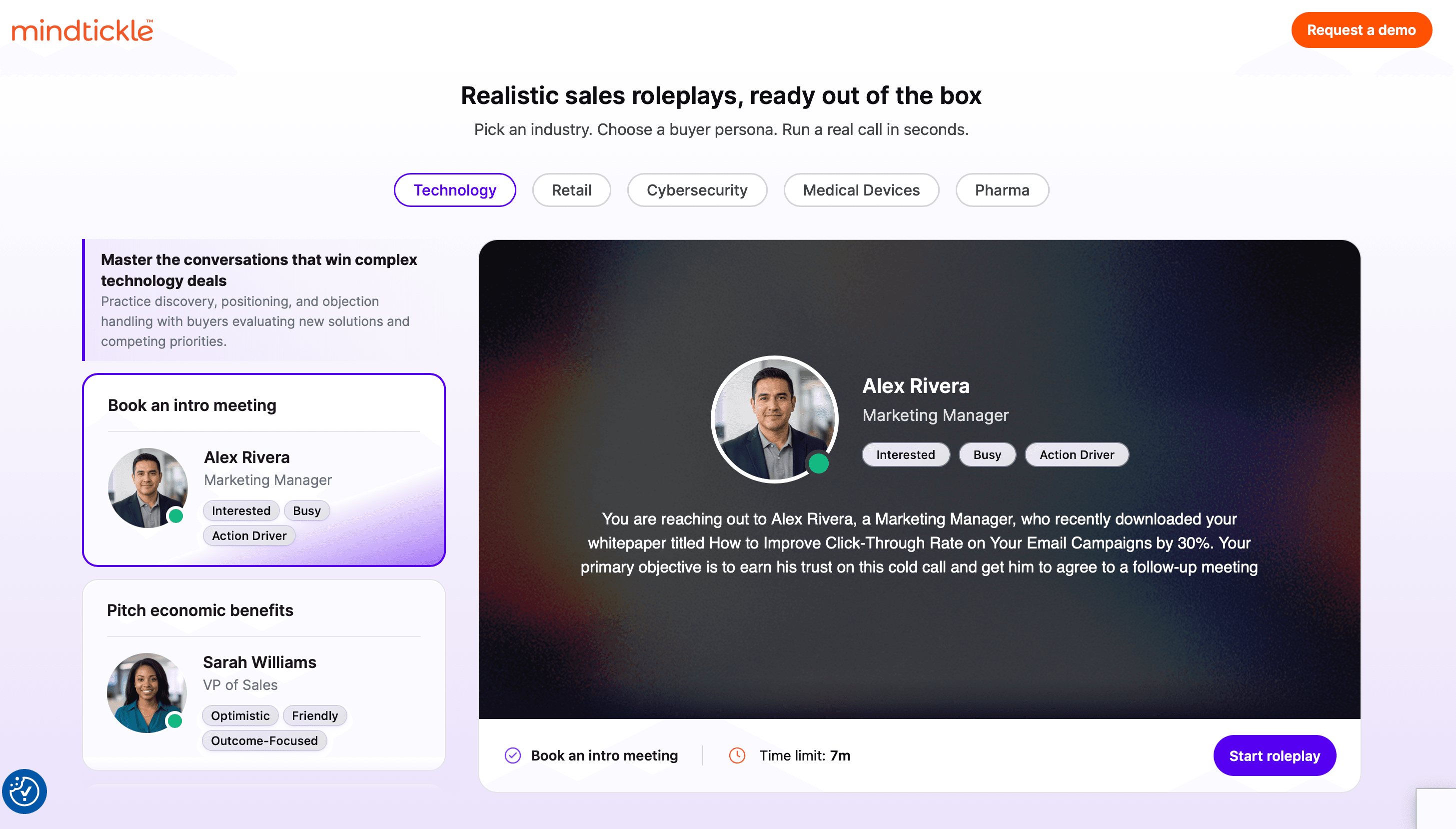
🎯 Try a 7-minute role play yourself
Pick a scenario, talk it through with an AI client, and get an instant score along with specific feedback on what to improve.
How do you keep AI coaching reliable as products and messaging change?
AI coaching is only useful if it's coaching reps on current information. In financial services, what counts as correct can shift quickly, and a scenario that was accurate in January can be wrong by March.
Scenarios update the moment something changes
Quarterly reviews move too slowly for this industry. A rate move, a new or revised product, updated regulatory guidance, or a change to approved messaging should each prompt a scenario review within days, handled by the owners you named when you set the program up.
Live conversations are one of the best early warnings. When you analyze sales call recordings and notice reps fielding a new objection or stumbling over a recently changed product, that's often the first sign a scenario needs an update.
Every score ties to the standard in effect at the time
Version your scenarios and rubrics so every score and certification maps to the messaging and rules in place when the rep practiced. That gives compliance a clear audit trail, and it shows right away which reps were certified on messaging that has since changed and need to practice again.
AI scoring stays calibrated against human judgment
Some parts of a financial services conversation are open to interpretation, and AI scoring shouldn't have the final word on those. Compare AI scores with experienced human reviewers on a set of benchmark conversations at regular intervals, and route ambiguous or high-stakes responses to people. Managers who already use conversation intelligence can also compare what AI flags in practice with what they hear on live calls, which keeps practice and reality aligned.
How do financial services leaders know which reps are actually ready for the field?
Practice volume tells you who showed up. Readiness tells you who's prepared for the next client conversation, and that's the question compliance and sales leaders both need answered.
Certify every rep against the same standard
Measure every rep in a role against the same rubric, set pass thresholds on the competencies that matter most, and trigger recertification when a product or rule changes. A certification program that builds real competencies looks less like a test at the end of onboarding, and more like a standard reps keep meeting throughout their careers.
Hold partner channels to the same bar
That same standard can extend past your direct team. Wholesalers, independent reps, and partner channels can certify through AI role play instead of repeated live workshops, so the bar stays the same no matter who's talking to the client.
Connect practice results to field behavior
When you pair role play results with manager observations and live call data, you can see whether certification shows up in real client behavior. It's also how you measure the impact of your training program in terms leadership cares about.
Where Mindtickle fits into this process
Mindtickle brings these pieces together in a way compliance and supervision leaders can stand behind. The AI Sales Role Play platform gives every rep personalized practice, recommending the next role play based on their detected skill gaps. Copilot also generates scenarios on demand from the personas and approved material your teams define. Each submission is scored against your own rubric with custom cutoff scores.
Reps who complete 10 or more role plays a year score 61% on live calls, compared with 57% for reps who complete fewer, per Mindtickle's 2026 State of Agentic Revenue Enablement Report.
The Readiness Index turns those results into benchmarks you can track by team, region, and line of business, so you can see whether behavior is changing over time instead of counting sessions. Since AI Sales Role Play is part of ElevateOS™, Mindtickle's agentic revenue enablement system built on a decade of rep behavior data, practice connects to coaching, content, and conversation intelligence instead of living in a separate tool.
The fastest way to see where your reps stand is to run the conversation yourself.
FAQs
About the Author
Lead Content Marketer
Jayadeep brings over a decade of experience in B2B content and product marketing, with expertise in editorial leadership, messaging strategy, and agency management.
He has built and scaled content operations, led agency partnerships, and collaborated across marketing, product, and demand generation teams to deliver integrated campaigns. His "process-first, execution-next" philosophy has made him a trusted resource at Mindtickle, where he helps shape content strategy, thought leadership programs, and flagship marketing initiatives.
Subscribe to the blog
Get the latest sales enablement tips, guides, and industry best practices delivered to your inbox. Unsubscribe anytime.