




How to Practice Cold Calls With AI: Realistic Role Play Personas and Scenarios



To practice cold calls with AI, you call an AI prospect that acts like a real buyer and talk to it out loud, just as you would on a live dial. When the call ends, you get feedback on what to change and run the same call again until it sticks.
If you're an SDR, you already know why that matters. You only get a few real conversations a day, each with a stranger who wants you off the phone. One fumbled opener or a frozen pause ends it. Practicing with a teammate who already knows your pitch doesn't come close to that pressure.
Below is a five-step way to set up AI practice that does, with ready-to-use personas and a prompt you can start using right away.
Key takeaways
- AI cold call practice means calling an AI prospect that reacts to you. It responds to your answers and decides whether you've earned more time, so you practice the parts of the call a script can't cover.
- Every session follows the same loop. You set one goal and build the prospect and call context before you dial. After the call, the feedback tells you what to change on the next attempt.
- Start with friendlier prospects and work up. A warm lead or a time-pressed VP makes a good first test, while the gatekeeper and the budget-conscious CFO can wait until your opener holds up.
- A good prompt hides something. Give the AI prospect a detail it only shares when you ask the right question, and the call starts rewarding discovery the way a real one does.
- Score behaviors and change one thing at a time. A scorecard covering six behaviors, from the opener to the next-step ask, shows what to fix before your next attempt.
What is AI sales role play for cold call practice?
AI sales role play for cold call practice is a training method where a rep makes a simulated outbound call to an AI prospect that listens and responds in real time. The AI plays a specific buyer with its own goals and objections. When the call ends, it scores the rep so they know what to change.
In outbound prospecting, the AI plays someone who wasn’t expecting your call. It might be a VP of Sales squeezed between meetings or an assistant whose job is to keep you away from their boss. Like most people who pick up a call from a stranger, they’re ready to say no, so you have a few seconds to give them a reason to keep talking.
With AI sales role play, you talk out loud, the way you would on a real dial, and the AI answers based on what you actually said. That's what makes it different from older practice tools. Open with a generic line, and the AI prospect gets impatient or tries to end the call. The conversation changes direction based on your choices, which is exactly what happens on a real cold call.
Rehearsing a script vs practicing a conversation
Most reps start with a script, and that's fine for the first 15 seconds. A good opener is worth memorizing. Trouble starts when the prospect says something the script didn't plan for.
Rehearsing a fixed script trains you to deliver lines in the right order. Practicing an adaptive conversation trains you to listen and respond to whatever comes back, which is what the rest of the call actually asks of you.
📌 Why generic openers fall flat
Buyers have little patience for outreach that isn't about them. According to a 2024 Gartner Sales Survey, 73% of B2B buyers actively avoid suppliers who send irrelevant outreach.
Where AI practice fits in onboarding and ongoing coaching
For new SDRs, AI cold call practice usually starts in the first week of onboarding. Live calls alone are a slow way to learn. The median SDR has just 4.1 quality conversations a day, according to the Bridge Group’s 2025 SDR Models, Motions & Metrics report.
With AI, new reps can rehearse openers and common objections dozens of times before their first live dial, which helps shorten ramp-up time for new hires without burning through the account list.
For experienced reps, it becomes part of ongoing sales coaching. A rep who keeps losing prospects at the same objection can practice that exact moment between calls, and their manager can see from the scores whether the fix is sticking.
5 steps to practice cold calls with AI sales role play
A useful AI cold call session takes only a few minutes, and it follows the same five steps every time. Decide what you're working on, set up the prospect and the situation, make the call, then use the feedback to run it again.
1. Define the outcome of the practice session
Pick one skill per session. If you try to fix everything in a single call, you won't learn much about any one part of it.
Good session goals are specific enough that you can tell whether you hit them:
- Earn permission to keep talking past the first 30 seconds
- Get past an assistant to the person who owns the problem
- Secure a discovery meeting with a prospect who's only mildly interested
- Respond to "we already use a competitor" without understating them
Write the goal down before you start. It tells you what to listen for in the feedback, and it gives the AI a clear finish line.
2. Build a realistic prospect persona
The AI can only be as convincing as the person you ask it to play. Decide on the prospect's job title, industry, business priorities, how familiar they already are with tools like yours, and the concerns they're most likely to raise.
Your own calls are the best source for all of this. The objections that keep coming up on recorded calls are the ones worth building into the persona.
Start easy and raise the difficulty over time. A curious prospect with a few minutes to spare is a fair first test, while a skeptic who's halfway out the door can wait until your opener is solid. Read: What Makes AI Sales Role Play Realistic Enough to Change Rep Behavior
3. Establish the call context
A persona tells the AI who to be, and the context tells it what's going on. Tell it what your company sells and why you're reaching out to this person now. Then name the next step you're after, such as a 20-minute discovery call later in the week.
Next, hold something back. Give the prospect a hidden detail, like a budget freeze or a messy rollout with their current vendor, and tell the AI to reveal it only if the rep asks a good question. The rep then has to find the real issue through conversation instead of having it handed over.
This kind of contextual practice is what makes the skill carry over. A rep who has practiced against prospects from their own territory, with the objections their market actually raises, walks into live calls with responses that already fit. The prompt section below shows how to put all of this into words the AI will follow.
4. Run the call without relying on a script
Talk to the AI out loud, the way you would on a real dial. Have your opener ready, then let the rest of the call go wherever the prospect takes it.
Good practice should feel a little uncomfortable. The AI prospect should interrupt when you ramble and push back when you haven't earned their time yet. If every call goes smoothly, the persona is too easy.
When you get stuck, keep going. You can't pause and restart a real cold call, so working your way out of an awkward moment is part of what you're practicing. A script can still help you nail the first few lines. Read: How to Write a Sales Call Script (+ 6 Free Templates)
5. Review the feedback and repeat the call
When the call ends, look at the feedback before you dial again. Pick one or two behaviors to change. Maybe you talked for 40 seconds before asking a single question, or you asked for the meeting before the prospect had said anything about their problem.
Then run the same scenario again with that change. Keeping the persona and the goal the same is what lets you see whether the change worked. If the score moves and the call felt better, try a harder version. If it didn't, try a different fix.
Repetition is where most of the progress happens, so expect to run the same scenario several times before a new habit holds.
Which AI cold call personas and scenarios should reps practice?
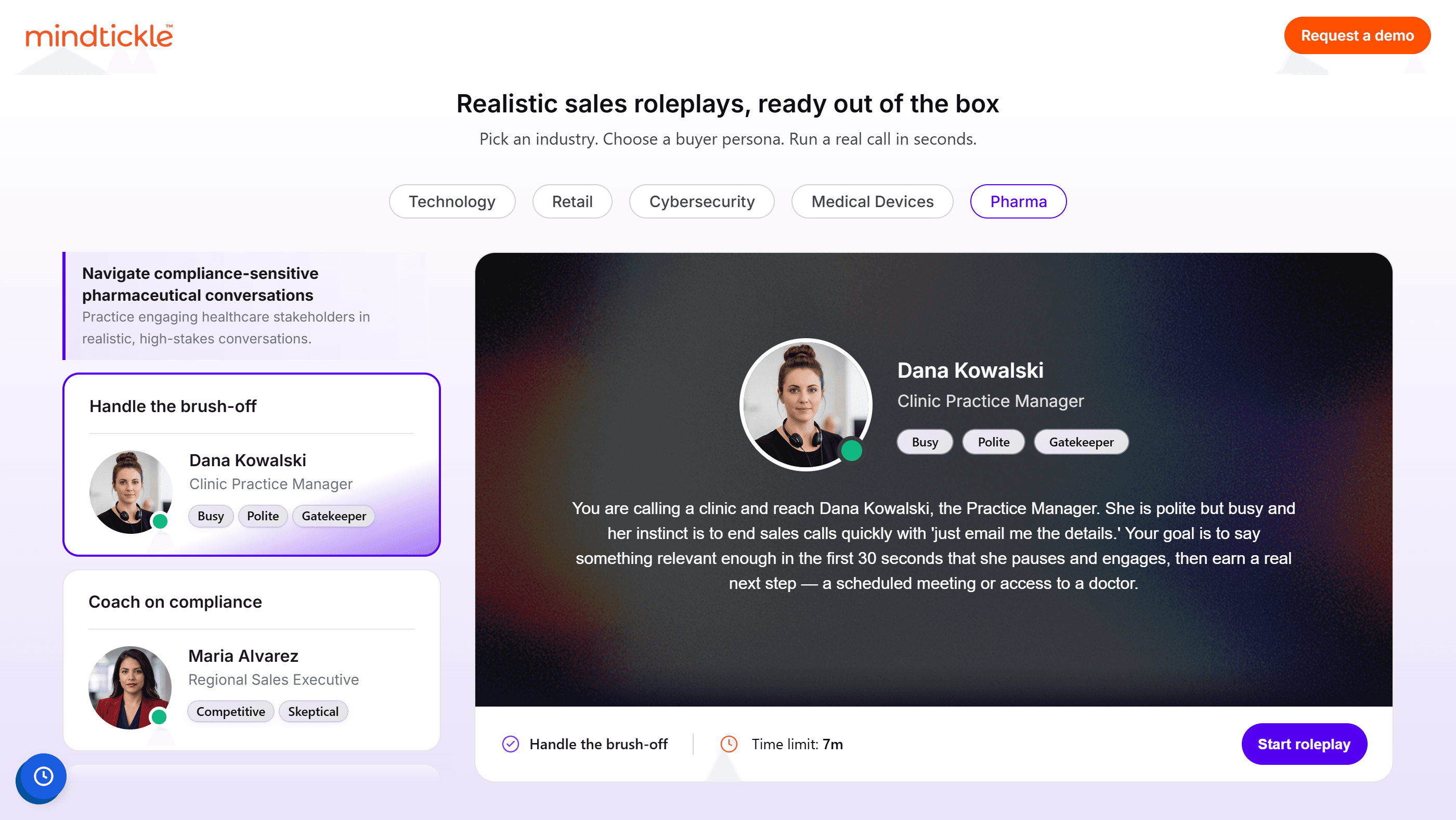
These six personas cover most of what SDRs and BDRs run into on outbound calls, and each one tests a different moment. Start with the warm lead or the time-pressed VP, then work toward the gatekeeper and the CFO as your openers get stronger.
| Persona | Skill to practice | What good looks like |
|---|---|---|
| The gatekeeper: Screening the VP’s calls | Reaching the right person honestly | Say who you are and ask for help: “Who looks after this, and when’s a good time to reach them?” |
| The time-pressed VP: “You’ve got 30 seconds” | Earning permission to keep talking | Give one reason you’re calling them specifically, then ask: “Two more minutes now, or 15 later this week?” |
| The brush-off: “Just send me an email” | Keeping the conversation open | Agree, then ask what the email should cover. Their answer often gives you a reason for a quick call. |
| The competitor’s happy customer: “We already have a tool for that” | Handling a competitive objection | Skip the comparison. Ask what they’d change, and pitch only once they name a gap. |
| The budget-conscious CFO: “What does it cost?” | Handling an early pricing question | Skip the number. Tie it to a cost they already worry about and offer a short call to size it. |
| The warm lead, who downloaded a guide last week | Turning interest into a meeting | Ask what made them download it, then suggest a meeting with a specific day and time. |
🎯 Try a 7-Minute Role Play
Run a live call against an AI buyer persona of your choice and get feedback on how you did instantly.
How do you write an effective AI cold call role play prompt?
An effective cold call prompt tells the AI who to be, what it knows, what it keeps to itself, and how to judge the call when it's over. Dedicated role play tools build much of this for you, but knowing what goes into a good prompt helps you get more out of any tool, including a general chatbot with voice mode.
The elements of a realistic prompt
- Your role and offering. Say who the rep is and what they sell in a line or two. Without it, the AI invents a product, and its objections drift away from anything you'd hear on a real call.
- The prospect's job title and business context. Describe where they work and what's on their plate right now. A VP of Finance facing a tighter close schedule reacts very differently from one who's just been told to cut costs.
- The reason for the outreach. Give the call a trigger, like a new funding round or a recent content download. A real reason gives the rep something specific to open with.
- The prospect's goals, concerns, and objections. Spell out what they want this year and the objections they'll raise if the rep hasn't earned their attention.
- Rules for dynamic responses and information disclosure. Tell the AI how to react to weak or generic answers, and which details to keep hidden until the rep asks the right question. This is the part that makes the call feel adaptive.
- The practice objective and evaluation criteria. Describe what a successful call looks like and what the AI should score once it's over. If your team sells with a sales methodology like MEDDIC or SPIN, add its terms so the feedback matches how you actually sell.
💡 Ready-to-use cold call role play prompt
Copy this prompt into an AI tool that supports voice-based conversations and custom instructions. Results may vary depending on the tool's ability to retain context and follow role play instructions.
You're Dana Ortiz, VP of Finance at {XYZ}, a 600-person logistics company. I'm an SDR at {ABC} which sells accounts payable automation software, and I'm cold calling you to book a 20-minute discovery call. You're between meetings and weren't expecting me. Your CFO wants a month-end close cut from 10 days to 6 this year, and you're wary of new software after a pilot two years ago went nowhere.
Hidden information: Last quarter, your team missed two vendor payment deadlines after a senior AP specialist left. Mention it only if I ask about your team's workload or staffing.
How to respond:
- Stay in character for the whole call and never say you're an AI.
- Keep your answers short. If my opener sounds generic, tell me I've got 30 seconds.
- Raise objections when they fit, like "Just send me an email" or "We tried something like this before."
- Open up only when I ask relevant questions, and agree to a meeting only if I connect my offer to a problem you've mentioned.
Post-call evaluation Evaluate my opener, discovery questions, listening, value proposition, objection handling, and next-step ask on a scale of 1 to 5. Give one sentence of feedback for each. Assess whether I uncovered a business problem, established its impact, and connected my solution to that problem. Don't reward generic product pitches. End with the single most important thing I should change in my next attempt.
📖 Read more: 8 Must-Try Sales Role Plays for Every Selling Situation
How do you evaluate AI cold call practice and improve performance?
You get better by scoring specific behaviors and changing one at a time until the improvement holds. A score per behavior tells you what to do about it.
Use a behavior-based cold call scorecard
Score what you can actually hear on the recording. These six behaviors cover the whole arc of a cold call, from the first line to the ask:
| Behavior | What to look for |
|---|---|
| Opening clarity and relevance | Within the first 15 seconds, the prospect knows who's calling and why. The reason connects to their role or something happening at their company. |
| Quality of discovery questions | Open questions get the prospect talking about their priorities before the pitch starts. |
| Listening and response adaptation | The rep's next line builds on what the prospect just said, instead of moving to the next talking point. |
| Accuracy of the value proposition | Claims match what the product actually does, and the value ties back to something the prospect raised. |
| Handling of objections | The rep acknowledges the objection and asks a question to understand it before responding. |
| Clarity of the next-step request | The ask is specific, with a time and a reason, like a 20-minute call on Thursday to walk through their invoice backlog. |
If discovery keeps scoring low, a list of sales discovery questions is a good place to borrow from. For listening, the talk-to-listen ratio is a helpful check. A cold call opener naturally runs more talk-heavy, so use that ratio as the direction to head once the prospect starts engaging. Read: AI Sales Role Play Metrics You Should Track
Turn feedback into the next practice session
Say a rep's scorecard shows a clear opener but a 2 out of 5 on discovery, because they asked one question and went straight into the pitch. On the next attempt, they change only that and ask two open questions before mentioning the product. Running the same persona with the same goal shows whether the fix worked
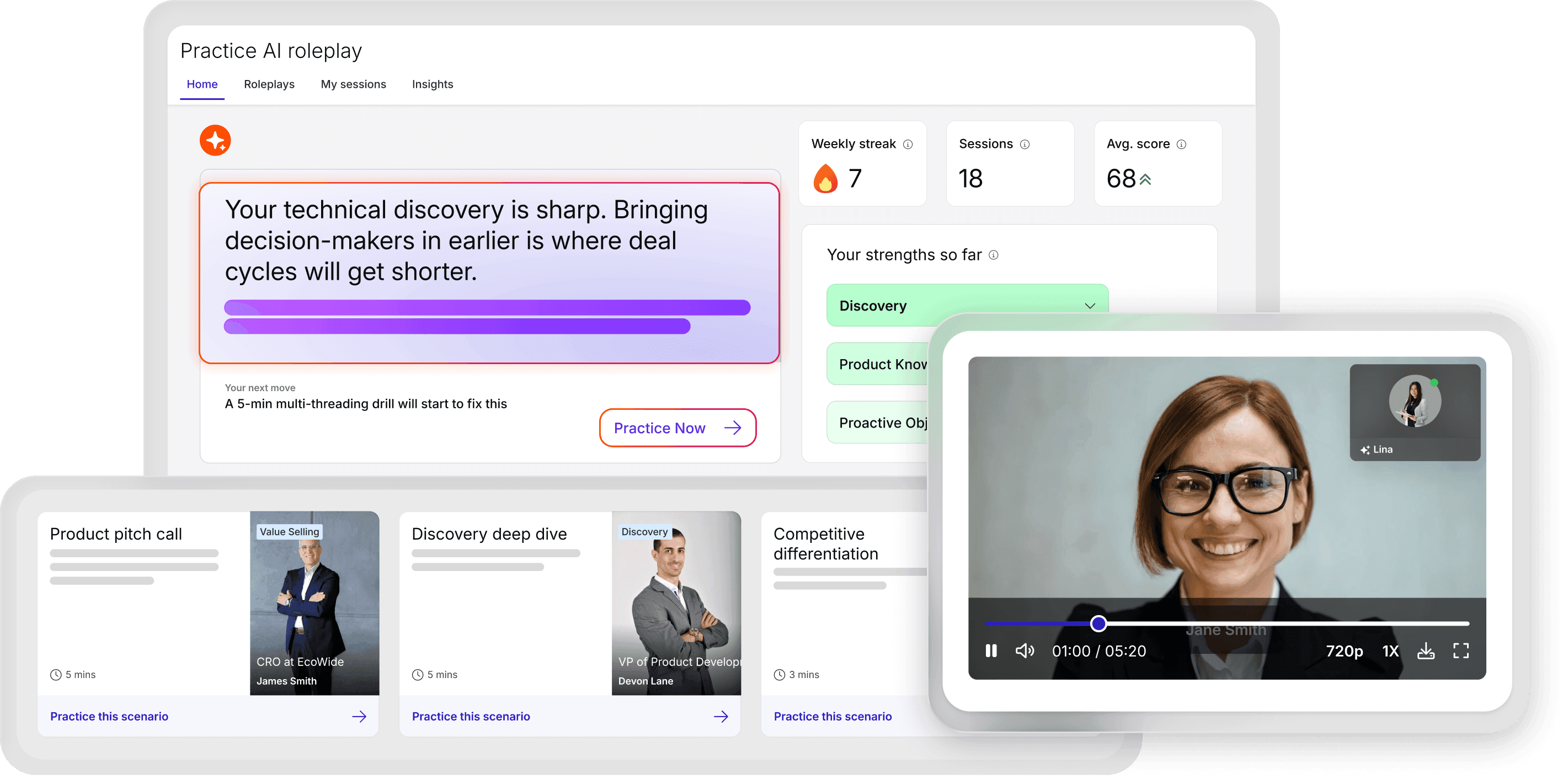
For managers, shared criteria show patterns across the team. If most SDRs score low against the competitor persona, one team session and a better talk track will help more than a dozen one-on-ones, and you can coach reps with AI role play by assigning that scenario to everyone who needs it.
📌 How often should sales reps practice cold calls with AI?
A few short sessions every week work better than one long session a month, and the volume adds up. According to Mindtickle's 2026 State of Agentic Revenue Enablement Report, reps who completed 10 or more AI role plays in a year scored 61% on live calls, compared with 57% for those who did fewer.
How does Mindtickle help reps practice cold calls with AI?
With Mindtickle's AI Sales Role Play, you can start from ready-made personas or build your own and upload the objections your reps hear most.
After each call, reps get feedback on what they said and how they said it, scored against your team's own methodology. Role plays run in 25+ languages, so global SDR teams can practice in the language they sell in.
Practice also connects to real calls. The platform uses signals from recorded calls in Call AI to find each rep's skill gaps, and the Readiness Index links role play performance with ramp time and quota attainment.
Cold calls get easier once you've already had the hard ones, and AI role play lets you have them before the phone rings.
Practice a Cold Call Before Your Next Dial
Frequently asked questions
About the Author
Lead Content Marketer
Jayadeep brings over a decade of experience in B2B content and product marketing, with expertise in editorial leadership, messaging strategy, and agency management.
He has built and scaled content operations, led agency partnerships, and collaborated across marketing, product, and demand generation teams to deliver integrated campaigns. His "process-first, execution-next" philosophy has made him a trusted resource at Mindtickle, where he helps shape content strategy, thought leadership programs, and flagship marketing initiatives.
Subscribe to the blog
Get the latest sales enablement tips, guides, and industry best practices delivered to your inbox. Unsubscribe anytime.