




AI Role Play Simulator: 2026 Guide for Training Leaders



An AI role play simulator is training software that lets contact center agents and sellers practice real customer conversations with an AI-powered customer, often while working in a realistic copy of the systems they use on the job. The simulator scores each attempt and gives feedback right away, so people can repeat the hard moments until they get them right.
Most training programs still split the job into pieces. New agents learn the talk track in a classroom and the CRM in a sandbox, and then face both at once on their first live call, with a real customer on the line. That handoff is where confidence breaks down and early attrition begins.
The stakes are higher in 2026. AI now resolves more of the simple requests, so the ones that reach a person are harder, more emotional, and more complex. Gartner found that 84% of customer service leaders plan to add new skills to the agent role. Training leaders need a way to build those skills before agents take live contacts.
This guide covers how AI role play simulators work, what to build first, how to measure results, and how to choose and roll out a platform.
Key takeaways
- An AI role play simulator pairs an AI customer with instant scoring and feedback.
- Practicing the conversation and the system together trains the skill agents struggle with most on a live call which is doing both at once.
- Start with three to five high-impact moments pulled from QA and escalation data, not a library of generic scenarios.
- Check for PII-free practice environments, configurable scoring, and LMS compatibility before you buy.
What is an AI role play simulator?
An AI role play simulator is a training environment where a learner has an unscripted conversation with an AI customer, is scored against a defined rubric, and gets feedback right away. Advanced simulators also include interactive copies of business software, so learners practice what they say and what they do on screen in the same session.
There are three parts.
- The AI persona plays the customer and responds to what the learner actually says, not to a fixed branch.
- The scenario sets the context: who the customer is, what they want, and what a good outcome looks like.
- The scoring engine compares the learner's performance to the rubric and explains what to change.
How it differs from chatbot role play
Consumer role play apps are built for open-ended interactions and have no goal. A training simulator is the opposite. Every conversation is tied to a job skill, measured against a standard, and reported to a manager. The AI customer is limited to realistic behavior for the scenario, so a frustrated caller stays frustrated until the learner earns a change in tone.
Four types of practice tools, compared

Training leaders usually weigh four options. They differ most in what they train and in how much IT effort they need.
| Practice tools | What it trains | Conversation realism | System realism | Setup effort | Best fit |
|---|---|---|---|---|---|
| Branching e-learning scenario | Decision points in a fixed script | Low: learners pick from preset options | None | Weeks of authoring per scenario | Policy knowledge checks |
| IT training sandbox | Software navigation | None | High, but drifts from production | High: IT builds and maintains it | System training for technical roles |
| Conversation-only AI role play | Talk tracks, objection handling, soft skills | High | None | Low | Sales and leadership conversations |
| System + conversation simulator | The full contact: talking and working in systems together | High | High, from interactive replicas | Low to moderate, often no-code | Contact center and service roles |
Why training leaders are adopting AI role play simulators in 2026
Training leaders are adopting AI role play simulators for three reasons. The contacts that reach people are getting harder, proficiency still takes months, and supervisors can't run enough live role plays to close the gap. Simulators give every agent unlimited, scored practice without pulling a coach off the floor.
AI is taking the easy contacts, and people get the rest
As self-service and AI agents take over routine questions, the calls that reach people are disputes, exceptions, and upset customers. Gartner's October 2025 survey of 321 service leaders found that nearly 80% plan to move some agents into new roles. Gartner is also advising organizations to prepare agents for "higher-value, more complex, and empathetic customer interactions."
Volume for people isn't disappearing either. In a March 2025 McKinsey analysis, 57% of customer care leaders said they expect call volumes to rise over the next one to two years.
⏯️ On-demand webinar: The AI Takeover That Wasn't
AI took the password resets and order-status calls. Agents got the angry customers, multi-system troubleshooting, and retention saves.
Marlene Summers, senior vice president of global support at ECI Software Solutions, reveals why sandboxing and shadowing can't keep up, and how to train system skills and difficult conversations together.
Proficiency still takes months
McKinsey reported in July 2025 that new contact center hires need about four to six months to reach peak proficiency, and that training costs organizations 5% to 10% of their total agent cost. Every agent who leaves in that window takes the training investment with them.
Shadowing and sandboxes don't scale
The traditional approach puts one supervisor with a handful of trainees, runs practice in an IT-maintained sandbox, and pairs new hires with tenured agents for side-by-sides. Each depends on a scarce resource: supervisor hours, IT time, or a top performer's patience. Sandboxes also drift from production as screens change, so agents learn outdated workflows.
How does an AI role play simulator work?
An AI role play simulator runs a practice loop. The learner picks up a scenario, talks with an AI customer while working in simulated systems, and gets a score with specific feedback. Then they try again. Each pass through the loop builds skill, and the data shows managers where to coach.
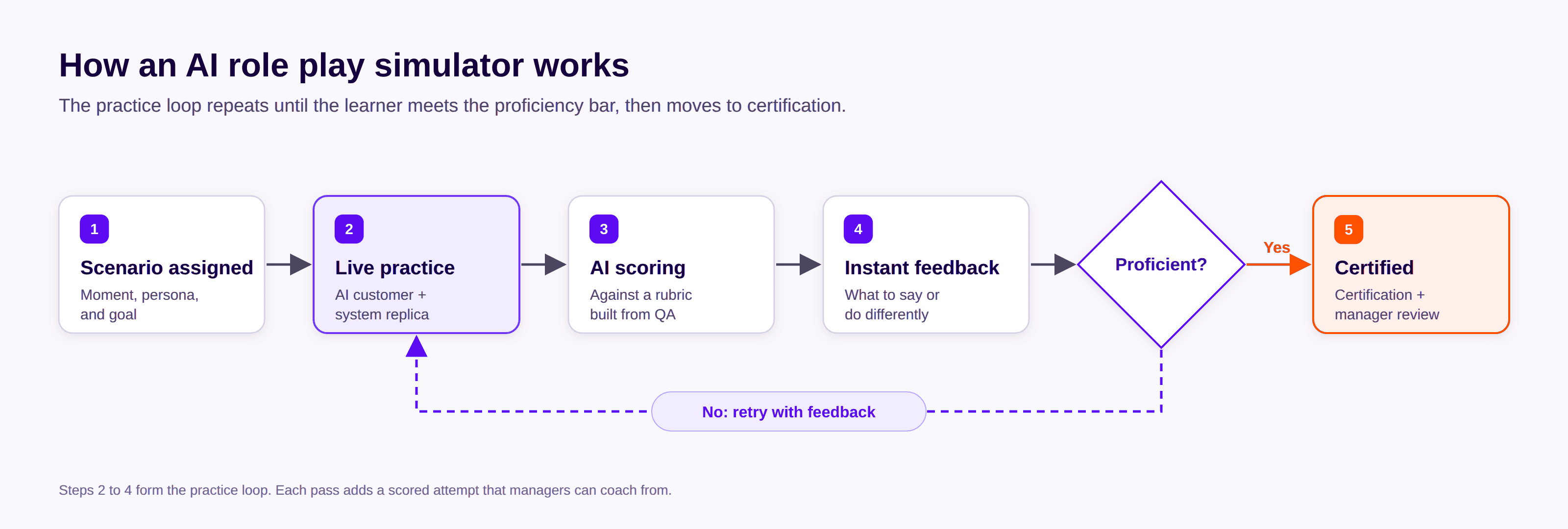
The loop repeats until the learner meets the proficiency bar, then routes to certification and manager review.
AI personas that react like real customers
The AI customer is set up with a goal, a mood, what they know, and what sets them off. If the learner interrupts, skips verification, or offers the wrong fix, the persona pushes back. Because the model generates replies instead of following a fixed branch, no two attempts play out the same way, and learners can't pass by memorizing answers.
System simulation
In a system + conversation simulator, the learner works in an interactive copy of the actual applications: CRM, billing, order management, or knowledge base. They scroll, click, enter data, and fill forms just as they would on the job. Nothing touches live systems or real customer records.
Voice, chat, and multimodal practice
Voice practice trains pacing, tone, and talking while typing. Chat practice fits digital support teams that juggle several conversations at once. Match the practice channel to the one the agent will actually work in.
Scoring and feedback
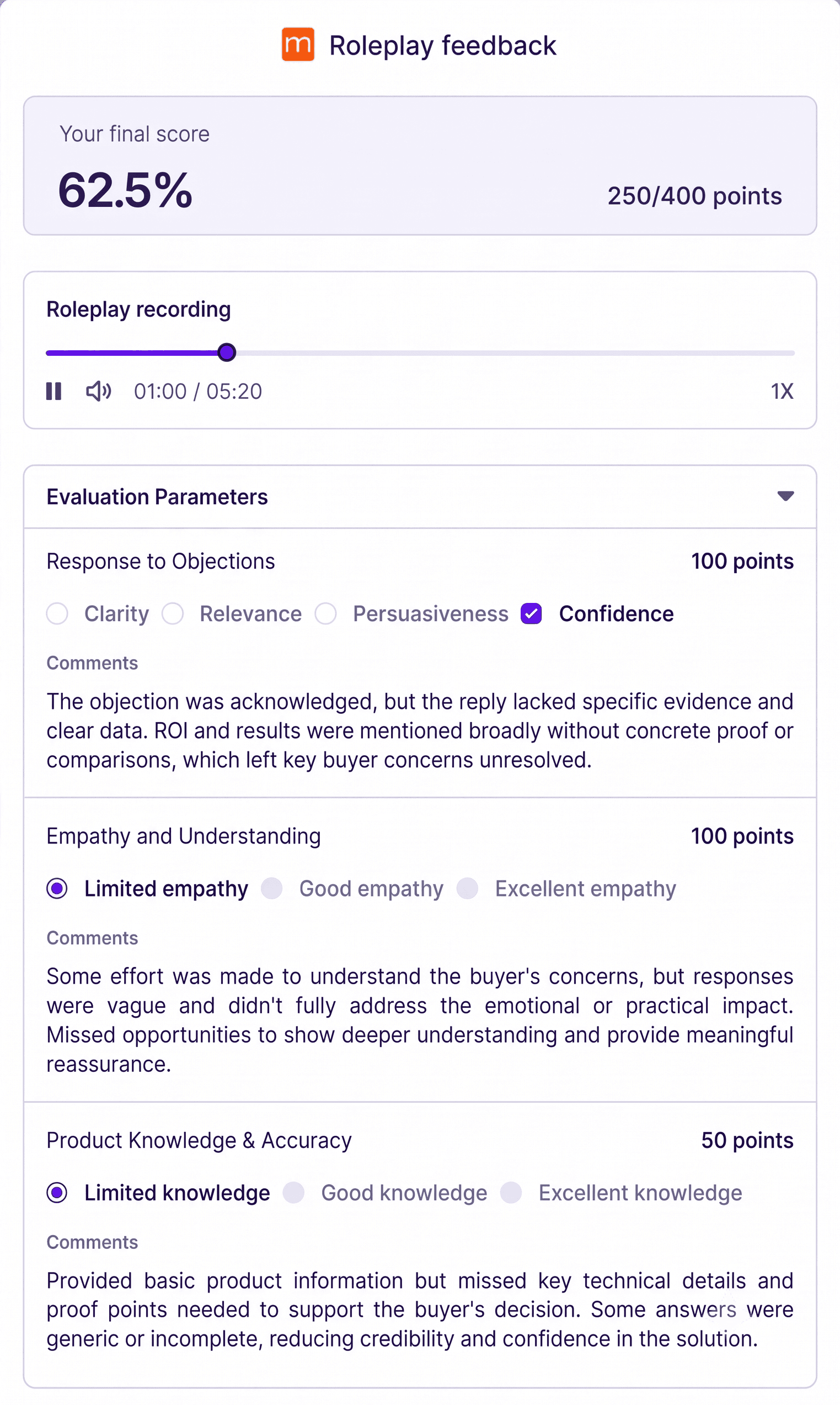
After each attempt, the simulator scores the learner against a rubric such as required statements, correct process steps, accuracy in the system, and soft skills such as empathy and confidence. Good feedback names the exact moment something went wrong and what to say or do instead.
Training the whole job: conversations and systems together
Contact center agents rarely fail because they don't know the policy or can't find the right screen. They fail when they have to do both at once, with a frustrated customer waiting. Practicing conversations and systems separately leaves that combined skill untrained. A system + conversation simulator is built to train it.
The cognitive load of a live contact
Picture a single billing call. The agent listens to the complaint, verifies identity, searches three screens for the right invoice, reads a policy note, decides on a credit, types case notes, and keeps their voice calm the whole time. Each task is simple. Doing them together is not, and it's the part that classroom training and sandbox drills never practice.
When that load gets too heavy, one side slips. The agent goes quiet while hunting for a field, and the customer hears dead air. Or the agent stays warm and engaged but applies the wrong code. Dual practice builds the fluency that lets agents keep talking while their hands handle the system.
Why sandboxes fall short
IT sandboxes were built to teach software, not conversations. They take IT time to stand up, they need scrubbed data to avoid exposing customer PII, and they drift from production each time a screen changes. Most importantly, a sandbox has no customer in it. Agents can learn the clicks, but they practice them in silence.
A simulator replaces the sandbox with a lightweight, interactive copy of the screens a scenario needs and adds an AI customer. This removes the IT dependency and lets training teams build replicas in minutes.
What dual practice looks like
Here's a billing dispute built as a single simulation:
- The AI customer calls, upset about a duplicate charge, and cuts in before the agent finishes the greeting.
- The agent acknowledges the frustration and completes identity verification in the simulated CRM.
- The agent opens billing history in the replica, finds the duplicate transaction, and checks the refund policy.
- While the agent searches, the customer asks, "Why is this taking so long?" The agent has to fill the silence without guessing.
- The agent applies the credit, confirms the amount and timing, and logs case notes.
- The simulator scores empathy and process adherence on the conversation side and accuracy of the credit and notes on the system side.
A conversation-only tool can train steps 1, 2, and 4. A sandbox can train steps 3 and 5. Only a combined simulation trains all six the way they happen on a real call.
Benefits of an AI role play simulator, and its limits
The main benefits are faster time to proficiency, consistent coaching at scale, safe practice for high-stakes moments, and readiness data before agents go live. Each one depends on design. A simulator full of generic, easy scenarios produces confident agents who still struggle on real calls.
- Shorter ramp-up time is what most leaders want. McKinsey links simulation-led onboarding to a 20% to 30% reduction in time to proficiency. Mindtickle reports a 40% reduction in onboarding time and a 35% reduction in training costs with its AI Role Play Simulator.
- Consistency is the second benefit. Two supervisors rarely coach the same call the same way. An AI scorer applies the same rubric to every attempt, on every shift, in every location, and frees supervisors to coach the patterns the data exposes instead of running every practice session themselves.
- Safety matters most for the calls you can't afford to get wrong: a bereavement account closure, a fraud claim, a regulatory disclosure. Agents can fail those calls in practice as many times as it takes, with no customer harmed and no compliance exposure.
- Then there's visibility. Before a cohort goes live, leaders can see who is ready, who needs more reps, and which scenarios trip up the whole class. That changes go-live from a date on the calendar to a decision based on evidence.
Where AI role play simulators fall short
Simulators have real limits, and knowing them up front is how you design around them.
| Limit | What it looks like | How to fix it |
|---|---|---|
| Personas that are too polite | The AI customer gives in after one apology | Write personas with hidden objections and triggers, and test each one against real recordings of difficult calls |
| Scenario fatigue | Agents repeat the same scenario until they memorize it | Rotate personas and vary facts, moods, and outcomes within a scenario |
| Scoring that ignores your method | Feedback is generic good advice that doesn't match your QA form | Build the rubric from your QA scorecard and calibrate AI scores against human reviewers |
| Word-for-word compliance scripts | Generative variation is risky where exact wording is legally required | Score required disclosures as must-say items, verbatim, and let the rest of the conversation vary |
| Stale content | Scenarios still reference last quarter's pricing or screens | Assign an owner to each scenario and review it whenever the product or policy changes |
AI role play simulator use cases
The most common uses for an AI role play simulator are new hire onboarding, ongoing skill refreshers for tenured agents, product and policy launches, de-escalation, and compliance. In sales, teams use it for discovery, objection handling, and certification. The best first use case is the one where mistakes cost the most today.
| Use case | Who it’s for | Sample scenario | Metric it moves |
|---|---|---|---|
| New hire onboarding | New contact center agents | First-week account inquiry with identity verification in the CRM | Time to proficiency, early attrition |
| Ongoing practice for tenured agents | Experienced agents and reps | Quarterly refresher on the top three QA misses | QA score, CSAT |
| Product and policy launches | All customer-facing staff | Customer asks about a pricing change announced yesterday | Time to readiness, repeat contacts |
| De-escalation | Service and retention teams | Customer threatening to cancel after a third outage | CSAT, escalation rate |
| Compliance and disclosures | Regulated service roles | Required disclosure during a payment arrangement | Compliance audit pass rate |
| Collections and retention | Specialized teams | Hardship conversation with a payment plan set up in the billing system | Promise-to-pay rate, save rate |
| Discovery and objection handling | Sellers | Skeptical buyer questions ROI in a first call | Win rate, ramp time |
| Coaching conversations | Front-line managers | Giving feedback to an agent who is missing targets | Manager coaching coverage |
Watch Video: AI Role Play Simulation for Price Objections and Renewals
How to build AI role play simulations that change behavior
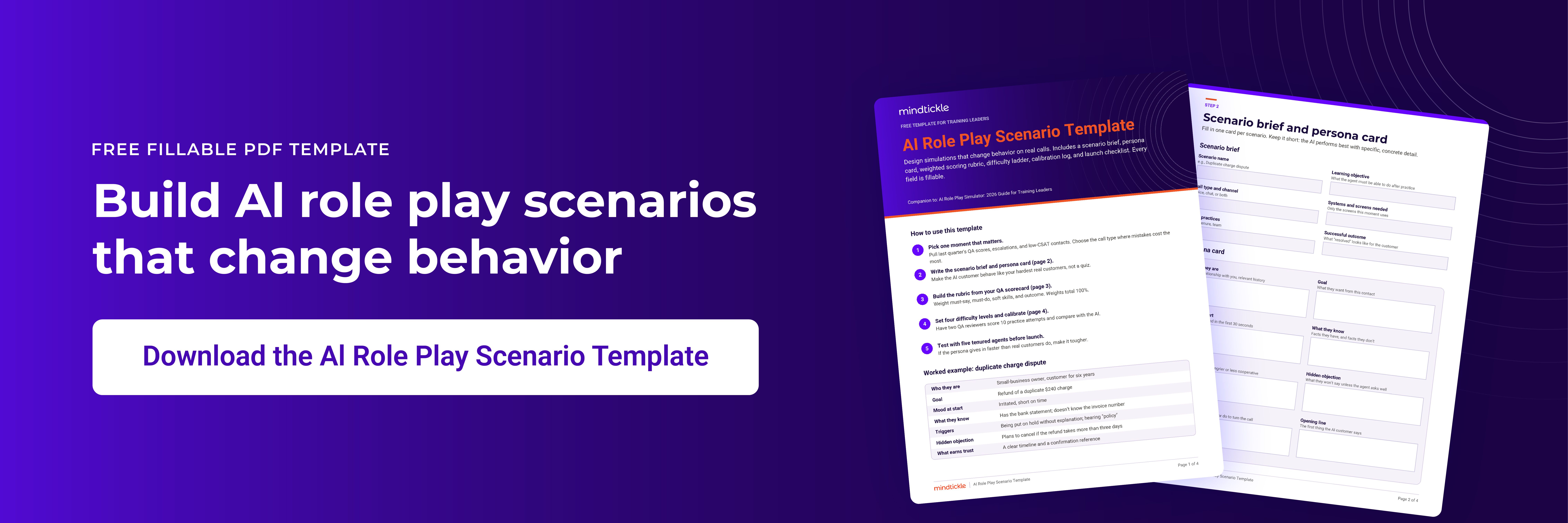
To build simulations that change behavior, start from real performance gaps, not a scenario library. Choose the moments that matter, write realistic personas, replicate only the screens each moment needs, set a rubric based on your QA standards, add difficulty levels, and connect practice to manager coaching.
1. Pick the moments that matter
Pull your last quarter of QA scores, escalations, and low-CSAT contacts. Look for the three to five call types where agents fail most often or where failure costs the most. These are your first scenarios. Resist the urge to build 40 scenarios at launch. Five good ones used heavily beat 40 used once.
2. Write persona cards
Each AI customer needs a short brief that makes it behave like a real person, not a quiz:
| Persona field | Example |
|---|---|
| Who they are | Small-business owner, customer for six years |
| Goal | Refund of a duplicate $240 charge |
| Mood at start | Irritated, short on time |
| What they know | Has the bank statement; doesn't know the invoice number |
| Triggers | Being put on hold without explanation; hearing "policy" |
| Hidden objection | Plans to cancel if the refund takes more than three days |
| What earns trust | Clear timeline and a confirmation reference |
Test every persona against recordings of real difficult calls. If the AI customer gives in faster than your real customers do, make it tougher.
3. Build the system replica
Replicate only the screens the scenario needs: the CRM search, billing history, and the credit form, not the whole application. Use realistic but fictional data, and update the replica whenever production screens change.
4. Design the rubric
Build the rubric from your QA scorecard so practice and live evaluation measure the same things. Split it into four parts and weight each one:
- Must-say items, such as required disclosures and verification language
- Must-do items, such as correct process steps and accurate system entries
- Soft skills, such as empathy, confidence, and clarity
- Outcome, meaning whether the customer's issue was resolved
📌 Quick tip
Calibrate before launch. Have two QA reviewers score 10 to 20 practice attempts and compare their scores with the AI's. Adjust the rubric until the gap is small enough that your QA lead would sign off on it.
5. Set a difficulty ladder
Create three or four versions of each scenario. For example, a cooperative customer, a confused customer, a frustrated customer, and a hostile one. New hires start at the bottom and move up only after they reach a set score. Tenured agents can start at the top. Read: 15 AI Role Play Scenarios for Customer Support Teams (by Industry)
6. Close the loop with coaching
Practice data is only useful if someone acts on it. Give managers a weekly view of who is stuck and on which rubric items, and set aside 15 minutes of one-on-one coaching on the pattern, followed by a targeted retry. Mindtickle's sales coaching tools are built for this kind of follow-up.
How to measure the impact of an AI role play simulator
Measure the impact of an AI role play simulator in two layers.
- Leading indicators from the simulator (completion, attempts to proficiency, rubric scores) show whether practice is working within weeks.
- Lagging indicators from operations (time to proficiency, AHT, FCR, QA scores, CSAT, early attrition) show whether it changed performance on real calls.
| Metric | Type | Where the data lives | What good looks like |
|---|---|---|---|
| Practice completion rate | Leading | Simulator | Rising week over week during the cohort |
| Attempts to proficiency | Leading | Simulator | Falling as scenarios and coaching improve |
| Rubric score by skill | Leading | Simulator | Weakest skill improves after targeted coaching |
| Certification pass rate | Leading | Simulator or LMS | Stable or rising at a fixed bar |
| Time to proficiency | Lagging | WFM & QA | Shorter than the pre-simulator cohort |
| Average handle time (AHT) | Lagging | Contact center platform | Lower for new hires, with no drop in quality |
| First contact resolution (FCR) | Lagging | Contact center platform or surveys | Higher on the call types you simulated |
| QA score | Lagging | QA platform | Higher on the rubric items you practiced |
| CSAT | Lagging | Survey platform | Higher on the call types you simulated |
| 90-day attrition | Lagging | HRIS | Lower than the pre-simulator cohort |
The link that matters most is between the two layers. If rubric scores rise but QA scores don't, the rubric is measuring the wrong things. Recalibrate it against QA.
A simple ROI model for ramp time
Ramp time is one of the clearest places to quantify the potential value of AI role play. If simulation helps an agent reach your defined productivity threshold sooner, each day of ramp avoided represents productive capacity recovered by the business.
A simple model is:
Annual Ramp Savings = New Hires Per Year × Working Days of Ramp Reduced × Daily Productivity Gap
The key is to define the daily productivity gap as the incremental value a proficient agent generates compared with an agent who is still ramping. Your finance or operations team can estimate this using historical productivity data, such as output, handled interactions, quality-adjusted productivity, or another role-specific measure.
For example, assume a contact center hires 200 agents a year. Historical data shows that a ramping agent generates $150 less productive value per working day than a proficient agent. If AI role play helps reduce the time to the defined proficiency threshold by 20 working days, the estimated annual productivity recovery is:
200 × 20 × $150 = $600,000
That represents $600,000 in recovered productive capacity before accounting for other potential benefits, such as lower supervisor coaching time, fewer quality issues, reduced rework, or lower attrition.
For a more precise model, use your team's actual productivity curve rather than assuming the same gap applies to every day of ramp. The goal is to compare cohorts with and without AI role play and measure whether agents reach the same defined proficiency threshold sooner.
🚧 How to run a clean pilot
Compare two cohorts hired within the same window, with the same tenure, trainer, and call types. One uses the simulator, the other uses your current approach. Track both for 60 to 90 days on the same lagging metrics. Without a control group, any improvement will be credited to seasonality or a strong trainer.
How to choose an AI role play simulator: 12 questions for your RFP
When choosing an AI role-play simulator, three capabilities deserve particular scrutiny: conversation realism, configurable evaluation, and enterprise-grade security. Beyond those, look closely at how quickly your enablement team can create, test, launch, and update scenarios without depending on developers or the vendor.
Use the questions below in vendor demos and RFPs. More importantly, ask vendors to show you the answer live. A feature that works in a controlled demo may behave very differently when a learner goes off script.
1. How does the AI customer respond when a learner goes off script?
Ask the vendor to run the same scenario three times, including an interruption, an incorrect answer, and an unexpected question. The AI should respond naturally and maintain the context of the conversation rather than simply steering the learner back to a predefined script.
2. Which interaction modes can learners practice?
Can learners practice through voice, chat, or both? If voice is supported, ask about speech recognition, interruptions, response latency, accents, and how naturally the AI persona handles conversational turn-taking.
3. Can the simulator reproduce the workflows agents actually use?
If your training requires more than conversation practice, ask whether the simulator can replicate your actual applications and workflows, including actions such as clicking, scrolling, searching, navigating screens, and entering data. Ask who builds those replicas, how long they take to create, and how they are maintained when the underlying application changes.
4. How quickly can a training designer build a scenario?
Ask a nontechnical training designer to create a new scenario from scratch during the demo. Find out whether they can define the persona, objectives, conversation context, expected behaviors, branching paths, and evaluation criteria without developer or vendor support.
5. Can scoring rubrics reflect our existing QA standards?
Ask whether you can build evaluation criteria from your existing QA scorecard, assign different weights to each criterion, and set different standards for different roles, scenarios, or proficiency levels.
6. How do you validate AI-generated scores?
AI scoring needs more scrutiny than simply asking whether the platform can produce a score. Ask how scores are calibrated against human reviewers, how consistency is measured, and whether managers can see the evidence or conversation moments behind each score.
7. What can managers see beyond individual learner scores?
Look for reporting that identifies recurring skill gaps across a team, cohort, scenario, or business unit. Ask whether managers can distinguish between an individual performance issue and a broader training gap affecting multiple reps.
8. How does the simulator fit into our existing learning and coaching ecosystem?
Ask whether it integrates with your LMS through standards such as SCORM or APIs and whether it can connect with QA, CRM, learning, or conversation intelligence systems. Also ask what data flows in both directions and whether those integrations require additional licensing or professional services.
9. Which languages, accents, and voice interactions does it support?
Do not stop at a list of supported languages. Ask the vendor to demonstrate the languages and accents your workforce actually uses, particularly if learners will practice through voice. Find out how the platform handles regional accents, pronunciation, and multilingual scenarios.
💡 Did you know - Mindtickle supports 25+ global languages. You can create one system simulation flow in one language, and AI will create simulation flows in multiple languages.
10. What customer data does the simulator require?
Ask whether learners ever need to enter real customer information and what safeguards prevent sensitive data from entering a simulation. Understand where data is stored, how it is encrypted, how long it is retained, and which parties can access it.
11. Is our data used to train your AI models?
Ask specifically whether your organization's prompts, conversations, learner responses, scores, or other data are used to train vendor models or shared with third-party model providers. Also ask whether those settings can be controlled contractually and at the account level.
12. How is pricing structured, and what does implementation require?
Understand whether pricing is based on seats, usage, scenarios, interactions, or another metric. Then ask what is included in onboarding, scenario development, integrations, training, support, and ongoing maintenance. A low license price can look very different once implementation and scenario-authoring costs are included.
For a side-by-side look at specific platforms, see the best AI role play simulators for 2026.
🎖️Customer example: From seven weeks to four
A global ride-hailing company with 10,000+ customer support representatives needed to accelerate new-agent readiness. With thousands of hires each year and 30% to 35% annual attrition, its existing seven-week onboarding model was difficult to scale without putting pressure on training quality.
Using Mindtickle’s AI Role Play Simulator, the training team created simulations of internal applications and gave new agents a realistic environment to practice both process and customer-facing skills before going live.
The result: ramp time fell from seven weeks to four weeks, a 43% reduction. The company also reported a 3% increase in CSAT and performance metrics, reduced supervisor dependency, and more consistent performance across regions.
Governance, security, and compliance for AI role play
An AI role play simulator should never require learners to handle real customer PII, should never use your data to train shared AI models, and should keep a record of who practiced, what they practiced, and how they scored. Ask IT, security, and legal to review these three points before any pilot begins.
Practice environments without PII
System replicas should run on fictional data, not copies of production records. That keeps practice separate from customer information, which sandboxes built on masked production data can't fully do.
How your data is used by AI models
Ask every vendor whether your scenarios, recordings, and scores are used to train their models or third-party ones, and get the answer in writing. For instance, Mindtickle never uses customer data to train AI. Visit Mindtickle Trust Center
EU AI Act and AI transparency
The EU AI Act puts extra obligations on AI systems used to evaluate workers' performance when those evaluations feed employment decisions. Under the Digital Omnibus agreement reached in May 2026, the deadline for those high-risk obligations moves from Aug. 2, 2026, to Dec. 2, 2027, according to Gibson Dunn. Transparency obligations, such as telling people when they're interacting with AI, largely stay on the original schedule.
For training leaders, the practical rule is to keep AI practice scores developmental unless your legal team has cleared their use in performance or promotion decisions. Tell learners clearly that the customer is an AI.
Audit trails for certification
In regulated industries, a certification is only as good as the record behind it. Make sure the simulator logs each attempt, score, and certification with a timestamp, and that you can export those records for audits.
What's next for AI role play simulators
AI role play simulators are moving from scheduled training to practice triggered by real performance. The next step is closing the loop between live calls and practice, where a gap spotted in QA or conversation intelligence automatically assigns the right simulation to the right agent.
Three changes are worth planning for. First, practice will be assigned automatically: an agent who stumbles on a cancellation call on Tuesday gets a cancellation simulation on Wednesday, without waiting for a manager to notice.
Second, scenarios will be built from your own call data, so new policies and new objections turn into practice within days instead of quarters.
Third, multilingual personas will let global teams practice in the language and accent their customers actually use.
The underlying principle stays the same. Agents improve through repetition with feedback, and the simulator's job is to make that repetition as close to the real job as possible.
See the AI Role Play Simulator in action
Mindtickle's AI Role Play Simulator lets contact center agents and sellers practice customer conversations and software workflows together, with AI scoring and instant feedback.
Frequently asked questions
About the Author
Lead Content Marketer
Jayadeep brings over a decade of experience in B2B content and product marketing, with expertise in editorial leadership, messaging strategy, and agency management.
He has built and scaled content operations, led agency partnerships, and collaborated across marketing, product, and demand generation teams to deliver integrated campaigns. His "process-first, execution-next" philosophy has made him a trusted resource at Mindtickle, where he helps shape content strategy, thought leadership programs, and flagship marketing initiatives.

Subscribe to the blog
Get the latest sales enablement tips, guides, and industry best practices delivered to your inbox. Unsubscribe anytime.