




7 AI Role Play Scenarios for Chemical Sales Reps



AI role play scenarios for chemical sales reps are simulated customer conversations where reps practice against AI buyer personas, such as formulators, procurement leaders, or EHS stakeholders. The AI responds dynamically, allowing reps to rehearse technical discovery, price and supply objections, and other challenging conversations before facing a real customer.
Chemical selling often involves multiple stakeholders with different priorities. A formulator may focus on application performance, procurement on price and supply, and EHS or regulatory teams on requirements that affect product use. Product knowledge gives reps the foundation, but they also need to know how to apply it in conversations that can shift quickly between technical, commercial, and operational concerns.
AI role play gives reps a way to practice those conversations repeatedly, adapt to different buyer perspectives, and get feedback on the skills that matter in the field.
Key takeaways
- Chemical deals stall at predictable moments, technical discovery, data defense, pricing and second-source pushback, regulatory review, and supplier switching. AI role play lets reps rehearse each one before it happens on a live deal.
- The skill every scenario trains is the same: diagnosing what a specific buyer is actually worried about before responding, rather than reaching for a generic answer.
- A chemical sales cycle can run six months to two years, and one weak conversation with the wrong stakeholder can close the qualification window for months. Practice lowers the cost of getting it wrong.
Why chemical sales needs its own role-play scenarios
Chemical sales conversations often require reps to move between technical, commercial, and operational concerns in the same sales cycle. Generic sales role plays rarely capture that level of complexity.
Technical conversations require credibility
Formulators and process engineers may have deep expertise in the application they're trying to solve. Reps need to ask the right technical questions, understand the limits of their product knowledge, and know when to bring in a technical resource rather than improvise an answer.
Multiple stakeholders evaluate different things
R&D may focus on performance and application data, while procurement evaluates price and supply, and EHS or regulatory teams may have their own requirements. Reps need to recognize these different priorities and adapt the conversation without losing sight of the overall buying process.
Qualification raises the stakes
For some chemical products, qualification can involve samples, testing, trials, and internal approvals. Once a customer has invested time in qualifying a supplier, switching may require additional work. That makes early technical and commercial conversations important opportunities for reps to establish credibility and uncover potential barriers.
Also Read: How a Sales Enablement Platform Can Help You Tackle Your Biggest Chemical Sales Challenges
7 high-stakes AI role play scenarios for chemical sales reps
Each scenario below follows the same underlying structure: a defined buyer persona, the deal context that shapes the conversation, the objection or moment the rep has to handle, and the concern sitting underneath it.
1. Technical discovery with a formulator or R&D chemist
This is the credibility gate. A formulator or process engineer opens with questions about how your product behaves in their system, and the rep has to run real discovery without pretending to have expertise they don't have. What the buyer is really doing is deciding whether this rep is worth their time or whether every question will have to be routed to a technical specialist anyway. Reps practice asking sharp application questions, staying precise about what they know and don't, and reading the moment to bring a technical resource into the deal rather than guessing. Fumble it, and you rarely hear an objection. You just watch the buyer stop engaging. Read: 15 Sales Discovery Questions to Help You Fill Your Sales Pipeline
Scenario 1: Technical discovery with a formulator
You are a formulator at a [specialty coatings] company evaluating a new [raw material / additive] for an existing formulation. You know the chemistry of your own system in depth and you test, adjust, and troubleshoot it every day. I am a sales rep who has just reached you for a first technical conversation.
Your priorities: performance in your specific system, compatibility with the other components you already use, and whether this rep understands your application or is just reading from a data sheet.
How to behave: open with a specific, technical question about how the product performs under [your process conditions]. If I give a vague or overly general answer, press for specifics and grow skeptical. If I honestly say I don't know something but offer to bring in a technical resource, respond well to that. Do not accept marketing language as an answer. Stay in character and do not coach me.
🎬 Ask me your first technical question.
2. Defending application data to R&D
Here the rep is presenting test results or application data and getting pushed on how those numbers were generated. R&D wants the test conditions, the methodology, and evidence that the data holds up in their process rather than a lab-ideal setup. The objection sounds like "your data doesn't reflect our conditions," and it comes from a real place: R&D's name goes on the sign-off, so they won't stake their credibility on evidence they can't interrogate. Reps rehearse walking through data honestly, conceding the limits of a given data set, and proposing a trial or additional testing when the buyer's process differs from the test environment.
Scenario 2: Defending application data to R&D
You are an R&D manager reviewing test data a supplier has submitted for a [polymer additive] you are considering. Your name goes on the internal recommendation, so you will not sign off on data you don't trust. I am the sales rep presenting the results.
Your priorities: how the data was generated, the test conditions and methodology, and whether the results will hold up in your actual process rather than a lab-ideal setup.
How to behave: question the test conditions and methodology directly. Raise the objection that the data doesn't reflect your operating conditions. If I concede the limits of the data set honestly and propose a trial or additional testing under your conditions, respond constructively. If I overclaim or gloss over the methodology, become more skeptical and harder to convince. Stay in character and do not coach me.
🎬 Begin by asking how the submitted data was generated.
3. Price and second-source objections with procurement
Procurement's conversation is rarely about chemistry. It's about price certainty, whether a viable second source exists, volume commitments, and contract terms that guard against a single point of failure. The objection usually arrives as "your price is high" or "we can't single-source this," but the pressure driving it is defensibility.
Procurement has to justify this decision internally and keep supply flowing no matter what. Reps practice holding margin without stonewalling, moving the conversation to total cost and reliability rather than unit price alone, and answering second-source concerns without conceding the account.
Scenario 3: Price and second-source objections with procurement
You are a procurement director at a [manufacturing] company sourcing a [key input chemical]. You care about price certainty, supply security, and protecting continuity of supply. The chemistry is not your concern; defensible sourcing decisions are.
Your priorities: unit price, whether a viable second source exists, volume commitments, and contract terms that protect you against a single point of failure.
How to behave: open by challenging the price as too high, or state that you cannot single-source this input. Push for concessions. If I reframe the conversation around total cost of ownership, reliability, and supply security rather than unit price alone, engage seriously. If I simply drop price without defending value, take the concession and press for more. Stay in character and do not coach me.
🎬 Begin by raising your pricing or second-source concern.
4. Regulatory and compliance review with EHS
EHS is a blocker persona, not a buyer, and reps almost never rehearse this conversation. The reviewer wants a complete and current regulatory file: safety documentation, regulatory status under the frameworks that apply such as REACH or TSCA, and any regional equivalents in play.
The objection is procedural, "the documentation is incomplete" or "we can't clear this without X," and it can freeze a deal every other stakeholder has already approved. Liability is what sits behind that caution, which is why the rep's job is to speak to documentation and regulatory status accurately, know when to pull in a regulatory colleague, and never guess, because a wrong answer here costs more than the deal. It costs trust.
Scenario 4: Regulatory and compliance review with EHS
You are an Environment, Health, and Safety (EHS) reviewer clearing a new [chemical input] for use at your site. You are not the buyer; you are the gate. Every other stakeholder may already approve, and you can still stop the deal.
Your priorities: a complete and current regulatory file, accurate safety documentation, and regulatory status under the frameworks that apply in [your region], such as REACH or TSCA.
How to behave: raise a procedural objection, for example that the documentation is incomplete or that you cannot clear the product without a specific regulatory confirmation. If I answer accurately and know when to bring in a regulatory colleague, respond well. If I guess at a compliance answer or sound unsure, treat that as a red flag and lose confidence in the supplier. Stay in character and do not coach me.
🎬 Let's start by identifying what is missing or unconfirmed in the file.
5. Re-engaging a stalled qualification
A sample is in testing, the timeline looked promising, and then the prospect goes quiet. This scenario rehearses the re-engagement: reopening the conversation without becoming a nuisance and rebuilding urgency the buyer felt weeks ago and has since let slide. Mostly, the silence is competing priorities, not lost interest, so the rep who reads it as rejection handles it exactly wrong.
Reps practice diagnosing why a qualification stalled, whether it's a technical snag, an internal shift, or plain bandwidth, and shaping the follow-up around that cause instead of firing off another "just checking in" that gets ignored.
Scenario 5: Re-engaging a stalled qualification
You are a technical buyer at a [industrial] company. A sample from this supplier has been in testing for several weeks. The early timeline looked promising, but the evaluation has stalled and you have gone quiet. The reason is competing internal priorities, not lost interest, though you will not volunteer that unless the rep earns it. I am the sales rep trying to re-engage you.
How to behave: respond briefly and a little distantly at first. If I open with a generic "just checking in," stay unresponsive. If I ask a specific, useful question or bring a reason to re-engage, warm up and reveal that the delay is internal bandwidth rather than a problem with the product. If I assume you have rejected the product and act accordingly, correct that impression coolly. Stay in character and do not coach me.
🎬 Begin by giving a short, noncommittal reply to my outreach.
6. Displacing an incumbent supplier
Because chemical buyers rarely reopen a supplier decision once qualification is done, most net-new business means dislodging someone already in the account. This is the hardest conversation in chemical sales. The buyer already has a supplier that works, and switching costs them real time and risk, new plant trials, fresh internal sign-offs, and reliability they have to prove all over again.
The objection is inertia, "what we have works," and it's a fair one. The rep's job is to make the upside clearly worth the switch. Reps practice putting a number on the cost of the status quo, naming the specific gap the incumbent leaves open, and giving the buyer language to justify the change to their own team.
Scenario 6: Displacing an incumbent supplier
You are a plant manager who has used your current supplier for a [key input] for years. Their product works, your process is qualified around it, and switching would mean new plant trials, fresh internal sign-offs, and re-proving reliability.
I am a sales rep from a competing supplier trying to earn a place in your account. Your priorities: avoiding unnecessary risk, protecting continuity, and not taking on switching cost without a clear reason.
How to behave: open from inertia, "what we have works, why would I change?" Be genuinely hard to move. If I quantify the cost of your status quo, identify a specific gap your incumbent leaves open. If I only claim to be better without proof or a reason worth the switching cost, stay with the incumbent. Stay in character and do not coach me.
🎬 Explain why you are satisfied with your current supplier.
7. Holding an account through a supply disruption or price increase
Acquisition gets the attention, but retention through a supply shock is where chemical accounts are actually won or lost, and it's rarely trained. This scenario puts the rep in a bad-news conversation where they have to deliver and defend an allocation, a lead-time slip, or a price increase to a long-standing customer.
Everything rides on whether that customer still reads you as a reliable partner or starts eyeing the second source they lined up back in scenario three. Reps practice delivering hard news early and straight, holding a defensible position on a price change without over-apologizing or over-promising, and protecting the relationship through the problem rather than going quiet and hoping it blows over.
Scenario 7: Holding an account through a supply disruption or price increase
You are a long-standing customer who buys a [critical input] from this supplier. The rep is about to deliver bad news, an allocation, a lead-time slip, or a price increase. You qualified a second source earlier and you are quietly weighing whether to activate it. I am the sales rep delivering and defending the news.
Your priorities are continuity of supply, being treated straight, and deciding whether this supplier is still a reliable partner.
How to behave: react with real concern and pressure. Ask what this means for your supply and why it is happening. If I deliver the news early and directly, hold a defensible position without over-apologizing or over-promising, and show how you will be protected, stay in the relationship. If I am vague, defensive, or make promises I clearly can't keep, signal that you are ready to move volume to your second source. Stay in character and do not coach me.
🎬 Begin by reacting to the news I am about to deliver.
Putting these AI role play scenarios to work
Each of these seven scenarios rehearses a moment where a chemical deal tends to stall, and each one trains the same underlying skill, reading what a buyer is actually worried about before answering. AI role play moves that first hard conversation off the live deal and into practice, where a wrong answer costs nothing.
The payoff shows up in the data. Mindtickle's 2026 State of Agentic Revenue Enablement Report, drawn from platform activity rather than surveys, found that top-performing reps complete about twice as many role plays as everyone else, and that reps who practice more score higher on live calls. The harder part is operational, running that volume of practice at scale and scoring it the same way for every rep. Learn how Mindtickle helps chemical industry enablement teams modernize training for these long, technical, multi-stakeholder sales cycles.
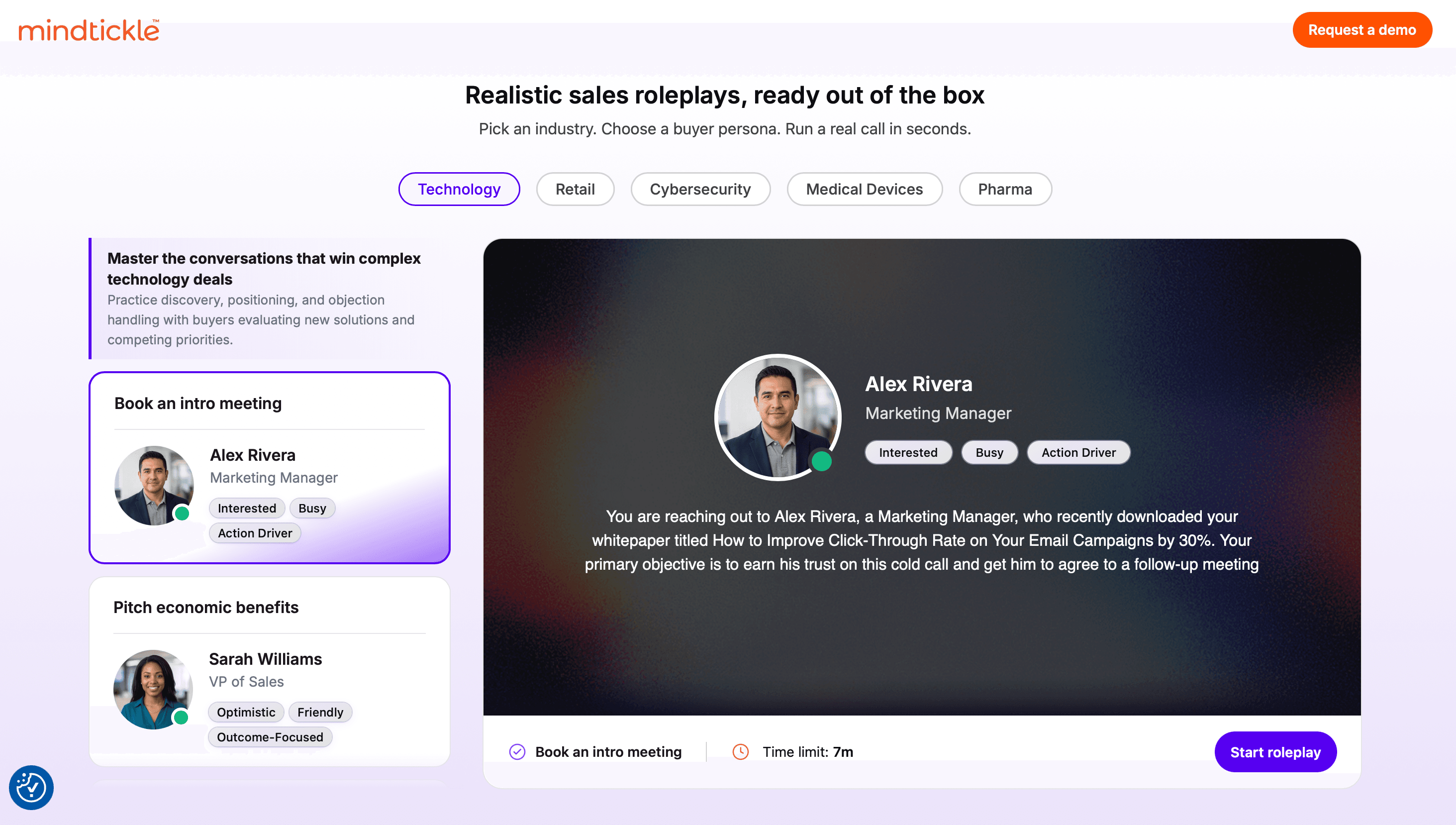
If you would rather feel how it works first, try Mindtickle's free AI sales role play. You step into a live buyer conversation, handle a real objection, and see the feedback on how you did. A few minutes inside a simulated call will tell you more than another paragraph here can.
Frequently Asked Questions
About the Author
Lead Content Marketer
Jayadeep brings over a decade of experience in B2B content and product marketing, with expertise in editorial leadership, messaging strategy, and agency management.
He has built and scaled content operations, led agency partnerships, and collaborated across marketing, product, and demand generation teams to deliver integrated campaigns. His "process-first, execution-next" philosophy has made him a trusted resource at Mindtickle, where he helps shape content strategy, thought leadership programs, and flagship marketing initiatives.
Subscribe to the blog
Get the latest sales enablement tips, guides, and industry best practices delivered to your inbox. Unsubscribe anytime.