




AI Sales Role Play for Negotiation Practice: How to Prepare Reps Before High-Stakes Deals



AI sales role play for negotiation practice is a rehearsal method where a rep works through difficult buyer conversations with an AI buyer that responds like a real stakeholder. Reps can practice handling objections, pricing pressure, and stalls before facing them in a live deal.
Most reps get plenty of practice with discovery and demos. Negotiation gets less attention, even though it often happens when the deal is under the most pressure. A buyer pushes back on price, asks for better terms, or challenges the value of the deal, and the rep has to decide how to respond without giving away too much or putting the deal at risk.
For many reps, that practice happens on live deals. By the time a manager sees how a rep handles a difficult negotiation, the concession may already be on the table.
Key takeaways
- Negotiation is the sales skill reps practice least and need most. AI role play moves that practice off the live deal, so the hard moments aren't new when the revenue is real.
- Traditional methods leave readiness to timing, personality, or luck. Workshops fade, manager role plays vary by who runs them, and shadowing depends on which deals happen to be live.
- The value is rehearsing the moments that go wrong. Defending price, trading concessions, holding a renewal increase on value, coaching a champion, each a distinct skill reps can drill before a buyer tests it.
- Renewals and expansions are the negotiations teams most often skip. By renewal the buyer holds leverage the rep didn't face the first time, and it usually gets far less preparation than new business.
What is AI sales role play for negotiation practice?
AI sales role play for negotiation practice lets reps rehearse difficult buyer conversations with an AI buyer that responds to what they say, raises objections, pushes back, and changes the direction of the conversation. Reps can repeat the same scenario, test different approaches, and build the judgment they need before entering a high-stakes negotiation. Read AI Sales Role Play: 2026 Guide for Enablement Leaders
Unlike scripted role play, an AI buyer can adapt the conversation based on the rep's responses. A procurement persona might challenge the business case, push for a lower price, introduce a new requirement, or question the terms of a deal. The rep then has to respond to the new pressure rather than follow a predetermined script. This ability to create dynamic, two-way conversations is a key difference between AI sales role play and traditional role play.
Why traditional negotiation training falls short
Most sales negotiation training uses a combination of workshops, manager-led role plays, and call observation. These methods can introduce negotiation principles and give reps some opportunity to practice, but they have a common limitation: reps often get too few chances to apply the skill before they need it on a live deal.
Classroom workshops fade before reps use them
Traditional negotiation training often starts with a classroom or instructor-led workshop. Reps learn negotiation frameworks, work through examples, and practice a few scenarios before returning to their regular sales activities. The challenge is reinforcement. A rep might learn a framework in March and not face a complex negotiation until June, leaving a significant gap between learning the skill and applying it.
Without opportunities to revisit and practice those concepts, the techniques can be difficult to recall when a buyer introduces unexpected pressure during a live conversation. Read: Why It's Almost Impossible to Get Sellers to Remember Sales Training (and Use it the Right Way)
Manager role plays depend on who is running them
Manager-led role plays can give reps valuable practice, but the experience varies based on the manager's approach, available time, and ability to create realistic scenarios. One manager might build a detailed negotiation around a specific deal, while another might rely on a more general scenario.
Repetition is another constraint. Managers have limited time across their teams, making it difficult to give every rep frequent opportunities to practice different negotiation situations. A rep might complete one mock negotiation and then have to wait weeks or months before getting another chance to practice.
Call shadowing leaves learning to chance
Shadowing real calls gives reps exposure to how experienced sellers handle difficult conversations, but that exposure depends on which negotiations happen to be live. A newer rep might get to observe a senior AE handling a tough renewal or procurement negotiation. If those opportunities do not arise during the rep's ramp period, they may have little exposure to complex negotiations before handling one themselves.
For sales enablement teams, that creates an uneven development experience. Reps should have opportunities to practice difficult negotiation scenarios without waiting for the right deal to appear on the calendar.
How AI sales role play prepares reps before negotiations
AI sales role play prepares reps by changing how, when, and how often they practice. Four things do most of the work.
Repeated practice against realistic pressure
The value of AI sales role play for negotiation practice is that it turns preparation into something a rep does repeatedly, on their own schedule, against pressure that behaves like the real thing. Instead of one mock session with a manager, a rep can work through the same negotiation several times, change their approach on each run, and see which version holds up. That repetition is what moves a tactic from something a rep understands in theory to something they can execute when a buyer is pushing back.
An AI buyer that responds instead of following a script
It starts with the buyer feeling real. A well-built AI persona carries a backstory, a budget it's protecting, and a set of motives, and it responds to what the rep actually says rather than following a fixed path. When a rep leans on price too early, the persona can press harder on discount. When a rep holds firm and reframes around value, the persona can shift its objection. That responsiveness is what recreates the pressure of a live negotiation, since the rep has to think on their feet instead of reciting a sequence they memorized.
Targeted drills for the moments that go wrong
Because the practice is repeatable, reps can rehearse the specific moments that tend to go wrong. Handling the first ask for a discount without immediately conceding. Holding margin when procurement stalls on ROI. Keeping the deal moving when a stakeholder goes quiet. Each of these is a distinct skill, and a rep can drill the one they're weakest on until the response comes naturally, rather than hoping the right scenario happens to surface in a group sales coaching session.
Earlier visibility for managers
The preparation also gives managers something they rarely get before a deal is live: visibility into how a rep actually negotiates. When reps rehearse ahead of real conversations, patterns show up early. A manager can see which rep folds on price, which one talks past the close, and which one is ready, and can coach the gap before it costs a deal instead of reviewing it afterward. That shifts coaching from a post-mortem on lost margin to preparation that happens while it still changes the outcome.
📌 Note
None of this replaces the judgment a rep builds in real deals. What it does is make sure the hard parts of a negotiation aren't happening for the first time when the revenue is real. By the time the rep is in the room, the objections are familiar, the responses are rehearsed, and the conversation is one they've already had.
Did you know?
According to Mindtickle's 2026 State of Agentic Revenue Enablement Report,a manual review of one role play takes a manager 17 minutes. AI does that in two.
Common negotiation scenarios AI can simulate
Every negotiation puts a different skill under pressure, and AI role play helps reps practice more scenario variety than most sales training accounts for.
| Buyer scenario | Targeted skill practice |
|---|---|
| Procurement demands an immediate 20% discount | Defending price with value instead of caving to features-for-discount |
| Buyer delays signing until payment terms shift in their favor | Trading terms without giving up margin |
| Buyer asks for a discount to match a lower-tier competitor | Differentiating on value instead of matching price |
| A new technical evaluator joins late and starts fresh objections | Re-selling value to a stakeholder who missed the earlier case |
| Buyer pushes back on a renewal price increase | Justifying the increase on delivered value, not tenure |
| Buyer wants added scope at renewal without paying more | Expanding scope without eroding the base deal |
| Buyer requests non-standard commercial terms | Structuring a deal that protects margin and precedent |
| Legal flags a liability clause days before signing | Negotiating contract terms under a signature deadline |
| Champion needs help selling the deal internally | Equipping a champion to negotiate on your behalf |
Best practices for implementing AI negotiation training
Getting value from AI sales role play depends on more than giving reps access to a practice tool. Enablement leaders need to decide which negotiations reps should practice, what good performance looks like, and how practice connects to the deals they are working on. A few principles can make that practice more relevant and repeatable.
Start with your highest-stakes negotiation scenarios.
Look at where deals stall, discounts increase, or commercial terms become difficult to negotiate. Build scenarios around those situations first instead of relying on generic negotiation exercises.
Mindtickle's 2026 State of Agentic Revenue Enablement Report
✅ Pro tip
If a must-win deal fell through after the last round of negotiations, don't let the call recording sit in the CRM as a postmortem. Pull out the moments that changed the trajectory of the deal through a conversation intelligence platform and turn them into the next role play scenario.
- Did the procurement lead push for a 20% discount after the economic buyer had already agreed on the value?
- Did the CFO question the business case and leave the rep scrambling for an ROI response?
- Did a technical evaluator introduce a new objection late in the cycle that the rep wasn't prepared to handle?
Use those moments to recreate the negotiation with the same buyer persona, objections, and commercial pressure. Then have the rep run the conversation again, test a different response, and see where the approach holds up. The goal is to turn a lost deal into practice material that prepares the team for the next one, rather than letting the lessons disappear with the recording.
Ground scenarios in real buyer language.
Use sales objections, requests, and negotiation tactics your reps actually encounter. The closer a scenario reflects the language and pressure of a real deal, the more useful the practice becomes.
Score negotiation-specific behaviors.
A negotiation scorecard should evaluate skills such as value articulation, persona-specific objection handling, concession discipline, questioning, and the ability to move toward a mutually acceptable next step. A scorecard designed for discovery or presentation skills will not show whether a rep can navigate commercial pressure effectively.
Tie practice to live opportunities.
Reps should practice conversations they are likely to have soon, whether that means preparing for an upcoming procurement call, renewal discussion, or pricing conversation. This gives practice an immediate purpose and creates a natural reason to repeat it.
Practice with different buyer personas.
A procurement lead may focus on price and terms, while an economic buyer may challenge the business case or ask for evidence of value. Exposing reps to different perspectives helps them prepare for the stakeholders who can influence the outcome of a negotiation. You can try a 7-min free AI sales role play with your preferred buyer persona here!
Reward disciplined negotiation, not fast concessions.
If practice rewards reps for reaching an agreement at any cost, they may learn to use discounts as the easiest path forward. Evaluation should instead recognize behaviors such as defending value, asking questions before conceding, and making concessions in exchange for something meaningful.
Connect AI practice with manager coaching.
AI can provide frequent practice and immediate feedback, while managers can use the results to identify patterns that need deeper coaching. Did you know - Mindtickle recommends this combination rather than treating AI role play as a replacement for human coaching?
Renewal and expansion: the negotiation type many teams overlook
Negotiation training often centers on new business, where procurement pressure, competitive pricing, and closing conversations are easy to recognize as negotiation moments. Renewal and expansion conversations deserve the same preparation, particularly because the buyer enters them with a much deeper understanding of the vendor relationship.
By renewal, the buyer knows what they use, where adoption is strong, and where the product has fallen short. They also have a better sense of the operational effort involved in changing vendors and may have their own view of how much leverage that gives them in the negotiation. The rep therefore needs to defend the value of the relationship while responding to a buyer who has much more information than they had at the start of the deal.
Expansion adds another layer. Strong adoption can support the case for additional products, users, or scope, but gaps in adoption can give the buyer reasons to push back on expansion or ask for better terms. A rep who prepares only for an upsell conversation may not be ready when the buyer turns the discussion toward existing usage, value delivered, or the cost of maintaining the current contract.
AI sales role play can give your reps a way to practice these conversations before the renewal or expansion meeting. A scenario can simulate a buyer challenging a price increase, questioning the value they received during the previous term, asking for additional scope without additional budget, or using underused licenses as leverage. Reps can work through those situations repeatedly and refine their responses before the negotiation affects a live account.
✌️ Two cents from Mindtickle
AI sales role play is well suited to this gap precisely because renewal and expansion negotiations are so patterned. The buyer's leverage points are predictable: the usage question, the switching-cost bluff, the quiet threat of a downgrade, the request for more scope at the same price. Reps can rehearse holding a price increase on delivered value rather than tenure, responding when a buyer weaponizes their own low adoption, and expanding scope without eroding the base deal.
These are learnable moments, and rehearsing them ahead of renewal season is far cheaper than discovering the gaps in the actual conversation.
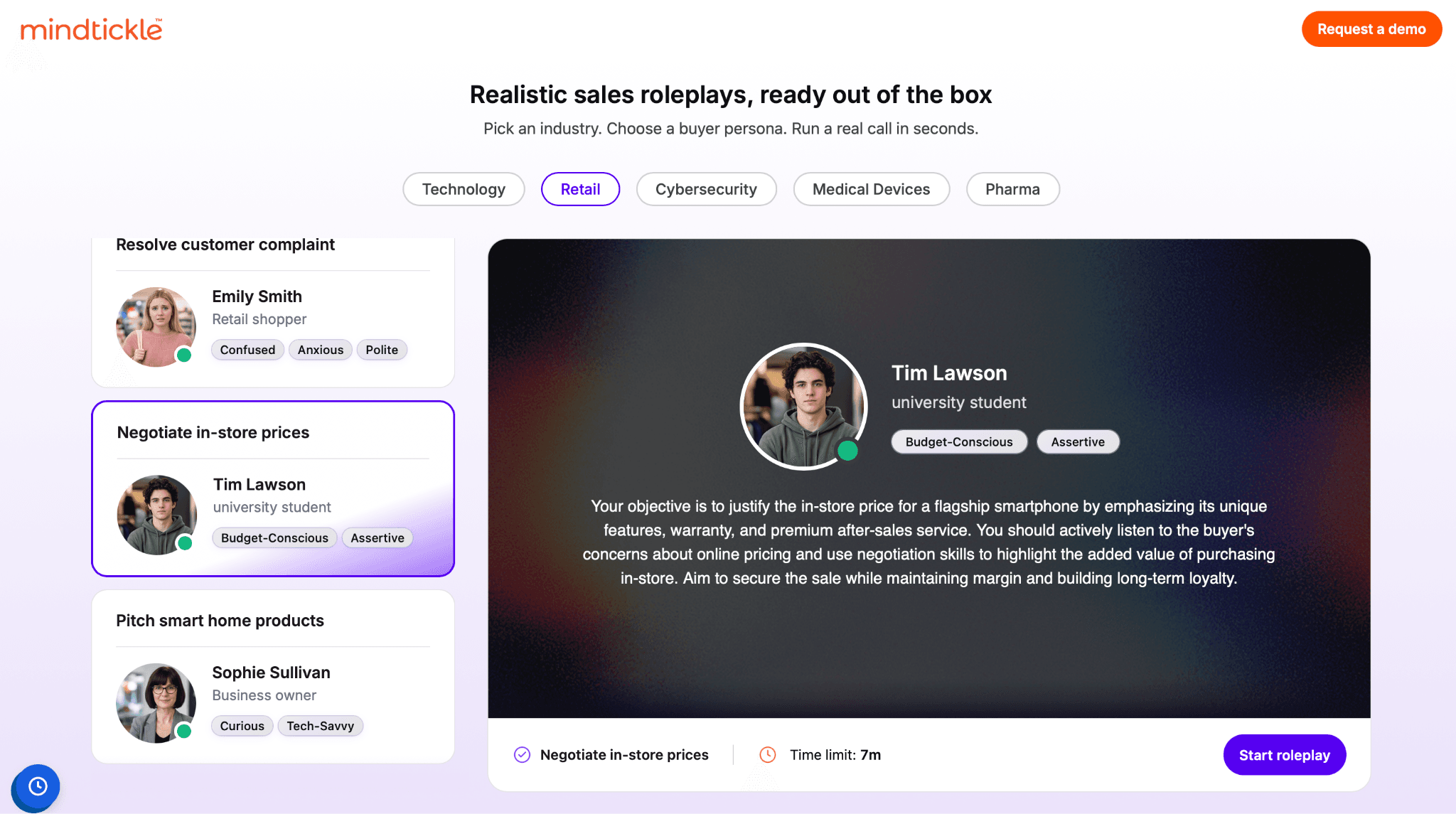
Want to try it? Mindtickle's free AI sales role play lets you run a negotiation scenario against an adaptive AI buyer and get instant feedback in 7-minutes.
Try A Free Negotiation Role Play
The rep who has already been in the room
The reps who hold margin in a tough negotiation are rarely the ones with the best instincts in the moment. They're the ones who have been in a version of the conversation before, worked through where it tends to go wrong, and know what they'll say when a buyer pushes on price or goes quiet. That kind of preparation used to depend on getting time with a manager or catching the right live deal at the right moment, which meant most reps got very little of it.
AI sales role play changes where that preparation happens. It moves the hard, expensive practice off the live deal and into a setting where a rep can run the same negotiation as many times as they need, against a buyer that pushes back the way a real stakeholder does. The objections, the pricing pressure, the stalls, the renewal that turns tougher than expected, all of it can be rehearsed before the revenue is real.
For enablement leaders, Mindtickle's AI Sales Role Play also turns coaching into something that happens before a deal is decided rather than after it's lost, with an AI buyer that adapts to each rep and feedback that points to exactly where a conversation slipped. Ready to see it with your own team's scenarios? Book a Mindtickle AI sales role play platform demo today!
Frequently asked questions
About the Author
Lead Content Marketer
Jayadeep brings over a decade of experience in B2B content and product marketing, with expertise in editorial leadership, messaging strategy, and agency management.
He has built and scaled content operations, led agency partnerships, and collaborated across marketing, product, and demand generation teams to deliver integrated campaigns. His "process-first, execution-next" philosophy has made him a trusted resource at Mindtickle, where he helps shape content strategy, thought leadership programs, and flagship marketing initiatives.
Subscribe to the blog
Get the latest sales enablement tips, guides, and industry best practices delivered to your inbox. Unsubscribe anytime.