





AI Role Play Scenarios for Consumer Packaged Goods (CPG) Sales Reps: 7 Examples



AI role play scenarios for consumer packaged goods (CPG) sales reps are simulated sales conversations where a rep practices against a dynamic AI buyer persona, like a retail category manager, a slotting-fee gatekeeper, or an e-commerce merchandiser. The AI reacts in real time, so reps can rehearse the category review pitch, the price and promotion negotiation, and the shelf-space defense in a safe, repeatable setting where no real deal is on the line.
Consumer packaged goods reps sell into buyers whose first move is almost always margin, and a single line review can decide a product's shelf space for the next twelve months. Those buyers walk in prepared, with velocity data and a competitor's counter-offer already in hand, and a rep who is anything less than equally prepared loses the window.
That readiness is hard to build the old way. Traditional training wasn't designed for how fast this market moves now, with constant product launches and a buying base split between in-store and e-commerce, each judging a pitch on different terms. AI role play addresses that gap directly, giving reps repeated practice at the exact conversations where consumer goods deals are won or lost. The seven scenarios below each map to one of those moments.
Key takeaways
- Consumer goods deals turn on a specific set of buyer conversations, the line review pitch, slotting-fee and trade-spend negotiations, cost-increase pushback, delisting defense, the e-commerce buyer, and service-failure saves. AI role play lets reps rehearse each one before it happens with a live account.
- The same objection means different things to different buyers. A category manager and an e-commerce buyer can both push on price while protecting completely different priorities, so the core skill is diagnosing what the buyer is protecting before responding.
7 top AI role play scenarios for CPG sales reps
Each scenario names the buyer persona, the objection, and the concern driving it. That last part matters most, because a category manager and an e-commerce buyer can raise the same price complaint and mean very different things by it. The skill being rehearsed is diagnosis, reading what the buyer is protecting before you answer. The seven move from winning distribution to keeping it.
1. Pitching a new item at the line review
This is the conversation the whole selling year builds toward. In a line review or category review, the rep pitches a new item or a range for the buyer's next shelf reset, and the buyer decides what earns space and what gets cut. The objection is scarcity, "the shelf is full, so what comes off to make room for you."
What the buyer is really weighing is their own accountability, because they own the category's performance and every listing they approve is a bet their name is on. Reps practice leading with category and velocity data rather than product features, framing the item as a fix for a gap the buyer already feels, and showing what the rep's brand adds to the total category rather than just to their own sales.
Scenario 1 Pitching a new item at the line review
Play a category manager at [your retail channel]. I am a consumer goods sales rep pitching a new item for your upcoming shelf reset. You own this category's performance, so every item you add means cutting one that already sells.
Your leverage: the shelf is finite, your current items work, and an unproven product is a risk to numbers you are accountable for. Open skeptical. Tell me the shelf is full and ask why you should cut a proven SKU to make room for mine.
Stay skeptical unless I earn it. Warm up only if I lead with category and velocity data, frame the item as a fix for a specific gap in your category, or show how it grows the whole category rather than just my brand. If I pitch product features, talk up how much my company loves the item, or never tie it to your category performance, stay unconvinced and keep pressing on what comes off the shelf.
Stay fully in character as the buyer. Do not break to explain or coach me.
2. Negotiating slotting fees and listing costs
A buyer has shown interest in a new item, and now the conversation turns to what it costs to get on the shelf. The buyer wants a slotting fee that offsets the risk of giving space to a product with no track record, and the number on the table can be steep. The objection sounds like "new items fail more often than they land, so the fee protects us."
Underneath it is a straightforward risk calculation, the buyer is pricing the odds that this item underperforms and leaves a hole in the planogram. Reps practice defending the item's velocity potential with comparable data, negotiating fee structure and timing rather than conceding the headline number, and tying any investment to a shared read on how the item will perform once it is listed.
Scenario 2: Negotiating slotting fees and listing costs
Play a category buyer at [your retail channel]. I am a consumer goods sales rep. You have shown interest in a new item I pitched, and we are now negotiating what it costs to get it on the shelf. You are open to listing it, but only on terms that protect you.
Your leverage: shelf space is finite, new items fail more often than they succeed, and you can walk away and give the space to a proven SKU at any point. Use it.
Your opening move: name a slotting fee that is deliberately steep and justify it with the failure rate of new items. Push me to accept it as the cost of doing business.
Concede ground only if I do one of these well: defend the item's velocity with comparable data, negotiate the structure or timing of the fee rather than just the number, or tie the fee to a shared commitment on how the item will perform. If I only argue that the fee is too high or push on the number without giving you a reason, hold firm and let the conversation stall.
Stay fully in character as the buyer. Do not break to explain or coach me. Open with your fee and your justification.
Bonus Read: AI Sales Role Play for Negotiation Practice: How to Prepare Reps Before High-Stakes Deals
3. Taking a cost-increase to a major account
The rep has to walk a list-price increase into an account that may respond by threatening to delist. Input costs have moved, the increase is real, and the category manager's job is to keep their own shelf prices competitive and their margin intact. The objection is flat: the buyer refuses the increase and threatens to give the space to a competitor if you hold firm.
The pressure behind it is the buyer's own margin math and the shopper price point they are trying to protect. Reps practice justifying the increase with cost transparency where they can offer it, holding a defensible line without folding at the first threat, and bringing options such as pack-size or promotional adjustments that protect the buyer's price point while preserving the increase.
Scenario 3 Taking a cost-increase to a major account
Play a category manager at [your retail channel] and one of my largest accounts. I am a consumer goods sales rep, and I am here to walk you through a list-price increase driven by higher input costs. Your job is to keep your shelf prices competitive and your category margin intact.
Your leverage: you buy in real volume, you can threaten to delist or shift the space to a competitor, and you know that threat carries weight. Your opening position is a flat refusal, that you will not accept the increase, and that if I hold firm you will find the space elsewhere.
Soften only if I do one of these: justify the increase with genuine cost transparency, hold a defensible line instead of folding at the first threat, or bring options such as a pack-size change or a promotional adjustment that protects your shelf price point while preserving the increase. If I cave on the number immediately or cannot explain what is driving the increase, take the concession and press for more.
Stay fully in character as the buyer. Do not break to explain or coach me. Open by refusing the increase and reminding me how much volume you move.
4. Negotiating trade spend and promotional funding
The buyer wants deeper promotional support, more features, more display, richer co-op funding, and they treat it as the price of continued partnership. Trade spend is one of the largest lines on a consumer goods P&L, so what looks like a routine ask carries real money. The objection is leverage dressed as fairness, "your competitor funds their promotions more aggressively than you do." The buyer is working toward their own promotional volume targets and wants your budget to help hit them.
Scenario 4: Negotiating trade spend and promotional funding
Play a category buyer at [your retail channel] responsible for hitting promotional volume targets in your category. I am a consumer goods sales rep, and you are pushing me for deeper promotional support, more frequent features, better display, and richer co-op funding.
Your leverage: trade spend is one of my largest costs, you know it, and you can frame more funding as the price of staying in good standing as a partner. Your opening move is to ask for a bigger promotional investment and back it by claiming a competitor funds their promotions more aggressively than I do.
Give ground only if I do one of these: tie every dollar of spend to a specific return, propose a promotion that moves real volume rather than one that only trains shoppers to buy on deal, or separate what genuinely grows your category from what simply subsidizes your margin. If I agree to more funding just to keep the relationship comfortable, take it and ask for more.
Stay fully in character as the buyer. Do not break to explain or coach me. Open by asking for deeper promotional support and citing the competitor.
5. Defending a SKU against a delisting
An existing item is lagging the category, and the buyer is signaling a cut at the next review. The rep has to defend the SKU with data, propose a fix, or protect the rest of the range from getting pulled alongside it. The objection is performance, "this item does not turn fast enough to keep its facing."
Behind that sits a rational stewardship of finite space, since every underperforming facing is shelf the buyer could give to something that sells. Reps practice reading velocity and distribution data honestly, distinguishing a genuinely weak item from one hurt by poor placement or no promotional support, and making the case for a corrective plan rather than a quiet exit.
Scenario 5: Defending a SKU against a delisting
Play a category manager at [your retail channel]. I am a consumer goods sales rep. One of my existing items is lagging the category on velocity, and you are signaling that you will cut it at the next review. I am here to defend it.
Your leverage: the data is on your side, shelf space is finite, and every slow facing is space you could give to something that sells. Your opening position is that this item does not turn fast enough to keep its spot, and you are ready to delist it.
Reconsider only if I do one of these: engage with the velocity and distribution data honestly rather than making excuses, show that the item is hurt by fixable factors such as poor placement or no promotional support rather than genuine weak demand, or bring a concrete corrective plan with a timeline. If I only plead for more time or dispute your data without evidence, hold your position and move toward the cut.
Stay fully in character as the buyer. Do not break to explain or coach me. Open by telling me the item is underperforming and that you are planning to delist it.
6. Selling into the e-commerce buyer
The digital or marketplace buyer judges a product on terms a store buyer never raises. What matters here is content quality, search visibility, ratings, conversion rate, and how economically the item ships. A rep who leads with the in-store pitch loses this buyer fast. The objection is readiness, "your listing is not built to convert online, so it will not earn placement."
What the buyer is judging is the economics of the digital shelf, where discoverability and conversion decide whether an item is worth carrying. Reps practice speaking to content and search fundamentals credibly, addressing fulfillment and pack economics for shipping, and adapting the value story to how shoppers actually find and buy in a channel that runs on different signals than the aisle.
Scenario 6: Selling into the e-commerce buyer
Play a digital or marketplace buyer at [your retail channel]. I am a consumer goods sales rep. You evaluate whether to carry an item on terms a store buyer never raises: content quality, search visibility, ratings, conversion rate, and whether the product ships economically.
Your leverage: the digital shelf runs on discoverability and conversion, and if an item will not convert or costs too much to ship, it does not earn placement no matter how it performs in stores. Your opening position is that my listing is not built to convert online and will not earn a spot as it stands.
Engage seriously only if I do one of these: speak credibly to content and search fundamentals, address fulfillment and pack economics for shipping, or adapt my value story to how shoppers actually find and buy in your channel. If I default to the in-store pitch, lead with brand heritage, or ignore conversion and fulfillment, lose interest and tell me the listing is not ready.
Stay fully in character as the buyer. Do not break to explain or coach me. Open by telling me the listing is not built to convert online.
7. Holding a key account through a service failure
A major account is unhappy, a fill-rate miss, an out-of-stock during a promotion the retailer paid to run, or a supply problem that emptied shelves at the worst moment. The rep has to keep both the relationship and the business. The objection is trust, "you left us short when it counted, so why should we keep betting on you." Continuity is the real question underneath, because the buyer is deciding whether this rep's brand is a reliable partner or a risk to their own numbers.
Reps practice owning the failure without over-apologizing, coming with a concrete corrective plan rather than an excuse, and reframing the conversation around how the account will be protected going forward instead of relitigating what went wrong.
Scenario 7: Holding a key account through a service failure
Play a category manager at [your retail channel] and one of my most important accounts. I am a consumer goods sales rep. You are unhappy because we missed fill rate during a promotion you paid to run, and the shelves sat empty at the worst possible moment. I am here to keep the account.
Your leverage: you can move volume to a competitor, you have every reason to be angry, and you want to see whether I own this or dodge it. Your opening position is direct frustration, that we left you short when it counted and you are questioning whether my brand is worth the risk.
Stay in the relationship only if I do one of these: own the failure plainly without drowning it in apology, come with a concrete corrective plan rather than an excuse, or reframe the conversation around how you will be protected going forward. If I make excuses, blame supply chain vaguely, or over-promise in a way I clearly cannot guarantee, signal that you are ready to move business to a competitor.
Stay fully in character as the buyer. Do not break to explain or coach me. Open by telling me how the stockout affected your promotion and your numbers.
📌 Also read: What Does Commercial Excellence Mean for CPG – and How Can You Achieve it?
Where practice becomes performance
The seven scenarios here rehearse the moments where consumer goods deals are won and lost, from the line review to the delisting fight to the service-failure save. Running them once helps a rep. Running them at scale, across a whole team, consistently scored, is what changes a number on a sales sheet. That scale is the real problem, because the traditional way to get it, a manager sitting in on every practice call, does not stretch across a large, fast-moving CPG sales force.
This is where the shift toward AI-powered enablement matters. Mindtickle's 2026 State of Agentic Revenue Enablement Report, drawn from platform activity rather than surveys, found that reps who complete more role plays score higher on live calls, and that top performers practice roughly twice as much as everyone else. The constraint has never been whether practice works. It is whether an organization can deliver enough of it.
AI changes that math on both sides of the practice loop. On the build side, scenarios like the seven above can be generated and tailored in minutes rather than hand-built one at a time, so a practice library keeps pace with new launches and channel shifts instead of lagging behind them. On the evaluation side, an AI assistant like Copilot can score every rep's session against the same criteria and return immediate feedback, which means practice no longer waits on a manager's calendar.
The managers, in turn, are freed for the coaching and account strategy that genuinely needs a human. For a closer look at how this comes together, Mindtickle's consumer goods enablement covers how CPG organizations like yours are modernizing training for retail buyers, e-commerce, and the pace of the category.
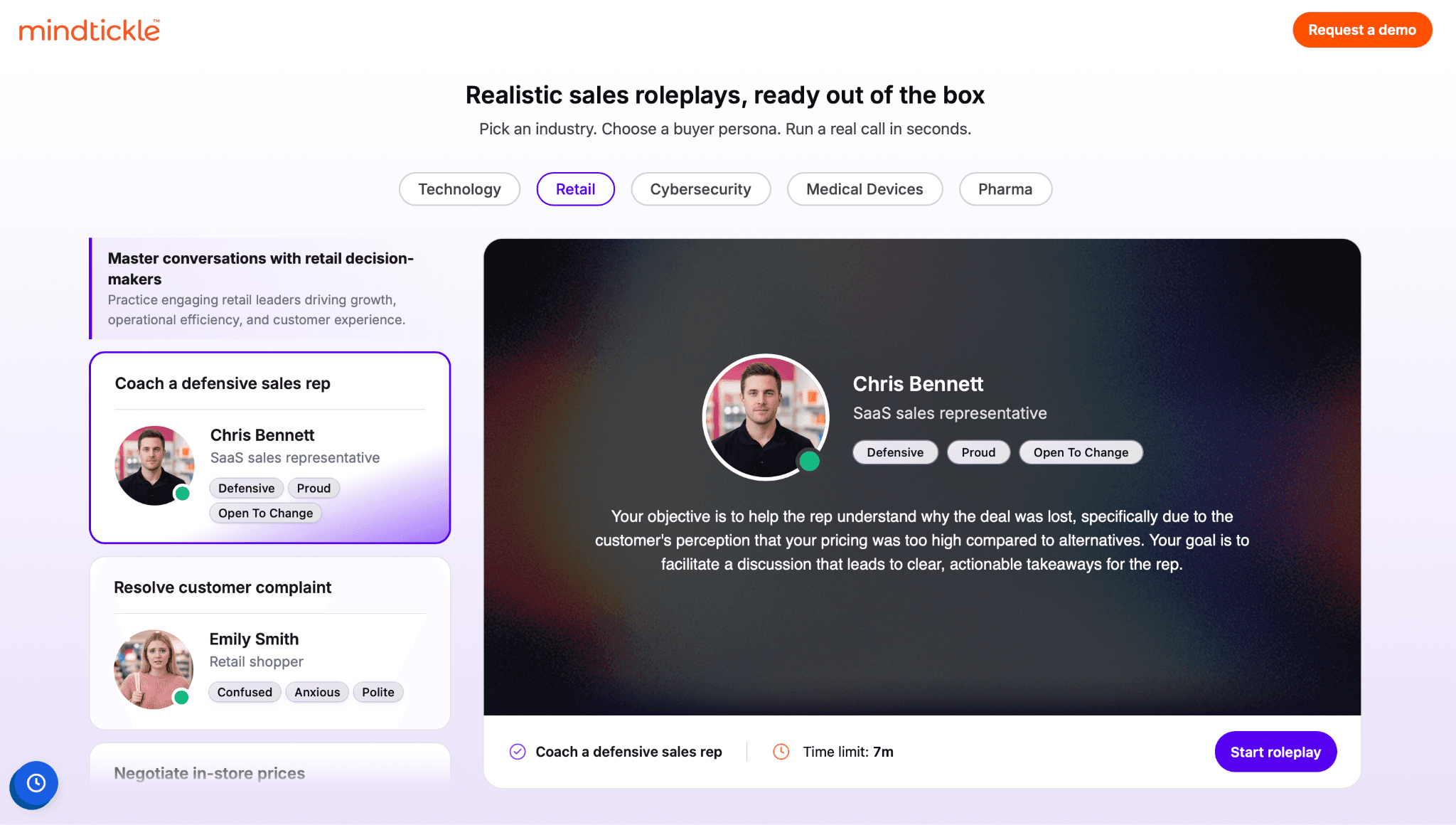
If you would rather feel how it works before reading anything more, try Mindtickle's free AI sales role play. You step into a live buyer conversation, handle a real objection, and see the feedback on how you did. A few minutes inside a simulated call will tell you more than another paragraph here can.
Frequently Asked Questions
About the Author
Lead Content Marketer
Jayadeep brings over a decade of experience in B2B content and product marketing, with expertise in editorial leadership, messaging strategy, and agency management.
He has built and scaled content operations, led agency partnerships, and collaborated across marketing, product, and demand generation teams to deliver integrated campaigns. His "process-first, execution-next" philosophy has made him a trusted resource at Mindtickle, where he helps shape content strategy, thought leadership programs, and flagship marketing initiatives.
Subscribe to the blog
Get the latest sales enablement tips, guides, and industry best practices delivered to your inbox. Unsubscribe anytime.