




Scaling AI Sales Coaching and Role Play for Medical Device Sales Teams in 2026



Medical device teams scale AI sales coaching and role play by grounding every scenario in approved product and clinical content, letting AI deliver consistent scoring and feedback to every rep, and tying certification to what each rep can actually do in a clinical or procurement conversation.
That's harder than it sounds in med devices. A single rep might walk a surgeon through a procedure step in the morning, answer a biomedical engineer's technical questions after lunch, and defend pricing to a value analysis committee later that week.
Multiply that across product lines, specialties, regions, and a launch calendar that rarely slows down, and keeping a whole field team prepared becomes a much bigger job. This guide covers what makes it hard, what to set up first, and how AI role play, certification, and ongoing upkeep work together.
Key takeaways
- Med device teams have more to scale than most sales teams. Broad portfolios, frequent product changes, and conversations with clinicians, engineers, and procurement expand what reps need to handle confidently.
- Scaling depends on standards set by the team. A shared definition of field readiness, clear ownership of content and rubrics, and current approved sources give AI a reliable foundation for practice and evaluation.
- AI role play carries the practice and review volume. Realistic clinician and procurement personas give reps relevant practice, while consistent scoring surfaces skill gaps and flags critical compliance errors that require intervention.
- A readiness platform brings it all together. Practice, certification, and real-world performance signals give leaders a clearer view of who is ready for the field and who still needs coaching.
Why does medical device sales role play become harder to manage at scale?
Most sales teams can standardize a set of role plays and roll them out without much trouble. Medical device teams face a different problem, because nearly everything a rep has to talk about keeps changing, and nearly every conversation is with a different kind of expert.
The product keeps moving
Med device sales often span implants, capital equipment, and disposables across several specialties, each with its own indications, evidence, and competitors. New sizes, revised instructions for use, and fresh clinical data arrive throughout the year. Each change reshapes what reps should say, and manual sales training rarely keeps pace.
One rep faces several kinds of buyers
A surgeon wants to know whether the evidence applies to their patients. OR staff care about setup and workflow, biomedical engineering asks about compatibility and service, and procurement wants to talk about cost and contracts. A rep has to be clinically credible, technically precise, and economically fluent, sometimes in the same week for the same account.
The skills that matter most are the hardest to script
Reps rarely lose these conversations on product facts. They lose them in the moments that require reading a buyer and adjusting on the spot.
📌 Where reps struggle most
Reps scored lowest in role plays on discovery, product pitch, and competitive intel, according to Mindtickle's 2026 State of Agentic Revenue Enablement Report. Those are the skills that depend on adapting to a buyer in real time, which is exactly what a clinician or procurement conversation demands.
Reps are on the road, and managers can't see most conversations
Coaching often happens in a parking lot between accounts, if it happens at all. Keeping standards consistent across field reps, inside sales, and channel partners in different regions is hard when no one can observe more than a fraction of what gets said.
Every conversation carries compliance weight
What a rep says about indications, outcomes, and competitors carries legal exposure. Inconsistent messaging to clinicians is a compliance risk as much as a revenue problem.
Together, these are why a med device role play program needs more structure than a generic one, and that structure starts before rollout.
What do med device teams need in place before scaling AI role play?
AI can deliver practice and scoring at a scale no team could manage by hand, but it works from the decisions and materials your team gives it. Three things need to be settled first.
A definition of field-ready for each stakeholder
Field-ready means something different depending on who is across the table. Writing that down gives every scenario, rubric, and certification something concrete to measure.
| Stakeholder | What they want to know | What a field-ready rep can do |
|---|---|---|
| Surgeon or physician | Whether the evidence applies to their patients and technique | Discuss the evidence accurately, including its limits, and answer procedure questions clearly |
| OR staff and clinical team | How the device changes setup and workflow | Explain practical changes without overpromising |
| Biomedical engineering | Compatibility, maintenance, and service | Answer technical questions precisely or bring in the right specialist |
| Value analysis committee and procurement | Cost, contract terms, and standardization | Connect clinical value to economic terms using approved value claims |
A rep who finished every module may still fall short in most of these rows. Readiness that goes beyond training completion is about what a rep can do in the conversation, not what they have been exposed to.
Owners for content, rubrics, and certification
Each piece needs someone accountable for it. Regulatory, legal, or medical affairs usually approve the content and decide which errors count as critical. Enablement defines the conversational skills being measured, like discovery and objection handling. Sales leadership decides which certifications a rep needs before covering a product, a case type, or an account.
This keeps the judgment where it belongs. The AI applies the standards your people set, and it doesn't invent its own definition of compliant.
Approved content the AI can draw from
AI role play is only as accurate as the material behind it. For each product and market, gather the current labeling and instructions for use, approved clinical evidence, approved value and economic claims, and competitive positioning your legal team has cleared. If those sources are scattered or out of date, every scenario built on them inherits the problem.
💡 Pro tip
Start small and build out from there. Begin with the conversations your reps lose most often, whether that's a surgeon's evidence question or a procurement pushback on price, and add scenarios as those take hold.
📖 Read more: AI Sales Role Play: 2026 Guide for Enablement Leaders
How does AI role play prepare med device reps for clinical and procurement conversations?
AI role play gives every rep, in every territory, the same access to realistic practice and consistent feedback. Here's what the tool itself does to make that happen.
Builds scenarios from your product and clinical content
AI role play generates scenarios from your approved sources and the buyer personas your reps actually meet, so practice reflects your devices rather than generic medical knowledge. When a product launches or messaging changes, new scenarios can be created around the updated content quickly, and practice can be targeted to each rep's specific skill gaps instead of handing everyone the same exercise. Throughout, the AI buyer reacts to what the rep says, and the scoring checks it against what your organization has approved.
Plays the clinician who has two minutes and hard questions
Clinical conversation practice only works if the clinician in the simulation behaves like a real one. A surgeon between cases gives short answers, challenges a generic claim, and asks whether a study's patient population looks anything like theirs. An interventional radiologist may expect the rep to ask about her workflow before pitching a single feature.
Hyper-realistic AI role play recreates that pressure, pressing on vague answers and moving the conversation off script. Reps can run the same conversation as many times as they need until explaining the evidence clearly and briefly feels natural.
Brings the procurement conversation into practice
Plenty of med device deals are won with the surgeon and then stall at procurement. Reps trained on clinical messaging often struggle to switch to the economic language a value analysis committee uses, where the questions are about cost per procedure, contract terms, and standardization.
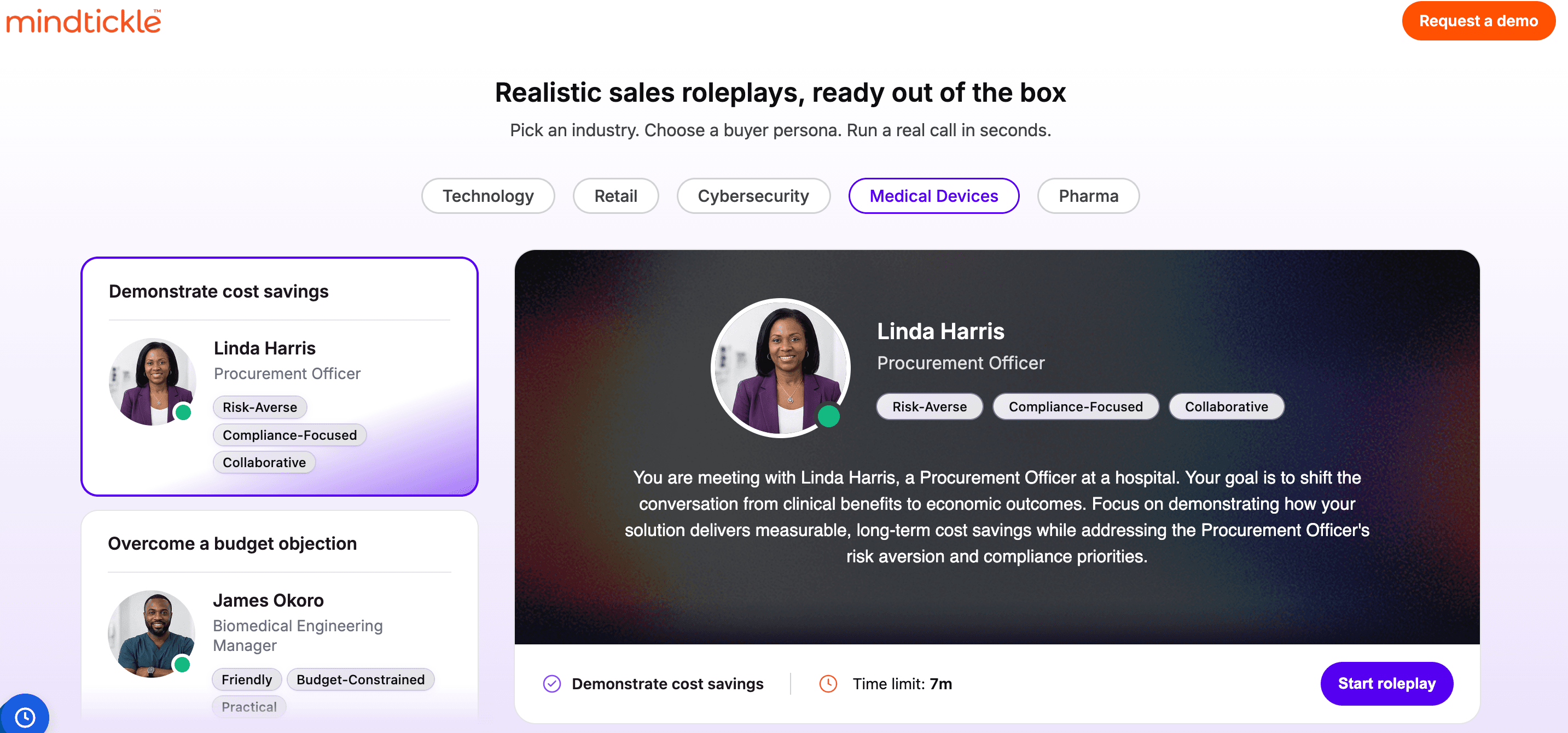
AI role play lets reps practice a hospital procurement pitch against the different people who shape that decision, such as a procurement officer focused on total cost or a biomedical engineering manager dealing with a budget freeze.
Each persona raises its own version of the same concern, so reps can rehearse the persona-specific objections that tend to stall deals at this stage.
➕ Bonus read: 9 AI Role Play Scenarios for Medical Device Sales Reps
Scores every attempt consistently and flags critical errors
Every rep is scored against the same rubric, whether they sell in Boston or Brisbane, and feedback arrives minutes after they finish instead of days later. That consistency is what makes compliance scoring useful at scale.
The scoring also separates skill gaps from compliance errors. A rep can run a strong conversation overall and still fail if they suggest an off-label use or make an unsupported comparison with a competitor's device. Those errors are flagged for review regardless of the overall score. Responses that fall into a gray area are routed to a person rather than decided by the AI.
🎯 See it for yourself
You try a 7-minute AI role play with a medical device buyer, whether that's a clinician questioning your evidence or a procurement lead pushing on price. Just pick the scenario and start.
📌 Dig deeper: How 3 Medical Device Companies Use Mindtickle to Help Their Reps Close More Deals
How do you certify med device reps on technical products at scale?
A role play score tells you how one conversation went. Certification decides what a rep is trusted to do next, whether that's supporting a case, pitching a newly launched product, or taking over an account. Certification needs to make that call the same way for every rep, regardless of region or manager.
Certify on scored conversations
A rep certified on a new implant system should have shown, in a scored conversation, that they can explain it accurately, answer a surgeon's technical questions, and handle a compliance-sensitive moment correctly. A cutoff score sets the bar, and a critical error means no pass until it's fixed.
This is where the gap between knowing and doing shows up. A rep can know the instructions for use by heart and still struggle to explain them to a surgeon who has two minutes, and AI role play helps close that gap for med device reps before a customer sees it. Because the assessment runs through AI role play, a team can certify an entire field force without scheduling a live session for every rep.
Give each role its own track
A clinical specialist who supports cases in the OR needs a different certification than an inside sales rep qualifying accounts or a channel partner covering a distant territory. Separate tracks, each with its own scenarios, rubric, and cutoff score, keep the standard consistent within a role without putting every seller through the same test. They also fit naturally into a broader medical device sales training plan, so reps know exactly which certifications stand between them and a new product or account.
Where managers step in
If AI handles the first review, it's fair to ask what managers are still needed for. They make the calls a rubric can't. They look at the attempts the AI flags as borderline, coach the gaps that keep coming back for a particular rep, and give the final sign-off before a rep supports a live case. The difference is that their time goes to the reps and moments that need their judgment, not to scoring every submission.
Also read: How Managers Can Use AI Sales Role Play Tools to Coach Reps
How do you keep AI role play accurate after rollout?
Once reps are practicing and certifying at scale, the work shifts to keeping everything current. In med devices, that work never really stops.
Update scenarios and recertify when the product changes
When a device gets a new indication, revised instructions for use, or new clinical data, the content owner updates the source material first. Every scenario and rubric built on it then needs revising, which is easy to track when each one is linked to the source it came from. Reps certified on the old version should recertify before they discuss the change with customers.
Check AI scores against your reviewers regularly
Have qualified reviewers score a small set of conversations every so often, and whenever a rubric changes, then compare their scores with the AI's. Include a few borderline examples, like a rep who hedges an evidence claim or half-answers a technical question, because that's where differences show up first. Catching a gap early is far easier than explaining it after certifications have been granted on it.
Look for patterns across reps
When one rep keeps missing the same point, that calls for coaching. When many reps miss it in the same scenario, the scenario, the source content, or the original training is usually the problem. Those patterns are worth checking against real calls, and conversation intelligence can show managers whether the same gap appears when reps talk to actual customers.
How do you know which reps are actually ready for the field?
Practice and certification pay off when leadership can see what they change in real conversations. That takes a closed-loop system that measures readiness and outcomes together.
Mindtickle's AI Sales Role Play is built into ElevateOS™, Mindtickle's agentic revenue enablement system, so role play is one connected part of the enablement workflow. Personalized Role Play detects each rep's skill gaps and surfaces the most useful next scenario on their dashboard, built around personas like a surgeon, a clinic manager, or a procurement officer. After each session, the rep sees what went well, one area to focus on, and a skill score, and managers can see where the same gaps keep appearing across their team.
According to Mindtickle's 2026 State of Agentic Revenue Enablement Report, reps who completed 10 or more role plays in a year scored 61% on real calls, compared with 57% for reps who did fewer.
Field reps, inside sales, and channel partners each get role plays built for their own conversations, with their own rubrics and passing scores. The standard stays the same across every product and region. The Readiness Index brings it together for leadership, showing how prepared each team is and where support is needed, so readiness decisions rest on skill rather than activity.
When practice and performance live in one system, leaders can see which reps are ready for the OR or the value analysis meeting, rather than guessing.
Want to see how your reps handle a skeptical surgeon or a value analysis committee?
FAQs
About the Author
Lead Content Marketer
Jayadeep brings over a decade of experience in B2B content and product marketing, with expertise in editorial leadership, messaging strategy, and agency management.
He has built and scaled content operations, led agency partnerships, and collaborated across marketing, product, and demand generation teams to deliver integrated campaigns. His "process-first, execution-next" philosophy has made him a trusted resource at Mindtickle, where he helps shape content strategy, thought leadership programs, and flagship marketing initiatives.
Subscribe to the blog
Get the latest sales enablement tips, guides, and industry best practices delivered to your inbox. Unsubscribe anytime.