




9 AI Role Play Scenarios for Medical Device Sales Reps



AI role play scenarios for medical device sales reps are simulated buyer conversations that let reps practice real-world sales situations with an AI buyer. A scenario might involve a surgeon questioning a device’s clinical value, a procurement stakeholder challenging its cost, or a hospital buyer evaluating whether to switch from an incumbent product.
These simulations give reps a way to practice how they respond when a conversation moves beyond the product pitch. They can work on discovery, objection handling, value messaging, competitive conversations, and other skills in a low-risk environment before applying them with customers.
This article covers nine AI role play scenarios for medical device sales reps, along with the sales skills each scenario can help reps develop.
Key takeaways
- Medical device sales role plays should mirror real field conversations, from time-pressed physician interactions and clinical discussions to competitive displacement and multi-stakeholder buying conversations.
- The best AI role plays test specific sales behaviors, such as discovery, evidence-based communication, objection handling, stakeholder adaptability, and judgment under pressure.
- Scenario quality matters more than scenario volume. Build simulations around realistic buyer personas, product context, objections, approved messaging, and clear performance criteria.
- Repeated practice helps reps improve before customer conversations. AI role play gives reps a scalable way to rehearse challenging situations, receive feedback, and focus practice where they need it most.
Why medical device sales needs its own role play scenarios
Medical device sales conversations can be very different from the scenarios used in generic sales training. Reps may need to engage physicians, surgeons, hospital administrators, procurement teams, or value analysis committees, with each stakeholder bringing different priorities and questions to the conversation.
Reps have limited access to key stakeholders
Medical device reps often have limited access to physicians and administrators and need to be prepared when those conversations happen.
A role play should reflect that reality. A surgeon may have only a few minutes to discuss a device, while a longer conversation with a hospital team may focus on different concerns. Reps need to practice getting to the relevant issue quickly, asking useful questions, and adapting their response to the person in front of them.
Clinical expertise changes the conversation
Medical device buyers and users often bring substantial cliƒƒnical or technical expertise to the conversation. A surgeon may have deep experience with the procedure in which a device is used, while a procurement or value analysis stakeholder may focus more on economics, workflow, utilization, or purchasing considerations.
That puts a higher bar on the rep’s preparation. Product knowledge matters, but reps also need to know how to apply that knowledge to different questions and stakeholder priorities. Role play can help them practice explaining the product clearly, responding to objections, and recognizing when they need to clarify the buyer’s underlying concern before responding.
Reps need to practice compliant conversations
Medical device sales reps also need to understand the boundaries around product claims, intended use, and approved or cleared labeling. FDA’s requirements differ by regulatory pathway, and a device’s indications for use are an important part of its labeling and marketing framework. For example, FDA requires the indications statement for a 510(k) device to be consistent with its labeling, advertising, and instructions for use.
That makes compliance a practical sales skill, not simply a topic to cover during sales onboarding. A realistic AI sales role play can put a rep in a situation where a physician asks a question that goes beyond the product’s approved or cleared use and assess whether the rep knows how to handle the conversation appropriately. The exact response should follow the company’s approved policies and compliance guidance.
9 high-stakes personalized AI role plays for med device reps
Med device reps carry a lot on every call. They balance clinical fluency, competitive positioning, and economic value, sometimes all in the same conversation. Here are nine role play scenarios worth mastering before your reps ever set foot in a clinic.
| Scenario | Target stakeholder(s) | What the rep practices |
|---|---|---|
| 1. Time-pressed physician conversation | Surgeon or specialist physician | Quickly establish relevance, ask a focused question, and earn the next step. |
| 2. Practice manager conversation | Practice manager or clinic administrator | Understand the stakeholder’s priorities and earn a productive path to the right decision-maker. |
| 3. Clinical discovery | Physician or clinical specialist | Ask relevant questions, understand the clinical need, and communicate evidence accurately. |
| 4. Competitive displacement | Physician or clinical/economic buyer | Understand the customer’s experience with the incumbent, uncover unmet needs, and establish meaningful differentiation. |
| 5. Price and value objection | Procurement or supply-chain stakeholder | Understand the economic concern and connect product value to the customer’s broader priorities. |
| 6. Value analysis presentation | Value Analysis Committee or similar hospital stakeholders | Communicate clinical and economic value and respond to questions from stakeholders with different priorities. |
| 7. Multiple stakeholder objections | Cross-functional buying group | Identify the underlying concerns, prioritize them, and keep the conversation moving without overlooking important stakeholders. |
| 8. OR workflow conversation | Surgeon and OR staff | Explain the device’s use and workflow clearly, respond to questions within the rep’s role, and know when to escalate. |
| 9. Questions outside approved messaging | Physician or other clinical stakeholder | Recognize when a question requires escalation, avoid unsupported claims, and follow the company’s approved response process. |
Scenario 1: Time-pressed physician conversation
A rep gets a few minutes with a surgeon who is between procedures. The surgeon already knows the category and has little time for a product overview. The rep needs to establish relevance quickly enough to earn the surgeon’s attention and, ideally, a more meaningful follow-up conversation.
Where reps can struggle: Under time pressure, reps may default to product features or technical specifications before understanding what matters to the physician. That can make the conversation feel like a product pitch when the physician is looking for a reason to engage.
What the rep should practice: Start with a relevant customer need rather than a list of features. Depending on the device and the conversation, that could mean exploring a clinical challenge, procedure workflow, patient-related outcome, or other priority that the product is designed to address. Any supporting evidence or product claim should be accurate and consistent with the company’s approved messaging.
The rep’s goal isn’t necessarily to complete the sale in a short interaction. It is to make the conversation relevant enough to earn the next step, whether that’s a longer discussion, product demonstration, or another appropriate follow-up.
🎬 Ready-to-use AI role play scenario
Act as a time-constrained surgeon who is between procedures and has agreed to speak with a medical device sales rep for a few minutes. You are familiar with the current solution you use and are not actively looking to change it.
Give short answers unless the rep asks a relevant question. Challenge generic product claims and ask for evidence when the rep makes a specific claim. If the conversation does not become relevant quickly, indicate that you need to leave. Evaluate whether the rep identifies your priorities, communicates relevant value clearly, and earns an appropriate next step.
Scenario 2: Engaging practice and clinical staff
Getting time with a physician or department leader often starts with a conversation with someone else. That might be a practice manager, scheduler, administrator, or clinical staff member who helps manage access and the day-to-day flow of the practice.
Where reps can struggle: A rep may focus so heavily on reaching the physician that they treat the initial contact as a barrier to overcome. They push for an appointment before understanding the person’s role, the practice’s preferred process, or whether there is a more appropriate way to follow up.
What the rep should practice: Treat the initial conversation as a meaningful interaction rather than a hurdle. The rep should briefly explain why they are reaching out, understand the person’s role, respect the practice’s workflow, and determine the most appropriate next step. That may mean scheduling time with the physician, speaking with another stakeholder, sending relevant information, or following up at a more suitable time.
🎬 Ready-to-use AI role play scenario
Buyer: Practice manager or clinical staff member
Situation: The rep is trying to connect with a physician who has limited availability. The person answering the call is responsible for managing the physician’s schedule and wants to understand why the rep is calling before agreeing to a meeting.
AI role: Respond according to the rep’s approach. If the rep immediately asks for the physician without providing context, ask why the meeting would be relevant. If the rep communicates a clear reason for the outreach and asks about the practice’s preferred process, provide appropriate information about scheduling or the next step. Become less receptive if the rep ignores questions or continues pushing for access.
Rep objective: Communicate a relevant reason for the outreach, understand the stakeholder’s role and preferences, and earn an appropriate next step.
What to assess: Whether the rep respects the stakeholder’s role, communicates the purpose of the outreach clearly, listens to the response, adapts their approach, and avoids treating access as something to force.
Scenario 3: Clinical discovery with a specialist physician
A specialist physician may want to go deeper than the product overview. They may ask about the evidence behind a claim, the study population, endpoints, results, methodology, or limitations of the available data. The rep needs enough clinical and product knowledge to have a credible conversation while recognizing where the question requires additional expertise.
Where reps can struggle: A rep may avoid a technical question because they are unsure of the answer, or make a claim that goes beyond what the available evidence supports. Both situations can make it harder to have a productive conversation with a clinically sophisticated buyer.
What the rep should practice: Reps should be able to communicate approved product evidence accurately, explain what the available data does and does not establish, and acknowledge when they need to involve an appropriate medical or scientific resource. They should also be comfortable asking clarifying questions rather than trying to answer every technical question immediately.
The goal is sound evidence-based communication. A rep does not need to have an answer for every question. They do need to know the evidence they are permitted to discuss, communicate it accurately, and recognize when a question is outside their role or expertise.
🎬 Ready-to-use AI role play scenario
Buyer: Specialist physician
Situation: The physician is evaluating the device and wants to understand the evidence behind the product’s stated benefits. They are familiar with the clinical area and ask increasingly detailed questions about the study design, patient population, endpoints, results, and limitations.
AI role: Act as a clinically knowledgeable and skeptical physician. Start with a broad question about the evidence supporting the product’s value. Based on the rep’s response, ask relevant follow-up questions about the study population, methodology, endpoints, results, or limitations. If the rep makes an unsupported or overly broad claim, challenge it and ask what evidence supports the statement. If the rep appropriately acknowledges a limitation or identifies a question that requires additional expertise, respond accordingly.
Rep objective: Communicate relevant evidence accurately, avoid overstating what the data demonstrates, and recognize when to provide an appropriate answer or involve a qualified medical or scientific resource.
What to assess: Accuracy of the rep’s evidence-based communication, ability to distinguish established findings from unsupported conclusions, handling of follow-up questions, and judgment about when to answer, clarify, or escalate.
Scenario 4: Competitive displacement and switching costs
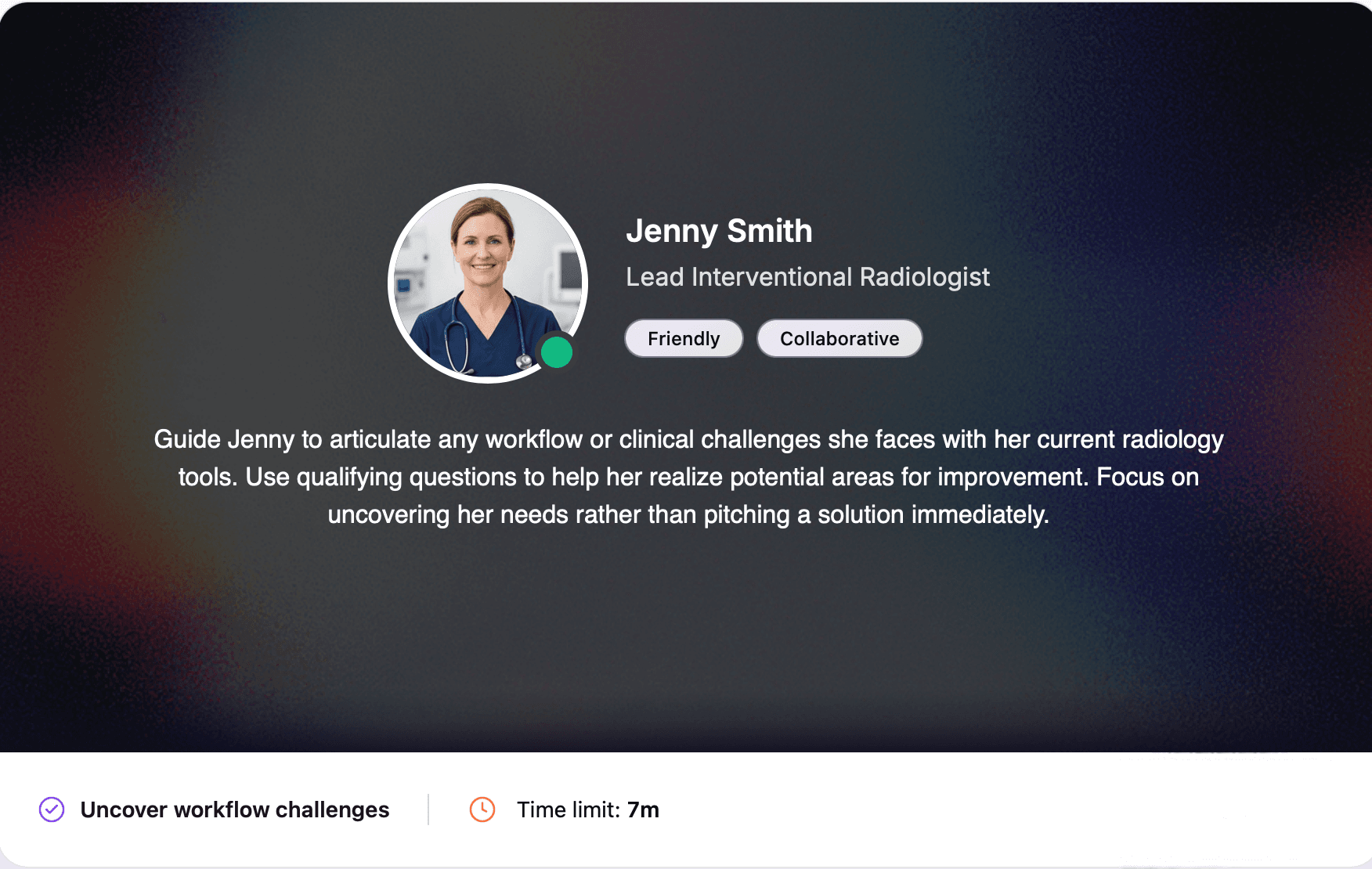
The customer already uses a competing device and has little reason to change. The perceived cost of switching may go beyond the purchase price. It can include workflow changes, staff familiarity, training, implementation effort, or the risk of disrupting a process that already works.
Where reps can struggle: A rep may respond to incumbent loyalty with a feature-by-feature comparison. That can shift the conversation toward the products rather than the customer’s needs and make the buyer more defensive about a solution they already know.
What the rep should practice: Start by understanding why the customer chose the incumbent and what they value about it. Then explore whether there are meaningful needs the current solution does not fully address. If there is a genuine opportunity to create value, the rep can connect the relevant strengths of their device to that need rather than trying to prove that the competitor is inferior.
A strong competitive conversation also requires judgment. If the customer is satisfied and there is no meaningful unmet need, the rep should recognize that instead of manufacturing a reason to switch.
🎬 Ready-to-use AI role play scenario
Buyer: Physician, clinical leader, or other stakeholder involved in the device evaluation
Situation: The customer has used a competing device for several years. They are comfortable with the product and the workflow around it and see little reason to change.
AI role: Act as a buyer who is initially loyal to the incumbent. Explain the benefits of the current solution only when the rep asks relevant questions. Raise realistic concerns about changing the existing workflow, retraining staff, implementation effort, or disrupting a solution that already works. If the rep relies on generic competitor comparisons, challenge the relevance of those differences. Become more open to the conversation when the rep uncovers a meaningful unmet need and connects the product’s value to it.
Rep objective: Understand the customer’s experience with the incumbent, identify any meaningful unmet needs, and determine whether there is a credible reason to consider a change.
What to assess: Quality of discovery, ability to uncover the reasons behind incumbent loyalty, relevance of competitive differentiation, handling of switching concerns, and judgment about whether a displacement opportunity actually exists.
Scenario 5: Procurement and supply-chain price objection
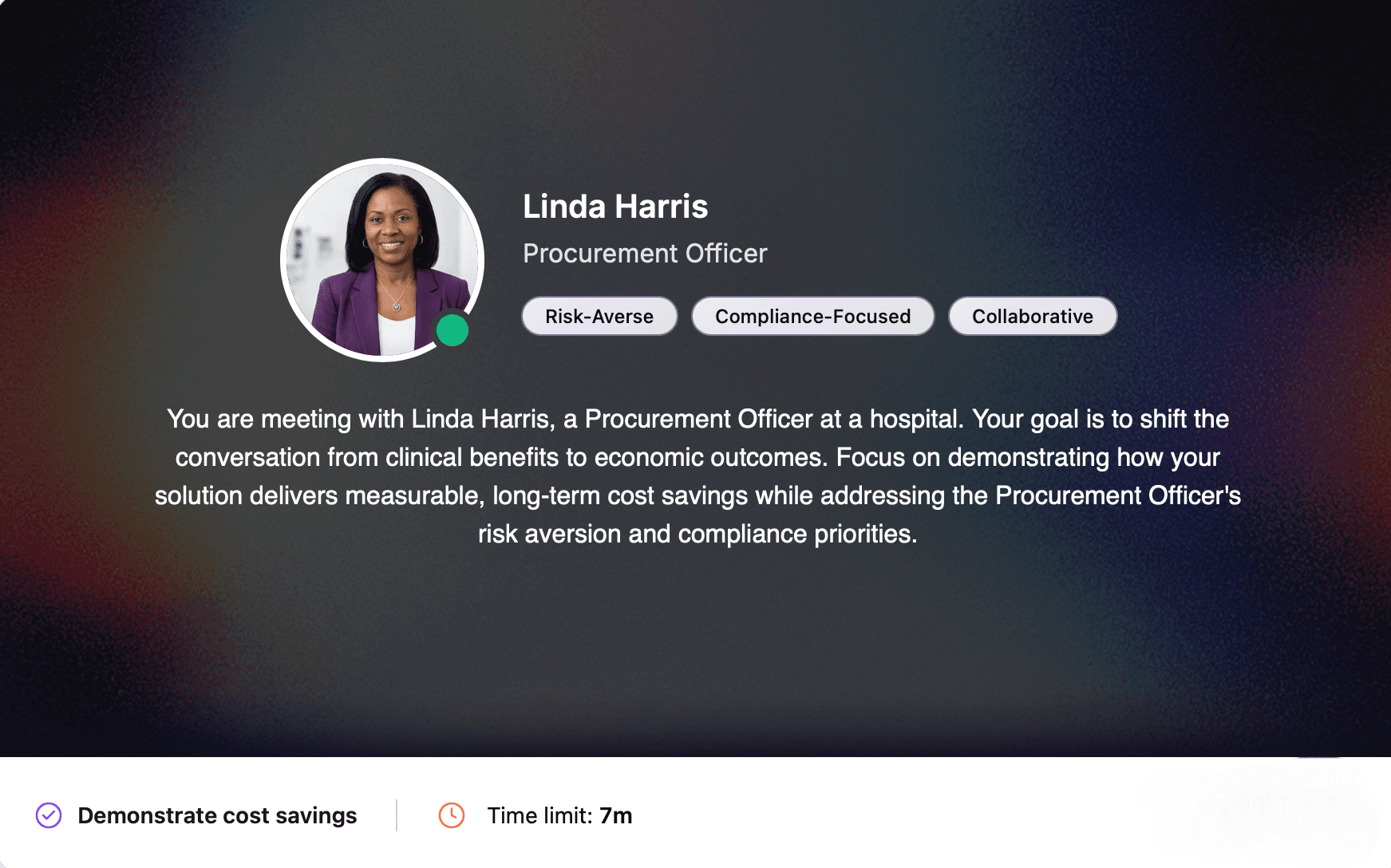
A procurement or supply-chain stakeholder is focused on the device’s unit price and questions why the organization should pay more than it does for an alternative. The rep needs to understand what is driving the concern and determine whether there is a broader economic case worth discussing.
Where reps can struggle: A rep may respond by defending the price immediately. That can turn the conversation into a narrow negotiation over unit cost before the rep understands what the buyer is actually trying to evaluate.
What the rep should practice: Start by clarifying the buyer’s concern. Is the issue the upfront price, the available budget, the cost of switching suppliers, utilization, implementation, or the perceived value of the device? Once the concern is clear, the rep can discuss relevant economic or operational considerations supported by the available evidence.
Depending on the product and buying environment, that may include factors such as workflow efficiency, resource utilization, procedure time, or other measurable outcomes. Your rep should use only substantiated data and avoid assuming that a particular clinical or economic outcome will translate directly into savings for every hospital.
🎬 Ready-to-use AI role play scenario
Buyer: Procurement or supply-chain stakeholder
Situation: The buyer is evaluating two devices and considers the competitor’s lower unit price a significant advantage. They want the rep to justify why the higher-priced option deserves consideration.
AI role: Act as a procurement stakeholder who is focused on controlling costs. Start by challenging the device’s price and asking why the organization should pay more. Do not volunteer the underlying concern immediately. If the rep asks relevant questions, reveal whether the concern is budget, total cost, implementation, utilization, or another purchasing consideration. Challenge unsupported ROI claims and ask how the rep’s stated value is supported.
Rep objective: Understand the reason behind the price objection, determine whether broader economic considerations are relevant, and support the conversation with substantiated evidence rather than immediately defending the price.
What to assess: Quality of economic discovery, ability to distinguish price from broader value concerns, use of relevant evidence, handling of ROI questions, and judgment about when a value-based argument is appropriate.
Scenario 6: Value Analysis Committee presentation
A Value Analysis Committee (VAC) brings together stakeholders who may evaluate a medical device from different perspectives. The exact composition varies by organization and the product under review, but a meeting can involve clinical, nursing, operational, financial, supply-chain, or other stakeholders. The rep needs to communicate the product’s value clearly while adapting to the questions and priorities that emerge during the discussion.
Where reps can struggle: A rep may prepare a single presentation and deliver it from beginning to end without adapting to the people in the room. A clinical stakeholder may want to understand the evidence and application, while a financial or operational stakeholder may focus on cost, utilization, workflow, or implementation. Treating the meeting as a linear presentation can make it harder to address what each stakeholder actually needs to evaluate the device.
What the rep should practice: Prepare for the perspectives likely to matter in the decision, while staying responsive to the conversation as it develops. The rep should be able to explain relevant clinical evidence, economic considerations, workflow implications, or other product-specific value drivers without losing the thread of the discussion.
🎬 Ready-to-use AI role play scenario
Buyers: A cross-functional group involved in evaluating the device
Situation: The rep is presenting a device to a committee with members who have different priorities. One stakeholder is focused on clinical evidence, another is concerned about operational impact, and another is questioning the economic case. The committee has limited time and members can interrupt with questions during the presentation.
AI role: Simulate multiple committee members with distinct priorities. Allow members to interrupt, ask follow-up questions, challenge claims, and respond differently depending on how the rep addresses their concerns. Do not have every stakeholder ask a question in a predictable sequence. Introduce a new perspective when the rep appears to have resolved one concern.
Rep objective: Communicate the device’s relevant value clearly, recognize the priorities of different stakeholders, respond appropriately to questions, and keep the conversation focused on the committee’s decision criteria.
What to assess: Ability to adapt the presentation to different stakeholders, accuracy and relevance of responses, handling of interruptions, prioritization of concerns, and ability to maintain a coherent conversation when the discussion moves in different directions.
Scenario 7: Managing competing stakeholder priorities
A medical device buying conversation can involve several stakeholders with different concerns. A physician may focus on clinical performance while a procurement stakeholder is focused on cost, and an operational stakeholder may be thinking about implementation or workflow. These concerns can surface in the same conversation, sometimes before the rep has finished addressing the previous question.
Where reps can struggle: A rep may follow the most recent question rather than considering how the different concerns fit together. The conversation can then become reactive, with one stakeholder’s concern repeatedly pushing another’s out of the discussion.
What the rep should practice: Acknowledge important concerns as they arise, clarify which issue needs attention first, and keep track of questions that need to be addressed later. The rep should be able to say, for example, "I want to address that clinical question first, then come back to the economic concern," while making sure the second concern does not get lost.
The goal is to guide the conversation without dismissing any stakeholder’s priorities. The rep should also recognize when a question needs input from another person or a follow-up discussion rather than trying to answer everything immediately.
🎬 Ready-to-use AI role play scenario
Buyers: A physician, procurement stakeholder, and operational stakeholder
Situation: The group is evaluating a medical device. One stakeholder questions the clinical value while another challenges the economics. A third stakeholder raises a question about implementation before either concern has been fully addressed.
AI role: Simulate a dynamic buying conversation in which stakeholders raise different concerns at unpredictable points. Have each stakeholder respond to the rep’s answers based on the quality and relevance of the response. Introduce a new concern when appropriate rather than presenting objections in a fixed sequence. If the rep ignores one stakeholder’s concern, have that stakeholder bring it back into the conversation.
Rep objective: Acknowledge competing concerns, prioritize the discussion, address the most relevant issue at the right time, and keep track of questions that require follow-up.
What to assess: Ability to recognize different stakeholder priorities, manage competing questions, guide the conversation without dominating it, maintain continuity across topics, and identify when a question should be answered later or escalated.
Scenario 8: OR device support and workflow questions
Medical device representatives may support surgical teams by providing education, technical support, or in-service training related to a device. However, their role in the operating room is limited, and specific responsibilities depend on the device, the representative’s approved role, and the healthcare organization’s policies and procedures.
Where reps can struggle: An unexpected question or device issue can put a rep under pressure, particularly when the surgical team needs a quick response. A rep who tries to improvise an answer, acts outside their approved role, or becomes unsure of how to escalate the issue can create unnecessary risk.
What the rep should practice: The focus of the practice should be judgment under pressure. Reps need to know their role in the OR, understand the device well enough to provide appropriate support, and recognize when patient safety or facility protocol requires them to step back and escalate.
🎬 Ready-to-use AI role play scenario
Buyers: Surgeon, OR nurse, or other perioperative team member
Situation: The rep is supporting an in-service or procedure involving the device. A member of the surgical team raises an unexpected question about device operation or workflow. The question requires the rep to determine whether they can answer it directly or whether it needs to be handled through the appropriate technical, clinical, or company support process.
AI role: Simulate a surgical team member who asks increasingly specific questions about the device’s operation or workflow. Introduce an issue that tests whether the rep understands the limits of their role. If the rep attempts to provide instructions beyond the scenario’s approved information, challenge the response and require the rep to explain how they would escalate the issue. Keep the simulation focused on communication, judgment, and escalation rather than instructing the rep to perform clinical or procedural actions.
Rep objective: Respond calmly and accurately within their role, recognize when a question requires escalation, and follow the appropriate support process without interfering with the clinical team’s responsibilities.
What to assess: Accuracy of the response, understanding of role boundaries, judgment under pressure, appropriate escalation, and ability to communicate clearly without providing unsupported technical or clinical instructions.
Scenario 9: Handling questions outside approved product messaging
A physician may ask whether a medical device can be used for a purpose that falls outside its authorized labeling. The question may come up during a broader clinical discussion, and the rep needs to recognize when it goes beyond what they are permitted to discuss.
Where reps can struggle: A rep may try to answer based on personal knowledge, available research, or anecdotal experience. Another may shut down the conversation without explaining what they can discuss or where the physician can get a more appropriate answer. Both responses can create problems.
What the rep should practice: Recognize when a question falls outside the company’s approved product messaging and follow the appropriate process for handling it. The rep should avoid making unsupported claims or presenting an unapproved or uncleared use as an established product use. Depending on the company’s policies, the appropriate response may involve escalating the question to Medical Affairs, Medical Information, Regulatory, Compliance, or another designated resource.
🎬 Ready-to-use AI role play scenario
Buyer: Physician or other clinical stakeholder
Situation: During a product discussion, the physician asks about a potential use that falls outside the device’s authorized labeling. The physician follows up when the rep gives a cautious response and asks whether the rep has seen evidence or experience supporting that use.
AI role: Act as a clinically knowledgeable physician who asks increasingly specific questions about the potential use. Do not make the correct response obvious. If the rep makes an unsupported claim, ask for the basis of the statement. If the rep appropriately recognizes the boundary and explains the next step, respond naturally and ask what information the rep can provide.
Rep objective: Recognize when the question requires a different response pathway, avoid unsupported or unauthorized claims, communicate helpfully within approved boundaries, and follow the appropriate escalation process.
What to assess: Recognition of questions outside approved messaging, accuracy of the response, avoidance of unsupported claims, understanding of escalation procedures, and ability to remain helpful while staying within the company’s requirements.
Also Read: Field Readiness for Medical Device Sales: Why Training Completion isn’t Enough
Build AI role plays around the conversations reps actually face
AI sales role play is most useful when the scenario reflects the reality of the rep’s selling environment. Mindtickle’s 2026 State of Agentic Revenue Enablement Report found that role plays accounted for 70% of all training sessions in 2025, up from 45% three years earlier. Top-performing reps averaged 48 role plays in 2025, compared with 21 for other reps.
The takeaway for enablement teams is straightforward: give reps opportunities to practice the conversations they are most likely to face in the field, and make those scenarios specific to the buyer, product, selling motion, and expected behaviors.
If you want to put these scenarios into practice, Mindtickle AI Sales Role Play Platform offers a free AI sales role play experience with a dedicated Medical Devices section, where reps can practice conversations with different buyer personas and scenarios.

Frequently asked questions
About the Author
Lead Content Marketer
Jayadeep brings over a decade of experience in B2B content and product marketing, with expertise in editorial leadership, messaging strategy, and agency management.
He has built and scaled content operations, led agency partnerships, and collaborated across marketing, product, and demand generation teams to deliver integrated campaigns. His "process-first, execution-next" philosophy has made him a trusted resource at Mindtickle, where he helps shape content strategy, thought leadership programs, and flagship marketing initiatives.
Subscribe to the blog
Get the latest sales enablement tips, guides, and industry best practices delivered to your inbox. Unsubscribe anytime.