




How to Reduce Rep Ramp Time With AI Sales Role Play



You can reduce rep ramp time with AI sales role play by giving reps access to unlimited practice without waiting on the manager. With AI sales role play tools, reps can practice pitches and objections on demand, get scored instantly, and fix mistakes before they cost a real deal.
A lot of the reason why rep ramp time stretches out comes down to how sales training works. A new hire sits through product training and maybe gets one mock pitch with their manager if the calendar allows it, and then they're on a real call with a real prospect.
There's no room in that process for a rep to get better at handling objections or running discovery before it counts.
Key takeaways
- Long ramp time is a capacity problem, not a talent or curriculum one. Reps ramp slowly because they don't get enough realistic practice before live conversations start counting, not because they were hired or trained badly.
- Measure ramp with the median, not the average. Define a ramped rep as one who sustains 80 to 90% of quota over two consecutive months, and measure from a consistent start point so cohorts are comparable.
- Ramp keeps getting harder because everything around the rep got harder. Products are more complex, buying committees are larger, and coaching thins as teams scale, so new hires clear a higher bar with less support.
How to calculate rep ramp-up time?
There's no single formula for ramp-up time. It depends on your sales cycle, your product's complexity, your hires' experience level, and whether you have historical data to work from yet. But there are a few ways to think through this.
Before you settle on any number, decide what you're measuring from. Ramp time is usually counted from a rep's start date, but some teams measure from the end of formal onboarding. Either can work, as long as you apply it consistently, since measuring different reps from different start points is the most common reason ramp numbers turn out unreliable.
Start with an estimate if you don't have data yet
Before you've onboarded enough reps to have real numbers, you need a placeholder to set expectations against. The simplest starting point is your sales cycle, extended by a buffer for the time it takes a rep to become credible in front of a buyer.
Estimated ramp time ≈ average sales cycle + onboarding buffer
Say your sales cycle runs 90 days. A rep needs to complete at least one full cycle to prove they can move a deal end to end, plus time before that to reach basic competence, so a 90-day cycle with a two-to-three month buffer lands you somewhere around six months as a rough working estimate. Treat this as directional. Reps usually start prospecting during sales onboarding, so the buffer and the cycle overlap rather than stack cleanly, which means the real number often comes in below the sum.
Size the buffer to what you're actually selling rather than to the cycle length. A commodity product might need only a few weeks before a rep is effective. Complex enterprise technology, with a deeper product and a larger stack to master, can take two to three quarters before a rep is fully credible and consistently productive.
Switch to actual data once you have a few cohorts
Estimates are useful early, but they're still guesses. Once you've ramped a handful of reps, move to the number that reflects your actual team.
Actual ramp time = median time to sustained 80 to 90% quota attainment, per cohort
A reasonable definition of a fully ramped rep is one who reaches 80 to 90% of full quota and sustains it across two consecutive months, rather than clearing the bar in a single strong month.
Requiring two consecutive months confirms the performance is repeatable rather than the result of one large deal closing or a favorable stretch, and setting the bar below 100% keeps the definition realistic, since early-tenure reps often carry a ramped quota or a partial territory that makes full attainment an unfair test.
Use the median across the cohort rather than the average, because one unusually fast or slow ramper will skew an average and misrepresent what's typical for your team.
⚖️ Time for a reality check
This median only holds up if conditions stay roughly comparable across cohorts. If your last cohort had better lead quality, smaller territories, or ramped during a stronger selling season, their numbers won't be a fair baseline for reps ramping now. Recalculate the baseline as those conditions shift, and compare cohorts with that context in view, rather than treating one cohort's median as a fixed target.
Track the curve, not just the finish line
Ramp isn't usually a clean switch from zero to full quota. Most teams see productivity build gradually, sometimes with plateaus along the way, rather than turning on all at once. Mapping that curve gives you a far more useful picture than a single end date, because it shows you where a rep is falling behind, not just that they are.
Leading milestones help here too. Track markers like first meeting booked or first closed deal alongside the quota curve, so you can catch a struggling rep in week three instead of finding out at the three-month mark.
Adjust for the variables the formula can't capture
Two reps who start on the same day can still ramp at very different speeds. A few things that explain why:
- Rep experience. A new hire with zero industry background typically needs more time than the estimate suggests. Someone poached from a competitor may ramp faster. Read: Comprehensive Guide to Ideal Rep Profile (IRP) in Sales
- Enablement support. The quality of manager coaching, the tools reps have access to, and how much real practice they get before going live all change how fast the math plays out.
Use the formulas as your starting benchmark, then adjust based on what you sell, who you're hiring, and how well they're supported once they're in the door.
➕Bonus Read: The Metrics for Measuring Your Sales Enablement Program
Why rep ramp time is long even in 2026
Reps today have more content, tooling, and AI assistance than any cohort before them. The catch is that so do buyers, and so does everyone else in the process, which is why ramp time hasn't shortened the way all that investment would suggest.
Products have grown more complex, with deeper feature sets, more integrations, and more technical validation involved, so a rep has to master more before they sound credible in front of a buyer. Buyers, meanwhile, arrive further into their own research and bring more stakeholders into the decision. Gartner's widely cited research on the B2B buying journey puts a typical committee for a complex solution at six to 10 decision-makers, each arriving with four or five pieces of independently gathered information, which means a rep now has to win over a whole buying group rather than a single contact, often people they never speak to directly. Both shifts raise the bar a new rep has to clear before they can carry a deal on their own.
Sales coaching hasn't kept pace either. As teams scale, the ratio of reps to experienced managers widens, so each new hire tends to get less direct coaching than the cohort before them did. Tool overload lands hardest on these same new hires, because they're learning which system does what at the same time as they're learning the product, the process, and the market, and the load compounds rather than adding up neatly.
💡It shows up in the numbers too
The average rep uses 8 to 10 tools a day, and half feel overwhelmed by it. Overwhelmed reps are 45% less likely to hit quota. Every switch between systems pulls focus away from the conversation in front of them.
Source: Mindtickle's 2026 State of Agentic Revenue Enablement Report
Is long ramp time a hiring or training problem?
Usually neither, at least not in the way teams assume. You can hire a rep with strong instincts and run them through a solid onboarding program, and still watch them take months to ramp, because the real bottleneck isn't aptitude or curriculum. It's capacity: how many realistic practice conversations a new hire can get before they go customer-facing.
Most new hires move through sales onboarding, get one shadowed call and one mock pitch, and are then pointed straight at a real buyer. Manager-led role play doesn't scale past a handful of sessions a week, so for many reps that's the entire amount of live practice they get before the conversations start counting.
Also Read: Sales Onboarding: 6 Tips to Help You Ramp Up Your Sales Reps and Accelerate Revenue
How AI sales role play reduces ramp-up time
AI sales role play doesn't replace onboarding, but it fixes the part that's broken: how much a new hire actually gets to practice before facing a real buyer.
Gives reps unlimited, low-risk practice
New hires can run role play scenarios as many times as they need, whenever they have time, without waiting on a manager's calendar. And because they're practicing against an AI buyer instead of a real prospect, a fumbled cold call or a blown discovery question costs nothing.
This gives reps the confidence to experiment with closing techniques or objection-handling frameworks in a zero-risk environment. Fumbling a pricing negotiation in simulation becomes a learning opportunity. This sense of safety encourages reps to attempt advanced techniques earlier.
Closes the feedback loop instantly
Traditional sales training means waiting days for a manager to review a call recording. AI sales role play scores the attempt the moment it ends, on talk-to-listen ratio, discovery quality, objection handling, and lets the rep retry immediately while it's still fresh.
It also removes the subjective bias that comes with different managers grading differently. Everyone practices against the same scenarios and the same rubric, so how well someone ramps stops depending on which manager they happened to get, or how that manager happened to feel about a given call.
Trains reps for unexpected situations they might run into
AI sales role play can simulate specific buyer personas, industries, and objection styles, giving new hires a range of tough conversations they'd normally only encounter live, deal by deal, over their first several months. And because the AI is doing the repetitive early-stage drilling, managers get that time back to spend on the higher-value sales coaching only a human can give, which speeds up the whole cohort, not just one rep.
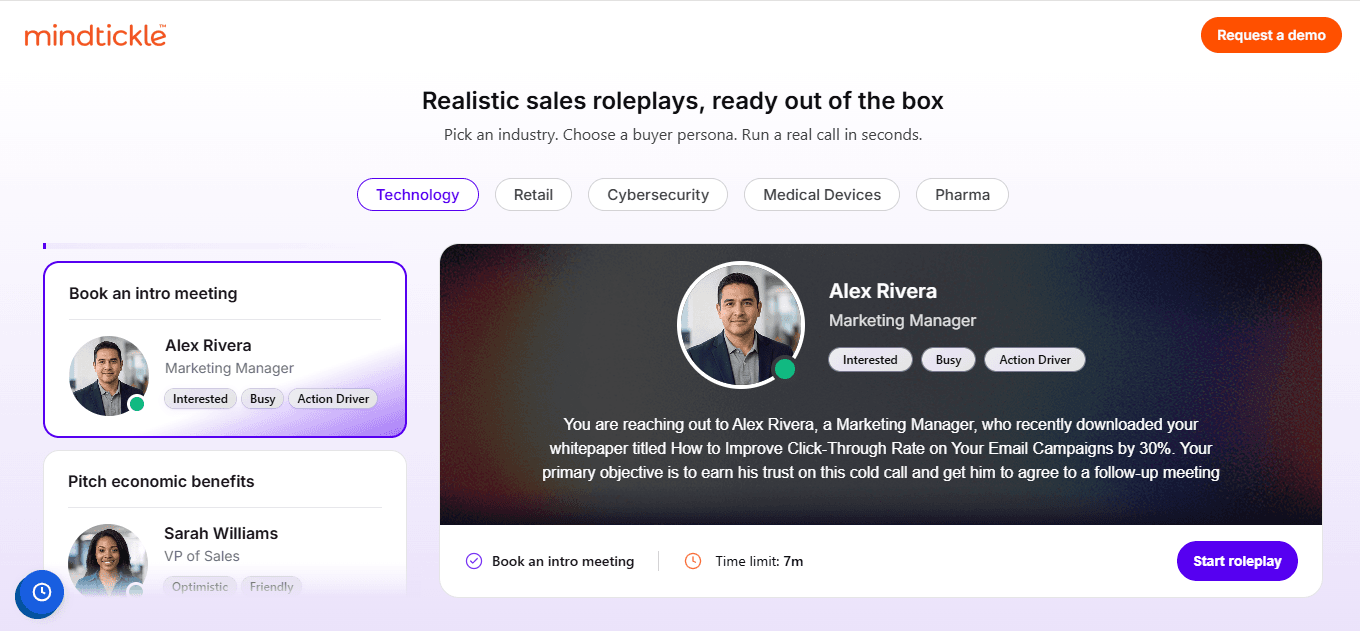
🎯 Try a 7-minute AI sales role play, free
Pick your industry and buyer persona, then hit start. Mindtickle's free AI sales role play lets you run your chosen scenario against a live AI buyer and get instant feedback on how you did, in about seven minutes.
Try AI Sales Role Play Now
What a faster ramp looks like in the real world
The gains show up differently depending on the team and the situation. These two examples show what's actually possible.
How Janssen India cut rep ramp time by 50%
Janssen India, the pharmaceutical company of Johnson & Johnson, runs a 600+ person sales force in a complex, highly regulated market. Before Mindtickle, rep training happened face-to-face or over video calls, with learning materials spread across multiple teams. Newer reps struggled to find what they needed, while attrition among content owners could disrupt training schedules and materials.
Janssen consolidated onboarding, training, assessments, and coaching on Mindtickle, giving sellers a single place to access learning. After launching its Nirmaan Academy onboarding program on the platform, Janssen cut rep ramp time by 50%.
Janssen also analyzed how more than 500 sellers engaged with learning over three years. Video role plays had the highest reattempt rate, with 71% of learners returning to practice at least once, compared with 39% for content with a quiz and 12% for content without either. Janssen responded by incorporating more role plays and quizzes into its learning programs.
The takeaway for enablement leaders is practical. When practice is built into the learning experience, teams can create more opportunities for reps to revisit and reinforce skills rather than relying on a single training event.
How Qlik scaled practice across a global sales team
Qlik, a data integration and analytics software company with a globally distributed sales force, had onboarding and certification programs in place but limited visibility into whether sellers could actually handle objections in a live conversation. Managers didn't have time to review every practice session, so practice was capped by their availability, the same capacity ceiling that slows most teams down.
Qlik introduced Mindtickle's AI role plays to give every seller a way to practice realistic customer conversations on demand, in their own language, before facing a live buyer. Adoption grew into a regular part of the workflow: more than 9,000 AI role plays completed across 860 go-to-market professionals. Because Copilot reviewed over 3,000 of those sessions automatically, managers saved roughly 850 hours of review time and could spend it on the coaching that needed a human. The result was more practice per rep, delivered consistently across regions, without adding manager hours.
What High-Performing Revenue Teams Get Right About AI Role Play
Faster ramp comes down to practice capacity
Long ramp time usually isn't a talent or curriculum problem. It's a capacity problem: the gap between how much realistic practice a new rep needs and how little they get before real conversations start counting. Product complexity, harder buyers, and thinner coaching only widen it. The teams that ramp faster are the ones that close it by making practice something reps can do repeatedly and on their own schedule instead of waiting on a manager's calendar or the right live deal.
That's what Mindtickle's AI Sales Role Play is built around. Reps rehearse real scenarios against an adaptive AI buyer, practice as many times as they need, and get objective feedback before the conversation is live, and managers get an early read on who's ready. Janssen's results point the same way: more repetitions, especially interactive ones, move a rep to proficiency faster.
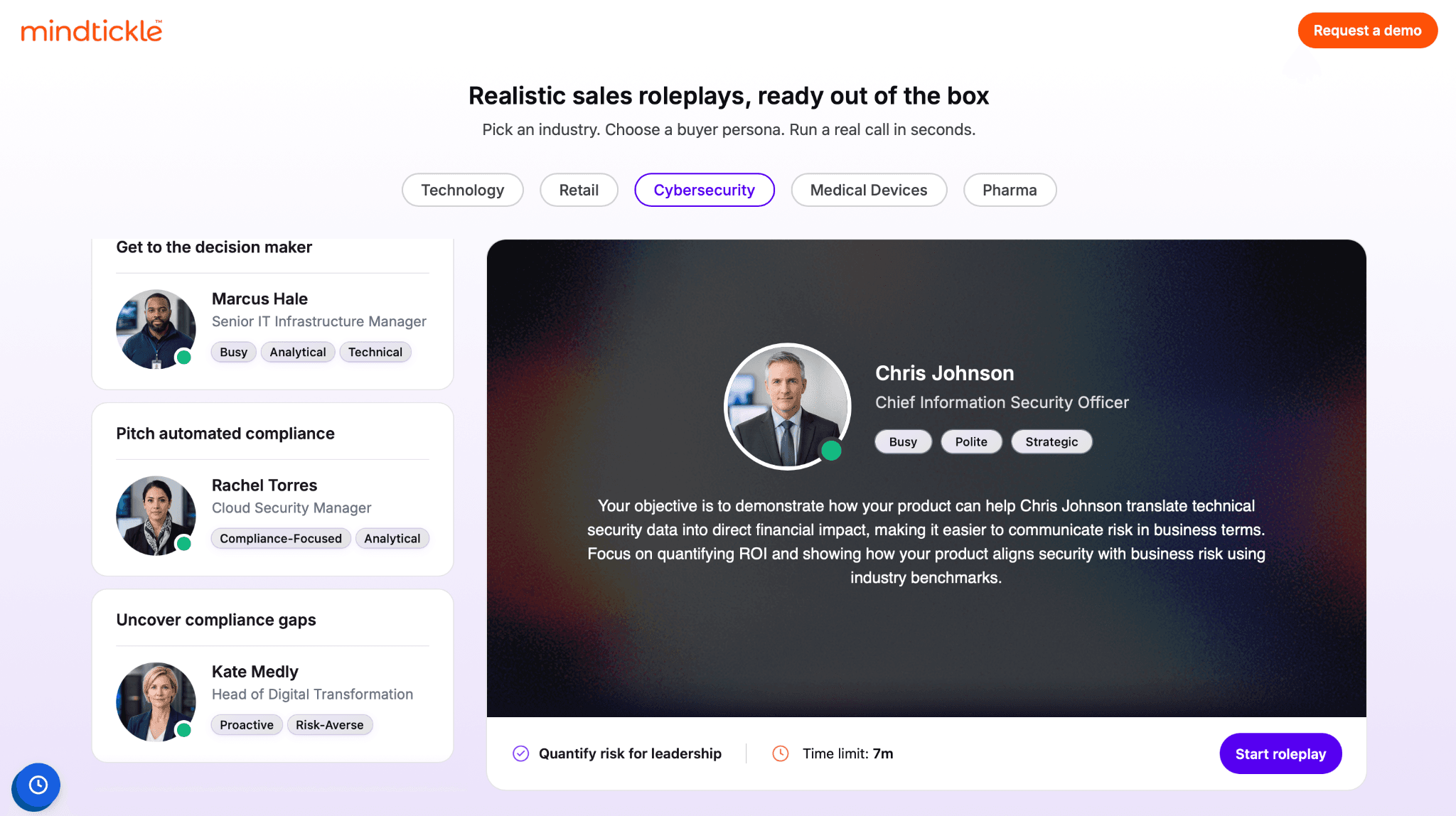
The quickest way to judge whether it fits your team is to run a scenario yourself. Mindtickle's free 7-min AI sales role play lets you pick your industry and buyer persona, work through a live conversation, and get instant feedback, which tells you more than any description on a page.
Frequently Asked Questions (FAQs)
About the Author
Lead Content Marketer
Jayadeep brings over a decade of experience in B2B content and product marketing, with expertise in editorial leadership, messaging strategy, and agency management.
He has built and scaled content operations, led agency partnerships, and collaborated across marketing, product, and demand generation teams to deliver integrated campaigns. His "process-first, execution-next" philosophy has made him a trusted resource at Mindtickle, where he helps shape content strategy, thought leadership programs, and flagship marketing initiatives.
Subscribe to the blog
Get the latest sales enablement tips, guides, and industry best practices delivered to your inbox. Unsubscribe anytime.