




How to Train Sales Reps Against Competitors: A Playbook for When a New Rival Enters Your Market



Consider the forecast call that is going well until the CEO asks:
“What are we doing about [the new competitor]?”
The competitor is no longer hypothetical. They raised a large round two quarters ago, are undercutting you on price, and have now appeared in three of your top deals. You lost all three.
The response is predictable. The enablement team is building a battlecard. The room nods, and the conversation moves on.
But this is exactly where competitive training gets tested, and where many programs fall short.
Most competitive enablement programs focus on giving reps information, from competitor profiles and feature comparisons to objection handling, trap questions, and positioning guidance. That content has value. But information alone does not prepare a rep for the moment a buyer says, “We’re also evaluating [rival].”
Now the rep has to assess what the competitor’s presence means for the deal, respond without becoming defensive, differentiate your solution around the buyer’s priorities, and keep the conversation moving, all in real time.
Preparing reps to compete against a new entrant therefore requires more than distributing competitive content. It requires practice built around the situations they are likely to encounter in the field.
What actually breaks when a new competitor lands
A new entrant does something more disruptive than adding another logo to the evaluation. It resets the buyer's decision criteria. When a funded rival shows up with a sharp message, buyers start asking questions they weren't asking before, and your reps get graded against a scorecard they didn't write. This is a messaging problem long before it's a feature problem, and reps who try to win it on a feature-by-feature comparison usually lose.
Here's the harder truth about why the battlecard approach fails. Recall decays fast when nothing reinforces it. The forgetting curve Hermann Ebbinghaus first mapped in the 1880s still holds up: people lose most of what they learn once and never revisit, and how much they keep comes down almost entirely to whether they practice it. A one-time battlecard rollout is a single exposure. By the time the rep needs it on a live call, most of it is gone.
Now layer in how little room the rep has to recover. Gartner's research on the B2B buying journey found that buyers spend only about 17% of their time meeting with all potential suppliers combined, and just 5% or so with any single rep. That sliver is shrinking, not growing.
In another 2026 survey, Gartner revealed that 67% of B2B buyers said they prefer a rep-free buying experience. Your rep gets a narrow window, and in that window, the competitor's name comes up once, maybe twice. There's no time to open a tab. Whatever the rep says in the next 20-30 seconds is the whole competitive program, delivered live.
So the real target is a trained response the rep can fire cold, in their own voice, the instant a rival gets mentioned. A better document won't produce that. This is a coaching and drilling problem, built the same way you build objection handling.
Now, here is how to go about it.
Start with your own lost-deal calls, before writing a single battlecard
The best competitive intelligence is already in your call recordings. Before anyone drafts positioning, pull the calls from the deals you lost to this rival and listen. Not the summaries, but the actual audio.
You're listening for four things.
- The exact words the buyer used to describe why the competitor appealed to them.
- The moment in the call where your rep's momentum broke.
- What the rep said in response, and whether it landed.
- And the question you wish the rep had asked but didn't.
This is where conversation intelligence earns its keep. A good conversation intelligence software lets you filter for calls where a competitor came up and see how those deals actually progressed, so you're working from what buyers really said rather than what your product marketing thinks the buyer cares about. If you don't have that tooling yet, three manual call reviews will still tell you more than a week of internal positioning debate.
What you'll usually find is that the deals didn't turn on a feature. They turned on a framing. The buyer came to believe one thing mattered most, and the rival owned it. Your rep never contested the premise. That framing is what you're going to train against.
Turn feature comparisons into questions that set traps
Feature grids lose competitive deals. The instant your rep starts listing what you do that the other guy doesn't, the conversation becomes a checklist, and checklists reward the cheaper option.
So instead of arming reps with "we have X and they don't," you arm them with questions that surface the rival's weak spot in the buyer's own words. A good trap question plants a criterion the buyer hadn't weighted, and it does so without ever naming the competitor. Then it gets the buyer to say the concern out loud themselves, which lands far harder than your rep saying it.
Here's what that looks like against a lower-priced, newer entrant. The generic move is to say "they're cheaper because they cut corners on support."
Weak and defensive, and the buyer discounts it because you're the incumbent trash-talking. The trained move is a question: "When you've rolled out tools from earlier-stage vendors before, how did the support hold up once you were past onboarding and into a real production issue?" Same point. The buyer arrives at it themselves.
Write three to five of these for the specific rival, phrased in plain rep language, and pressure-test each one against a simple bar: could the buyer answer it in a way that helps the competitor? If yes, you've handed the competitor a gift. Rewrite it.
Drill competitive moments the way you drill objection handling
A trap question the rep reads once is worthless. A trap question the rep has said out loud eight times, in slightly different conversations, becomes automatic. Reps handle pricing objections smoothly because they've said the same few lines a hundred times, and competitive recall gets built the exact same way.
Run it as live-fire role play, short and frequent. A manager or a peer plays the buyer and drops the competitor's name at a realistic point in a mock call. The rep has to run the play in real time, no notes. The group watches, then someone replays it with a sharper question. 15 minutes once a week beats a two-hour competitive kickoff that nobody remembers by Thursday.
Mindtickle’s take
There's a ceiling on the manual version, and it's the manager. One person can run a 15-minute drill with the team once a week, but they can't sit with every rep every day, and the reps who most need the practice are usually the ones who get the least manager time.
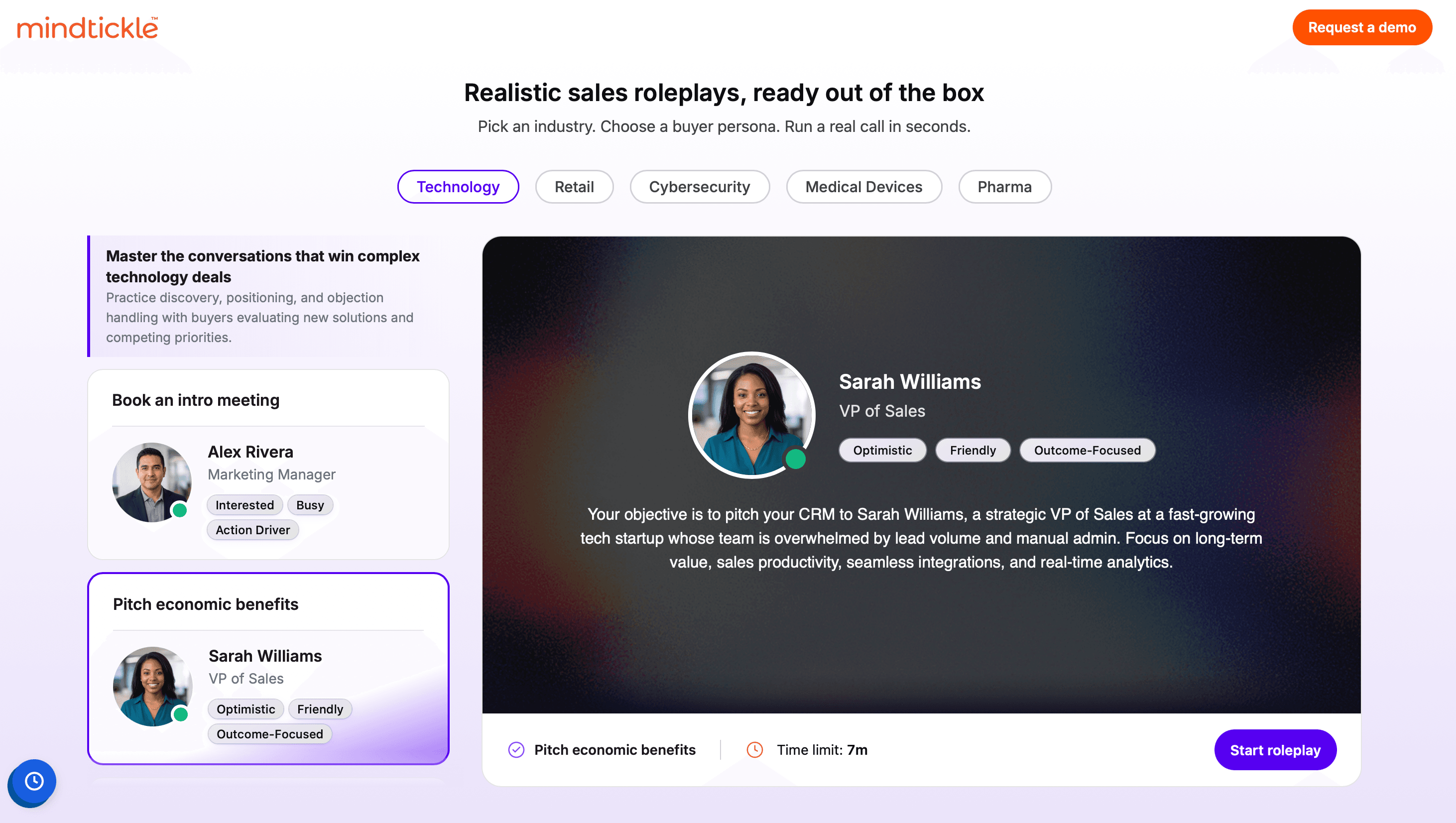
AI Sales Role Play changes that math. Mindtickle's AI Sales Role Play lets a rep practice the competitive scenario against a dynamic AI buyer as often as they want and get instant feedback on what landed, without booking their manager, while you review the whole team's attempts instead of the three you happened to sit in on.
It runs competitive-differentiation scenarios specifically, so the rep is rehearsing the exact moment this playbook is about. You can try it free and put a rep through their first competitive rep before the next forecast call.
Keep the intel alive with a weekly field refresh
Competitive intel has a shelf life measured in weeks when a rival is moving fast. Their pricing shifts and their pitch changes, and your six-week-old battlecard now teaches reps to fight a competitor that no longer exists in that form.
Build a standing 15-minute slot into your existing team cadence where competitive learning flows back up from the field. What is the rival saying on calls this week? Which trap questions are landing, and which ones are falling flat? One person owns capturing what's new, including any fresh claim a prospect keeps repeating, and the winning moves get folded into next week's drill.
This closes the loop. The field surfaces what's real and you drill against it, and each week's drill sharpens what the field does next. The battlecard, if you keep one at all, becomes a running log of that loop rather than a document that ages the moment it's published.
Where that breaks, and what to do about it
Many of them, you must have heard or experienced often. Take a look.
- "My managers don't have time to run weekly drills."
They have time for a 15-minute segment inside a meeting that already exists. The failure mode is treating the drill as a separate event that needs its own calendar hold. Time was never the real blocker. Bolt it onto the weekly team call or the existing deal review and it survives. Stand it up as a new recurring meeting and it dies in a month.
- "We tried competitive training and reps didn't adopt it."
They almost certainly adopted the framing they built themselves and ignored the content handed down from marketing. This is the whole reason step one is mining your reps' own calls. When the trap questions come out of language your reps have already heard buyers use, adoption stops being a compliance problem, because the reps recognize it as theirs.
- "The rival keeps changing their pitch."
Good, that's why the refresh loop exists. A static program can't survive a moving competitor. A weekly field refresh can, because it's designed to move at the same speed the rival does.
- "Leadership wants a number by Friday."
Reasonable. Track competitive win rate against this specific rival as your headline metric, and pull it straight from your CRM's competitor field and your call platform. Set the baseline now, before the sales training, so you can show the delta. If reps aren't logging the competitor on the opportunity, fix that first, because you can't manage what you can't see.
📌 Three trap questions for a funded, lower-priced new entrant
- On durability of support: "When you've brought in newer vendors before, how did their support and roadmap hold up once you were a year in and past the honeymoon?"
- On hidden switching cost: "If you needed [critical integration or workflow] to work on day one, how would you verify a newer platform can actually deliver that at your scale before you commit?"
- On the real cost of cheap: "When you've chosen the lower-priced option in the past, where did the true cost show up later, and how are you pressure-testing for that here?"
The 20-minute competitive drill you can run this week
A manager can run this in any existing team meeting. No prep deck required.
- Minutes 0 to 3: Manager sets the scene. "You're deep in a real deal. The buyer just said they're also evaluating [rival]." Name the actual competitor.
- Minutes 3 to 10: Two reps role-play live. One plays the buyer and drops the rival's name naturally mid-conversation. The other has to respond with a trap question, cold, no notes. Then swap.
- Minutes 10 to 15: Group reacts. What framing did the rep concede? Which question would have made the buyer do the work? Replay the same moment with a sharper question.
- Minutes 15 to 20: Lock in the one best question from the room. Everyone writes it in their own words. That becomes the line they take into their next real call.
Run it weekly against the same rival until the response is automatic, then move to the next competitor.
The Shift: The value of role play comes down to what you practice
According to State of Agentic Revenue Enablement 2026, role plays now account for 70% of all programs, up from 45% three years ago. But more practice only helps when the scenarios reflect the situations reps actually encounter. The strongest programs use role play to rehearse specific competitive moments and close specific skill gaps, giving reps a chance to practice before those moments happen in a live deal.
Try a competitive drill with Mindtickle AI role play tool now!
The call-review filter that finds your losses
To feed the loop, review these calls each week:
- Deals marked closed-lost in the last 30 days where the competitor field names the rival.
- Open deals where a rep flagged the rival, so you can coach before the loss instead of after.
- Any call where the buyer, not the rep, introduced a new competitive claim.
Pull three and listen for the framing that broke the deal, then bring the sharpest example into the drill.
The one move to make this week
Don't commission a battlecard. Pull three lost calls from the deals this competitor took from you, and listen to how the buyer described why the rival appealed. That single hour will tell you what to drill, and it will tell you it in your buyers' own words, which is the only vocabulary your reps will actually use under pressure.
From there the sequence is simple. Write the trap questions from what you heard, then drill them live for 15 minutes a week and refresh from the field as the rival moves. The teams that win against a new entrant have reps who can run the play cold, without looking at anything. The card is beside the point.
If you want that recall to stick across a whole team, the answer is building reinforcement and live practice into your enablement motion instead of relying on one-time rollouts. That is where a platform like Mindtickle fits. Its conversation intelligence surfaces the competitor mentions buried in your call recordings, and its AI Sales Role Play lets reps drill the response until it holds up under pressure. The tool matters less than the habit. Build the habit first.
Frequently asked questions
Subscribe to the blog
Get the latest sales enablement tips, guides, and industry best practices delivered to your inbox. Unsubscribe anytime.