




How to Choose the Right AI Role Play Platform for Sales Tech Consolidation in 2026



Choose an AI role play platform that gives reps realistic practice scored against your sales methodology, then sends each result into coaching and readiness reporting. A platform that does both can replace tools you already run instead of adding a new one. Before you sign, run a pilot that follows one skill from practice to a live call.
As AI reshapes revenue enablement, RevOps and enablement leaders have many new tools to consider, and most of them come with their own app and login. AI role play is a valuable addition to the stack because it gives reps a place to sharpen their skills before real calls. But adding it as a separate tool means one more thing for reps to open and one more system for enablement to manage.
That's why choosing a role play platform is also a good moment to think about consolidation. The right platform keeps practice connected to the rest of your readiness work, and it can take the place of a few tools along the way.
Key takeaways
- Separate tools keep practice data apart from everything else. Each one brings its own login, data, and upkeep, which makes it harder for reps to build a practice habit and for leaders to see who's ready.
- A standalone tool still suits focused needs. It works well for a narrow or short-term goal, like one team building one skill, while consolidation makes sense once role play needs to connect with training, coaching, certification, or conversation intelligence.
- A unified platform links practice to live calls. A skill gap moves from practice to coaching to real conversations in one workflow, and shared data shows whether practice is changing how reps perform with buyers.
- Consolidating doesn't mean weaker role play. On a platform where role play is a core product, reps still practice against adaptive AI buyers, get scored against your own methodology, and work through scenarios built from your own content.
- A pilot shows whether the platform connects the way it claims. Pick one skill your team is working on and follow it from a practice session to the manager's coaching view to a live call, using your own content along the way.
What breaks when role play data lives outside your enablement stack?
Role play can be excellent on its own and still deliver only part of its value when its results stay in a separate tool. Once practice sits on the same platform as training and call analysis, each session feeds the rest of the program, and the benefits grow as more teams join in.
Practice scores never reach coaching
In a standalone tool, a rep's progress in practice usually stays with the rep. On a connected platform, when a rep works through a discovery scenario and improves on the points the AI flagged, that progress appears right in the manager's coaching view. The next one-on-one can pick up from what the rep has been practicing, which makes every coaching conversation more focused. It's a simple shift that helps teams get more from AI coaching. Read: 4 Common AI Sales Coaching Mistakes to Avoid in 2026
No one can tell whether practice shows up on live calls
When role play and call analysis run in separate tools, each one scores skills its own way, and connecting the two takes extra work. With role play and conversation intelligence on one platform, both score the same skills against the same rubric. So when a rep sharpens how they handle a pricing question in practice, you can watch that improvement show up in their real conversations with buyers. Enablement can then report on growth in skills, rather than only on how many sessions were completed.
Scenarios drift out of sync with approved content
Messaging moves quickly as new products launch and pricing evolves, and a separate role play tool needs its scenarios updated by hand each time. When role play draws from the same content library reps use in their deals, every content update reaches the scenarios as well. Reps always rehearse the current pitch, which is the whole idea behind moving from generic scenarios to contextual practice.
Readiness reporting becomes a spreadsheet exercise
Across separate tools, answering who's ready for a launch means pulling exports together by hand. On one platform, the answer is already waiting. Practice scores sit alongside learning progress and call performance, so enablement can share a clear picture in minutes and spend its time acting on it.
Reps skip practice that lives behind another login
Reps usually prepare for calls in short windows between meetings, often from their phones, and a separate app is easy to set aside in those moments. When role play lives in the same app where they already find content and training, practicing becomes an easy, natural step in getting ready for the next conversation.
💡 Fewer tools, more focus
Reps use eight to 10 tools a day, according to Mindtickle's 2026 State of Agentic Revenue Enablement Report. The same report found that reps who feel overwhelmed by their tech stack are 45% less likely to hit quota. Bringing practice into the platform reps already use gives them more of their day back for selling.
Every tool adds another security review
Role play sessions capture how your reps sell, and custom personas often include details about your accounts, so each separate vendor goes through its own review. On one platform, your security team reviews a single data policy and a single approach to AI governance. That keeps things simple for regulated teams and helps every rollout that follows move faster.
📖 Read more: AI Sales Role Play: 2026 Guide for Enablement Leaders
When should you consolidate, and when does a point solution still make sense?
Both approaches have their place. The right choice depends on how far you'd like practice to reach once a rep finishes a session.
A point solution fits narrow, contained needs
A standalone tool can be a great fit when one team wants to build one skill, like an SDR team polishing its cold call openers. It also works well for a short pilot to see how reps take to AI practice, or for a team that's happy to keep practice separate from coaching and certification for now.
Consolidation fits when practice has to connect to everything else
The picture shifts as more teams, regions, and partners come on board. Certification programs call for practice scores to feed a formal readiness record, and managers want those scores right inside their coaching workflow. Over time, leadership also looks for clear evidence that practice is shaping how deals go. A unified platform handles all of this naturally, since every result already lives in one place.
📖 Read next: Best AI Sales Role Play Tools in 2026: Buyer’s Guide
Here's how the two approaches compare side by side.
| Point solution | Unified platform | |
|---|---|---|
| Getting started | Quick to launch when you're focused on one team and one skill. | Takes a little more setup at first, and each new team launches faster after that. |
| Role play depth | Often deep in the specific skill it was built for. | Just as deep when role play is a core product on the platform. |
| Connection to coaching and call reviews | Usually relies on integrations or exported reports. | Practice scores flow into coaching and call reviews on their own. |
| Day-to-day admin | Each tool keeps its own scenarios, content, and rubrics. | One content library and one rubric serve every team. |
| Readiness reporting | Pulled together from each tool whenever leaders ask. | Ready in a single view whenever leaders need it. |
| Security and AI reviews | Each vendor goes through its own review. | One review covers practice, content, and coaching together. |
| Cost as you grow | Grows as new tools are added for new needs. | Stays within one contract as the program expands. |
➕ Bonus read: Are You Outgrowing Your Enablement Platform? 4 Signs It's Time to Switch
🌟 How Radware brought enablement under one roof
Radware is a global cybersecurity company with 1,200 employees across 23 regions, selling to seasoned IT buyers who expect reps to know the latest threats. As the company grew, its teams came to rely on different tools, and onboarding often ran past six months.
It brought its enablement together on Mindtickle, where AI-powered search became one of the most used tools. With the AI Sales Role Play platform, reps now prepare for tough conversations whenever they want, without switching platforms.
Daniel Lewenhoff, Sales Enablement Expert at Radware, says:
“We went from a six to 12-month ramp time to just one to three months. Now onboarding is structured, consistent and can scale across roles, regions and languages. New hires can easily find what they need and get up and running quickly.”
What should a consolidated platform replace, and what should it connect to?
A clear line between what moves onto the platform and what stays put makes consolidation smooth for everyone. The systems your business relies on stay in place, and the enablement work comes together around them.
The enablement work worth running in one place
Start with the work that shapes how ready a rep is, from onboarding and training through to practice, coaching, and call reviews. These activities share the same data and tend to change together. When a new product launches, the content, training, and scenarios all need to reflect it, and on one platform a single update carries through to each of them. Read: The Magic of Bringing Your Tech Stack Under One Roof
The systems it should connect to, not replace
Your CRM remains the home of every deal, and your meeting tools stay where calls happen. A strong sales enablement platform connects to both, so practice can be assigned based on what's happening in live deals, and insights from calls can flow back into coaching. Some larger companies also keep an existing LMS for company-wide courses, and a platform that connects to it lets those programs carry on just as they are.
➕ Bonus read: How to Build a Sales Tech Stack That Works Together
Does consolidating mean settling for weaker role play?
A well-chosen platform can offer role play that holds its own, and the clearest way to judge it is in two parts. Start by looking at the role play on its own merits, and then look at what the platform does with each result. A platform worth building around shines in both.
AI buyers adapt to what the rep actually says
A realistic AI buyer reacts to each answer as the conversation unfolds. When the rep addresses a concern well, the buyer warms up and moves the conversation forward, much like a real prospect would. In a demo, try a few different answers to the same question and see how the buyer's responses change. It's a quick way to see what makes AI sales role play hyper-realistic.
Scoring follows your rubric and methodology, not a generic one
Look for scoring built around the framework your team already sells with, whether that's MEDDIC, MEDDPICC, SPIN, or one of your own. Good scoring looks at what the rep covered, such as whether they qualified the opportunity, and at how they came across, such as how much they listened. That way, practice reinforces the same standard reps are measured against in real deals.
💡 Practice adds up on live calls
Reps who completed 10 or more role plays in a year scored 61% on real calls, compared with 57% for reps who did fewer, according to Mindtickle's 2026 State of Agentic Revenue Enablement Report. A connected platform lets you spot that same pattern in your own team's data.
Admins build scenarios from their own content in minutes
On a consolidated platform, admins can create a scenario from a prompt, an uploaded playbook, or a real call recording, using content that already lives on the platform. New products and competitive updates can become practice the same day, which keeps reps current and frees the enablement team to focus on bigger programs.
A weak spot in practice triggers targeted coaching
When a rep submits a role play, the AI scores it within minutes and the result goes straight to their manager. If a rep is still building confidence with pricing questions, the manager sees that skill highlighted and can open the next one-on-one right there. Managers can grow their own coaching skills the same way, as this look at AI role play for manager training shows.
The same skills get checked on live calls
A strong platform follows a skill beyond practice. When role play and conversation intelligence score the same skills against the same rubric, you can see a rep's progress carry into their real conversations and choose the next scenario based on what those calls show.
🎯 Run a 7-minute role play now
Pick an industry and a scenario, talk it through with an AI buyer, and see how your response is scored against a clear rubric.
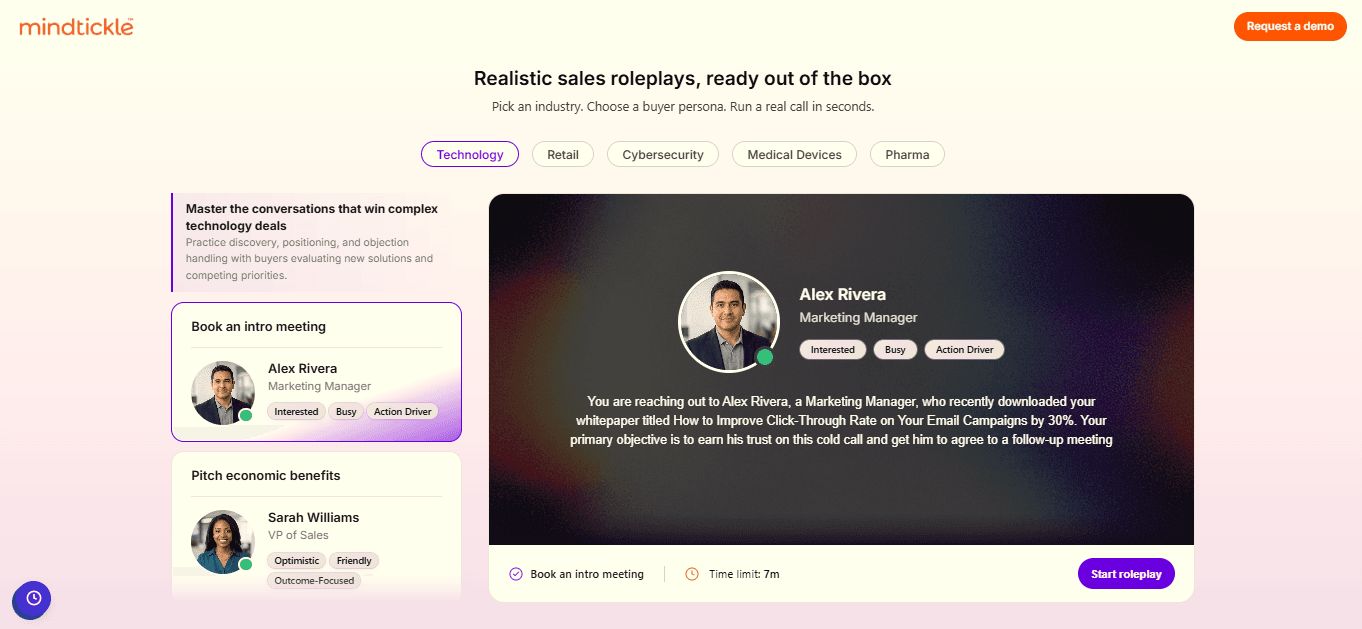
Mindtickle’s AI Sales Role Play with ready-made buyer personas for realistic sales conversation practice
How do you test a platform's consolidation claims before you sign?
A pilot is the best place to see a platform's connections in action. Plan it around how the pieces work together, and you'll come away with a clear sense of how the platform will serve your whole team.
Follow one skill from practice to a live call
Pick a skill your team is focused on, such as handling pricing questions, and follow it through the pilot. Watch the rep's practice score reach their manager, then see how the coaching conversation builds on it and how the skill shows up in their next live call. When each step flows into the next on its own, you've seen the platform at its best.
Bring your own content and scenarios
Move a slice of your actual content library and a few of your existing scenarios into the pilot. Working with your own material shows you how easily everything carries over, and it gives reps practice that feels relevant from their very first session.
Compare adoption with the tools you use today
Keep an eye on how often reps practice during the pilot compared with your current tools. Growing practice is one of the best signs that consolidation will stick.
✅ Pro tip
Invite a manager who's new to AI coaching into the pilot group. Their experience shows you how the platform will land with the wider team, and their enthusiasm can help carry the rollout.
Bring your security team in early
Invite your security team into the pilot from day one. They can confirm where session data is stored, how long it's kept, and how the vendor governs its AI, so approvals move quickly once you're ready to roll out.
➕ Bonus read: Best Unified Revenue Enablement Platforms for Enterprise Teams in 2026
How do you build the business case for consolidating?
The most persuasive business cases open with outcomes and then show the savings. Finance leaders respond well to a clear line from the platform to results they already track.
Start with ramp time and readiness
Ramp time is often the clearest place to begin, because every month a new hire reaches full productivity sooner adds quota capacity for the business. Readiness makes a strong second measure, since it shows how many reps meet the bar for a launch or a key account. Read: How to Reduce Rep Ramp Time With AI Sales Role Play
Add the savings from a simpler stack
With the outcomes in place, the savings round out the picture. Retiring tools frees up license costs, and admins get back the hours they used to spend keeping content and scenarios aligned across systems. One security review in place of several is a welcome saving for your IT and security teams too.
Set your baselines before you switch
Measure ramp time, readiness, and practice volume before the move, then compare the same group of reps a few quarters later. A before-and-after built on your own numbers gives finance real confidence in the results. Read: The ROI of AI sales training and coaching.
How does Mindtickle help revenue teams consolidate without trading off role play?
With Mindtickle, the work that once spanned several tools runs in one place, which gives the enablement team far less to keep in sync.
Mindtickle's AI Sales Role Play is a core part of the broader platform. Scenarios are built from the same content reps use in their deals, and Copilot scores every submission against your own rubric, so practice and coaching share one standard. The skills reps rehearse are the same ones tracked on their live calls, which means progress in one place shows up in the other.
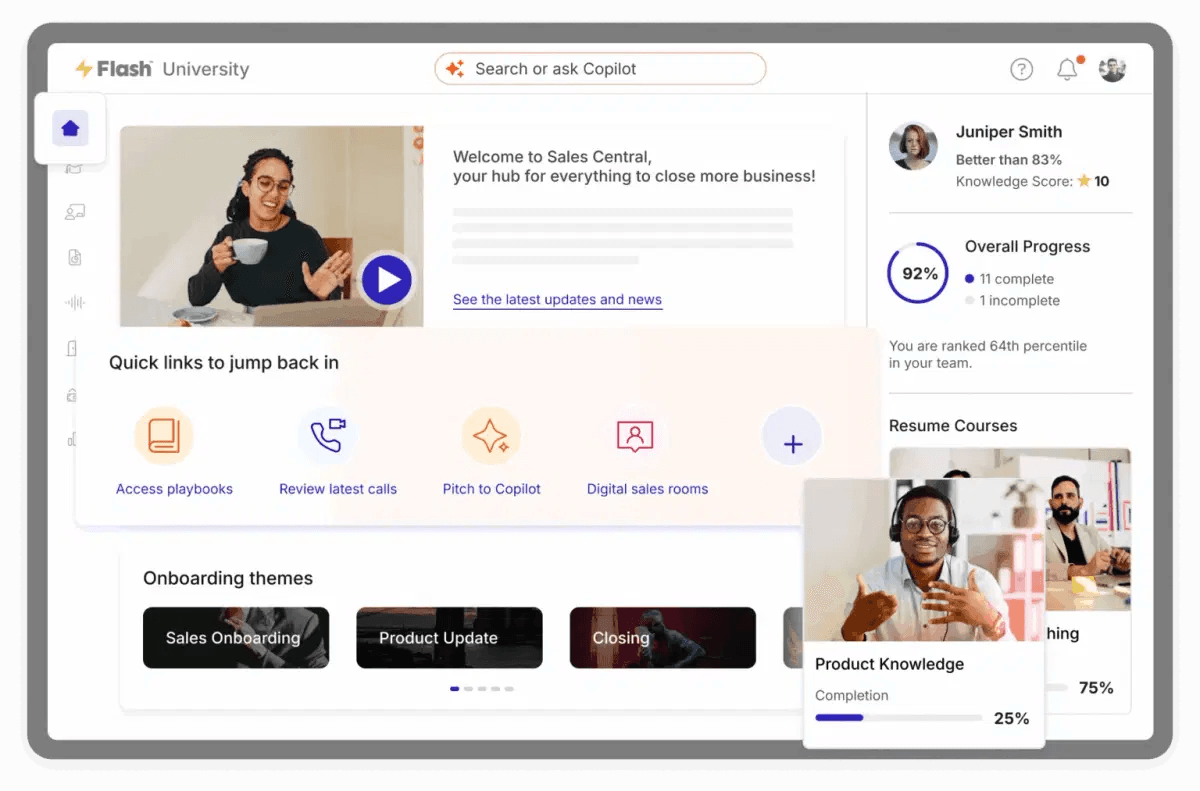
The Readiness Index brings each rep's scores and skill gaps into one view, so managers can see who's ready for a launch or a key deal at a glance. Tying it all together is ElevateOS™, Mindtickle's agentic revenue enablement system, which notices where a rep needs support on live deals and surfaces the practice that helps.
Security stays simple as well, with one review instead of several. Mindtickle is certified against SOC 2, ISO 27001, and GDPR and complies with HIPAA. It also holds ISO 42001 certification for how its AI systems are governed and has assessed its EU AI Act compliance through an external auditor.
The result is a simpler stack and one clear answer to the question every sales leader eventually asks, which is who's ready.
Frequently asked questions
Subscribe to the blog
Get the latest sales enablement tips, guides, and industry best practices delivered to your inbox. Unsubscribe anytime.