



Buyer Enablement for Complex Sales Cycles: A 4-Step Strategy to Build Consensus



Buyer enablement for complex sales cycles means helping a whole buying group reach a decision together. Each stakeholder gets answers to the questions their role cares about, inside one shared story and one shared plan, so the group can agree even when you're not in the room.
In complex deals, your champion may be convinced, but the decision rests with a buying group that includes finance, IT, security, and procurement. Each of them weighs the purchase from a different angle, often in internal meetings. When those views don't come together, a promising opportunity can sit in the pipeline for months, and the forecast moves with it.
This guide explains what buyer enablement means in complex sales and why buying groups slow down. It then walks through a four-step strategy for building consensus, how an ideal platform can help, and how to measure progress.
Key takeaways
- Complex deals depend on group consensus. Buying groups now include more than a dozen internal stakeholders with different priorities, and agreement across the group shapes how a deal moves.
- Content can serve the whole group at once. Each role's question is answered inside one shared story and one business case, which helps stakeholders align.
- A forwardable kit helps the champion sell internally. Built around proof, it carries your case into internal meetings.
- A shared room keeps the committee on the same page. A digital sales room with a mutual action plan gives every stakeholder the same version and a reason to come back.
- Group engagement is an early signal of consensus. Stakeholder engagement and plan completion show alignment forming, while no-decision rate and cycle length confirm the result.
What is buyer enablement and how does it help in complex B2B sales cycles?
Buyer enablement is the practice of equipping a B2B buying group with the tools, tailored information, and shared plans they need to navigate a purchase decision together. Popularized by Gartner, the concept shifts the focus from simply helping reps pitch to actively helping buyers buy.
In complex B2B sales cycles, 6 to 10+ stakeholders across Finance, IT, Legal, and operations must reach consensus, often debating internally without a rep in the room. Buyer enablement removes the friction that causes these deals to stall in "no decision":
- Arms internal champions: Gives your main point of contact CFO-ready ROI calculators, security documentation,and executive one-pagers to win internal buy-in on your behalf.
- Aligns competing priorities: Uses shared Mutual Action Plans (MAPs) and Digital Sales Rooms (DSRs) to keep every stakeholder aligned on timelines, evaluation criteria, and legal milestones.
- Surfaces real-time buyer intent: Shows sellers when new decision-makers engage with content, or where they get stuck, so reps can address blockers proactively rather than guessing.
Buyer enablement vs sales enablement
Sales enablement prepares your reps to sell. Buyer enablement prepares the buying group to buy, including the people your reps never meet.
Buyer enablement also doesn't belong to sales alone. Marketing and enablement can build the core materials, while reps and presales tailor them to each deal and RevOps tracks how the group engages.
The two work best when they're connected. What buyers do between meetings should shape what reps practice in role plays. A rep who sees the CFO returning to the pricing page can rehearse that conversation before the next call.
Why do buying committees stall complex B2B deals?
Complex deals slow down when the people who have to agree aren't working from the same information. According to Forrester's State of Business Buying, 2026, a typical purchase involves 13 internal stakeholders and nine external influencers. Procurement is a decision-maker in 53% of buying cycles and gets involved from the start.
Each of those people arrives with a different question. Finance wants to know whether the numbers work, while IT wants to know whether the product fits the stack. They also join at different points, so a stakeholder who shows up in month three can raise questions the rest of the group thought were settled, and the sales cycle stretches while everyone catches up.
Much of that evaluation now happens without the rep. A 2025 Gartner survey of 646 B2B buyers found that 67% prefer a rep-free experience and 45% used AI during a recent purchase.
Coordination also falls to one internal champion, who relays what they remember and answers what they can. Champions aren't salespeople, and details can get lost as the story is retold. Content plays a part too, because material written for one person can pull the group in different directions.
4 steps to build a consensus buyer enablement strategy
A buyer enablement strategy in enterprise sales is a repeatable plan for helping the buying group reach agreement. You find out who's involved and what each person needs to know, then give them one shared story and one place to decide. That's what consensus buyer enablement looks like in practice.
Step 1: Map the buying group and each member's question
List everyone who will have a say in the decision. Your champion is the best source here. Ask who else needs to sign off and what they're likely to ask, then update the list as new names appear.
| Stakeholder | Their question | What answers it |
|---|---|---|
| CFO or finance lead | Does this pay for itself, and when? | A business case with cost and payback, built on assumptions they can check |
| IT | Will it fit our architecture? | Integration details and a technical review with your solutions engineer |
| Security | Is our data safe? | Security documentation and answers to their review questionnaire |
| Procurement | How do we buy this? | Your terms and a realistic timeline for contract review |
For presales teams, this map is where technical validation gets planned. Agree on what a proof of concept has to show before it starts, and write those criteria down to help IT and security judge against the same bar. New people often appear late, so keep watching for hidden decision-makers as the deal moves.
➕ Bonus read: How to Manage Complex B2B Deals With Multiple Stakeholders
Step 2: Write for the group, not the individual
Mapping each person’s question doesn’t mean building separate content for each of them. When the CFO gets a cost deck and IT gets a technical deck, each person builds their view from different material. Those views can be hard to bring together later, because each one reflects a single role’s priorities instead of the goal the whole group shares.
The fix is to answer every role's question inside one shared story. Start with a problem statement in the buyer's own words, and success measures the whole group agrees on. Then build one business case where the CFO finds the payback math and IT finds the architecture section, both tied to the same goal. Building content in reusable blocks makes this practical for every deal. Read: How Sales Content Management and Automation Helps Reps Close More Deals?
With more buyers researching through AI tools, the business case should answer each role's questions clearly enough to stand on its own.
Step 3: Equip your champion to sell internally
Your champion is the one who presents your case in team meetings. Give them a kit they can forward without rewriting it:
- An executive summary on one page, in the buyer's language, covering the problem and the outcome they expect
- An ROI model finance can open and adjust with their own numbers
- An objection sheet with short answers to the questions the champion will hear from each role
- Customer proof from companies like theirs, such as a case study or testimonial
💡 Learn more: How to Create Better Sales Documents
Give the proof extra weight, since it helps your champion answer the question "Who else has done this?"
Walk your champion through the kit on a call to prepare them for pushback. A well-equipped champion still benefits from backup. Giving the whole group one place to go keeps everyone working from the same material.
Step 4: Put the committee in one shared space
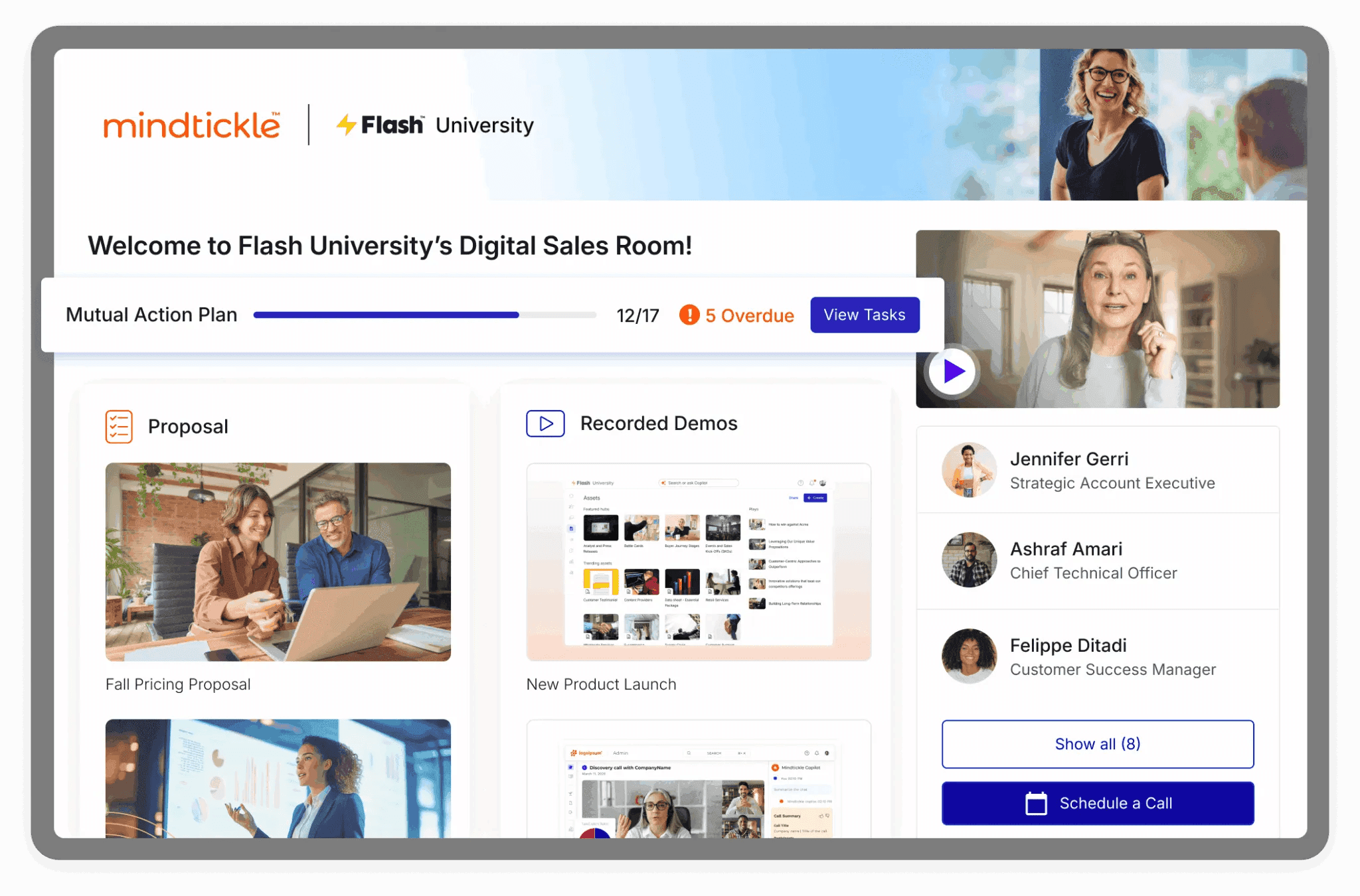
A digital sales room (DSR) gives the buying group one link where every stakeholder finds the material for their role and the latest version of the proposal. Someone who joins in month three can read the history and catch up quickly. Read: How Digital Sales Rooms Help Reps Win More Deals
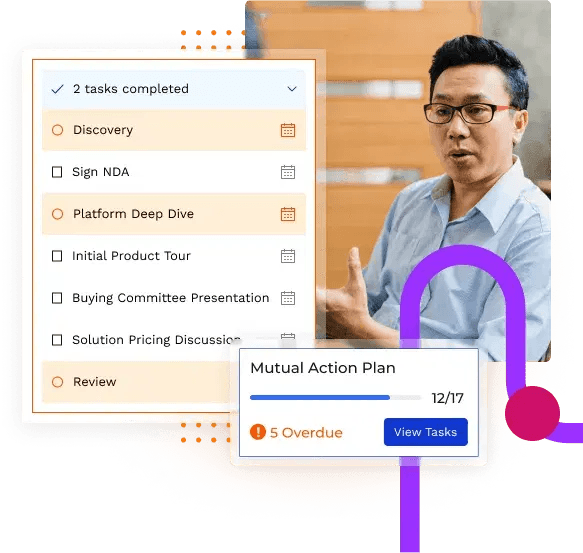
Add a mutual action plan to the room for the group to track what it has agreed to. List the steps to a decision, including legal and security reviews, with an owner on each side and a date.
📌 What shared rooms do for deals
Mindtickle’s 2026 State of Agentic Revenue Enablement Report found that deals with a digital sales room close 30% bigger and 36% faster than deals without one. Rooms with a mutual action plan also get twice as many visits, because a next step gives buyers a reason to return.
What should you look for in a buyer enablement platform for complex B2B purchases?
Judge buyer enablement software by whether it helps a group come to a common conclusion. These six capabilities matter most for consensus:
- Multi-stakeholder rooms. Everyone works from the same version of the deal, whenever they join.
- Mutual action plans. Shared next steps keep the group moving, and overdue steps show where it needs support.
- Per-stakeholder engagement analytics. You see who's engaged and who has gone quiet, helping you follow up before momentum drops.
- Group-level personalization. Content is organized by role around one business case, so tailoring helps the group stay aligned.
- CRM integration. New stakeholders and their engagement write back to the opportunity, and the forecast reflects the whole committee.
- Rep readiness tied to buyer signals. When the room shows the security lead opening the security documentation, the rep can rehearse that conversation with an AI role play tool to prepare for the next call.
Which types of platforms support buyer enablement?
Most tools in this space fall into four groups, and many teams use more than one:
| Platform type | How it supports consensus | A good fit when |
|---|---|---|
| Digital sales rooms | One shared space per deal, usually with a mutual action plan both sides work from | The gap is buyer-side collaboration, and your team already has content and coaching tools it wants to keep |
| Interactive demo tools | Technical evaluators explore the product on their own time and share what they find | IT or end users want to see the product in action before a live demo or trial |
| Business case and proposal tools | Reps build ROI models and proposals that finance can review and adjust | Approval depends on finance signing off on the numbers |
| Revenue enablement platforms | Combine DSRs with content management and rep readiness in one platform | You want buyer activity to inform coaching and practice as well as deal tracking |
How do you measure buying group consensus?
Consensus doesn’t show up in a single number, so it helps to track a few metrics. Some show alignment forming while a deal is still in motion, like how many stakeholders are engaged and whether the mutual action plan is on track. Others, like no-decision rate and cycle length, confirm the result as deals close.
| Metric | What it tells you |
|---|---|
| Stakeholders engaged vs. identified | Whether the conversation has reached the people who sign off, beyond your champion |
| Mutual action plan completion | Whether both sides are following through on agreed steps, and which steps are overdue |
| Return visits from more than one role | Whether the group is reviewing the deal between meetings |
| No-decision rate | How often qualified deals end without the group choosing any option |
| Sales cycle length | How long the group takes to move from first meeting to signed contract |
| Average deal size | The scope the group commits to once it agrees |
💡Did you know - In won deals, each buyer visited the room 7 times on average, compared with 3.7 in lost deals, according to Mindtickle’s 2026 State of Agentic Revenue Enablement Report.
Engagement and plan progress are most useful in deal reviews, where they point to a next step. A deal with one engaged stakeholder is a cue to ask the champion who else needs to see the business case. An overdue plan step is a reason to check in with its owner before the close date moves.
📖 Read more: What Is Buyer Engagement (+KPIs That Actually Matter)
How does Mindtickle help buying groups reach consensus?
Digital Sales Rooms are part of Mindtickle's revenue enablement platform, which connects buyer engagement to rep readiness. Each deal gets one branded room where the buying group finds its content and follows a mutual action plan that both sides update.
Reps see which stakeholders are engaging and get alerts when plan steps fall overdue. When someone new from the account opens the room, contact enrichment identifies them and writes them back to the CRM. This helps the buying group in your forecast match the real one.
Reps can rehearse the CFO or procurement conversation with the AI Sales Role Play before it happens, and managers can track which reps are ready for real calls. It all runs on ElevateOS™, Mindtickle's agentic operating system for revenue enablement, where Digital Sales Rooms make up its Intelligent Buyer Engagement pillar.
Consensus rarely forms in one meeting. Digital sales rooms give the group a place to build it in between.
See how Digital Sales Rooms help move buying groups from first meeting to signed contract.
Frequently Asked Questions
About the Author
Senior Content Manager
Ruchi Madan leads content marketing at Mindtickle. She has spent her career in enterprise SaaS, building content programs that span product, demand, and customer marketing.
Her work sits at the intersection of brand and pipeline, producing content that demand gen teams can use and that moves buyers through the funnel. She directs external agencies and freelancers, sets editorial standards, and works closely with product marketing and sales enablement to keep messaging consistent across campaigns and channels.
Subscribe to the blog
Get the latest sales enablement tips, guides, and industry best practices delivered to your inbox. Unsubscribe anytime.