




How to Scale Sales Pitch Certification Globally in 2026



An efficient way to scale sales pitch certification globally is to define one standard for what "certified" means, let reps prove it through scored AI role play, and adapt each scenario to the buyers, language, and rules of every market without moving the bar.
The hard part is running it. A certification program that works well for 100 sellers in one office starts to strain when thousands of reps pitch different buyers, in different languages, across a dozen time zones. You need to tell leadership who is ready to sell, but you can only sit in on a small share of pitches, and every regional manager grades a little differently.
Here's how global teams keep one standard while every market still sounds like itself, and how AI role play makes certification work at that scale.
Key takeaways
- Certification measures what a rep can do. Finishing training shows a rep has seen the material, while a scored pitch shows they can deliver it to a buyer.
- The standard stays global, and the conversation goes local. Every market uses the same core skills and passing standards, while personas, objections, and language reflect each region.
- Each market's rules set the limits of localization. Local rules on claims and data decide how far a pitch can adapt.
- AI role play carries the volume. Reps practice and complete certification assessments on their own schedule, with AI evaluating their attempts against a shared rubric and providing feedback within minutes.
- Managers keep the final say. They review borderline attempts, check AI scores against their own, and sign off on readiness.
Why does pitch certification get harder as teams go global?
Pitch certification gets harder globally because the number of pitches to review grows much faster than the number of people who can review them, and every market needs its own version of the conversation.
Finishing training doesn't prove a rep can pitch
Most programs start by tracking completion. A rep watches the product videos, passes the quiz, and gets marked as trained. Sales training gives reps the knowledge they need, and certification checks whether they can use it with a buyer who asks hard questions and pushes back.
A completion report looks the same in every region. Certification shows how each rep handles a pricing objection, market by market.
Every market needs consistency without an identical pitch
Two reps can sell the same product to buyers with very different priorities. One buyer wants to discuss the business case right away, while another wants to understand the implementation approach first.
Leadership still needs to know that both reps explain the value correctly, handle the objections that matter, and meet the same standards. Live reviews, where a manager watches each rep pitch and scores it, work well for a team of 50 in one office. Across regions and time zones, they turn into a scheduling project, reviewers start scoring a little differently, and reps wait weeks for a slot.
📌 Dig deeper: How to Create a Sales Certification Program That Actually Builds Sales Competencies
What should stay global, and what can change by market?
Keep core competencies and scoring standards consistent across equivalent roles, while adapting buyer scenarios, objections, and language to each market.
What stays the same in every market
A certified pitch proves the same skills in every market. The rubric scores behaviors rather than a script, such as how well a rep connects the product to the buyer's needs and handles the objections that matter most.
Passing thresholds and readiness levels stay the same for equivalent roles, so every rep demonstrates the same core skills to earn certification.
What can change by market
Everything the buyer sees can change. Personas reflect the people reps meet in each region, with local job titles, priorities, and objections, and the conversation runs in the language the rep sells in. Local customer examples and competitors make this contextual practice feel like the calls reps already have, which is personalized training at scale applied to every market.
Where compliance draws the line
Local regulations determine how far a pitch can adapt. In the US, FINRA Rule 2210 holds broker-dealer communications to a fair and balanced standard, so promissory claims and missing risk disclosures put firms at risk. Rules like this become critical errors in that market's rubric, so certification catches an off-limits claim wherever a rep sells.
Data rules shape how the program itself runs. In the EU, GDPR governs how companies store and process recordings of their reps, and in Germany, the Works Constitution Act gives works councils co-determination rights over tools capable of monitoring employee behavior or performance. Legal, HR, and relevant regional stakeholders should review these requirements before rollout.
Who decides what passes
Global enablement owns the standard, including the rubric, the passing score, and the list of critical errors. Regional leaders review each local scenario so the buyer and the objections ring true, and legal confirms what reps can claim in that market. Managers all score against the same criteria and compare notes regularly so the same score means the same performance in every region.
✅ Pro tip
Start with the pitch that matters most this quarter, such as a product launch, and pilot it in one or two markets. Tune the personas and the rubric there, then add markets in waves.
📌 Read more: Five Tips to Virtualize a 5-Day Sales Certification Bootcamp
How does AI role play certify reps at global scale?
AI sales role play lets every rep practice and certify against an AI buyer from their own market, while the AI scores each attempt against the global rubric as soon as it ends and sends borderline cases to managers.
Reps practice against buyers from their own market
A rep in Tokyo pitches, in Japanese, to an AI procurement lead who asks about local support and implementation timelines. A rep in Chicago pitches the same product to a CFO who wants the payback period early in the call. The two conversations sound very different, yet the AI scores both reps on the same skills: finding the buyer's priority, connecting the product to it, and handling the pushback.
That realism is what makes the score worth trusting. Hyper-realistic buyers interrupt, question vague answers, and move off script, so reps earn certification in conditions close to a real call.
🌟 How Radware scaled practice across languages
Radware is a cybersecurity company with 1,200 employees across 23 regions. As it grew, keeping reps and partners aligned across those markets got harder. Managers also had little view of who was ready, and onboarding ran past six months.
With Mindtickle’s AI Sales Role Play, reps in every region rehearsed tough conversations in their own languages, including French, Spanish, Korean, and Japanese. Onboarding scaled across roles, regions, and languages, and ramp time dropped from six to 12 months to just one to three.
Practice comes before the certification attempt
Give reps open practice against the same rubric before the attempt that counts. They see exactly how the AI will score them, retry their weak spots, and arrive ready for certification. The certification then measures the skill they built rather than how quickly they figured out the test.
That volume of practice is the clearest gain of AI over traditional role play, where every rehearsal takes a manager's or a colleague's time.
One rubric scores every attempt
Manager reviews depend on each reviewer's judgment and calendar, so scores can vary from one region to the next, and reps often wait days for feedback. The AI scores every attempt the same way, whether the rep sells in Madrid or Melbourne, and feedback arrives within minutes.
💡 Good to know
Reps who retry a role play after AI feedback raise their average score by 45%, according to Mindtickle's 2026 State of Agentic Revenue Enablement Report.
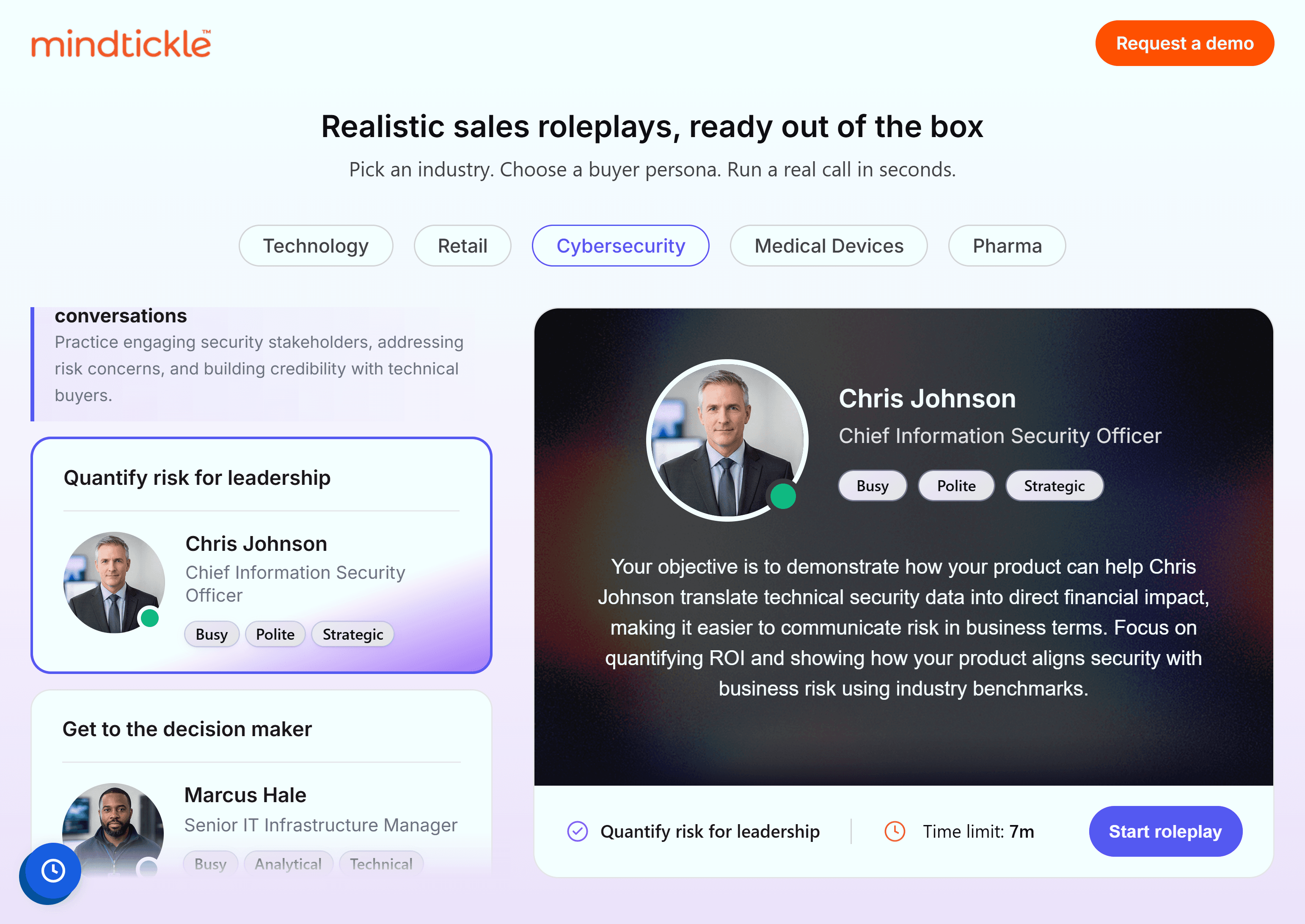
Try it yourself with a 7-minute role play for free. Pick your industry, a buyer, pitch your product, and see your feedback in minutes.
The AI flags compliance errors regardless of score
A rep can run a strong conversation and still make a claim that's off-limits in their market. Because the rubric marks those claims as critical errors, the AI flags the attempt for review, regardless of the overall score. That keeps a polished delivery from covering a compliance problem.
Managers review the borderline cases and sign off
AI handles the volume, and managers make the judgment calls. They review the attempts the AI marks as borderline, coach the gaps that keep coming back, and give the final sign-off before a rep certifies.
Once a quarter, and whenever the rubric changes, have regional reviewers score a sample of attempts themselves and compare their scores with the AI's. Close agreement shows the scoring holds in the markets you checked, and any gap shows where to adjust.
➕ Bonus read: How Managers Can Use AI Sales Role Play Tools to Coach Reps
How do you keep certification current and know it's working?
Treat certification as a cycle that refreshes whenever the pitch or the market changes, and judge it by what reps do on real calls.
Recertify when the pitch or the market changes
Products launch, pricing shifts, new competitors enter a region, and buyers start raising objections nobody planned for. When the pitch changes, update the source content first, then the scenarios and rubric built on it, and ask reps to recertify before they use the new version with customers.
Keep recertification short and focused on what changed. A ten-minute check on the new pricing story respects reps' time more than a full retest of a pitch they already know.
Real calls show whether certified skills hold up
Certification earns its value when the skills it scores show up in front of buyers. Review live calls for the same behaviors the rubric measures, and feed what you find back into practice. Call analysis and role play work best as one loop:
Set the standard → practice → certify → observe live calls → find gaps → update practice → recertify
When many reps in one region miss the same point, look at the scenario or the training behind it first. That's where training and coaching divide the work. Training addresses what a whole team missed, and coaching addresses what one rep keeps missing.
📖 Read more: 4 Common AI Sales Coaching Mistakes to Avoid in 2026
Measure readiness, not completion
Completion rates show the program is running, and readiness metrics show it's working. Track how many attempts reps need to pass, which skills fall short most often in each region, and whether certified behaviors show up on live calls.
Set those measures before launch, the way successful training programs do, then connect them to outcomes leadership already tracks. Tracking certification results alongside ramp time and win rates shows finance what readiness is worth.
What does global certification look like when practice and readiness connect?
Mindtickle’s AI Sales Role Play runs on ElevateOS™, the agentic revenue enablement system, so global certification connects with everything else your reps learn and practice. Enablement sets the rubric once, and reps in every region practice and certify against buyers from their own market, in 25+ languages.
Certification paths fit each role, so field reps, inside sales teams, and channel partners each certify on their own scenarios against the same bar, while test-out options let experienced reps go straight to the assessment. The Readiness Index then shows leaders who is ready in each region and where a team needs support.
When every market practices against the same standard, leaders can trust certification wherever a rep sells.
FAQs
Subscribe to the blog
Get the latest sales enablement tips, guides, and industry best practices delivered to your inbox. Unsubscribe anytime.
Related Articles

Why Teams Are Switching from Reactive Call Coaching to Proactive AI Role Play in 2026

How to Choose the Right AI Role Play Platform for Sales Tech Consolidation in 2026