




Why Teams Are Switching from Reactive Call Coaching to Proactive AI Role Play in 2026



Teams are switching to proactive AI role play because it moves coaching to the moment before the call, when reps can still shape how the conversation goes. Reps rehearse pricing pushback, tough discovery, and competitive questions with an AI buyer, get feedback within minutes, and walk into the real call already prepared.
If you lead a sales team, you know the frustration this solves. A manager reviews a call on Thursday and spots the moment a rep talked past a price objection. By then, the rep has had that same conversation three more times, and the coaching lands on a habit instead of a single slip. Everyone works hard, and the feedback still shows up after the moment it was meant for.
Proactive coaching changes that timing. This guide talks about what's driving the shift, what teams gain from it, how call review still fits in, and where managers focus once AI takes on more of the practice.
Key takeaways
- Proactive coaching happens before the call. Reps rehearse the hard moments with an AI buyer, so they walk into the real conversation already prepared.
- Managers have less time to coach while buyers expect more from reps. AI role play gives every rep realistic practice whenever they need it, without waiting on a manager's calendar.
- Fast feedback helps reps improve between calls. Reps see their score within minutes of a role play and can retry the scenario right away.
- Call review still guides what reps practice. Each new objection or gap that shows up on real calls becomes the next role play scenario.
- Managers spend their time on the coaching only they can do. AI handles the scoring, so managers can focus on deal strategy and on deciding when a rep is ready.
What's the difference between reactive call coaching and proactive AI role play?
The difference comes down to timing. Reactive call coaching looks back at a conversation that already happened. A manager listens to a recording, spots a missed moment, and talks the rep through it in their next 1:1.
Proactive AI role play looks ahead. Reps practice a conversation before it happens, against an AI buyer that pushes back the way a real prospect would, and they get scored feedback right after each attempt.
Both belong in a strong sales coaching program. Call coaching gives managers real evidence from the field, and AI sales role play gives reps a place to build the skill before a deal depends on it. What's changing is where coaching starts.
📌 Dig deeper: Role play vs. call analysis
Why are more teams making the switch in 2026?
Teams are switching because the pressure on sales conversations has grown faster than the time managers have to coach them. Four shifts are driving the change.
Managers have more to coach and less time to do it
Frontline managers juggle coaching, deal support, forecasting, and a growing list of operational work. Gartner reports that CSOs say nearly half of their managers don't consistently meet performance expectations, and it traces that gap to the complexity of the role rather than managers' ability. The stakes are high, since the same report also finds that effective managers can lift seller performance by up to six times. Proactive role play takes repetitions and scoring off a manager's plate, so the time they have goes to the coaching that moves performance.
Buyers expect a prepared seller from the first conversation
Buyers do most of their research before they ever speak with a rep. According to Mindtickle's 2026 State of Agentic Revenue Enablement Report, 88% of buyers enter the conversation with a clear understanding of the solution they need. They come to confirm what they've already learned, so the first answer a rep gives carries more weight.
That bar stays high even as products, pricing, and competitors change. With role play, the whole team rehearses a new message the week it ships, so buyers hear a confident version from the very first call.
AI practice now feels close to a real buyer
Traditional role play depended on a manager or peer having time, and colleagues often went easy on each other. Today's AI buyers respond to what the rep actually says, push back on vague answers, and stay in character for the whole conversation. A realistic AI buyer makes practice worth a rep's time, which is why reps now come back to it on their own.
AI practice also fits around each rep's schedule. Reps practice at their own pace and as often as they need, with scenarios matched to their role and their deals. That kind of personalized training at scale once took a team of trainers, and now it runs on demand.
Leaders want proof of readiness, not just activity
Sales leaders know their teams need new skills. Course completions and quiz scores show what reps know, and leaders now want to see what reps can do when a buyer pushes back. Role play gives them that view, because each session measures how a rep handles the actual moment, scored against the team's own standards. Read: What Makes a Successful Sales Training Program?
What do teams gain when coaching starts before the call?
Teams gain reps who walk into high-stakes conversations already practiced, and they gain it across the whole team at once. Here's what that looks like day to day.
Reps rehearse the moments that carry the most risk
Every deal has a few moments that decide where it goes: a procurement lead asking for a 20% discount, a technical evaluator comparing you to the tool they already use, or an executive questioning the business case. With contextual practice, reps rehearse those exact moments, built around the personas and objections they meet in their own deals. Discovery and competitive conversations benefit the most, because no script covers them and reps have to adapt to the buyer in real time.
Mistakes happen in practice instead of in front of buyers
A rep can fumble a pricing answer five times in practice and nail it on the sixth, and no buyer ever hears the first five. That freedom changes how reps learn. They try a new approach, watch how the AI buyer reacts, and adjust, with no deal or audience riding on the outcome. When the real call comes, they bring a tested response instead of an improvised one.
Every rep gets practice, not only the ones a manager reaches
AI role play gives every rep the same access to practice, whether they work at headquarters or cover a remote territory on their own. New hires, steady performers, and top reps all practice against the same buyers. Even the reps a manager rarely gets time with can practice as often as anyone else on the team.
Feedback arrives right after the attempt
Feedback works best while the conversation is still fresh. AI scores each role play as soon as the rep finishes, points to the exact moment they missed a cue or talked past an objection, and suggests what to try next. The rep can run the scenario again within minutes and watch the score move. That quick loop is what AI sales coaching adds to a program: steady, specific feedback that keeps reps improving between 1:1s.
💡 Feedback that arrives in time to use
Mindtickle's 2026 State of Agentic Revenue Enablement Report found that managers return role play feedback seven to eight days after a rep submits it, while AI reviews it within one to two minutes. Reps who hear back in minutes can use that feedback on their very next call.
New hires ramp faster
Role play lets new reps practice the full range of buyer conversations in their first weeks, from a cold open to a tough renewal, rather than meeting each objection one live call at a time. That's how teams reduce rep ramp time: new hires work through the hard conversations in practice first, so the real ones already feel familiar.
➕ Bonus read: ROI of AI sales training
One standard applies across regions, teams, and tenure
AI scores every session against the same rubric, built around your sales methodology. A rep in London and a rep in Singapore get measured on the same skills, and a ten-year veteran works toward the same bar as a new hire. Managers can compare readiness across the team with confidence, because everyone practices to one shared definition of good.
Readiness becomes visible before deals are at stake
Every practice session produces a score, so leaders can see who's ready for a launch, a pricing change, or a competitive push before it starts. They can direct support to the reps who need it ahead of the moment, while there's still time to make a difference.
📌 Did you know?
Reps who retry a role play after AI feedback raise their scores by 45%, according to Mindtickle's 2026 State of Agentic Revenue Enablement Report. Run a scenario built around your own buyer and see the feedback for yourself.
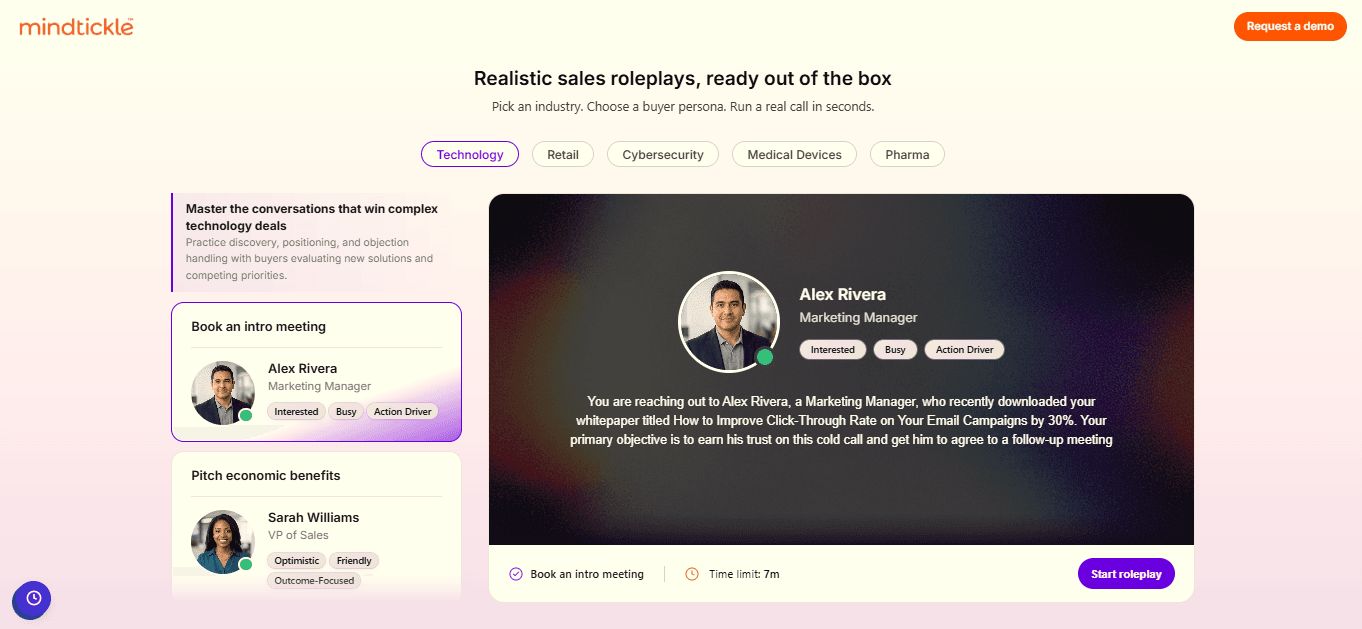
Ready-made AI buyer personas for role play practice in Mindtickle's AI role play demo
Does proactive coaching mean you stop reviewing calls?
No. Call review stays an essential part of coaching, and it takes on a sharper job: showing reps what to practice next. Each approach does its best work at a different point in the cycle.
| Reactive call coaching | Proactive AI role play | |
|---|---|---|
| When coaching happens | After the call, once a manager has time to listen to the recording | Before the call, whenever a rep has a few minutes to practice |
| What it draws on | A real conversation with a real buyer, including the moments nobody planned for | Scenarios built from your own deals, buyer personas, and common objections |
| Who gets coached | The reps whose calls a manager has time to review that week | Every rep on the team, as often as they want to practice |
| How feedback arrives | In a 1:1, based on what the manager noticed and remembered | Within minutes, pointing to the exact moment that needs work |
| What the rep does next | Applies the advice the next time a similar moment comes up | Retries the same scenario right away and watches the score move |
| The manager's role | Listening to calls, scoring them, and scheduling 1:1s | Reviewing scores and coaching where the results point |
| How consistent it is | Shaped by each manager's style and bandwidth | Scored against the same rubric for every rep, region, and tenure |
| How it helps | Spotting new objections, rising competitors, and real execution gaps | Building skill and confidence before high-stakes conversations |
Call review becomes the input, not the whole program
Recorded calls show how reps perform with real buyers under real pressure, and proactive teams put that evidence to work earlier. When a manager notices reps rushing to discount or skipping a key qualification question, that pattern becomes the next role play scenario. Grounding practice in real calls keeps it focused and helps teams steer clear of common AI coaching mistakes, like assigning generic scenarios that don't match the deals reps are working.
Real calls catch what no scenario predicted
Live calls show what the market is doing right now. A new competitor starts showing up in deals, a pricing question begins coming up in renewals, or buyers start asking about a feature the team hasn't trained on. Call review spots these shifts first, and the team can turn each one into practice within days.
The two work as one loop
Together, the cycle looks like this: practice → live call → review → targeted practice.
Reps rehearse, apply the skill with buyers, and real calls show whether it held up. Any gap the calls reveal becomes the focus of the next practice session. Over time, this loop connects sales training to what actually happens in the field.
✅ Pro tip
Start with one team and one high-stakes skill, such as pricing conversations. Pull three or four real calls where that moment came up, build a scenario from them, and run it for a few weeks before you expand to other teams and skills.
Where does the sales manager fit when AI handles more of the practice?
Managers move to the part of coaching only they can do. AI runs the repetitions and the scoring, and managers use what it surfaces to coach judgment, strategy, and readiness.
Managers decide what's worth practicing
Managers hear things on calls that no dashboard fully captures, like the deal that keeps stalling at legal review or the objection that sounds slightly different in one region. They turn those observations into scenarios, so the team practices what's happening in the market this month, not last quarter.
Coaching conversations start from practice results
Instead of scoring every submission themselves, managers open a 1:1 with the scorecard already in hand. They can see where a rep stumbled, how many times they retried, and how their score moved. That frees the conversation for the work only a manager can do, like talking through a specific buyer or deciding when to bring in an executive sponsor. It reflects the difference between sales training and sales coaching: AI builds the skill, and the manager shapes how the rep uses it.
🌟 How Qlik gave managers more time to coach
Qlik moved practice to Mindtickle's AI Sales Role Play platform so reps could rehearse customer conversations and get immediate feedback before speaking with buyers. Across 860 go-to-market professionals, reps completed more than 9,000 AI role plays, and Mindtickle Copilot reviewed more than 3,000 of them. This saved managers about 850 hours of review time.
As Nicholas Gregory, Qlik's Global Head of Sales Enablement, puts it:
"Our sellers could complete training and pass certifications, but neither told us whether they could handle a tough objection in a live conversation. AI Role Play closed that gap - transforming formal on-demand training from a knowledge checkpoint into a performance accelerator. Together, they give sellers the foundation to understand what to say and the repetitions to know how to say it under pressure. We'd much rather they learn through practice than during a live sales opportunity."
Managers confirm when a rep is ready
AI shows managers how a rep performed in practice. The manager then decides whether that rep is ready for a strategic account, a product launch, or a tough renewal, weighing practice scores alongside what they hear on live calls.
Managers set the standard by practicing too
Reps take practice seriously when their managers do. Managers who run the same role plays, share their own scores, and talk openly about what they learned show the team that practice is part of the job at every level.
➕ Bonus read: How Managers Can Use AI Sales Role Play Tools to Coach Reps
How does proactive coaching strengthen the rest of your revenue enablement?
With Mindtickle, proactive coaching shows you who's ready before the moments that matter. The AI Sales Role Play platform builds scenarios from the personas and objections your reps meet in real deals, scores each session against your methodology, and returns feedback within minutes. Conversation intelligence then shows which skills carry into live calls and which ones need another round of practice.
The Readiness Index brings practice and performance together, so managers walk into a 1:1 already knowing where a rep stands, and leaders can see which teams are ready ahead of a launch or competitive push. All of it runs on ElevateOS™, Mindtickle's agentic revenue enablement system, which recommends the next scenario for each rep based on how they perform.
Bringing these pieces together on one unified platform means coaching starts earlier and keeps building after every call. When practice comes first, your reps meet every important buyer conversation already rehearsed.
FAQs
Subscribe to the blog
Get the latest sales enablement tips, guides, and industry best practices delivered to your inbox. Unsubscribe anytime.