




Scaling AI Sales Role Play and Coaching in Pharma: Building Compliance-Ready Reps in 2026



Scaling pharmaceutical sales AI role play safely requires approved source material, carefully designed scoring, and human review for decisions involving medical or regulatory judgment. The goal is to give every rep realistic practice without allowing speed and scale to weaken compliance controls.
The real test comes after the pilot. With 20 reps, your team can review every scenario and investigate every questionable response. With thousands of reps across products, regions, and languages, that level of manual oversight becomes difficult to sustain.
Meanwhile, the conversations keep changing as new indications launch, messaging gets updated, or Healthcare Professionals (HCPs) start asking questions the training deck never anticipated. Managers also have limited time to review practice.
A scalable training program for pharma reps needs a way to keep practice realistic, scoring consistent, and human judgment focused on the moments that matter most.
Key takeaways
- Successful pilots don't automatically translate to safe scale. More reps, products, markets, and scenarios make consistent practice, scoring, and oversight harder to maintain.
- Scaling for pharma requires more than just reps practicing. It takes controlled content, consistent scoring, and a clear line for when a human needs to step in.
- Compliance readiness depends on the context. Reps need to stay within the approved boundaries for their product, market, and audience, even when an HCP pushes the conversation somewhere unexpected.
- AI replaces most review but not all of it. Serious messaging failures should trigger remediation or human review rather than disappear inside an otherwise strong average score.
- Readiness extends beyond the simulation Connecting role play, coaching, and real conversation signals helps teams identify recurring gaps and direct the next round of practice.
Why doesn't a successful pilot guarantee a safe rollout at scale?
Teams turn to AI sales role play to replace the manual grind of traditional sales training, and it does what teams expect in the beginning. The problem is that success in a pilot doesn't automatically carry over once the same program has to scale, and there are two reasons why.
Small group makes success look simpler than it is
An AI role play sales training pilot usually runs under favorable conditions. The group is small, and enablement leaders usually test only a few scenarios at first. Medical, Legal, and Regulatory (MLR) teams closely review the scoring criteria, and managers can flag any questionable outputs. That level of attention can make the program look ready to scale.
An enterprise program introduces much more variation. Hundreds of reps may practice across different products, markets, HCP personas, and conversation paths. When product messaging or regulations update, those conversations go stale, and the organization eventually loses track of which ones still need attention.
Leadership can't see whether the practice is actually working
The other thing a pilot hides is impact. Reps can be practicing consistently and improving their scores, but a rising score only proves a rep is getting better at the simulation, not that the same skill is showing up in a real HCP conversation.
Leadership has no way to tell which one it actually is. That gap only gets wider at scale, and closing it requires a well-connected sales readiness system.
📖 Read next: The Five Pillars of Pharmaceutical Sales Training Excellence
What does "compliance-ready" actually mean in pharma?
“Compliance-ready” in pharma means a rep doesn’t drift past what's actually approved, and that covers more ground than most teams picture.
Regulators generally hold brochures, digital portals, and field resources to the same bar as the product information a rep gives. Anything a company puts a rep's name behind gets judged against those same rules.
The FDA's Office of Prescription Drug Promotion enforces this specifically through what it calls the “fair balance” requirement. It means risk information has to get as much attention as the benefits. Reps can't mention the risks quickly or quietly while spending most of the conversation on the benefits. Overstating a benefit, downplaying a risk, or answering something the label never covered brings real liability and consequences.
Other regulators enforce the same principle under their own rules, which is where things get complicated for a global program. A claim cleared under FDA rules in the US can violate EMA rules in Europe, PMDA rules in Japan, or NMPA rules in China. Even who a rep is allowed to talk to shifts by market. For example, marketing directly to patients is legal in the US and restricted almost entirely to HCPs under EMA rules in the EU and equivalent restrictions in the UK, so a message that's compliant in one country can cause real problems in another.
How does AI role play help pharma teams practice compliant messaging?
A simulation is only as useful as what it's built on and what it actually tests. Here’s how AI role play helps in pharma sales training.
Grounds practice in approved content
A general AI model can know a lot about a therapeutic area. That knowledge doesn’t have much to do with what your organization has approved for a specific product, indication, and market.
The safer approach grounds every scenario and the scoring rule in your own approved sources. MLR defines the boundaries and the critical compliance criteria, and enablement and field leaders add the conversational behaviors on top of that.
The model uses those approved sources and policies as the basis for the scenario and scoring. That keeps the organization's own standards at the center of the practice rather than asking the model to define compliance for itself.
📌 Dig deeper: AI Sales Role Play: 2026 Guide for Enablement Leaders
Pushes back as a real HCP would
One of the biggest struggles for pharma reps is the 20-second window they actually get. A physician often immediately decides whether a conversation is worth their time, interrupting, doubting, or asking the question the training deck never covered before a rep has even finished their opening. A compliant AI buyer that patiently waits through the whole pitch doesn't prepare a rep for that at all.
AI role play is built to hold its ground on objections, press on vague answers, and drift the conversation somewhere unscripted, the way a real conversation actually does. Plus, the difficulty levels keep increasing as the rep gets better. Read: What Makes AI Sales Role Play Hyper-Realistic
That's what makes the score mean something. A rep who handles a difficult AI persona well is far more likely to handle a difficult HCP well too.
Also read: 12 of the Most Common Sales Objections (and How to Overcome Them)
Applies the same rubric at scale
AI role play checks several things at once: whether the rep represented the evidence correctly, stayed within approved claims, handled risk information properly, and knew when to escalate. Every rep gets the same rubric no matter how many times they run the scenario.
Treats critical violations separately
A rep who scores well on discovery and communication but makes one unsupported clinical claim doesn't pass just because the average still looks good. Unsupported superlatives, off-label references, and unsubstantiated comparisons always trigger a hard stop or mandatory review, no matter how the rest of the conversation went.
🎬 Sample scenario: handling an off-label question
Situation. A physician who uses your product for its approved indication asks, mid-conversation, whether it would also help with a related but unapproved condition.
What the rep needs to demonstrate: Recognize the question, avoid speculating, and redirect to the appropriate escalation path, whether that's Medical Affairs or Medical Information, without shutting the physician down.
What the AI tests: Whether the rep catches the shift in real time and follows the approved response path, instead of trying to be helpful and overclaiming in the moment.
It knows when to step back and let a human decide
AI role play handles the scoring a rubric can check objectively. It isn't built to make medical or regulatory judgment calls. Those still belong to a qualified person. Teams that want extra confidence before rollout can have trained reviewers score a benchmark set of conversations alongside the AI, then compare the two to catch anywhere the rubric needs fixing before anyone relies on it.
Once it's live, the same principle can carry through. A response that's ambiguous, medically nuanced, or close to a critical violation gets routed to a manager or compliance reviewer instead of being given a pass, so the person best equipped to make that call is the one making it.
➕Bonus read: AI Role Play for Pharma Reps: A 30-Day HCP Readiness Model
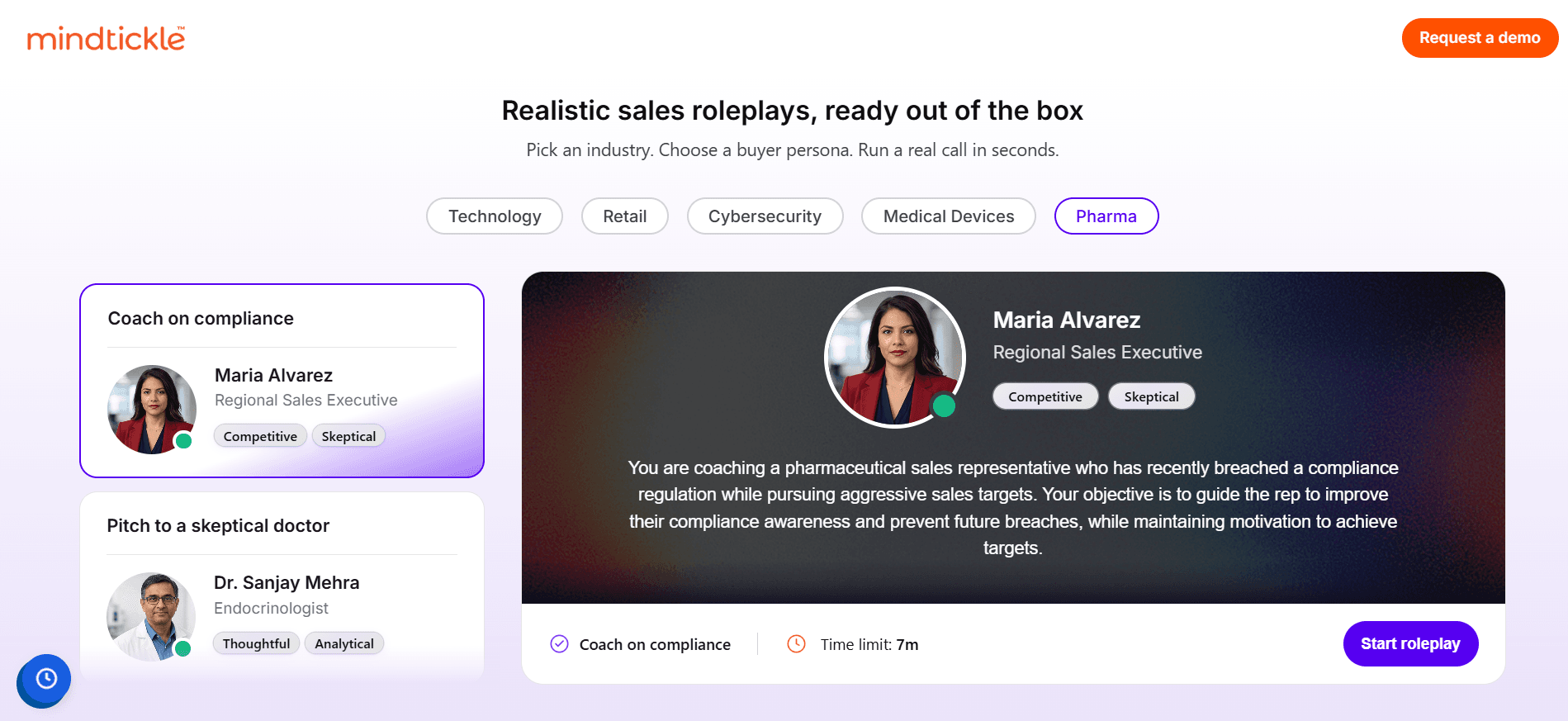
🎯 Try it yourself
Pick a scenario, run a 7-minute role play against an AI pharma buyer, and see how the scoring actually works.
Reps who acted on AI feedback and retried a role play improved their average score by 45%, up from just 10% the year before, per Mindtickle's 2026 State of Agentic Revenue Enablement Report.
Does AI role play replace certification?
It doesn’t replace certification itself, but it replaces almost everything leading up to it.
The old model measured seat-time. A rep passed because they sat through the training workshop and passed one role play, often judged informally rather than against a fixed standard. AI role play replaces that with mastery gates: a rep advances only once they've actually demonstrated the required behavior consistently at different difficulty levels. That's a higher bar than attendance ever was.
But it doesn’t make the final call. AI role play builds the record of which scenarios were run, how each rep scored, and where they needed a retry. The sign-off still belongs to commercial leadership and compliance.
What changes for field managers when AI role play operates at scale?
A manager's job shifts once AI can handle routine first-line scoring. Since AI reviews against a fixed rubric, the manager only spends time on reps who are actually struggling.
The workflow makes it easier by surfacing why a rep was flagged in the first place. One rep keeps making unsupported comparative claims, while another struggles to recognize an off-label question when it comes up. That specificity gives a manager somewhere concrete to actually start coaching, instead of a generic review queue.
📊 How this solves the manager capacity problem
Active managers ran an average of 22 coaching sessions a month in 2025, down from 40 in 2022, a 45% drop in three years.
Source: Mindtickle's 2026 State of Agentic Revenue Enablement Report
Read more: How Managers Can Use AI Sales Role Play Tools to Coach Reps
How does this come together into a readiness system?
In the end, making AI role play scalable requires a closed-loop agentic system that measures readiness and outcomes.
That’s what Mindtickle's AI Sales Role Play offers. It’s built into the agentic revenue enablement system, ElevateOS™, so role play is one part of the whole enablement workflow.
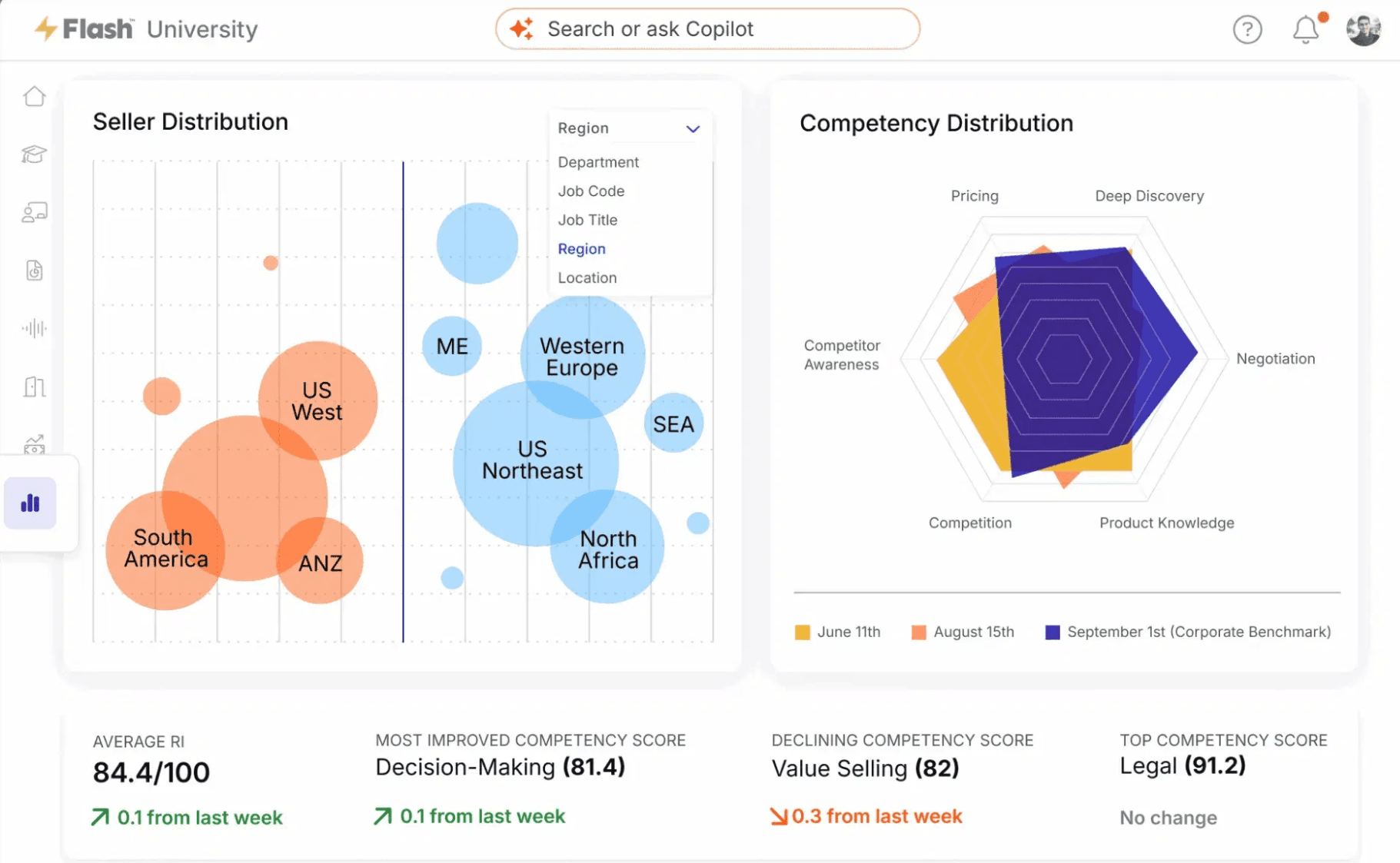
Copilot catches the exact messaging gap, unsupported claim, missed escalation, or a shaky payer objection the moment a rep finishes a role play. It also assigns follow-up practice targeting the gaps. The Readiness Index rolls all of that up for leadership, showing how many reps are ready to be in front of a physician and where the gaps sit for the rest.
Conversation intelligence carries that same thread into live calls, checking whether what a rep built in practice shows up when it matters. That's the loop completing itself, from practice to outcome, without leadership having to guess in between.
Frequently asked questions
About the Author
Lead Content Marketer
Jayadeep brings over a decade of experience in B2B content and product marketing, with expertise in editorial leadership, messaging strategy, and agency management.
He has built and scaled content operations, led agency partnerships, and collaborated across marketing, product, and demand generation teams to deliver integrated campaigns. His "process-first, execution-next" philosophy has made him a trusted resource at Mindtickle, where he helps shape content strategy, thought leadership programs, and flagship marketing initiatives.
Subscribe to the blog
Get the latest sales enablement tips, guides, and industry best practices delivered to your inbox. Unsubscribe anytime.