



People as Your Best Sales Enablement Tool with Christine Rogers
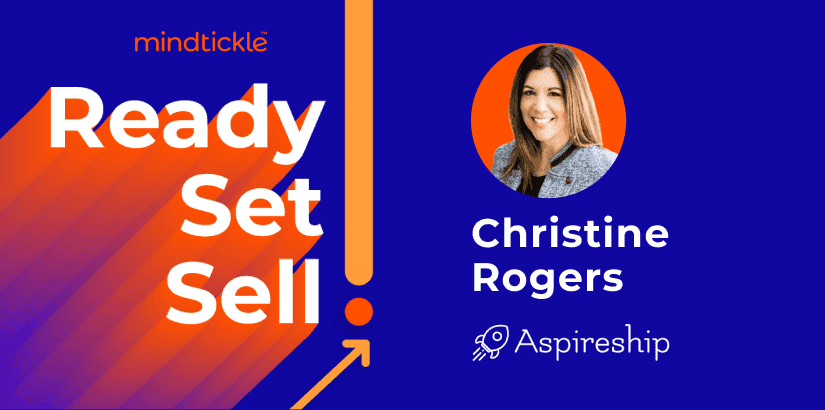

Our fifth episode of Ready, Set, Sell recently aired featuring Christine Rogers, President & COO of Aspireship, a reskilling and job placement platform that helps people pivot their careers into SaaS sales. In case you weren’t able to tune in, don’t worry. We’ve got a recap of the podcast below, covering major themes such as:
- Helping people make the transition into selling
- The role of sales enablement
- How sales leaders can evolve their own skillset
- Building a winning sales culture
Who is Christine Rogers?
Hannah: Christine Rogers is the president and COO of Aspireship, a platform that helps people reskill and pivot into the world of sales.
Tony: Christine is here today to offer her tips for helping your team learn new skills, stay curious, and unlock new talents every day.
Hannah: Christine, I’d love to start right from the beginning and understand a bit more about your career so far — and, more specifically, the moment that really kickstarted everything else for you.
Christine: It’s been all over the place. I did some insurance. I owned my own business for a while, a retail store. I then moved into selling software, and that’s been the past 10 years or so. I’ve been selling since I could sell lemonade, right? But I will tell you: when I got into technology and software sales, that’s when I really felt this is for me.
Helping people make the transition into selling
Tony: Is there any one specific thing that said, yeah, sales is for me?
Christine: Well, I think it was really important that my prior life had been in that entrepreneurial small business. So, when I found a software that supported small businesses, I felt like, “Oh, this makes so much sense. I can bring my understanding and my experiences from being on the other side of that to this experience in this field.” I found that I was actually able to relate in such a way that it could be very successful.
I don’t believe there’s any specific experience that you have to have to be in sales. I think you have to use what you uniquely bring to the table, the lens that you’ve had your entire life. Bring that to the table and be competent in what you do. That’s the entire idea around Aspireship: we built this organization in order to help people make the transition into selling based on a true meritocracy. Can you do this work? That’s what I want to know. I don’t care about your background. I don’t care about your fancy résumé. I don’t care about your schooling. I don’t care about the initials after your name. What I care about is: do you have the character that it takes to do this and the competency that it takes to do this?
Hannah: I love it because the work you’re doing at Aspireship is the mission of getting people to transition into what is what can be a really successful, lucrative career path. It’s similar to some of the work that we do at Sistas in Sales, which I know you’re familiar with.
But in terms of people who come from backgrounds that are not always considered to be something that’s going to naturally allow you to get into a sales career, I’d love to ask you a question about hiring managers. What kind of conversations are you having or do you need to have with these recruitment people to say those candidates could still do it?
Christine: So I sell. I sell to companies because my candidates come through our platform. It’s free for them to do. They take the assessment. They have to be able to pass that and then if they do, we will introduce them to companies that are hiring. So my role and the role of the person who helps me is selling to companies the notion that we believe that our people can do this work. It’s fascinating because it’s a two-pronged sale for sure. Actually, sales leaders most often understand because I’m a sales leader. It takes me five minutes to have a little chat with a sales leader and say, you and I both know, you can’t predict whether they can do it based on the résumé.
We’ve seen enough people with the most beautiful résumés and they just crash and burn. And then you’ve seen a candidate with zero. You gave a shot to the best top performer that you have. Now, with talent acquisition, people sometimes have an established way of thinking. So that is sometimes where I have more of a rep because they’re like, “What do you mean? They’re not going to have this? They’re not going to have this? They’re going to have this?” We are actually challenging that way of thinking, proving over the last two years that it works. But that’s a little uncomfortable.
Tony: Yeah, it’s pretty evident hearing you talk that you’ve got a lot of passion for this. I’m just wondering: why are you so passionate about helping salespeople succeed? Is there anything in particular in your background that gives you that passion?
Christine: People are fascinating to me. I generally don’t care about all the bells and whistles and all these other things. I want to know your story. One of the first placements we did, she had been a stay-at-home mom for eight years and had been doing fitness instructing on the side. She tried to find a job for three years and nobody would hire her in sales. And she was so frustrated by that. And then I look at her and she’s still with the company that we placed her with and they’re saying, “Find me 10 of her.” She’s incredible. Man, I love an underdog story.
There are so many of us in sales that maybe didn’t go to college, didn’t get great grades, just had the gift of gab. One of my kids is like that: he negotiated with me at three years old. And I look at him and think to myself that they can not only have a good job but a phenomenal career that will help them establish well and that they can actually do some pretty powerful things in the world. That gets me super pumped.
The role of sales enablement
Hannah: Enablement is huge. One thing that people look for now, when they’re going into an interview, is what training, coaching, or support is offered? What kind of everboarding stuff do they do? But the new thing that’s come up even more in the last few years is what can salespeople be doing to help themselves? I’d love to get your opinion on that.
Christine: I have a lot of opinions about enablement. So when I was at the company where I was an individual contributor and I was there for about almost five years, doing different roles, enablement was kind of a hot topic, right? We didn’t even have it. We were a pretty high-growth company and nobody was doing training. In fact, there wasn’t even a structured hiring process. It was like a “can you sell me this” kind of a situation. And this was a Series B Round funded company at this point. But investing in these things has thankfully become more important to companies.
Now, here are some things that I think are really important, as a sales leader, whether you’re a manager, whether you are the sales leader, the CRO, the VP of sales: it is your job to make sure that your team is enabled and trained. It is not enablement’s job. It is not up to RevOps to make sure that they have everything. This is one mistake that I hear constantly.
Having the training team or L&D do this: wrong. You need to do that. You – as the leader – you have to hold your team accountable. And training is silly if you’re not actually going to implement what you need.
Great enablement functions, I believe, are in lockstep with the team. When I create an enablement team, they sit on the floor with my reps. You want to know what they’re doing? They listen to calls, they get in it because otherwise it’s just stupid. What you bring to the table, what you start training them on and how you’re relating to them makes zero sense if you’re not in it. And so I think those organizations that make them be together.
I owned both organizations, which meant if I said, “You’re going to this training.” Guess what? They went to the training. And if I said, “I want the training on this before you do the training on handling objections, I need you all in the training. I need you to listen to 30 calls each and tell me what is the actual problem. Then come to me with what the training is going to be about.”
I don’t want to waste time… you take good sellers off the phone for an hour and that’s an expensive meeting. But I better get the ROI on. And if I don’t, I’m looking to my training team and saying, “You’re expensive. That’s not OK.” So I think it’s really about having high accountability, workability, and everybody really understanding whose job is what. Enablement is not to be in servitude of the sales team and the sales team always saying every five minutes at the same time, they are there to support.
How sales leaders can evolve their own skillset
Tony: A lot of organizations that I’ve talked to over the last couple of years almost see training as almost onboarding only. And a lot of companies fall short because they don’t think beyond that. I’m curious to get an understanding of what you think about ongoing training and continuous learning. How do you think that really fits in today’s landscape? And why do you think that might be an essential component for someone to succeed?
Christine: I think there are a couple parts to this. Number one, it is absolutely critical for us to continue learning. So as a seller, as an individual contributor — I don’t care what — you need to take your learning on your own. You owe it to yourself to continue learning whether or not your employer keeps you updated or fails to give you more training. You own your own learning, first of all.
Companies should be absolutely doing what they can to enable and continuously train their team, as different competitors come out, as different things in the market change.
But oftentimes it becomes a question of whose responsibility that is. My success is my responsibility. I’ve had people be scrappy about this… and this is when I absolutely get frustrated with sellers. I’ll tell them to get on G2 and look up the last 10 reviews for their top competitor to figure out where they’ve got the gaps. How about do that every other week? Like, be smart about what you’re doing. Own this experience.
And also, if I am a sales leader who is trying to enable my team, make sure that what we’re training them on is relevant. What are you hearing that is problematic? What are we seeing that’s problematic? Where are we losing deals and how do we figure out what those conversations are? You know, maybe it’s your terrible proposal process. Where are the areas that we can tighten up and really slick the wheels of the sales team? But keep in mind that absolutely this needs to be happening regularly. We’re learning from each other. We’re learning from the market. We’re learning from our competitors. This is all really important.
Hannah: I feel like a lot of companies try to make continuous learning and training so complicated. I’m a big believer in making sure that you’ve at least covered the basics. I created a video the other day that said something like: just do some research before you jump on a finer prospect. That’s some basic stuff.
And then I had a sales call later on that day as I was trying to buy some technology and they did no research. And this is a senior IE, a very well-known company. So it seems basic, but it’s not being done. It really isn’t being done. I’m thinking about building out the basics, but what are some of the learning techniques and tools that you use to help sales professionals really learn new skills and ultimately succeed?
Christine: It always goes back to the fact that there are just a few steps in the sales process. There are things that we need to know, and almost always when things go sideways, we missed it. We didn’t ask the right questions. I get the same thing. I am a seasoned seller, and if I don’t have my sheet, my notes, my cheat sheet, my discovery cheat sheet, I forget to ask, “Wait, what was your revenue last year?” I heard the buying signals. I got excited. I knew we were moving forward. We all do it. And it is in the practice of listening to our calls, understanding and, I mean, this is as basic as it gets.
Some of the best organizations really do just a few things that make sense. They listen to calls together, they coach each other. You have you have different things that are happening there. They’re sharing their learning regularly and they are grading each other on how they’re doing with the questions, with the discovery.
Tony: Seems like a lot of organizations are kind of using outdated techniques for their hiring processes, which is ultimately leading to failures or not being as successful as they potentially could be. How would you say people could really look at things differently in order to bring themselves into the current timeframes?
Christine: Now is something like we’ve never seen before. So I want to definitely couch the market being as hot as it is now in a candidate market… so different from even a year or a year and a half ago. Where we are today, a couple of things are archaic in the thinking. I worked at a company where we were getting 60, 70 applicants a week for a sales role.
So we created a gauntlet. We made it very difficult to get in the door because we were weeding out. Now we’re in an environment where we need to be selling this opportunity, selling the company and they are selling us. But we are we are having a selling conversation on both sides, right?
The other idea of,“I want to see 10 people and then I’m going to pick the three,” does not work. What you have to know is what are the characteristics you’re measuring for? What are the attributes that you’re seeing? What are the things that we’re testing for through the process?
And I want to be able to and need to be able to make a decision on an applicant’s stand-alone. She hit it here. This is where she’s at and it’s like a scorecard mentality: she had 89 percent. If you can’t move somebody through an entry-level sales position a week, max two weeks, and get them through the hiring process and you’re in a tight spot and you’re going to lose all your hot people.
I think it’s important to really be able to create a seamless, frictionless process that makes sense to candidates. “Why am I doing this assignment?” Well, because that’s what the role is. You want them to be able to self-select out, emulate the role as best as possible if they have to go cold on a LinkedIn contract, have them do that. Pick somebody that we would go cold on. Go write me what you would say in a LinkedIn DM, then call me and give me a voicemail. Here’s the voicemail number. You call this and leave a voicemail. I want it done by three o’clock tomorrow afternoon. See if they can do it.
Hannah: I love the example you gave. Once somebody just sat me down, probably one of the most senior roles I went for, and they just said, tell me how you would go out, find someone cold, and sell them this solution. What would you need to go through all the steps? And the manager cut me off halfway through my answer and said, “You get it, OK.” That’s that part. Let’s go into looking at the role: when, how, and what we’re doing here. And that was easy.
I mentioned all of that because I love the fact that you’re talking about more practical approaches to hiring. So let’s just continue on the theme of people and losing your hot people in the hiring process. What more can sales organizations be doing to kind of prioritize people and culture? And what kinds of things should we be putting into practice more often?
Christine: So many times, I’ll hear from hiring leaders, “Hiring is my number one.” And I say, “OK, if hiring is your number one, then I need you to open up your calendar for me. You either open up the calendar or you give us times that are allotted for these things so we can get people in and out quickly through this process.” Because what we’re going to do is set expectations upfront. This is a three-step process. We will have boom, boom, boom and by doing these things and then every single step along the way, we are meeting expectations by telling candidates everything they need to know about that company. If a company is saying they’re prioritizing getting great people into the org, does that actually work in practice or do the actions support the words?
Tony: I’ve worked with a lot of different sales folks over the years, and I think a lot of people who have had success have come from unique backgrounds. I know people that have been teachers. I know people that have been actors. I know people that have come from real estate. I think you can actually learn a lot in just about any sort of role. And if you have the right will, you can apply it to sales and have a lot of success.
Hannah: I love the fact that people from untraditional backgrounds are coming into sales. I actually interviewed someone who is an opera singer. And it’s interesting because that person spent a lot of their time organizing things and also maintained a side hustle, which was being an EA to senior execs. So when you literally know how to communicate with senior execs you’re going to be good at sales. You bring your experiences and people buy from people. As long as you have been engaging with people for your adult life, I think you’re right to start the transition into sales.
I also had somebody who has been a musician for 20 years, and they just aced every interview because they had stories from traveling around the world for that time. That’s much more interesting than me just talking about being in sales for the last 15 years. I’ll probably lose that one: I was up against someone who’s been traveling the world for 20 years. Just the best stories.
Tony: Absolutely. I mean, I actually was a musician in the earlier part of my career, and even now I’m in the film industry in my spare time. So I like to bring unique stories to every sales engagement that I have, because it really lets you personalize yourself. It shows that you’re a human being and you’re not just some sales robot that’s trying to win someone over. You’re a human being that has a unique perspective, and you bring that to the sales situation, and it makes it a lot easier to work with people.
Hannah: Tony, I feel like you’re indirectly saying that you’re just more interesting than me. Is that what is that what you’re saying right now?
Tony: Never, never. We haven’t really figured out exactly who Hannah is yet. We’re going to get there, but it’s just a matter of time. I really love Christine’s philosophy of moving towards a true meritocracy instead of just relying on arbitrary titles or credentials to land a new role.
Hannah: I agree. I think that, in 2022, the workforce has evolved to accommodate a wider variety of backgrounds, skills and even educational pathways. This is a testament to how far we’ve come as a society.
Tony: I also find it inspiring to see people moving away from the traditional cookie-cutter careers and not only doing something for a notch on a résumé.
Hannah: Oh yeah, big time. But Tony, I have a 2022 motto and it’s called, “#shootyourshot” because life is too short not to go for what you want, especially now that the entire world is at your fingertips.
Tony: And since the world is at our fingertips, I have my own motto for 2022. It’s, “Where’s my cocktail?” It’s never too late or too early to learn a new skill, switch career paths or explore a new industry.
Hannah: Let’s hear some more from Christine about why a culture of continuous learning is a key building block of success.
Building a winning sales culture
Tony: Coming back to people and culture a little bit. I’ve been here at Mindtickle for about two and a half years now, and I’ve dealt with a lot of learning development groups and enablement readiness groups. And in some places, they’re very distinct organizations. They’re not really tied together in the ways that you think that they might be. So I’m curious as to how you feel about that and if learning and development really have a direct impact and can help improve sales enablement.
Christine: Yes, I think that they should work well together. I think that when I think of learning and development versus kind of sales, RevOps, enablement, all of those different types of things, I think that most organizations that I’ve seen have learning and development that supports organizational structure around how the company functions and things like that. Like if we’re trying to roll out the future of work or something like that, that’s how I’ve seen it work. I tend to see that, organizationally, if there is an enablement team for candidate experience, customer experience, different things like that, then those might have their own places. Or a business partner that rolls up into learning and development might be kind of tangential there and working kind of with those organizational leaders to make sure that they’re there.
Tony: Christine, what are some of the most valuable enablement tools that you think companies really don’t think about or they overlook at this point?
Christine: I think there is so much out there. Of course, the CRM and of course, you’re going to need marketing and technology. You need a pretty good stack there. When you think about tools and resources, it’s good to use some of the old-school ways of doing things, teaching people how to understand if they’re effective, teaching them the math of basically if you need to get to $25,000 in revenue and you only did $15,000 and you did X amount of prospecting calls, what’s the math that actually gets you to like, “Oh, I have to be doing 80 calls a day.” I find that sometimes we provide lots of tools and resources and then don’t actually show people what that means. “So I didn’t get to the number and I did 67 demos.” All right. Well, you either have to get better or do more. That’s it. There are only two options.
So we’re going to help you get better. And I’m going to help you get better by coaching, but you’ve got to do more until you’re better.
Hannah: Thinking about the skill sets and the different tasks that salespeople are doing, coming out of the most wackiest two years ever that nobody predicted: Which areas should salespeople be zero in on in terms of learning and development?
Christine: I think the most important thing is always understanding people and where we saw people going really tone-deaf and coming out weird is when they were trying to have the same conversation that we had had prior and not being sensitive to the fact that you should actually just talk to me like a regular person now. And when it’s appropriate to elevate the conversation, bring in some different language and be mindful of that language.
One of my biggest burns is that people don’t understand how important what you’re saying is and how critical the way you say something is. And in going back in, you shift a couple of different little words and it makes a meaningful difference. I think it’s really important to understand people. So really digging into what you’re hearing, what the sentiment is around things, not missing when people are complaining around certain things or are feeling a certain way: there’s psychology going on here.
The most important thing I would say right now is to get out of all of the tech and all the things that you’re really excited about, about your product and really understand the person on the other side of the sale and you will do better. I know that’s not really a new way of thinking, but I think people are very sensitive right now. If you don’t take that into account, they’re not even going to give you the time of day. They’re getting kind of mouthy, saying things like, “You know what, you’re not even being empathetic with me at all. You’re not even understanding. You’re completely tone deaf.” People are saying this now when before people would just delete the email.
Hannah: When the salesperson listens to what you’ve said and you’ve poured your heart out and they say, “Yeah, so what CRM system do you use?” I’m crying inside.
Christine: I literally told you and poured out my heart. So when were you looking to make a change?
Tony: Christine, earlier you touched upon the hiring market. If you were to give some advice to someone that’s looking to make a move, a sales professional, what do you think your best advice would be? And conversely, as an organization trying to attract top talent, what would you recommend there?
Christine: Be open to different backgrounds. I mean, I can’t tell you, the companies are really doing well right now. They’re bringing all different types of personality types.
They’re bringing different experiences, different ages of people. There are amazing individuals that are been given no opportunity because they’re too young, too old, or whatever. I love that we’re bringing this unique perspective.
This is what I would say to somebody wanting to transition, and this is what I do say all the time to our grads. Stop trying to go for the most sexy logo, the biggest names, all of these things because some of the best companies out there that we hire for, that we do work with, with strong leaders that are people are making great money and everybody is learning, are you might never have heard of. You might not be super passionate about construction estimation software. You might not like it. You know, your heart beats from a fleet management software or from analytics software. But you can learn a lot.
Care less about title. Care more about like opportunity. Who’s going to develop me? How am I going to do it? The number one question I ask people is when you pick a job, think about, “What do I want to learn now?” Think about a long day and your long opportunity. “The thing I want to learn next is this and this one is actually going to provide me that in the best way”: I like that as far as qualifications for making decisions.
Hannah: I just say to salespeople: go to where you can make money. But it’s not easy. If people in the business are making money and you can look backward and forwards and you can see that they could still be making money, then that’s where you need to be, not at the big logos. I’m completely with you, Christine. I know Tony was going to jump in and ask you this later, but I want to understand what’s exciting you about the things happening in sales right now?
Christine: Even two years ago when this idea came up. people said it sounds good, but I don’t think anybody would give anybody that didn’t have fast experience a shot. I remember thinking, yes, they will, if we can prove that they can be successful. I see the way that we’ve always done things, with everybody having a similar look and age and all of those things. And I see that we’re now bringing in different perspectives, fresh eyes. I’m learning every day from the companies that I’m talking to where they’re telling me, “This individual came in and came up with this great idea. We have totally shifted our product. We never even thought about that before because she came from a completely different industry and was like, why don’t we do it like this?”
And I’m seeing sales influence product like I’ve not seen before. Because we’re not just in these little, very defined lanes, and we’re bringing in some people that can really communicate well rather than sales being like the high school football team. Now we have the art club, the drama club, all these other things.
But the sales team is like the lifeblood of the organization. We’re now having an influence differently on different parts of the organization, which I think is great, rather than just being kind of the troublemakers that make all the money and are like wildly crazy and get in trouble at the President’s Club. We’re now coming to the table, changing a bit of that whole stigma and bringing a really different approach. And I’m excited by that… like when I hear one of our grads is now a rep for Square. He was a college history professor. You can imagine what a different perspective and the ideas and innovation that come from that. I’m excited that salespeople are having that kind of chance rather than just selling this stuff and being integrated into a whole company experience, which I’m super pumped about.
Tony: What’s next for you and Aspireship? We’d love to hear a little bit more about what the future holds for you.
Christine: We’ve had some amazing groups of individuals that we’ve been able to help make the transition to sale. So last year, I’m sure you saw just tons of hospitality workers that were laid off a lot of them came to sales because — think about it — those individuals are perfectly well suited for sales. All they’re doing is thinking about “How do I make someone happy next?” We were just in the Wall Street Journal last weekend in an article about all of the teachers who are now shifting over to selling. Teaching, what a beautiful environment to bring to the selling market. And, because what we offer candidates is free, they can see if it’s for them.
We have a lot of people who start to take our coursework and say, “Not for me. I do not like doing that role-play.” And you know what? Good. Self-select out because this isn’t for you, at least you know. But other people are confidently going into roles that they know that they can nail. I like that we can be a part of this experience, a part of this journey for individuals. Just the other day, we got a whole bunch of signups and it was through a nursing cohort: a group of nurses who were saying, “I don’t want to do this anymore. I want to shift out.” I love that we can help these individuals and let them see if this is for them and then make a transition and do very, very well in the roles that we’re hiring with them. So it’s very exciting.
Tony: Oh, it’s great. Christine, we’ve learned a lot, but we’re not done with you just yet. We’re going to go through our rapid-fire questions. We have 30 seconds. Just kidding. But Hannah is going to kick us off.

Hannah: All right. What is your sales philosophy in just three words?
Christine: Understand your buyer.
Hannah: What is the best piece of advice you’ve been given in your career?
Christine: To say yes.
Tony: What is your top productivity hack?
Christine: Turn off notifications when I’m doing work, I turn everything off, including on my app.
Tony: What is your top prediction for the sales industry this year?
Christine: I think that it is going to continue to be gangbusters. But through this year I think we’ll see the pendulum swing back a little bit because I think what happened is it got atrophied. It’s going to boom and then it’s going to right itself a little bit.
Hannah: If you could share just one piece of advice to all sales professionals, what would it be?
Christine: Have more fun.
Tony: Love it. There are a lot of voices out there right now. Where do you go to get your industry news?
Christine: I’m on LinkedIn a lot. I look at the news. I look at industry leaders there. Also HPR is one of my favorites. I always look in on what they’re publishing, what they’re talking about. Those are probably my two best sources for keeping up to date on all different types of things that matter.
Tony: That’s cool. Would you say sales leaders are made or born?
Christine: I think that we all are born with some tendencies, but when I think about growth and development, the fact that you want to be a great sales leader is the reason you are.
Hannah: What book has inspired you the most in your career?
Christine: This is not a business book, but it’s called Language and the Pursuit of Happiness. And it’s by this gentleman named Chalmers Brothers. And it’s all about how everything we say is impacting and generating and creating and how our lens is impacting everything as well.
Tony: All right, so our last question here. You’re with Michael J. Fox, you’re going back to the future and you see your younger self. What would be the advice that you would give to yourself just starting out in the industry?
Christine: I’m a people pleaser, so it would definitely be: you’re not for everyone. Just knowing that early on would have helped quite a bit.
Tony: Well, you were definitely for us, Christine. You did a great job here today. We really enjoyed getting to know you today and thank you so much for your time.
Christine: You guys, have been great. Thank you for that. I know I got a little passionate. It was really fun. Thrilled to join you guys today.
Hannah: Tony, I know I shout about the coaching thing a lot and you follow me on LinkedIn and we have quite a few offline chats but in the beginning and early on in my career, I wasn’t great at the ongoing learning. I’ll be honest, I had some fantastic opportunities very early on in my career. I’m having very regular training and I used to read sales books and newsletters, but I didn’t really implement or apply that learning.
And as I moved up in my career and got into more senior roles, I found that nobody was willing to teach or coach or support anymore. It was very much left to me. You have a mindset that you, as a salesperson, are there to serve your customers; you are there to help, to help diagnose. You can only do that by staying on top of your game. You can only do that by being a tiny bit ahead of them or anticipating the problems that are over the horizon that maybe customers aren’t really thinking about. And when you put yourself in a position of strength by constantly learning, constantly going out there to try to find new answers to these problems, then you put yourself in a much better position to actually to help and serve your customers. And I think once I started to recognize that in the early to mid-stage part of my career, I realized how that started to help me perform better.
Tony: Wow, that’s really interesting. Well, first, I want to clarify something, I’m not following you on LinkedIn, I’m stalking you on LinkedIn, so I want to make that clarification. But no, I think it’s funny to have a little bit different take on that because, in my first sales position, I was thrown into it and given no training whatsoever. I had to learn everything on my own and it wasn’t easy. It was a challenge: it was, “Here’s your laptop… go learn the software and then go present however you think it should be done.” It took me a lot of time and effort to do that. But as the company started growing, I realized that if we are really going to get to the point where we want to be as an organization, we have to have some way of teaching people and coaching them on the way to do things right. So without any provocation, I started training people on how to do things, and the company actually grew very quickly. It had a great success story there.
So, you know, I learned early on in my career that these are the things that you really have to do in order to succeed as an organization. And then a software platform started doing it. Just like Mindtickle. Did I say Mindtickle? I think that’s part of the reason why I’ve been so happy where I’ve landed because they’re doing the things that 20-odd years ago I saw were important. And now it’s all put onto a platform that really drives value and sets people up for success.
Hannah: Tony, I‘m sure you’ve hired many people over your career. Me too. And you notice the difference between people who have been invested in when it comes to ongoing training and development. When you do get into a conversation with someone who has, it’s like, “Wow, you don’t know how rare you are. You’re a rare breed because I can just tell that you, you’re listening. You’re curious. You’re asking good questions. You haven’t just gone on to Google and typed, “What to ask in a sales interview.”
I’ve worked alongside some really strong sales individuals, and as I started to move around companies, I realized this isn’t the norm. A lot of people have had no training. A lot of people kind of just stuck in the space, and they don’t know how to move left or right or forward because they’re thinking “this is my skill set,” which is really unfortunate. But I think when you invest in yourself, you really can accelerate your career way beyond your wildest dreams.
Tony: When I think about all the people that I’m looking at when I’m hiring, I don’t really need that cookie-cutter sort of background where they’ve worked at the big sales organizations or they’ve taken all of the huge sales training processes. I’m more interested in someone that has their own hunger. They have that curiosity. They really want to be part of something and are willing to put in the time and the effort to do it, right. Learning new things is not the easiest thing to do so any time I can find someone that really has that spark, that is what I find most important. Christine’s fresh take on the working world today has really inspired me to broaden my perspective.
Hannah: Times are changing, that’s for sure. And Christine has her finger on the pulse of the sales industry today.
Tony: She really does. And one thing that we talked about was the idea that anyone can switch industries or learn a new skill, no matter their age, background, or career experience so far.
Hannah: Well, it’s really about keeping a growth mindset. Look how much things have changed in the last few years, Tony.
Tony: For those in search of a new role in 2022 or 2023 or whenever it might be, Christine reminded us all to avoid placing too much emphasis on the bright and shiny things like big brand names or logos. Sometimes finding a position that’s right for you just takes a little extra digging.
Hannah: Overall, Tony, this episode with Christine has served us some powerful reminders of the value of continuous learning. I really hope everyone listening takes away some insights from the discussion today. Thank you for listening to this episode of Ready Set Sell.
Tony: We hope you took away some valuable lessons and insights that inspire you to reevaluate your approach to sales readiness.
Hannah: Don’t forget to subscribe, rate and review the show when you get a minute.
Tony: And stay tuned for the next episode of Ready Set Sell.
Enhance Sales Skills With AI Role Plays Using Mindtickle Copilot
Win More Deals with the Leading AI Sales Role Play Provider

Subscribe to the blog
Get the latest sales enablement tips, guides, and industry best practices delivered to your inbox. Unsubscribe anytime.